Hello! Well it pleases both Tom and I greatly to announce the official line-up of the 2016 Decades Blogathon, and so quickly. Thank you for responding so quickly and we are both looking forward to jumping in here and reading what you all have to say about your chosen movies. Once again this year we have an impressively eclectic selection of titles, and that’s just the way we like it.
So here’s how things are going to play out. Once again, there will be one review posted each day either on this site or on Digital Shortbread, and whichever site it doesn’t go up on first, it will be re-blogged there on that day.
Posts are ordered on a first-come, first-serve basis. Which means our esteemed blogging machine Rob from Movie Rob kicks things off in style with his review of Top Gun (1986), will I will conclude things with my thoughts on Taxi Driver (1976). Tom, meanwhile, will be offering his top draw thoughts on Spike Lee’s Inside Man (2006).
We have decided that Monday, 16 May will be the first day of posting. Please have entries in latest by Friday the 13th to give us time to sort through the reviews and get them formatted and set-up for presentation.
Because the spots filled so quickly this year, we’re anticipating a few late requests. Though we won’t be able to expand the pool to more than 20, last year we had one or two people duck out of the race at the last second, so if you find yourself on the outside looking in, you might just have a chance to get in if you let us know soon. If someone does drop out, those spots will be yours (again, on a first-come, first-serve basis). Thanks for your interest everyone and we look forward to getting this thing rolling on the 16th.
Here are the entries in order of planned publication:
One of modern cinema’s most compelling cinematic double acts reunite to powerful effect in this fearless and singular work of soul-searching science fiction.
A film must be doing something right when it divides its audience as much as the ending of Jeff Nichols’ fourth picture has.
Midnight Special is nevertheless brave, bold filmmaking that sticks its landing and maintains enough mystery to leave you wanting more
Those who have followed Nichols’ career will have been here before with Take Shelter, his remarkable 2011 sophomore movie that left viewers to decide for themselves what happens next as the credits rolled.
While Midnight Special is a more overt piece of sci-fi filmmaking it remains at its core, like Take Shelter, a movie about a family trying to stay together in the face of extraordinary circumstances. It also marks the fourth occasion Nichols has worked with the powerhouse that is Michael Shannon; a partnership that each time has brought out the very best in both director and star.
Alton (Jaeden Lieberher) and his devoted father Roy (Michael Shannon) in Midnight Special
Nichols has set himself apart from many of his contemporaries for his contemplative and beautifully realised portraits of Americana. He’s also a child of the ’80s and the influence of Steven Spielberg’s blue-collar sci-fi classic Close Encounters Of The Third Kind (1977) (the leading man in both films is called Roy) and John Carpenter’s E.T for grown ups Starman (1984) (Nichols acknowledges the influence by naming one of his senior Army types ‘Carpenter’) isn’t remotely disguised.
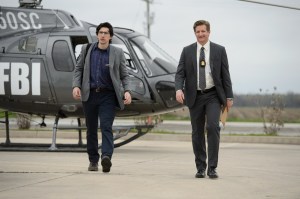
While there is little doubt there’s something very different about eight-year-old Alton (Jaeden Lieberher), we’re left to ponder what that will mean both for him and his father (Shannon), who has fled a religious cult with Alton and is trying to get to a certain location by a certain time for an unknown purpose. They are helped by Roy’s friend Lucas (Joel Edgerton) and, later on, Alton’s mother Sarah (Kirsten Dunst), but the odds are increasingly stacked against them as the full force of the military, FBI and NSA (led by Adam Driver’s Paul Sevier) come down to bear and cult leader Calvin Meyer (Sam Shepard) sends his believers in search of the boy.
NSA agent Paul Sevier (Adam Driver) and FBI Agent Miller (Paul Sparks) go after Alton in Midnight Special
Similar to Robert Zemeckis’ Contact (1997), faith plays a significant part in Midnight Special, whether it be the extreme kind peddled by Shepard’s quietly menacing cult leader, the conviction of Lucas to go all the way for his long-lost friend or the determination of Roy in the face of extreme odds to ensure his son arrives at his rendezvous in time for a purpose he only later comes to understand.
The relationship between Shannon and Lieberher is compelling, entirely believable and heartbreaking and is taken to another level with the introduction of Dunst. In many ways, Midnight Special is sold on the strength of its superlative cast, who totally commit to their roles and help to drive the narrative forward towards its spectacular climax.
Kirsten Dunst plays a special boy’s mother in Midnight Special
When we’re first introduced to Alton, he’s a timid little boy, confused at what is happening to him, but as the film progresses we see a subtle shift both in his body language and his mannerisms as we watch the boy grow into someone more comfortable in their own skin; someone who isn’t afraid in the end to take control of their own destiny and lead the family to their final destination.
Likewise, Nichols makes sure to give even his bit part players something to get their teeth into, most notably Bill Camp’s trod upon Doak, who has doubts about his mission from Meyer to go out armed and find the boy, but is convinced to do so believing it to be part of God’s bigger plan (“What do I know about these things?”).
Alton (Jaeden Lieberher) has his eyes on the prize in Midnight Special
If the film has a failing, it’s in the narrative threads that are discarded or not properly pursued, which invites the suspicion that significant material was left on the cutting room floor to bring the film in under two hours. Meyer dominates much of the opening act, but disappears soon after never to return, while the only remnants of the cult are the henchmen sent after Alton.
Likewise, the military angle is never entirely handled satisfactorily and feels like a narrative device to ensure certain characters arrive at the right place at the right time. Driver, meanwhile, is great, but could have used more screen time. Indeed, this is one of those rare modern examples of a movie that could have done with a longer running time.
Midnight Special is nevertheless brave, bold filmmaking that sticks its landing and maintains enough mystery to leave you wanting more. And come the end, your eyes will light up in wonder.
Greetings everyone! Guess what time of year it is? That’s right! Christmas 2.0! Or, better known as the time of year where Tom and I start inviting our esteemed bloggers from around the world to participate once again in the Decades Blogathon, a 10(ish) day event in which we take a look at films from different decades.
Last year was the inaugural event and it went off without a hitch and was a lot of fun. So much so, we just had to do it again. For those who sent their wonderful entries last year, you already know the drill. But to get newcomers on board, it’s going to go a little something like this:
Pick a film from any decade with the year ending in ‘6’ (given that it’s now 2016), and there’s no restrictions here – We’re not snobs… not really, anyway; we’ll gladly accept anything from 1906 all the way up to releases that have come out so far this year). Just remember the year must end in a ‘6.’
The postings will go up on a first-come, first-serve basis – We’ll put up the entries that come in first and there will be one posted every day on this site and Digital Shortbread, with each entry having a corresponding re-blog on the other site.
The Decades Blogathon will be capped this year at 20 posts – As much as we would love to take 50 or 100 entries, that’d be a daunting task to take on so we are going to limit the entries to 20. We kindly ask participants to only send one piece in so we can maximise the number of contributors (Tom and I will also be included in that count. Our reviews will come at the end.)
If you want to become involved, send an email to either myself (threerowsback@gmail.com) or Mark (tomlittle2011@gmail.com) with your suggestion – If no one else has already claimed that movie we’ll give you the green light and you can fire those entries right back to those same email addresses (or you can send them normally, that’d be preferable).
Like last year, we’re aiming for mid-May to start posting entries – Please have your reviews/posts in by Thursday 12 May and no later than Friday 13th. That gives us time to go over the posts and construct the posting schedule. If you need any extra time to enter, just send either Tom or myself an email and we’ll get you in any way we can!
ONE LAST THING: As to the availability of the titles, I will be talkin’ to you about Martin Scorsese’s 1976 classic Taxi Driver, while Tom will be covering the 2006 Spike Lee joint Inside Man. Those are the only titles that are already claimed. Be sure to let us know if you’d like to talk about something and we’ll get this thing rolling! Thanks everyone!
This is my latest contribution to The Big Picture, the internationally recognised website that shows film in a wider context. April marks the 400th anniversary of William Shakespeare’s death and The Big Picture is running a series of features and reviews related to the Bard. This piece is part of the Four Frames section, wherein the importance of four significant shots are discussed, in this case from Gus Van Sant’s independent cult classic My Own Private Idaho.
The Bard and Keanu Reeves didn’t exactly hit it off when one half of Bill and Ted got himself Golden Raspberry nominated for his grisly turn in Kenneth Branagh’s Much Ado About Nothing (1993).
Two years earlier, however, Reeves enjoyed far more success channelling the spirit of Shakespeare’s Prince Hal when he appeared opposite River Phoenix in Gus Van Sant’s idiosyncratic indie My Own Private Idaho.
The film that rivalled Betty Blue (1986) for the number of walls its poster adorned in student flats across the land is two films in one. One narrative thread centres on the introspective Mike (Phoenix), a gay street hustler who goes in search of his missing mother while succumbing to regular and extreme bouts of narcolepsy (“I’ve been tasting roads my whole life”).
The other strand is a partial retelling of Shakespeare’s Henry IV, Parts I and II, with Scott (Reeves) the charismatic best friend to Mike, who ostensibly appears to be rebelling against his rich parents but, just as Prince Hal, has an ulterior motive for his present bad behaviour.
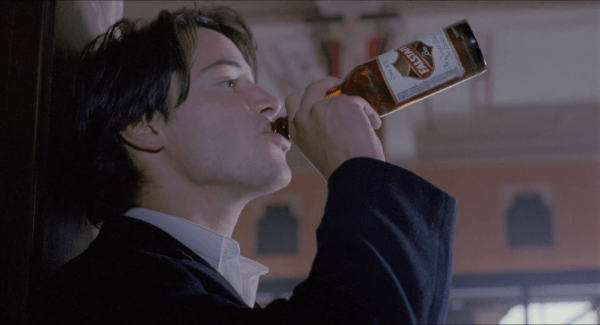
Scott and Mike hang out with Bob (William Richert), a portly father figure modelled on the larger-than-life Falstaff who, like the Bard’s sublime tragi-comic creation, is given to pomposity, showmanship and self-aggrandizement, often to his own detriment. This is crystalised in a scene, lifted directly from Shakespeare’s play, where Bob waxes on about a fight he supposedly had with increasing embellishment and is humiliated by Scott who, in a subtle nod to the source material, has been drinking from a bottle of Falstaff beer.
As an affectionate kiss earlier in the film demonstrates, Bob is in love with Scott, which makes his eventual betrayal of his surrogate paterfamilias that much more heartbreaking (and Shakespearean).
Now 21 and with his birth father deceased, Scott has inherited his great wealth and turned his back on Bob and Mike. Akin to Shakespeare’s Prince, Scott has willingly chosen the responsibilities that come with his family name and, as if to rub salt into the wound, keeps his back turned to Bob as he tells the grief-stricken tramp: “There was a time when I had the need to learn from you, my former and psychedelic teacher, and although I love you more dearly than my dead father I have to turn away.”
Scott’s rejection is a final dagger in the heart for Bob, who dies from a fatal heart attack. Van Sant stages both funerals within yards of each other in the same cemetery. Whilst Bob’s funeral descends into chaos as Mike and his fellow street kids celebrate his life in uproarious fashion (shot in a freewheeling style reminiscent of the American New Wave), Scott looks blankly upon his former friends one last time as his father’s far more civilised service takes place.
Van Sant is credited with writing My Own Private Idaho although old Bill should probably get a name check too as swathes of the Bard’s verse from Henry IV, Parts I and II are either lifted from the play or paraphrased. As indebted as the director is to Shakespeare’s text, the cinematic influence comes from Chimes At Midnight, Orson Welles’ 1966 masterpiece that refocuses the events of the plays to the perspective of Falstaff.
Watching Chimes At Midnight proved to be the lightbulb moment for Van Sant as it afforded the realisation that a play about the heir to the English throne’s graduation from ne’er-do-well to king-in-waiting could work just as effectively on the streets of Portland with a group of street hustlers.
Unrequited love, deception, tragedy, loss – these are all themes common in many of Shakespeare’s works and My Own Private Idaho incorporates them all in an unbuttoned and distinctive fashion.
As a curtain raiser for Warner’s belated attempt to muscle in on the extended comic book universe market, this latest white elephant from Zack Snyder gets things off to the worst possible start.
If Batman vs Superman is the dawn of what’s to come, goodness knows what’s awaiting for us with the rest of this franchise
As the anointed poster boy of the franchise, Snyder’s limitations as a director are laid bare, while every one of the film’s 151 minutes merely compound his weaknesses.
Snyder certainly has a unique visual signature, one that he has been refining since embarking on his first graphic novel adaptation, Frank Miller’s 300, in 2007. In the case of 300, the director’s penchant for uber-violence and fan-serving visuals (a number of the frames looked like they had been lifted directly from the graphic novel) was the perfect fit for the source material.
It’s mano e mano in Batman vs Superman: Dawn Of Justice
When Snyder moved on to adapt Alan Moore’s seminal Watchmen (2009), that same dark and moody palette was used, but all the nuance was notably absent, which resulted in an experience that was akin to observing someone turning the pages of a comic book instead of watching an actual movie.
With 2013’s Man Of Steel, you got the sense that Christopher Nolan’s guiding hand was at least having some influence, especially in the early scenes when Clark Kent is coming to terms with his extraordinary gifts. However, that was before an extended last act which saw Snyder give in to his natural tendencies by practically destroying a city and wiping out thousands of innocent bystanders – presumably with the intention of pulverising his audience into submission.
That movie’s final rampage forms the prologue of Batman vs Superman: Dawn Of Justice, which sees Batman/Bruce Wayne (Ben Affleck) swear revenge on Superman (Henry Cavill) following the Man of Steel’s apocalyptic bust up with General Zod (Michael Shannon). Batman sees the son of Krypton as a clear and present danger to humanity (his logic doesn’t convince Alfred (Jeremy Irons) – nor us it has to be said), while Superman views the Dark Knight as an increasingly unstable vigilante whose brutal methods, including branding his prey, have taken a sadistic turn.
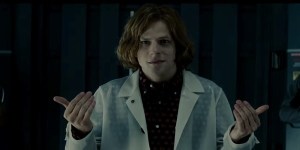
Jesse Eisenberg trying not to overact as Lex Luthor in Batman vs Superman: Dawn Of Justice
Megalomaniacal mogul Lex Luthor (Jesse Eisenberg) also sees Superman as a direct threat and seeks to use Kryptonite as a ‘deterrent’ against him alongside other, even more deadly, weapons.
The hype machine that cranks into gear when a tent pole release is on the horizon rarely works entirely in the movie’s favour as the final product invariably fails to match the expectation that has been ratcheted up. In the case of Batman vs Superman, it feels as though that machine worked so hard and for so long to generate buzz that it practically incapacitated itself in the process.
It says a lot about the film that, within the space of a single week of its release, the feverish anticipation had already fizzled out and we were left with what this really is: smoke, mirrors and sledgehammers that equals far less than the sum of its parts.
Intrepid reporter Lois Lane (Amy Adams) in Batman vs Superman: Dawn Of Justice
Although it’s not entirely fair to compare this to Nolan’s Dark Knight trilogy (those films are directed by someone operating at a far higher level), comparisons nevertheless demand to be made and it doesn’t take long to notice the chasm that exists between them. Whilst Nolan’s triumvirate had something to say about the dichotomy between justice and vengeance, the danger of becoming the thing you swore to fight and the ease in which civil liberties can be sacrificed when fear is allowed to take over, Snyder’s Batman is a virtually unrecognisable washed up fascist who has seemingly forgotten what it is he’s supposed to be fighting for and sees threats in every nook and cranny.
Liewise, the work put in to humanise Superman in Man Of Steel has essentially been tossed to the sidelines as we are presented with a figure who is given little more to do than look bewildered at the turning tide of public opinion against him.
Chris Terrio’s and David S Goyer’s script feels like it has been chopped to pieces, as evidenced in the dreadfully disjointed narrative that flits all over the place and throws in discombobulating dream sequences that may look cool, but simply don’t serve the story and are shameless attempts at sprinkling breadcrumbs for future movies.
Ben Affleck plays an aging Dark Knight in Batman vs Superman: Dawn Of Justice
This universe-building reaches new lows when Gal Gadot’s Wonder Woman (the best thing in the movie and the only person who breaks a smile throughout) sits at a laptop and goes through Luthor’s secret files (how does he have all of this stuff??), watching footage of metahumans Aquaman, Cyborg and the Flash that play out like teaser trailers.
So what of the fight itself? Well, like everything else in the film it is laden with ponderous dialogue and the sort of action choreography that Michael Bay would be proud of. It also goes on for an exceedingly long time, although it is the mere aperitif for the main event involving Doomsday, which smashes you over the head so relentlessly you’ll be screaming for it to end.
The Holy Trinity of Superman (Henry Cavill), Wonder Woman (Gal Gadot) and Batman (Ben Affleck) in Batman vs Superman: Dawn Of Justice
Cavill does his best in a movie that, instead of being Man Of Steel 2, sees him playing second fiddle to the Dark Knight, while Affleck, to his credit, emerges with his head held high in spite of the serious limitations placed on him by the script and director.
In spite of the character being touted as Mark Zuckerberg’s (even more) evil twin, Eisenberg is horribly miscast and gives a dreadfully mannered turn that exudes little or no menace. Amy Adams, meanwhile, does her best as Lois Lane but is again given very little to work with, while Irons shines in his all-too-brief moments on screen.
Even Hans Zimmer’s score (working with Junkie XL), normally so rock solid, is patchy and unsure of itself; reflected in the composer’s admittance in interviews that he struggled on this occasion to produce something distinct from what had gone before.
If Batman vs Superman is the dawn of what’s to come, goodness knows what’s awaiting for us with the rest of this franchise.










 three rows back