Review – Jason Bourne

As Jason Bourne’s fellow action spy James Bond once said, never say never again as the former CIA assassin emerges from the shadows to deliver his own particular blend of gritty retribution.

Jason Bourne - a hugely enjoyable hurrah for the franchise and a superior action movie in a summer that is sorely in need of one. If it ain't broke, don't fix it, eh?

Jason Bourne – a hugely enjoyable hurrah for the franchise and a superior action movie in a summer that is sorely in need of one. If it ain’t broke, don’t fix it, eh?

The sight of Matt Damon’s amnesiac swimming away to an uncertain, but seemingly triumphant future at the conclusion of 2007’s The Bourne Ultimatum perfectly capped off a trilogy which redefined action cinema.

That was it right? Damon certainly seemed to think so, pointing out in numerous interviews that this chapter in Bourne’s story had reached its natural end. The door was admittedly left ajar (Damon and director Paul Greengrass have been open about how much they love working together), but Ultimatum‘s denouement was the franchise’s perfect top and tail, while its poorer relative The Bourne Legacy suggested the well had been tapped enough.

The sleeping giant awakes in Jason Bourne

The sleeping giant awakes in Jason Bourne

Almost a decade on, however, and Bourne’s back; older, just as tortured and surviving on the fringes of a world that is almost unrecognisable to the one he swam away from years earlier. Whilst Bond gets around this by flipping the reset switch to make way for a new era and a new actor, Bourne’s return is a continuation of where we left off, with his fellow CIA-agent-turned-fugitive Nicky Parsons (Julia Stiles) tracking Bourne down in Greece to tell him that he still has unfinished business and that his former employers are, surprise surprise, up to no good.

Another day, another dodby CIA Director: Tommy Lee Jones plays spook Robert Dewey in Jason Bourne

Another day, another dodgy CIA Director: Tommy Lee Jones plays spook Robert Dewey in Jason Bourne

Bourne just wants to be left alone, but finds he must once again go in search of answers and confront the CIA’s shadiest characters, in particular Director Robert Dewey (Tommy Lee Jones – exhibiting capital ‘C’ craggy features), while up-and-coming Agent Heather Lee (Alicia Vikander) seemingly has somewhat muddy motivations.

In keeping with the overarching thread of the series, previous deeds have continued to echo throughout the Bourne franchise, whether it be the similar way certain ‘assets’ are dispatched from film to film (strangulation), the aftermath of the car chases in Ultimatum and The Bourne Supremacy when he confronts his respective nemesis, or even the scene in Ultimatum when Nicky dyes and cuts her hair which harkens back to Marie having done the same in The Bourne Identity.

Double/triple cross: Alicia Vikander plays CIA agent Heather Lee

Double/triple cross: Alicia Vikander plays CIA agent Heather Lee

In Jason Bourne, these echoes continue to reverberate, from the tragic fate of a character who gets caught in the hunt for Bourne, to the European locations he revisits in his quest for the truth (Berlin, London).

Many have criticised this latest adventure for ultimately leaving Bourne back where he started – a fugitive who must stay off the grid in order to survive. It’s an argument that certainly holds some water, but when it’s executed with as much adrenaline-fuelled effortlessness as it is here then this ‘problem’ feels largely insignificant.

Back together again: Bourne (Matt Damon) and Nicky Parsons (Julia Stiles) in Jason Bourne

Back together again: Bourne (Matt Damon) and Nicky Parsons (Julia Stiles) in Jason Bourne

Did we really need to know any more of Bourne’s past? Probably not; too much information has a way of diluting what makes the character interesting in the first place. However, Greengrass and fellow screenwriter Christopher Rouse, much like in the original trilogy, have managed to deliver a full-throttle action movie that taps in to the societal and political concerns of the day; in this case unrest with austerity and our ongoing unease with the impact on privacy in the rapidly evolving digital world (personified here in a plotline involving Riz Ahmed’s social media magnate Aaron Kalloor).

The extended opening salvo in Athens is masterfully handled, with Bourne and Nicky trying to evade Vincent Cassel’s unrelenting asset whilst the city descends into anarchy in the wake of an anti-austerity demonstration. Likewise, the cat and mouse game played out on the streets of London is reminiscent of the inspired Waterloo Station sequence from Ultimatum.

The asset (Vincent Cassel) goes after our hero in Jason Bourne

The asset (Vincent Cassel) goes after our hero in Jason Bourne

Of course, no Bourne movie would be complete without a car chase and this latest chapter delivers its biggest one yet. Bigger doesn’t always make better, however, as the scene involving a destructive SWAT vehicle ploughing through the neon-lit streets of Las Vegas not only outstays its welcome , but also has an incredulity to it that certainly wasn’t there in the previous films.

It’s a duff note, but one that doesn’t spoil what is a hugely enjoyable hurrah for the franchise and a superior action movie in a summer that is sorely in need of one. If it ain’t broke, don’t fix it, eh?

Review – Ghostbusters

There can’t be many films out there that arrive on the big screen with as much internet-fuelled ill-will as Paul Feig’s Ghostbusters.

Whilst not the car crash that many haters had hoped for or expected, Ghostbusters regretfully compromises itself by trying to be all things to all people - what a shame

Whilst not the car crash that many haters had hoped for or expected, Ghostbusters regretfully compromises itself by trying to be all things to all people – what a shame

Whilst 2014’s The Interview incrediby led to a diplomatic incident between the United States and North Korea, Feig can’t have imagined the seismic social media explosion that awaited him when he announced he would be directing the third installment in the Ghostbusters franchise – featuring (dun dun duuu…) an all-female cast.

Ivan Reitman’s massively successful 1984 original remains a much-loved touchstone in the lives of many a cinemagoer, but the unfiltered rage meted out to Feig and, later, the reboot’s core cast of Melissa McCarthy, Kristen Wiig, Kate McKinnon and Leslie Jones came from a particularly ugly place.

Who ya' gonna call? That's right.

Who ya’ gonna call? That’s right.

Watching Ghostbusters, it becomes clear that, far from ignoring the rampant negativity of YouTubers with too much time on their hands, the film has instead chosen to embrace it.

Feig and Katie Dippold’s script features more than one reference to shallow comments left by internet trolls who can’t seem to get their heads around the concept of females bustin’ ghosts. Such an approach, whilst admirable, is also systematic of a film that doesn’t seem to know what it wants to be.

Indeed, it could be argued that the film’s chief villain, Neil Casey’s Rowan North, is the embodiment of the nerdy, disgruntled misfit Feig and co perceive to be 2016 Ghostbusters‘ biggest hater. As it happens, Casey is actually pretty good in the part, although the spectral chaos he unleashes in the final act makes little or no sense.

Chris Hemsworth as nice-but-dim secretary Kevin Beckman in Ghostbusters

Chris Hemsworth as nice-but-dim secretary Kevin Beckman in Ghostbusters

The decision to feature cameos from the surviving members of the original Ghostbusters is a serious mis-step (Harold Ramis is saved from this on account of his being dead, although a bust of his head is a lovely touch), with Bill Murray looking bored as a flamboyantly dressed sceptic, while the film virtually grinds to halt to make way for Dan Ackroyd’s laboured cameo.

The film borrows liberally from Reitman’s original, with scientist Erin Gilbert (Wiig) stumbling onto taking down ghosts with the help of estranged friend and colleague Abby Yates (McCarthy) and live wire inventor Jillian Holtzman (McKinnon) – they are joined later by public transport worker and keen historian Patty Tolan (Jones).

Kate McKinnon gives a breakout turn in Ghostbusters

Kate McKinnon gives a breakout turn in Ghostbusters

Wiig and McCarthy are gifted comedians, but they are given little to get their teeth into here and it’s left largely to the excellent McKinnon to deliver some of the film’s best sight gags. Jones, meanwhile, does her best with what is a limited role and plays off nicely against her co-stars.

Alongside McKinnon, the film’s biggest revelation is Chris Hemsworth as their nice-but-dim secretary Kevin Beckman. His interview scene is hands down the funniest scene and Hemsworth gives an inspired performance brimming with physical humour, whether it be wearing glasses without the lenses, asking his colleagues which ridiculous headshot works best or enquiring as to their policy on bringing pets to work (wonderfully surreal).

The special effects have been accused by some, a little unfairly, as looking like something from Scooby Doo, although the multi-coloured ghosts wouldn’t necessarily look out of place in a film featuring the Mystery Machine gang. The appearance by the Stay Puft Marshmallow Man is pointless, but fun, whilst the cameo by Slimer (who has got a wife and kids now, seemingly) is a sop to the original and should have been consigned to the containment unit.

Slimer makes an unwelcome appearance in Ghostbusters

Slimer makes an unwelcome appearance in Ghostbusters

Slimer’s extended appearance takes place during a final act that is terribly edited (a sequence involving a group of soldiers and police who are frozen mid-disco move is baffling simply because the scene leading up to it was cut) and is devoid of any real threat. The Ghostbusters flee from the 10-storey high big bad ghoul, but quite clearly cause it serious distress with their proton packs, while the less said about the getting-sucked-into-another-dimension ending the better. Simply put, it doesn’t work.

There are glimpses of the film you suspect Feig originally had in the back of his mind, but it plays too safe and ends up the worse for it.

Whilst not the car crash that many haters had hoped for or expected, Ghostbusters regretfully compromises itself by trying to be all things to all people. What a shame.

Review – The BFG

If anyone could be relied upon to capture the magic of one of children’s fiction’s most beloved stories it’s Steven Spielberg.

Dahl famously hated virtually every adaptation of his books - had he lived to see Spielberg's take on The BFG he would surely have deemed it scrum diddly umptious

Dahl famously hated virtually every adaptation of his books – had he lived to see Spielberg’s take on The BFG he would surely have deemed it scrum diddly umptious

Following a string of more serious pictures, Spielberg returns to the type of family friendly cinema he is arguably most loved for.

Perhaps learning from the mistakes of his last foray into such territory – 2011’s The Adventures Of Tintin: The Secret Of The Unicorn – which was entirely computer generated and failed to escape from the dreaded uncanny valley, the bearded one instead has a human cast playing off a (literally) towering motion-captured performance by the great Mark Rylance and, to a lesser extent, a supporting cast of not-so-friendly giants led by Jermaine Clement’s Fleshlumpeater.

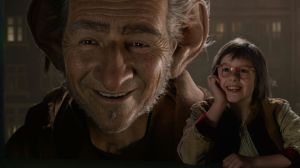
The BFG (Mark Rylance) and Sophie (Ruby Barnhill) in The BFG

The BFG (Mark Rylance) and Sophie (Ruby Barnhill) in The BFG

It’s fair to say that such technology has continued to evolve at a remarkable pace in the intervening years but, as Andy Serkis’ game-changing turn as Gollum in The Lord Of The Rings films demonstrated 15 years earlier, it’s the interplay between such characters that determines whether the audience is going to buy a 24ft giant interacting with a young girl.

The moment the film definitively answers that question comes near the start when, having spied the BFG late one night from the open window of the orphanage she calls home, Sophie (Ruby Barnhill) runs to her bed only to be smuggled away by the giant.

The BFG (Mark Rylance) snatches up Sophie (Ruby Barnhill) in The BFG

The BFG (Mark Rylance) snatches up Sophie (Ruby Barnhill) in The BFG

It’s a technically bravura sequence (lent typically enriching musical support from John Williams), full of potential threat, that acts as a springboard for the BFG’s breathless journey out of London (in which he pulls various shapes to trick passing pedestrians and motorists that he’s a lamppost, for instance) and away into Giant Country.

The BFG, Sophie learns, is a dreamcatcher whose kindness and benevolence is in stark contrast to the “boys” – child-eating giants who pick on the “runt” and suspect he is hiding a human. Determined to stop the gang from helping themselves to more hapless youngsters, Sophie realises that she and the BFG must go straight to the Queen if they are going to stop them.

Orphan Sophie (Ruby Barnhill) can't believe what she's just seen in The BFG

Orphan Sophie (Ruby Barnhill) can’t believe what she’s just seen in The BFG

Roald Dahl’s stories have remained so beloved by kids the world over because they resolutely refuse to treat their target audience as small-minded children. In Dahl’s fiction, magic and danger exist side by side and his feisty young heroes are more than capable of thinking for themselves.

Featuring a lovingly crafted screenplay by the late Melissa Mathison (whose previous collaboration with the bearded one, 1982’s E.T. The Extra Terrestrial, shares many The BFG‘s qualities), Spielberg is simpatico with Dahl’s sensibilities, which begs the question of why it’s taken so long for him to adapt one of the writer’s works.

The magical dreaam tree in The BFG

The magical dream tree in The BFG

The film perhaps spends a little too long establishing the relationship between the giant and Sophie (a curious complaint I appreciate bearing in mind the strength of both performances), while the special effects involving Sophie being transported in the BFG’s hand or evading the other giants feel a bit weightless. The final confrontation between the “boys” and a fleet of helicopters sent by Her Majesty is also a little underwhelming.

However, The BFG really comes into its own during the enchanting sequence in Dream Country and the potential stumbling block of the final act encounter between the Queen (the always wonderful Penelope Wilton), the BFG and Sophie (it’s arguably the weakest part of the book) which is handled with mastery and not a little hilarity as the whizzpopping effects of the giant’s fizzy frobscottle drink affects even the corgis.

The BFG and the not-so-friendly big giants in The BFG

The BFG and the not-so-friendly big giants in The BFG

The previously unknown Barnhill is lovely as the wide-eyed young girl whose wish to be taken care of is granted by a giant with his own unique version of English language, but it is Rylance who breathes warmth and an ageless kindness into the titular role and gives a performance equal in stature to his Oscar-winning turn in Spielberg’s previous movie Bridge Of Spies.

Dahl famously hated virtually every adaptation of his books – had he lived to see Spielberg’s take on The BFG he would surely have deemed it scrum diddly umptious.

Review – Independence Day: Resurgence

As the honest trailer for Roland Emmerich’s latest diaster-thon perhaps should have said, “we knew they’d come back, but nothing could prepare us for the mind-numbing stupidity of Independence Day: Resurgence“.

"We knew they'd come back, but nothing could prepare us for the mind-numbing stupidity of Independence Day: Resurgence"

“We knew they’d come back, but nothing could prepare us for the mind-numbing stupidity of Independence Day: Resurgence”

No-one was probably expecting the belated sequel to the 1996 monster hit to be a high water mark in cerebral filmmaking, but Emmerich and his four co-screenwriters could have at least tried to pen a script that had ambitions beyond head-bangingly terrible.

There’s something to be said for a good old mindless night at the cinema. Independence Day remains a quintessential blockbuster that strikes a balance between cheese, exhilarating (and occasionally unnerving) spectacle and charismatic acting led by the peerless Jeff Goldblum and Will Smith in a star-making turn.

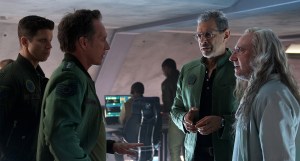
Why are we here again? General Joshua Adams (William Fichtner), Earth Space Defense head honcho David Levinson (Jeff Goldblum) and Dr Okun (Brent Spiner) in Independence Day: Resurgence

Why are we here again? General Joshua Adams (William Fichtner), Earth Space Defense head honcho David Levinson (Jeff Goldblum) and Dr Okun (Brent Spiner) in Independence Day: Resurgence

Goldblum, thankfully, returns as David Levinson, the former science geek turned saviour of humanity (thanks to an uploaded computer virus that put the “universal” into universal serial bus (USB)), who is now heading up Earth Space Defense (ESD) at Area 51. He’s joined by fellow ID4 veterans Bill Pullman as former President Whitmore, plagued by the psychic alien link he experienced first time around, and Brent Spiner’s colourfully eccentric Dr Okun, who awakens from a 20-year coma just in time for ET’s return and, like numerous others, starts drawing what looks like a power symbol.

Smith, however, decided to opt out of this particular sequel (this from the guy who signed up for Men In Black 2 and Bad Boys II) and on wise-cracking duty this time around is Liam Hemsworth, who plays a maverick ESD pilot stuck in a dead-end detail on the Moon.

In spite of every major city and military base on the planet having been wiped out along with the majority of mankind following the last invasion, the human race has, with the help of alien tech (it’s not explained how we’ve been able not only to understand but also so successfully exploit ET’s technology in such a relatively short timescale) set aside its differences and rebuilt itself, even setting up bases on Mars and Saturn’s moon Rhea as well as on the Moon.

Today it's our Independence Day: Resurgence for ex-President Whitmore (Bill Pullman)

Today it’s our Independence Day: Resurgence for ex-President Whitmore (Bill Pullman)

Another invasion is expected although the scale of their return when it finally comes suggests the aliens are no longer messing around, having sent a 3,000-mile wide spaceship that’s intent on finishing the job. With the odds once again firmly stacked against humanity, it’s up to our plucky bunch of heroes to save the day, including Jessie Usher as the son of Smith’s super-pilot, Maika Monroe as President Whitmore’s daughter and Angelababy as a crack Chinese pilot with ESD.

Whilst ID: Resurgence (or should that be Regurgitation?) is far from the worst summer blockbuster to have landed on our big screens, its paint-by-numbers plotting, laughable script and uninspired acting (even the normally solid William Fichtner looks dead-eyed, while Goldblum does his best with material that’s beneath him) make the 129  minute running time feel twice as long.

Top guns: Space pilots Jake Morrison (Liam Hemsworth) and Dylan Dubrow-Hiller (Jessie Usher) in Independence Day: Resurgence

Top guns: Space pilots Jake Morrison (Liam Hemsworth) and Dylan Dubrow-Hiller (Jessie Usher) in Independence Day: Resurgence

Even the special effects, so solid in the first movie, look largely unconvincing. A gravity-defying attack that flings all manner of giant man-made stuff in the air inspires nothing more than a resigned shrug. Maybe it’s overblown action set piece fatigue finally setting in, but watching London or some other city get flattened just doesn’t have the wow factor it once did.

Robert Loggia (rest in peace) and Vivica A. Fox, both fellow ID4 vets, are criminally wasted, while poor DeObia Oparei’s African warlord is given the worst dialogue of all (he praises somehow for “having the heart of a warrior” and reveals at one point that the aliens’ immodest ambitions encompass “the entire universe”) and is decked out by a costume department that had seemingly just watched Beasts Of No Nation.

The typically subtle special effects of Independence Day: Resurgence

The typically subtle special effects of Independence Day: Resurgence

The unoriginality also seeps into the soundtrack by Harald Kloser and the unfortunately named Thomas Wanker, who drown every scene with ‘music for dummies’ compositions that only serve to cheapen the film yet further.

The film ends with an depressingly unapologetic sequel pitch that promises destruction on an intergalactic scale. If it’s anything like as bad as Independence Day: Resurgence I’ll be rooting for the aliens.

Review – Captain America: Civil War

Hands up who thought the clean-cut, living, breathing symbol of freedom and liberty would have ended up showing the rest of the Marvel Cinematic Universe how it’s done?

Forever a man out of his time, Steve Rogers’ guiding principles have seen the first Avenger become a square peg in a round hole that has resulted in him falling out of favour with the powers that be.

Captain America: Civil War harvests the seeds of doubt that were planted in The Winter Soldier and closes a chapter on the MCU that has led to the ultimate emblem of apple pie-eating pride transform from, in the words of directors Anthony and Joe Russo, “patriot to insurgent”.

So long as the calibre of films remains as high as Captain America: Civil War, then we'll continue to hold out hope

So long as the calibre of films remains as high as Captain America: Civil War, then we’ll continue to hold out hope

It’s been a fascinating journey, one that is arguably the defining aspect of Marvel’s epic big screen enterprise and the Cap trilogy has stood head and shoulders above the rest thanks to a compelling mixture of great storytelling, engaging characters and standout direction.

Chris Evans’ central performance should also not be underestimated and he gives his best turn yet in Civil War. Evans has the square-jawed all-American looks befitting the part, but there’s also steel behind the eyes that gets sorely tested this time out.

Civil War picks up after the events of Avengers: Age Of Ultron, with a tragedy during an Avengers mission being the metaphorical straw that breaks the camel’s back for the authorities. U.S Secretary of State Thaddeus Ross (William Hurt) announces that, despite the debt owed by society, no longer can collateral damage by tolerated.

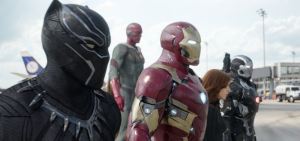
Black Panther (Chadwick Boseman) gets stuck in alongside his allies in Captain America: Civil War

Black Panther (Chadwick Boseman) gets stuck in alongside his allies in Captain America: Civil War

The Sokovia Accords (so named after the country affected by the events of Age Of Ultron) are drawn up and the Avengers are urged to sign and agree to fall under the jurisdiction of the United Nations. Wracked with guilt for his part in creating Ultron, Tony Stark/Iron Man (Robert Downey, Jr.) leads the call to sign up and while some fall into line others, most notably Cap, are less inclined.

When a terrorist act seemingly points the finger at Cap’s old buddy Bucky Barnes, aka the Winter Solider (Sebastian Stan), the fissure between the Avengers and, in particular, Iron Man and Captain America grows bigger and more strained. But was Bucky responsible or is another force at work?

Black Panther (Chadwick Boseman) gets stuck in alongside his allies in Captain America: Civil War

Black Panther (Chadwick Boseman) gets stuck in alongside his allies in Captain America: Civil War

On paper, Civil War treads a similar path to Batman vs Superman: Dawn Of Justice – superheroes end up at each other’s throats when they should be on the same side. However, the difference in execution is glaring, with Zack Snyder’s effort little more than a one-dimensional bludgeoning in comparison to Marvel’s latest.

Another difference between both films is how it brings new characters into the fold. Whilst Batman vs Superman crowbarred in the likes of Aquaman via a flimsy laptop session, this introduces a young, inexperienced Spider-Man (Tom Holland) and a hard-as-nails Black Panther (Chadwick Boseman) in organic and believable ways. The scenes Downey, Jr shares with Holland are especially fun and promise much for Spidey’s official Marvel debut.

Indeed, fun is something that can be found in plentiful supply here (another advantage over Bats vs Supes) and the balance between light and dark is nicely handled.

Spider-Man (Tom Holland) joins the party in Captain America: Civil War

Spider-Man (Tom Holland) joins the party in Captain America: Civil War

Importantly, both sides of the argument are given equal weight. It’s difficult to disagree with the weight of evidence brought to the table by Ross, while Stark’s point that it’s better to sign now rather than having more draconian accords thrust upon them later on is persuasive. However, the counterpoint put forward by Rogers that becoming the tool of political forces means you will forever be in its sway is equally valid. After all, following the events of The Winter Soldier, it’s not surprising Rogers has his doubts about the fortitude of institutions.

The charge that Civil War gets too bogged down with its characters is understandable – as is the assertion that this is basically Avengers 3 rather than Cap 3. That does a disservice, though, to Christopher Markus and Stephen McFeely’s script and the Russo’s direction, which tries not to leave anyone behind.

The plethora of A and B-list Avengers ultimately pays off in the central airport hanger sequence, which starts off lightly as both sides weigh in to each other whilst saying “we’re still friends right?” before the punches start to land with more purpose. It’s a great action scene that again mixes dramatic stakes alongside lighter moments, not least of which involving Ant-Man (Paul Rudd) who literally gets the biggest moment.

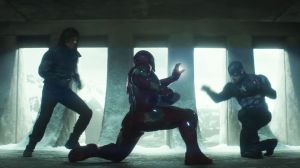
Who needs friends? Iron Man (Robert Downey Jr) goes up against Cap (Chris Evans) and Bucky Barnes (Sebastian Stan) in Captain America: Civil War

Who needs friends? Iron Man (Robert Downey Jr) goes up against Cap (Chris Evans) and Bucky Barnes (Sebastian Stan) in Captain America: Civil War

Perhaps in response to the criticism levelled at Marvel movies that their final acts often descend into epic CGI-heavy carnage, Civil War‘s denouement is far more effective for being much smaller and personal in scale as well as bleaker in tone. The motives behind Daniel Bruhl’s pitch perfect villain Helmut Zemo become clear as the endgame draws near and speaks to the overall tone of the film – of actions having consequences down the line and the fragility of alliances when trust is in short supply.

Quite how much longer the MCU can keep juggling so many balls is up for debate, but so long as the calibre of films remains as high as Captain America: Civil War, then we’ll continue to hold out hope.