Review – The Croods

Throw in the Yabba-Dabba Doo domesticity of The Flintstones and a sprinkling of Ice Age cutesiness and you’re well on your way to summing up DreamWorks Animation’s latest.

The Croods

“The Croods may be prehistoric when it comes to offering up anything even vaguely original, but there’s just about enough here to make their animated antics an entertaining diversion”

The discovery of  perfectly preserved cave paintings in France dating back more than 30,000 years ago could well have acted as the springboard for The Croods.

A smart montage of crude cave drawings is used at the start of the film to illustrate rebellious Eep’s (voiced by Emma Stone) narration explaining the reasons why her overprotective father Grug (Nicolas Cage) insists the family “never leave the cave”, while Grug uses the cave walls to sketch out the stories he tells the clan every night.

Eep (Emma Stone) and Guy (Ryan Reynolds) in The Croods

Eep (Emma Stone) and Guy (Ryan Reynolds) in The Croods

Despite Grug’s best efforts to shield his family from the dangers of the outside world, an earthquake destroys the cave and leaves them with little choice but to explore the world beyond. As they try to find a new home, they are joined by the smart, but lonely Guy (Ryan Reynolds), who is convinced the world as they know it is coming to an end and the only way to avoid certain death is to reach a distant mountain.

The one major problem with The Croods is, well, the Croods themselves. The family are made up of such generic stereotypes – anxious, overbearing father, understanding mother, inquisitive daughter, dumb son, unruly baby and annoying mother-in-law – they could be flat-packed and reassembled into any movie, animated or otherwise.

The Croods

The Croods in, well, The Croods

Much like Grug, the team behind the film (randomly, John Cleese is credited as one of the team behind the story) insist on playing it safe instead of trying something original or daring.

We’re used to seeing impressive visuals in computer-generated animations these days, but The Croods is particularly stunning and a big reason for this can probably be put down to Oscar-nominated cinematographer Roger Deakins being drafted in as ‘visual consultant’.

The wonderful visuals are The Croods' trump card

The wonderful visuals are The Croods’ trump card

The use of fire (and the look of bewilderment, confusion and fear on Eep and co’s faces when they first set eyes on it) is beautifully rendered, while the moment the characters stare up in wonder at a perfectly clear galaxy of stars (for the family this is the first time they have seen a night sky) is breathtaking.

Aimed more squarely at tweens and below, there are enough cute animals (in particular Guy’s pet sloth Belt) to keep kids entertained, although adults will struggle to find much to latch onto.

Guy's trusty pet sloth Belt in The Croods

Guy’s trusty pet sloth Belt in The Croods

The characters themselves are slightly exaggerated versions of humanity (even allowing for the fact they’re neanderthals) in the way that so many animations are, while Eep’s appearance (and feisty nature) is remarkably similar to that of Merida from Pixar’s Brave, right down to the big red hair.

Cage brings his usual manic energy to patriarch Grug (this being an animated film, the kids are spared his mad staring eyes and loony grin), and Stone and Reynolds work nicely off each other as the hormonal teenagers whose inquisitiveness  regularly lands the clan in danger.

The Croods may be prehistoric when it comes to offering up anything even vaguely original, but there’s just about enough here to make their animated antics an entertaining diversion.

Review – The Paperboy

There’s a moment in the seedy, southern-fried gothic noir The Paperboy when Nicole Kidman urinates on Zac Efron to relieve his character’s painful jellyfish stings.

Lee Daniels' The Paperboy - "you're left scratching your head wondering whether it was all worth the bother"

Lee Daniels’ The Paperboy – “you’re left scratching your head wondering whether it was all worth the bother”

It’s a bizarre scene in a frankly head spinning film that comes across as a jubilant two-finger salute by its director Lee Daniels.

Measured alongside his previous film, 2009’s Precious (which earned him a Best Director Oscar nomination), it’s fair to say Daniels has something of the bull in a china shop approach about him and a keen eye for a headline-grabbing project.

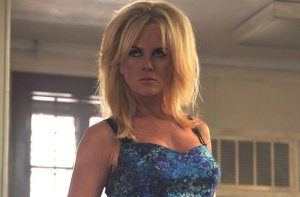
Nicole Kidman as the vampish "oversexed Barbie doll" Charlotte Bless in The Paperboy

Nicole Kidman as the vampish “over sexed Barbie doll” Charlotte Bless in The Paperboy

Based on Pete Dexter’s novel, The Paperboy exudes a clammy, twisted luridness that would have had Tennessee Williams choking on his iced tea and a roll call of characters that make the buck-toothed Hillbillies of Deliverance look like boy scouts.

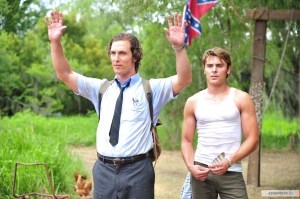
Ostensibly, it deals with investigative reporter Ward Jansen (Matthew McConaughey) returning to his Florida hometown with partner Yardley Acheman (David Oyelowo) in tow to try to prove death row convict Hilary Van Wetter innocent (John Cusack) of the local sheriff’s murder. Ward has been coaxed into it by vampish “over sexed Barbie doll” Charlotte Bliss (Kidman), a green mile groupie who’s formed a bond with Van Wetter, and teams up with his younger brother Jack (Efron) to drudge through the murky swamp waters of the case.

Reporter Ward Jansen (Matthew McConaughey) and his brother Jack (Zac Efron) in The Paperboy

Reporter Ward Jansen (Matthew McConaughey) and his brother Jack (Zac Efron) in The Paperboy

However, what starts out as a straightforward enough crime drama very swiftly gets churned up in the film’s wild vortex as its uncomfortable events play out.

While much of the attention and hoo-ha has been directed at the urination scene, there’s plenty else to get more innocent viewers squirming in their seats, including a ludicrously trashy moment when Bliss mimes a sex act for Van Wetter during visiting hours in front of a dumbfounded Ward, Jack and Acheman. It’s so ridiculous – and so sleazily filmed by Daniels – that you end up chuckling at the sheer brazenness of what you’re watching.

Redneck death row inmate Hillary Van Wetter (John Cusack) in The Paperboy

Redneck death row inmate Hillary Van Wetter (John Cusack) in The Paperboy

The film is narrated by the Jansens’ housemaid Anita (singer Macy Gray), who can barely disguise the contempt she has for her racist employers. She clearly feels protective toward Jack, however, and Daniels emphasises this when a sex scene involving him is cut short when she suggests “I think you’ve seen enough”.

A few exceptions aside (there’s something off about Gray’s performance in particular), a starry cast work their socks off. In her most outlandish role to date, Kidman somehow keeps a straight face throughout, a feat unto itself bearing in mind what’s expected of her.

Yardley Acheman (David Oyelowo), Charlotte Bless (Nicole Kidman) and Jack Jansen (Zac Efron) in The Paperboy

Yardley Acheman (David Oyelowo), Charlotte Bless (Nicole Kidman) and Jack Jansen (Zac Efron) in The Paperboy

Cusack has a great time chewing the scenery and playing against type as the reddest of rednecks, while Efron is a million miles from his High School Musical days (and all the better for it) and McConaughey continues the ‘McConassance’ (not my pun mores the pity) he’s been enjoying of late in such fare as The Lincoln Lawyer, Magic Mike and Killer Joe.

Set in the 1960s, the film uses a grainy lens and many of the visual tricks adopted at the time to give the film a suitably authentic look. At its best, The Paperboy brings to mind the twisted lunacy of Scorsese’s remake of Cape Fear and the woozy, hallucinatory nature of Night Of The Hunter, but in choosing to turn the dial up to 11 Daniels ends up losing the plot as the narrative gets sucked into the swamp and the whole endeavour takes leave of its senses.

There are many things to admire about The Paperboy, not least of which its sheer weirdness, but what in the hands of a David Lynch or Luis Buñuel could have been a real strength ends up here being the film’s most damaging weakness as you’re left scratching your head wondering whether it was all worth the bother.

Review – Red Dawn

After the New Hollywood of the 70s self-destructed in a blaze of cocaine and squandered opportunities the 80s ushered in the kind of cinematic reckoning we’re still living with today.

Red Dawn Poster

Red Dawn – “a film so underwhelming you’d have to check your ticket to remember what it is you’ve just seen”

As well as being the decade that taste forgot, the 80s also served as the decade that embraced the tent pole blockbuster and gave us countless straight-to-video dumb-as-nails cheapies.

It’s a cinematic legacy we’re still living with today as the brain puddle at the heart of Tinseltown green-lights more and more remakes, re-imaginings and reboots.

Red Dawn

Sullen-looking Matt Eckert, Robert Kitner (Josh Hutcherson) and Jed Eckert (Chris Hemsworth) wonder what they’re doing in Red Dawn

This law of diminishing returns reaches a new bone-headed, flag-waving nadir with Red Dawn, a retread of the equally appalling 1984 flick directed by John Milius.

The original has gained a sort of cult appeal over the years (which probably explains the remake), but this casually ignores its many, many flaws, not least of which a script that’s so rabidly anti-communist it tramples over everything else, like a coherent narrative or character development.

That the context of the original at least made sense in that it you knew it was nothing more than a propaganda exercise for Ronald Reagan’s reheating of the Cold War, the timing of stuntman-turned-director Dan Bradley’s update is way off.

Red Dawn

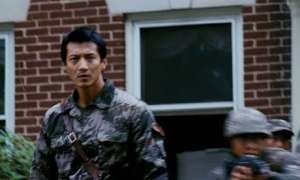
The evil North Korean Captain Cho (Will Yun Lee) in Red Dawn

If it had been released during George W Bush’s tenure in the White House a similar argument could possibly be made, but the fact it went before the cameras in 2009 and is only now seeing the light of day rubber stamps what it is – a film out of its time, out-of-place and out on its ass.

While Milius’ original relied on the evil old Soviet Union to launch an invasion of the United States, Red Dawn 2.0 couldn’t even have the courage of its convictions to stick with China as its chief villain; in post-production this was changed to North Korea so as not to offend a potentially lucrative financial territory (as such it’s now reminiscent of the video game Homeland, also written by Milius).

Red Dawn

Red Dawn 2.0 – Patrick Swayze is probably spinning in his grave

The fact that North Korea would be able to muster a big enough army to launch a successful land invasion of the Land of the Free, and that such a force would go unnoticed until thousands of parachutes are seen over American skies is beyond laughable.

One can imagine the only reason this has made it into cinemas is to cash in on the star power of its lead Chris Hemsworth (Thor, The Avengers), whose US Marine Jed Eckert turns a ragtag group of teenagers into a gun-toting squadron of insurgents called the Wolverines (named after the local high school football team) out to take the homeland back from the evil clutches of the North Koreans, led by Captain Cho (Will Yun Lee).

Red Dawn

“Go Wolverines!”, or not, in Red Dawn

Setting aside the complete ridiculousness of the plot (hardly the first movie to be guilty of such a crime), Red Dawn‘s 93 minute running time at least avoids the Michael Bay trap of not knowing when to employ an editor.

That being said, those 93 minutes are some of the most lame-brained you’re likely to sit through this year. Hemsworth aside, the entire cast is dreadful, most notably Josh Peck as Jed’s sullen-looking brother Matt.

The odd choice line of dialogue aside (“Marines don’t die. They just go to hell and regroup”), the script slavishly adopts the lowest common denominator setting of a film so underwhelming you’d have to check your ticket to remember what it is you’ve just seen.

Review – Flight

The poster for Robert Zemeckis’ first foray into live action filmmaking for a dozen years captures everything that’s good – and not-so-good – about Flight.

in Robert Zemeckis' Flight

A towering performance by Denzel Washington is almost ruined by a clumsily heavy-handed symbolism in Robert Zemeckis’ Flight

Denzel Washington’s airline pilot ‘Whip’ Whitaker conveys an authority befitting his vocation, but the rain pouring down suggests something is very wrong.

It’s a simple image that tells you all you need to know about the film. At its core is a towering central performance of one man’s painful journey towards redemption, but that odyssey is marred by a style of direction that’s about as subtle as taking a sledgehammer to crack a walnut.

The signs are there from the first few moments when flight attendant Katerina (Nadine Velazquez) wanders naked around the hotel room she’s sharing with lover Whitaker after a heavy night on the booze to the strains of the Barenaked Ladies’ Alcohol. Then, after a pick-me-up and a snort of cocaine a swaggering Whitaker emerges from the room with Joe Cocker’s Feelin’ Alright playing in the background.

Whip Whitaker (Denzel Washington) prepares for take off in Flight

Whip Whitaker (Denzel Washington) prepares for take off in Flight

This clumsiness is further compounded when the plane Whitaker miraculously pilots symbolically clips the top of a church before it crash lands, killing six (including Katerina) but crucially saving almost 100 other passengers and crew.

Zemeckis has proven himself a master filmmaker of the plane crash following 2000’s Cast Away (his last live action film), which showed it from the terrified perspective of Tom Hanks’ Chuck Noland. Here, we see the action from the cockpit as Whitaker confidently takes charge and rolls the plane upside down to bring it out of a nose dive. It’s heart-pounding stuff that will have you on the edge of your seat.

Whip Whitaker (Denzel Washington) performs a miraculous manoeuvre in Flight

Whip Whitaker (Denzel Washington) performs a miraculous manoeuvre in Flight

He’s saluted as a hero by both the media and friends, including union rep Charlie Anderson (Bruce Greenwood) and his flamboyant dealer Harling Mays (John Goodman), whose musical cue is the Rolling Stones’ Sympathy For The Devil lest we forget his chosen profession. But Whitaker’s world begins to crumble when he discovers a blood sample was taken in hospital which, if it were to become public would reveal he was drunk at the controls and land him in jail.

Harling Mays (John Goodman) comes to an unusual rescue in Flight

Harling Mays (John Goodman) comes to an unusual rescue in Flight

It’s an intriguing story, extremely well scripted by John Gatins that has you rooting for an anti-hero who isn’t just flawed, but plain unlikable for stretches. It also examines the lengths people and corporations will go to distort the facts to maintain a story so long as it has a happy ending, while also pointing a finger at the media for endlessly speculating and editorialising when there’s little or nothing to report.

Whip Whitaker (Denzel Washington) finds a connection with fellow addict Nicole (Kelly Reilly) in Flight

Whip Whitaker (Denzel Washington) finds a connection with fellow addict Nicole (Kelly Reilly) in Flight

Whitaker is that familiar movie cipher, the flawed genius, but Washington in his best performance since winning an Oscar for 2001’s Training Day (an equally unlikable role) adds layers of nuance to give us one of the most expressive and fascinating portrayals of functioning alcoholism yet seen on screen.

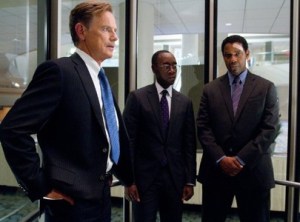
It's judgement time for union rep Charlie Anderson (Bruce Greenwood), company lawyer Hugh Lang (Don Cheadle) and "unstable pilot Whip" Whitaker (Denzel Washington) in Flight

It’s judgement time for union rep Charlie Anderson (Bruce Greenwood), company lawyer Hugh Lang (Don Cheadle) and “unstable pilot Whip” Whitaker (Denzel Washington) in Flight

Furthermore, Flight asks the uncomfortable question of whether it’s the drink and drugs that bring out the real brilliance in Whitaker; the film certainly seems to suggest so.

Goodman’s blunderbuss performance is out-of-place and more in keeping with his Walter Sobchak from The Big Lebowski, although Don Cheadle is excellent as the morally dubious lawyer trying to paper over the cracks and Brit Kelly Reilly does a lot with a thin role as a heroin addict who Whitaker befriends after meeting in hospital (just in case we didn’t know she’s an addict, the Red Hot Chilli Peppers’ drug anthem Under The Bridge helpfully plays on the soundtrack).

In many ways Flight is a welcome return to the ‘real’ world for Zemeckis following his triumvirate of motion-capture uncanny valley animations The Polar Express, Beowulf and A Christmas Carol, but in his zealousness for proper, adult drama he serves up a film so heavy-handed in its use of symbolism and music he almost ruins it.

Review – The Impossible

Natural disasters are invariably so enormous in their scale the only way to avoid them becoming too overwhelming on screen is to chronicle the unfolding tragedy through the eyes of a small group of people.

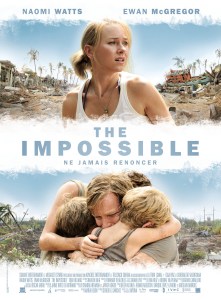
The Impossible

“There are powerful moments, but too few and far between to elevate The Impossible into the awards contender is clearly aims to be”

The Indian Ocean earthquake and resulting tsunami that struck on Boxing Day in 2004 claimed the lives of more than 230,000 people, many of them in south-east Asia.

The scale of the catastrophe boggles the mind, so much so that Juan Antonio Bayona’s The Impossible seeks to narrow its focus by having the desperate plight of one stricken family symbolise the horror and anguish of those fateful days.

This isn’t the first film to deal with the tsunami; the HBO miniseries Tsunami: The Aftermath was screened less than two years after the tragedy. In spite of winning a cabinet full of awards, it drew criticism for leaning too heavily on the stories of white victims at the expense of the native population.

Young Lucas (Tom Holland) fights to save his stricken mother’s (Naomi Watts) life in The Impossible

A similar charge has also been levelled at The Impossible, which exclusively follows the Bennett’s – Henry (Ewan McGregor) and Maria (Naomi Watts) and their three sons, teenager Lucas (Tom Holland), middle child Tomas (Samuel Joslin) and youngest Simon (Oaklee Pendergast) – a white English-speaking family who are on holiday in Khao Lak, Thailand when the wave hits.

You know what’s coming, which makes the opening scenes of peaceful tranquility and tropical beauty all the more suspenseful. Although you’re left in no doubt this is a story of survival and the tenacity of the human spirit in the face of overwhelming odds, The Impossible will inevitably be judged by its audience for the way the tsunami itself is portrayed on screen.

The Impossible

Henry (Ewan McGregor) with his sons Tomas (Samuel Joslin) and Simon (Oaklee Pendergast) in The Impossible

In this, Bayona pulls out all the stops. Just as Steven Spielberg leaves you shell-shocked with his opening D-Day landing sequence in Saving Private Ryan, so too does Bayona, who pounds you into submission by showing the full, awesome power of nature as the tsunami tears through the resort, scoops up those in its path and tosses them around in the torrent of water like rag dolls before finally subsiding.

The Impossible

The terrifying moment the tsunami strikes in The Impossible

It’s a terrifying, dizzying sequence that serves as the launchpad for the rest of the movie as a badly injured Maria and determined Lucas must rely on the selfless generosity of the Thai people to get them to safety, while Henry, with Tomas and Simon in tow, begins a desperate search to reunite his family.

The problem with The Impossible is that the devastating impact of the tsunami is so powerfully depicted it proves impossible for the remainder of the film to match what has gone before (akin to Saving Private Ryan). Much of the blame for this must be levelled at Sergio G. Sánchez’s script, which falls back on heavy-handed symbolism and, in its closing minutes resorts to ham-fisted melodrama that’s as unnecessary as it is manipulative.

The Impossible

Mother and son Maria (Naomi Watts) and Lucas (Tom Holland) cling on for dear life in The Impossible

It’s a pity as the cast are largely superb. Holland is a real discovery and shows a maturity well beyond his years in his portrayal of the resourceful son who goes through hell and (literal) high water to help save his mum. McGregor gives his best performance for years as a father and husband wracked with guilt and fear at the thought of losing his wife and family.

The Impossible

A moment of peaceful tranquility before the family’s world is turn asunder in The Impossible

Bayona leans on Watts to deliver much of the emotional payoff and she doesn’t let her director down. It’s a draining performance, both physically and psychologically as we see Maria fighting to survive for the sake of her family. Bayona made his name as a horror director in the excellent Spanish-language The Orphanage and he brings that same sensibility to the moment when an exhausted, ailing Maria experiences the sting in the tsunami’s tail.

Although based on the experiences of a Spanish family, Bayona has come under fire for making them English-speaking. Setting aside the director’s rather unconvincing explanation that he chose not to specify their nationality in order to make The Impossible as universal as possible (it’s pretty obvious they’re supposed to be British), the fact they aren’t Spanish doesn’t detract from the story the film is telling.

There are powerful moments (the telephone call made by Henry to a relative back home is gut-wrenchingly played by McGregor), but too few and far between to elevate The Impossible into the awards contender is clearly aims to be.