Review – Saving Mr Banks

The story behind one of cinema’s most magical family classics is told in a shamelessly self-congratulatory, but ever-so  supercalifragilisticexpialidocious way in Disney’s warm-spirited love letter.

Saving Mr Banks may be a giant spoonful of sugar, but it's charm and outstanding performances certainly help the medicine to go down

Saving Mr Banks may be a giant spoonful of sugar, but it’s charm and outstanding performances certainly help the medicine to go down

From the moment Julie Andrews flew in to the lives of the Banks family courtesy of her magic umbrella, generations of moviegoers young and old were swept away by Walt Disney’s beloved 1964 adaptation of P.L Travers’ iconic Mary Poppins.

Walt Disney (Tom Hanks) promises he won't let Mrs Travers (Emma Thompson) down in Saving Mr Banks

Walt Disney (Tom Hanks) promises he won’t let Mrs Travers (Emma Thompson) down in Saving Mr Banks

Saving Mr Banks chronicles the tireless efforts of Mr Disney (Tom Hanks) to persuade Mrs Travers (Emma Thompson) to relinquish the rights to her hugely popular children’s novel. Flown over to LA at the Mouse House’s expense, she attends a two-week workshop with co-writer Don DaGradi (Bradley Whitford) and composer/lyricists Richard M Sherman (Jason Schwartzman) and Robert B Sherman (BJ Novak) to determine whether she’s happy (or not) with the direction the studio wants to take with the picture.

Mrs Travers (Emma Thompson) seems unimpressed with LA when picked up by her chauffeur Ralph (Paul Giamatti) in Saving Mr Banks

Mrs Travers (Emma Thompson) seems unimpressed with LA when picked up by her chauffeur Ralph (Paul Giamatti) in Saving Mr Banks

As Walt and co work on winning over Mrs Travers, the experience stirs up memories to her childhood spent in Australia at the turn of the century with her mother Margaret (Ruth Wilson) and alcoholic, but deeply loving bank manager father Robert (Colin Farrell).

Walt Disney (Tom Hanks) himself at Disneyland in Saving Mr Banks

Walt Disney (Tom Hanks) himself at Disneyland in Saving Mr Banks

Disney has wallowed in the syrup of sentiment and schmaltz more than once, so it shouldn’t come as much of a surprise to learn a film in which the Mouse House raises a glass of milk to itself and celebrates the genius of its founder is unadulterated whimsy. But it’s whimsy with a heart and an old-fashioned charm that’s irresistible to resist.

Walt Disney (Tom Hanks) promises he won't let Mrs Travers (Emma Thompson) down in Saving Mr Banks

Walt Disney (Tom Hanks) promises he won’t let Mrs Travers (Emma Thompson) down in Saving Mr Banks

The cast is truly splendid. Thompson, who’s seen too rarely on our screens, is terrific as the prim and proper sourpuss Mrs Travers, who must learn to let go of her painful past and trust in Mr Disney in order to finally move forwards. It’s a masterfully restrained performance, one that thaws authentically as she gets taken in by the genuine love and respect Disney and the gang have for the material.

Mrs Travers remembers her youth with her father (played by Colin Farrell) in Saving Mr Banks

Mrs Travers remembers her youth with her father (played by Colin Farrell) in Saving Mr Banks

She’s matched by Hanks’ charming turn as ol’ Walt, a character that’s far removed from his recent turn as Captain Phillips. Hanks is perfect and brings a charismatic authority to the role that hints at the steely businessman who’s built an empire out of the vision of a friendly little mouse. The scene he shares with Mrs Travers late in the film when he talks about his difficult childhood and the significance her story has had both to his family and countless others is a textbook example of great acting by both Hanks and Thompson.

"Gawd bless Mary Poppins!"

“Gawd bless Mary Poppins!”

Paul Giamatti also gets a great cameo as Mrs Travers’ kind-hearted chauffeur Ralph. It’s the sort of turn that could drip with saccharine, but Giamatti gives it just enough bite.

The recurring flashbacks to Oz are perhaps the film’s weakest point and the parallel narratives between 1907 Queensland and 1961 LA are a little too neat and tidy, but John Lee Hancock’s thoughtful direction is both moving and genuinely funny.

Saving Mr Banks may be a giant spoonful of sugar, but it’s charm and outstanding performances certainly help the medicine to go down.

Review – Thor: The Dark World

It’s hammer time once again as the Marvel juggernaut rolls into town for a universe-ending epic of god-like proportions that’s more akin to Lord Of The Rings on party pills.

Thor: The Dark World Poster

After watching The Dark World, one wonders where the franchise can go from here. There’s nothing Thor-some this time around and not even Loki can change that

This sequel had an awful lot to live up to, not only in light of the surprisingly enjoyable Thor, but also following the box office dynamite of Avengers Assembled (as it was called in these here parts) and this summer’s Iron Man 3.

Thor (Chris Hemsworth) and Odin (Anthony Hopkins) share a father-son moment in Thor: The Dark World

Thor (Chris Hemsworth) and Odin (Anthony Hopkins) share a father-son moment in Thor: The Dark World

A major factor behind Thor‘s success was the tongue-in-cheek approach it took towards what’s, let’s face it, is pretty ridiculous material. It also struck gold with the chemistry between Thor (Chris Hemsworth), astrophysicist Jane Foster (Natalie Portman) and, in particular, Thor’s adopted brother Loki (Tom Hiddleston).

Loki stole the show in both Thor and Avengers Assembled, so it should come as no surprise to see him front and centre here. However, not even the wonderful Hiddleston can save The Dark World from ending up as an unengaging and leaden experience and the worst film in the Marvel canon since Iron Man 2.

Jane Foster (Natalie Portman) finally meets her man again in Thor: The Dark World

Jane Foster (Natalie Portman) finally meets her man again in Thor: The Dark World

In trying so hard to rekindle the spark that brought Thor so brightly to life and build on the world that was so imaginatively created first time around, the sequel gets bogged down in unnecessary exposition, a confusing narrative and a mind-boggling amount of special effects.

God of Mischief Loki (Tom Hiddleston) in Thor: The Dark World

God of Mischief Loki (Tom Hiddleston) in Thor: The Dark World

The hiring of Game Of Thrones director Alan Taylor, who replaced Sir Kenneth Branagh, makes sense when watching the film as it has a distinctly Tolkienesque look and feel, from the long, flowing costumes to the Howard Shore-inflected score and the presence of elves.

The elves in question here are The Dark World‘s chief baddies, led by Dark Elf overlord Malekith (a barely recognisable Christopher Eccleston). Malekith was thwarted by the Asgardians in his last attempt to bring darkness to the universe by taking possession of the all-powerful Aether. Centuries later, however, he’s given another chance when Jane, who’s now living in London, enters another realm (don’t ask) and unwittingly becomes the Aether’s vessel. Thor takes Jane to Asgard for her own protection and must turn to the imprisoned Loki for help when Malekith unleashes his forces on the city.

The evil Dark Elves ruler Malekith (Christopher Eccleston) in Thor: The Dark World

The evil Dark Elves ruler Malekith (Christopher Eccleston) in Thor: The Dark World

When Hiddleston’s on screen, the film springs to life and thrives on the mischief the Brit thesp brings to the part. The scenes he shares with Hemsworth are head and shoulders above anything else in and when he’s not around you find yourself counting the minutes until his next appearance.

The Dark Elves invade Asgard in Thor: The Dark World

The Dark Elves invade Asgard in Thor: The Dark World

This rather speaks volumes about the film as a whole, as the scenes without Loki fail to grab the audience in spite of the valiant attempts of the cast. Anthony Hopkins is given more to do this time around as Odin, while Idris Elba’s all-seeing, all-hearing gatekeeper Heimdall gets to take off his helmet and have a drink with Thor.

All-seeing, all-hearing Heimdall (Idris Elba) in Thor: The Dark World

All-seeing, all-hearing Heimdall (Idris Elba) in Thor: The Dark World

However, Portman’s Foster is nothing more than a distressed damsel to be rescued and is so underwritten it brings to mind her turn as Queen Amidala in the Star Wars prequels. She’s saddled with a couple of irritating sidekicks in the form of Kat Dennings’ teeth-grinding Darcy (whose role was expanded from the first film for some reason) and nice-but-dim Ian (Jonathan Howard), although the scenes she shares with Stellan Skarsgård’s eccentric Dr Erik Selvig make for some nice comic relief.

"Nooooooo!!!!" Chris Hemsworth plays Thor in Thor: The Dark World

“Nooooooo!!!!” Chris Hemsworth plays the godlike superhero in Thor: The Dark World

Hemsworth, meanwhile, does his best to bring some depth to the semi-omnipotent superhero and gets a few moments to play up the ridiculousness of the character, most notably when he’s sans hammer and must make his way to Greenwich to stop Malekith’s evil plans via the London Underground. Alas, these are not nearly frequent enough to lift proceedings.

After watching The Dark World, one wonders where the franchise can go from here. There’s nothing Thor-some this time around and not even Loki can change that.

Review – Blue Jasmine

There’s nothing finer than a fine Woody Allen film and Blue Jasmine finds the bespectacled one in his richest form for many years.

Allen may never again reach the dizzy heights of Manhattan or Annie Hall, but Blue Jasmine is a compelling character study and proves there's plenty of life in the old dog yet

Allen may never again reach the dizzy heights of Manhattan or Annie Hall, but Blue Jasmine is a compelling character study and proves there’s plenty of life in the old dog yet

Allen’s mercurial career has seen more than its fair share of peaks and troughs over the past 50-odd years. When he’s good, he can be great as he was throughout the 70s and much of the 80s, but when’s he’s bad he can be terrible (2001’s The Curse Of The Jade Scorpion being one inglorious example).

Jasmine (Cate Blanchett) hits the bottle again in Blue Jasmine

Jasmine (Cate Blanchett) hits the bottle again in Blue Jasmine

After decades of largely New York-based movies, Allen embarked on a European tour which, like much of his filmography, was a decidedly hit and miss affair. Blue Jasmine is his first US-set production since 2009’s forgettable Whatever Works and the return to home soil (all be it in San Francisco instead of the Big Apple) has served him well.

Left penniless following her high-flying husband Hal’s (Alec Baldwin) arrest for fraud, former one-percenter Jasmine (Cate Blanchett) arrives on her adopted sister Ginger’s (Sally Hawkins) doorstep fallen from grace and with nowhere else to go.

Jasmine's (Cate Blanchett) wealthy husbad Hal (Alec Baldwin) woos Augie (Andrew Dice Clay) and Ginger (Sally Hawkins) in Blue Jasmine

Jasmine’s (Cate Blanchett) wealthy husbad Hal (Alec Baldwin) woos Augie (Andrew Dice Clay) and Ginger (Sally Hawkins) in Blue Jasmine

Although welcoming, there is an underlying tension between them which is exacerbated by Ginger’s new boyfriend, red-blooded greasemonkey Chili (Bobby Cannavale). Now forced to join the other 99 per cent, the stiff-necked Jasmine still maintains an aloofness fuelled by Martini and Xanex. She attempts to rebuild her life and spies in wealthy widower Dwight (Peter Sarsgaard) an opportunity to rejoin the social elite; however, her past can’t stay locked up forever.

Jasmine (Cate Blanchett) finds the chance of a new life with Dwight (Peter Sarsgaard) in Blue Jasmine

Jasmine (Cate Blanchett) finds the chance of a new life with Dwight (Peter Sarsgaard) in Blue Jasmine

The problem with so many of Allen’s films over the past two decades has been that they end up becoming weighed down by the baggage of being ‘a Woody Allen film’; whether it be the clunky narrative (the overrated Match Point, Scoop, Anything Else), recycled dialogue or faux-Allen twitchiness of some of his actors (Larry David in Whatever Works or, worst of all, Kenneth Branagh in 1998’s Celebrity).

Blue Jasmine succeeds because it features believable characters instead of Allen caricatures and has one of his very best scripts. The film’s structure, which flits between the present and flashbacks to New York that reveal how Jasmine ended up in the here and now, is particularly effective.

Ginger (Sally Hawkins) tries to calm down volatile boyfriend Chili (Bobby Cannavale) in Blue Jasmine

Ginger (Sally Hawkins) tries to calm down volatile boyfriend Chili (Bobby Cannavale) in Blue Jasmine

The film is also incredibly well served by the excellent cast, led by Blanchett’s tour de force performance. It’s hard to believe it’s taken quite so long for her and Allen to work together, but it was most definitely worth the wait.

Woody Allen directs Cate Blanchett and Alec Baldwin in Blue Jasmine

Woody Allen directs Cate Blanchett and Alec Baldwin in Blue Jasmine

Jasmine is one of Allen’s most memorable creations and Blanchett fully inhabits the character in a warts-and-all turn that’s equal parts pathetic and self-destructive. Like a bull in a china shop, Jasmine is a ticking time bomb of delusional self-entitlement, self-loathing and toxic depression. When she’s not babbling to herself and railing at the injustice she perceives she’s suffered, she’s trying her best to persuade Ginger to ditch Chili in favour of someone more refined.

Hawkins holds her own against Blanchett and turns in a perceptive and subtle performance. Ginger isn’t just a working class girl with a heart of gold; she makes mistakes and has a difficult past to contend with, as shown through her failed marriage to Augie (an unusually restrained Andrew Dice Clay).

The self-destructive Jasmine (Cate Blanchett) in Blue Jasmine

The self-destructive Jasmine (Cate Blanchett) in Blue Jasmine

Bobby Cannavale is a lot of fun as Chili, although the comparisons to A Streetcar Named Desire‘s Stanley Kowalski are a little off; for one thing Chili’s tear ducts get more of a workout than Brando’s ever did. That being said, Blue Jasmine‘s similarity to Streetcar… is difficult to ignore.

One area where the film falls down is in the soundtrack. As usual, Allen goes for a jazz score, but when a jaunty number suddenly plays over a dramatic scene, as is the case towards the end of the film, it has a habit of taking you out of the moment and undermining the fine work being done by Blanchett and company.

Allen may never again reach the dizzy heights of Manhattan or Annie Hall, but Blue Jasmine is a compelling character study and proves there’s plenty of life in the old dog yet.

The Horror, The Horror – Film’s Freakiest Scenes (A Personal List)

Cinema is an emotive beast; it can make us laugh out loud, shed a tear or think about things is a new and different way.

It can also scare the bejesus out of us. Horror is almost as old as cinema itself and over the past century or so has adapted to reflect the times we live in.

We love having our primal fears tapped into and each of us is affected differently. For some it’s slasher movies, while for others it’s good old fashioned creature features. For me it’s supernatural horror, which shouldn’t come as a big surprise when glancing over the list below.

This is just a limited selection of scenes that have freaked me out over the years. There are many more I could list, but I’d much prefer to find out:

What are your scariest scenes?

Ring (1998)
Sadako

The J-Horror wave produced plenty of scares, but none as blood-curdling as this deeply unsettling scene from the supremely effective Ring (Ringu). Unfortunate viewers of a cursed video receive a phone call telling them they will die exactly one week later.  It’s a fate that befalls poor Ryūji (Hiroyuki Sanada), who watches the TV with mounting horror as the vengeful spirit of Sadako crawls out a well and then out of the TV towards Ryūji. It’s a terrifying conclusion to a film that severely curtailed my video cassette watching.

The Haunting (1963)
“Whose Hand Was I Holding?”

There’s nothing like a well-made haunted house movie to really chill the bones and Robert Wise’s classic The Haunting (as opposed to the dreadful 1999 remake) is as good as it gets. Highly strung Eleanor Vance (Julie Harris) agrees to join several others to disprove the ghostly tales that have built up around a creaky old house by staying there for a few days and nights. Big mistake. Wise slowly cranks up the tension and spooky goings on to unbearable levels, not least of which in the unnerving scene when Eleanor is in bed and trying to shut out the ghoulish crying and laughter emanating from the walls. She thinks her hand is being held by Theodora (Claire Bloom), only to discover she’s in bed across the room. “Whose hand was I holding?” a terrified Eleanor asks, not wishing to know the answer.

Zodiac (2007)
The Basement

Although not a horror movie per se, there’s plenty in David Fincher’s 2007 masterpiece about the obsessive – and ultimately unsuccessful – hunt by a detective (Mark Ruffalo), crime reporter (Robert Downey Jr) and political cartoonist (Jake Gyllenhaal) to identify the Zodiac killer, who murdered several people in the late 1960s and early 1970s. Fincher, who showed he could do grisly in Seven, amps up a different kind of dread here, not least of which in the hair-rasing scene when Gyllenhaal’s Robert Graysmith visits the home of movie projectionist Bob Vaughn (Charles Fleischer), believing he can shed light on the case. Following the unnerving Vaughn down into his basement, the paranoid Graysmith suddenly believes he’s standing in front of Zodiac himself. It’s a masterclass in psychological horror on Fincher’s part, helped in no small part by Gyllenhaal’s convincingly strung out performance.

The Blair Witch Project (1999)
The House

One of the first films to properly take advantage of viral marketing, the buzz around The Blair Witch Project had audiences freaking out before they even set foot in the theatre. Despite trying to convince you otherwise, horror movies are generally at their best when they adopt the less is more approach and it certainly works here. It also reinvigorated the found footage sub-genre, for better or worse. More than just a story of three student filmmakers getting lost in the woods while investigating a local witch legend, the genuinely terrified reactions of its cast elicit a raw fear in the audience that builds and builds until the frenzied finale when they enter what appears to be an abandoned house… only to find out something terrible lurks inside.

REC (2007)
Night Vision

One of the more effective found footage films that followed in the wake of The Blair Witch Project was this low-budget Spanish zombie flick, which follows a TV crew as they cover a fire station’s night shift. They’re called to check on an old woman who’s trapped in her apartment, but before they know it all hell breaks loose when the old dear – and others within the apartment block – turns very, very nasty. Although not to everyone’s taste, REC‘s use of ‘shaky cam’ is particularly effective and adds a sense of chaotic terror to proceedings. It’s a pretty scary film throughout and the heart beats that much faster during the nerve-shredding climax, which borrows the night vision technique of The Silence Of The Lambs and throws in extra nastiness.

The Eye (2002)
The Lift

The second Asian film on this list (and another product of the Hollywood remake machine) that truly chills, the concept of The Eye  is simple. A young blind woman regains her sight after undergoing cornea transplant surgery, but this gift turns into a curse when she begins seeing figures that seem to foretell death. Her visions are as distressing as they are supremely hair-raising, in particular the one she experiences when she enters a lift and realises she’s not alone. As the lift ever-so-slowly reaches its destination, a figure first seen facing the corner floats closer and closer to her, cranking up the creepiness to unbearable levels.

Great Films You Need To See – One Day In September (1999)

The greatest show on Earth proved to be the greatest showcase on Earth for a faction of radical Palestinian terrorists one fateful day in September during the 1972 Olympic Games in Munich.

Despite a few rough edges here and there, One Day In September is a powerful and absorbing experience that grips like a vice and refuses to let go until its shattering climax

Despite a few rough edges here and there, One Day In September is a powerful and absorbing experience that grips like a vice and refuses to let go until its shattering climax

Following the 1936 Berlin Olympics, which had been turned into a Nazi propaganda tool for the master race, and less than three decades after the end of the bloodiest war in human history, West Germany sought to find some sort of catharsis through the Munich Games and move on from its recent past by projecting a positive image of itself to the world.

One of the Black September terrorists who held Israeli athletes hostage in One Day In September

One of the Black September terrorists who held Israeli athletes hostage in One Day In September

The symbolism surrounding the event wasn’t lost on anyone – diabolical Nazi war crimes led to the foundation of a Jewish state following the war and now Israel was sending athletes to compete on German soil. Promoting itself as the Games of peace and brotherhood, security was intentionally lax within the athletes’ village, which meant it was easy for eight members of the Palestinian Black September organisation to make their assault and kidnap 11 Israeli athletes on 5 September 1972.

Kevin Macdonald’s gripping documentary recounts the awful chain of events that took place over the ensuing 21 hours, from the initial confusion over what was going on, through to the attempts at negotiation with the terrorists, the German authority’s botched ambush operation and the final, bloody firefight at Fürstenfeldbruck Air Base, which led to the massacre of all the hostages, a German police officer and five of the eight Black September members.

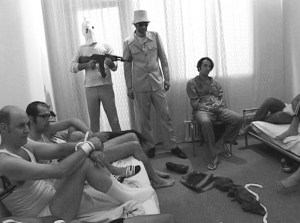
The bleak scene from within the Israeli athletes' apartment in One Day In September

The bleak scene from within the Israeli athletes’ apartment in One Day In September

Macdonald doesn’t do anything particularly radical with the format – the film is made up of archive footage, talking head interviews and digital reconstructions of the final confrontation – but through skilful editing he has you on the edge of your seat throughout.

The film’s major coup was in securing the first known interview with Jamal Al-Gashey, the only surviving member of the terrorist cell who, still in fear for his life from Israel’s national intelligence agency Mossad more than 25 years after the incident, appears on camera wearing a cap and sunglasses and with his face blurred.

The symbolism of an Israeli flag paraded on German soil at the 1972 Munich Olympics in One Day In September

The symbolism of an Israeli flag paraded on German soil at the 1972 Munich Olympics in One Day In September

Al-Gashey speaks to the mood of both his compatriots and the hostages during the crisis and clearly remains proud of what he achieved. Macdonald, however, possibly out of fear of losing his ace in the pack, makes little attempt to gain an understanding of precisely what led to his joining Black September and fails to put him on the spot to more fully explain his actions.

Macdonald has greater success in his other interviews, particularly Walther Tröger, Mayor of the Olympic Village, who was among the first to encounter the terrorists, and General Ulrich Wegener, who rather hangs himself by adopting a somewhat glib attitude towards the tragedy (he founded Germany’s counter-terrorist unit GSG 9 in the wake of the incident).

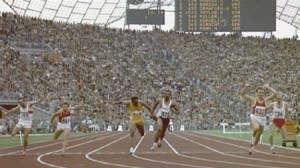
The 1972 Munich Olympics went on in spite of the tragedy unfolding in its back yard

The 1972 Munich Olympics went on in spite of the tragedy unfolding in its back yard

Indeed, the actions on the part of the German authorities seem clueless and Macdonald isn’t afraid to stack the blame on their shoulders. This hapless ineptitude was reinforced when tracksuit-wearing border guards with no experience of handling firearms were drafted in to retrieve the hostages at the athletes’ village, only to have the ill-conceived operation aborted at the last minute because their every move was being reported live on TV and could be seen by the terrorists.

Furthermore, the calamitous rescue attempt at the air base was given little or no chance of success when a group of German police officers waiting to ambush the terrorists voted at the last moment to abandon their mission, while snipers positioned at the air base had no way of communicating with each other.

ABC anchor Jim McKay, whose rolling news provides the commentary for One Day In September

ABC anchor Jim McKay, whose rolling news provides the commentary for One Day In September

ABC anchor Jim McKay, whose rolling news provides a sort of commentary for the film, gave the most fitting and sombre of epitaphs on hearing of the massacre when he said: “When I was a kid my father used to say ‘Our greatest hopes and our worst fears are seldom realized’. Our worst fears have been realized tonight. They have now said there were 11 hostages; two were killed in their rooms yesterday morning, nine were killed at the airport tonight. They’re all gone.”

It wasn’t just the German authorities who came in for flak; there was also anger that the International Olympic Committee decided to continue the Games in spite of the tragedy unfolding in its own back yard and only later bowed to intense international pressure to impose a suspension. The film also shows footage of athletes remarkably – and obscenely – sunning themselves just 200 yards away from where their fellow competitors were being held hostage.

The Olympic Games were forever changed following the tragic events in Munich in September 1972

The Olympic Games were forever changed following the tragic events in Munich in September 1972

It’s details such as this that set One Day In September apart and help to explain why the film won Best Documentary at the 2000 Academy Awards. As well as the exhaustive research that’s clearly gone in, Macdonald is also well served by Michael Douglas’ measured narration.

The film has come under fire, not least of which by the late Roger Ebert, for choosing to accompany a montage of pictures of the victims’ corpses with a rock score (specifically Deep Purple’s Child In Time). The scene would have worked better without music – the images speak for themselves – but in fairness this can probably be put down to the naive decision of a first-time filmmaker.

Despite a few rough edges here and there, One Day In September is a powerful and absorbing experience that grips like a vice and refuses to let go until its shattering climax.