Review – Mission: Impossible – Rogue Nation

In a summer that’s seen a car traverse skyscrapers and a woman in high heels managing to outrun a Tyrannosaurus Rex, the sight of Tom Cruise clinging onto the side of a plane as it takes off should be the most ridiculous of them all.

Finding the right balance of engaging espionage and flat-out action, Mission: Impossible - Rogue Nation is a Cruise missile that really delivers the goods

Finding the right balance of engaging espionage and flat-out action, Mission: Impossible – Rogue Nation is a Cruise missile that really delivers the goods

That Cruise insisted on doing his own stunt speaks to the star’s commitment to a franchise that has outlasted most actor’s entire careers.

John Woo’s dated and misjudged 2000 M:I 2 aside, each of the Mission: Impossible movies has forged its own identity and brought something different to a genre that’s well endowed with memorable figureheads.

Just another day at the office: Tom Cruise plays Ethan Hunt in Mission: Impossible - Rogue Nation

Just another day at the office: Tom Cruise plays Ethan Hunt in Mission: Impossible – Rogue Nation

A big reason for this is because each film is helmed by a different director and in Rogue Nation it’s Christopher McQuarrie’s turn to sit in the big chair. His association with Cruise can be traced back to Valkyrie (2008) and the pair have worked together numerous times since, most recently in 2012’s so-so Jack Reacher (McQuarrie’s previous film as director) and in the underappreciated Edge Of Tomorrow (2014), which McQuarrie wrote.

That partnership bears fruit in M:I 5, which sees Ethan Hunt (Cruise) and his cohort of fellow IMF-ers Benji (Simon Pegg), Luther (Ving Rhames) and Brandt (Jeremy Renner) going up against the Syndicate, a SPECTRE-like terrorist consortium that wants to bring Hunt down almost as much as CIA Director Hunley (Alec Baldwin) does. As Hunt tries to get to the bottom of who and what the Syndicate are, he encounters the mysterious Ilsa Faust (Rebecca Ferguson), an agent seemingly working for both sides.

Kick ass MI6 agent Ilsa Faust (Rebecca Ferguson) in Mission: Impossible - Rogue Nation

Kick ass MI6 agent Ilsa Faust (Rebecca Ferguson) in Mission: Impossible – Rogue Nation

The one area the M:I franchise has struggled with most has been with its villains, so it’s pleasing that in the Syndicate and its nefarious leader (played with psychotic calm by Brit Sean Harris) Hunt finally faces an opponent that is his match.

Where Mission: Impossible has never struggled has been in its set pieces and Rogue Nation delivers some of the best blockbuster action you’ll see all summer. The much-hyped plane dangling sequence would be the climax of most action movies, but here it’s merely the preamble for what’s to come; a rip-roaring adrenaline shot that Bond would be proud of.

Sardonic IMF agent Benji Dunn (Simon Pegg) in Mission: Impossible - Rogue Nation

Sardonic IMF agent Benji Dunn (Simon Pegg) in Mission: Impossible – Rogue Nation

While the prologue has garnered the most attention, the film’s best set pieces take place later in the film, the first and best being a stand out and nail-biting sequence at the Vienna Opera House that invokes Hitchcock’s The Man Who Knew Too Much and is soundtracked to suitably dramatic effect by the performance of Puccini’s Turandot taking place inside the hall. A later sequence involving an underwater break-in a Moroccan power station may not be as strong as the Langley infiltration from Brian De Palma’s 1996 original, but it’s the sort of material the Mission: Impossible franchise does so well.

While his personal belief system may be just this side of loony tunes, it’s hard not to be won over by Cruise the performer and once again he’s up to the task. Quite how long he can kep putting his aging body through the rigors that such a film as this demands is anyone’s guess, but for a guy who’s now settled into his early fifties, he handles himself as well as he did back when the franchise kicked off almost 20 years ago.

IMF-ers Luther Stickell (Ving Rhames) and William Brandt (Jeremy Renner) in Mission: Impossible - Rogue Nation

IMF-ers Luther Stickell (Ving Rhames) and William Brandt (Jeremy Renner) in Mission: Impossible – Rogue Nation

Mission: Impossible should never just be about Ethan Hunt, though and it’s good to see his co-stars getting a fair crack of the whip (Rhames’ Luther aside), most notably Ferguson who gives a star-making turn as an ass-kicking agent who can look after not only herself but Hunt too and has the wherewithal to take off her high heels when serious running is required.

Finding the right balance of engaging espionage and flat-out action, Mission: Impossible – Rogue Nation is a Cruise missile that really delivers the goods.

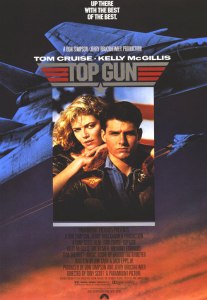
In Retrospect – Top Gun (1986)

Product placement has been prevalent in the movies for decades; however, few can claim to have had their product so ingrained within each frame as the U.S military in Tony Scott’s Top Gun.

In spite of its many flaws, Top Gun remains an adrenalin shot to the stupid, nostalgic part of the brain that should know better

In spite of its many flaws, Top Gun remains an adrenalin shot to the stupid, nostalgic part of the brain that should know better

It’s no surprise the Navy set up recruitment booths in some cinemas showing what must have been a Fleet Admiral’s wet dream and it’s a marketing ploy that paid dividends; the number of impressionable young men wanting to enlist as Naval Aviators after watching the movie soared by 500 per cent – not to mention the boost in sales for aviator sunglasses and bomber jackets.

One scene set in a men’s shower room even has an actual recruitment poster prominently on display; somewhat ridiculous bearing in mind it takes place in Top Gun HQ, wherein everyone already works for Uncle Sam.

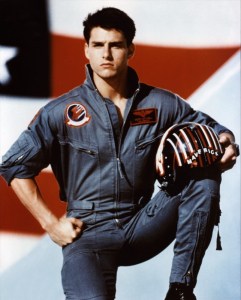
Maverick (Tom Cruise) in full-on flag waving fascist pose in Top Gun

Maverick (Tom Cruise) in full-on flag waving fascist pose in Top Gun

Jumping into bed with the U.S military normally results in a super serious square-jawed circle jerk like Act Of Valor (2012), but Top Gun is so unashamedly over-the-top and, well, 80s it somehow manages to get away with it.

Based on a magazine article, Top Gun promised to be the kind of sky high concept popcorn entertainment that Don Simpson and fellow super-producer Jerry Bruckheimer had already refined with Flashdance (1983) and Beverley Hills Cop (1984).

80s hair! 'Charlie' Blackwood (Kelly McGillis) in Top Gun

80s hair! ‘Charlie’ Blackwood (Kelly McGillis) in Top Gun

With up-and-coming Brit Scott (who would come to exemplify the brand of glossy action cinema so beloved of Simpson and Bruckheimer) at the helm, Top Gun was packaged in much the same way as Beverley Hills Cop – with one eye on the soundtrack sales and the other on the box office.

The film’s central figure is Naval Aviator Lt Pete Mitchell (Tom Cruise), who is  ‘Maverick’ by callsign and maverick by nature; a genius pilot deemed “dangerous” by rival pilot Tom ‘Iceman’ Kazanski (Val Kilmer) because he defies orders and is a lone wolf. Maverick and his partner-in-flying Nick ‘Goose’ Bradshaw (Anthony Edwards) are selected against their commanding officer’s better judgement to attend the Top Gun school to compete against “the best of the best” to see who is number one.

Iceman (Val Kilmer) dominates the beach volleyball arena in Top Gun

Iceman (Val Kilmer) dominates the beach volleyball arena in Top Gun

There he meets Top Gun instructor ‘Charlie’ Blackwood (Kelly McGillis), who succumbs to Maverick’s winning smile and cocky nature. However, after tragedy strikes, a guilt-ridden Maverick must once again find his edge when a crisis situation emerges.

It’s fair to say the script was probably not the important piece of the puzzle when it came to bringing Top Gun to the screen. The film is absolutely rammed with clunky dialogue; be it Jester (Michael Ironside) saying “I don’t know… I just don’t know” when Viper (Tom Skerritt) asks if he’d have Maverick on his side; Stinger (James Tolkan) informing Maverick that “your ego is writing checks your body can’t cash”; and Viper, during a heart-to-heart with Maverick saying “what I’m about to tell you is classified; it could end my career”.

"For the reord, I'm not gay": Maverick (Tom Cruise) and Goose (Anthony Edwards) in Top Gun

“For the record, I’m not gay”: Maverick (Tom Cruise) and Goose (Anthony Edwards) in Top Gun

As you’d imagine of a film whose script was altered at the Navy’s request, Top Gun flies the Stars and Stripes with fascistic gusto. Whilst the old Soviet Union is never named in the film, it’s abundantly obvious the unnamed enemy at the end of the movie is the ‘Evil Empire’ which you’d imagine would make the open warfare that breaks out in the skies a genuinely disturbing diplomatic development; however, it’s brushed under the carpet with a shot of Cruise’s trademark grin.

The movie’s homoeroticism (most famously dissected by Quentin Tarantino in 1994’s Sleep With Me) is comically rampant, from the (in)famous beach volleyball scene (soundtracked by Kenny Loggins’ Playing With The Boys no less), to the shower room confrontations and hilarious dialogue (“This gives me a hard on”/”Don’t tease me”).

There's that smile: Tom Cruise plays Maverick in Top Gun

There’s that smile: Tom Cruise plays Maverick in Top Gun

Dodgy discourse aside, Top Gun‘s money shot remains its excellent aerial sequences and it’s here where the filmmakers’ partnership with the Navy pays off. The odd dodgy special effect aside (Maverick’s inverted encounter with a MIG looks pretty lame), the shots of Tomcat aircraft leaving an aircraft carrier are still awesome, while the dogfighting sequences involving multiple planes are among the best since Howard Hughes’ Hell’s Angels (1930).

In spite of its many flaws, Top Gun remains an adrenalin shot to the stupid, nostalgic part of the brain that should know better.

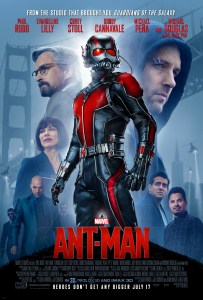
Review – Ant-Man

The smallest superhero on the block finally crawls onto the big screen – but is it an import-ant addition to the Marvel Cinematic Universe or just p-ants?

There's enough potential here for a fun and unpretentious franchise; Ant-Man proves that good things can come in small packages

There’s enough potential here for a fun and unpretentious franchise; Ant-Man proves that good things can come in small packages

The knives were being sharpened by many for Marvel’s latest when Edgar Wright, who had been attached to the project before The Avengers was a glimmer in head honcho Kevin Feige’s eye, left the project due to reported ‘creative differences’ and garnered plenty of sympathy in the process.

As is Marvel’s wont, the studio again went against convention by hiring the little known Peyton Reed, whose biggest hit until now had been the forgettable Jim Carrey vehicle Yes Man (2008) (he also helmed 2006’s The Break-Up; another one of Vince Vaughn’s painful ‘comedies’).

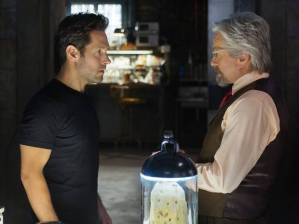
The Ant-Man mantle is passed from Hank Pym (Michael Douglas) to Scott Lang (Paul Rudd) in Ant-Man

The Ant-Man mantle is passed from Hank Pym (Michael Douglas) to Scott Lang (Paul Rudd) in Ant-Man

Bearing in mind the tight schedule Reed inherited to meet the film’s summer release date – as well as the fact its star Paul Rudd and Anchorman‘s Adam McKay weighed in on Wright and Joe Cornish’s initial script – it’s pleasantly surprising how well Ant-Man holds up.

The story itself is relatively lean. Newly released prisoner Scott Lang (Rudd) finds himself unwittingly recruited by former S.H.I.E.L.D super-scientist Hank Pym (Michael Douglas) to inherit the mantle of  the Ant-Man. Lang dons the suit and is trained by Pym and his estranged daughter Hope van Dyne (Evangeline Lilly) to properly use the powers inherent in the Ant-Man suit in order to stop Pym’s former protégé Darren Cross (Corey Stoll) from perfecting his own miniaturizing suit – the Yellowjacket – and using it to revolutionise warfare.

Nice bob: Hope van Dyne (Evangeline Lilly) in Ant-Man

Nice bob: Hope van Dyne (Evangeline Lilly) in Ant-Man

After the excessive bombast of Avengers: Age Of Ultron, it’s refreshing to watch a Marvel movie that manages to avoid its now familiar epic final act with something that, logically in this case, is much smaller in scale. Instead of duking it out on a giant airship or throwing a nondescript foreign city up in the air, Ant-Man‘s final battle takes place in the far more modest surroundings of a suburban house (involving a genuinely inventive and amusing train sequence).

The film also manages maintain a light and breezy tone in spite of the studio’s usual shenanigans; poking fun at the concept of a man being able to zap himself down to the size of an insect whilst avoiding the pitfall of descending into lame farce.

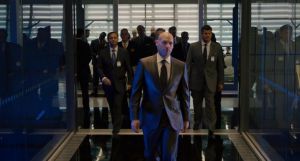
Can you guess which one is dodgy Darren Cross (Corey Stoll) in Ant-Man

Can you guess which one is dodgy Darren Cross (Corey Stoll) in Ant-Man

The casting of Rudd certainly signalled the direction the studio was going in for Ant-Man, although the transition from comic actor (with the occasional dramatic role) to superhero was never going to be a given and it’s to Rudd’s credit that he just about sells the action alongside the comedy.

This knowing self-deprecation comes to the fore when Lang comes up against an Avenger and can’t help apologising to his opponent when he somehow manages to get the better of him.

Scott Lang (Paul Rudd) dons the superhero suit in Ant-Man

Scott Lang (Paul Rudd) dons the superhero suit in Ant-Man

He’s lent great support from the ever-versatile Michael Peña, who plays Lang’s former cellmate and is part of the crew who gets dragged into the plan to steal the Yellowjacket. Peña’s comic timing is first-rate, while his character’s decision to save a security guard he knocked out earlier is a nice touch.

Douglas is given the heavy lifting script-wise with exposition-aplenty, but if there’s one actor you can rely on to deliver reams of dialogue with effortless charisma it’s Mr Gordon Gekko. Douglas’ presence adds heft to what is ultimately a light and frothy blockbuster and his scenes with Rudd are among the film’s highlights.

Luis (Michael Peña), Dave (Tip "T.I." Harris) and Kurt (David Dastmalchian) plan their next job in Ant-Man

Luis (Michael Peña), Dave (Tip “T.I.” Harris) and Kurt (David Dastmalchian) plan their next job in Ant-Man

Lilly, on the other hand, struggles to make much of the movie’s sole female part. Sporting a harsh black bobbed haircut which lazily exemplifies her cool exterior, Hope is clearly far more qualified than Lang to don the Ant-(Wo)Man suit, but is instead there to merely roll her eyes and serve the plot. Pity.

It will be interesting to see how the Ant-Man fits into the rest of the Marvel Cinematic Universe as it moves into its latest globe-swallowing phase. There’s enough potential here for a fun and unpretentious franchise; Ant-Man proves that good things can come in small packages.

Review – Terminator Genisys

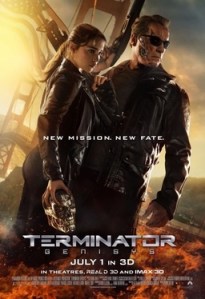
He said he’d be back, and sure enough Arnold Schwarzenegger returns to the franchise that made his name for this convoluted and confounding exercise in everything-and-the-kitchen-sink filmmaking.

This is the start of a supposed trilogy - on the basis of Terminator Genisys, Judgement Day can't come soon enough

This is the start of a supposed trilogy – on the basis of Terminator Genisys, Judgement Day can’t come soon enough

James Cameron may not be everyone’s favourite director, but in The Terminator (1984) and its game-changing sequel Terminator 2: Judgment Day (1991) he kept the narratives straightforward, the characters interesting and the action eye-popping.

Cameron was smart enough to avoid getting bogged down by the head-scratching ins and outs of time travel; instead using it as a device to drive the action rather than the other way around.

I'll be back...again: 'Pops' (Arnold Schwarzenegger) in Terminator Genisys

I’ll be back…again: ‘Pops’ (Arnold Schwarzenegger) in Terminator Genisys

Alas, the same cannot be said of Terminator Genisys, which ignores the events of Rise Of The Machines (2003) and Terminator Salvation (2009) – no bad thing – and instead tries to have its cake and eat it by invoking Cameron’s first two installments whilst rebooting the franchise.

It’s a tactic that is becoming increasingly popular in Hollywood following the success of J.J. Abrams’ Star Trek (2009), which cleverly took the Trek franchise down an alternate timeline whilst still keeping everything that made the series so successful in the first place.

John Connor (Jason Clarke) and Kyle Reese (Jai Courtney) take the war to the machines in Terminator Genisys

John Connor (Jason Clarke) and Kyle Reese (Jai Courtney) take the war to the machines in Terminator Genisys

Here, director Alan Taylor (Thor: The Dark World) faced an uphill task from the word go, working from a nonsensical script by Shutter Island scribe Laeta Kalogridis and Patrick Lussier, whose most recent credit is, er, Drive Angry, and delivering a movie that has the whiff of studio interference all over it.

The messy trailers didn’t exactly sell the film and a later trailer (not the one I’ve linked to in my review) stupidly gave away a crucial plot twist – a sign that usually signals a studio’s lack of belief in a product.

Genisys follows resistance fighter Kyle Reese (Jai Courtney), who is sent from a 2029 ravaged by Skynet’s apocalyptic destruction back to 1984 by leader John Connor (Jason Clarke) to protect his mother Sarah (Emilia Clarke – no relation) from a Terminator, or Terminators as it turns out. However, Kyle gets a shock when it emerges that Sarah isn’t the defenceless waitress he’s been expecting, but rather a kick-ass soldier who has been protected from childhood by a reprogrammed T-800 model Terminator (Schwarzenegger).

Hanging out: Sarah Connor (Emilia Clarke) and Kyle Reese (Jai Courtney) in Terminator Genisys

Hanging out: Sarah Connor (Emilia Clarke) and Kyle Reese (Jai Courtney) in Terminator Genisys

That just about covers the first 20-30 minutes, which actually promises much before the shark gets truly jumped over and the time travel-laden plot goes off the deep end.

The method behind Skynet’s ploy to achieve world domination is at least relevant to the digital age, but by treading over Cameron’s original the film ties itself up in a ridiculous amount of plot threads to get to where it needs to; with lazy waffle about time nexuses and dual realities served up as creaky bridging points to keep the whole thing from crashing and burning (and failing in the process).

Whilst the script goes off in a multitude of head-scratching tangents, the film attempts to divert the audience’s attention away from picking black hole-sized holes in the plot (who sent Arnie back to protect a young Sarah? Actually, who cares) by piling in action set piece after action set piece. Machines that Cameron’s movies built up to be near unstoppable killers are disposed of with relative ease early doors to make way for the central villain, whose identity is the film’s supposed ace card but only serves to undermine the first two, far superior, installments.

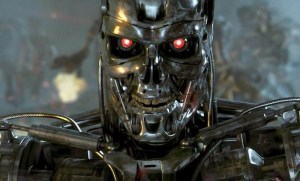
Can you guess which Terminator this is? Nope, neither can I.

Can you guess which Terminator this is? Nope, neither can I.

Arnie is clearly having a good time as everyone’s favourite cyborg. Although the explanation for an ageing Terminator isn’t entirely convincing, it does allow him to point out to all the haters that he is “old, not obsolete”. Emilia Clarke is given a rather thankless task in an underwritten role and the chemistry she shares with a very average Courtney is, at best, tepid.

Jason Clarke, meanwhile, looks like he’s treading water waiting for the next Apes picture, while JK Simmons gets to loosen up in a fun role as a police officer who’s lucky to be alive and Matt Smith, like so many others, gets virtually nothing to do.

This is the start of a supposed trilogy – on the basis of Terminator Genisys, Judgement Day can’t come soon enough.

Review – Inside Out

Pixar’s sublime return to form may be set almost entirely within someone’s head, but it’s the heart this beautifully realised love letter to the highs and lows of growing up really speaks to.

Inside Out - Welcome back Pixar, we've missed you.

Inside Out – Welcome back Pixar, we’ve missed you.

After falling short with the diminished artistic returns of sequels Cars 2 (2011) and Monsters University (2013), there was a fear that laziness had set in at Pixar and the stratospheric heights of The Incredibles (2004) and WALL-E (2008) were no longer being reached for.

Pete Docter clearly had other ideas, however, and with Inside Out has delivered the best original Pixar feature since Up (2009), ironically also helmed by the same director.

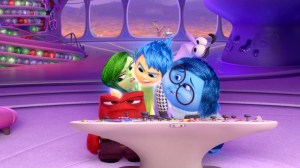
It's going to get emotional: Joy (Amy Poehler) and Sadness (Phyllis Smith) in Inside Out

It’s going to get emotional: Joy (Amy Poehler) and Sadness (Phyllis Smith) in Inside Out

Docter clearly understands the golden rule of animation – don’t talk down to the kids. Ever since Disney had the balls to (spoiler alert) kill off Bambi’s mum way back in 1942, the most timeless animated movies have been the ones that treat their audience, young or old, with the respect they deserve.

Monsters, Inc (2001), Docter’s first film, declared that being scared was a good thing and all part of growing up, while Up dealt with issues of loss and loneliness, most notably in the heartbreaking opening reel. Crucially, both films speak to adults and children in their own way, and not just by throwing in a bit of innuendo or cheap gags to please the mums and dads.

The same can be said of Inside Out, which may follow the familiar Pixar formula of having two disparate characters thrown together and forming a bond through a shared jeopardy, but does so in a beautifully engaging fashion.

Riley's (Kaitlyn Dias) not happy with mum and dad (Diane Lane and Kyle MacLachlan) in Inside Out

Riley’s (Kaitlyn Dias) not happy with mum and dad (Diane Lane and Kyle MacLachlan) in Inside Out

Riley (Kaitlyn Dias) is a happy young girl whose life is thrown upside down when she moves with her mum (Diane Lane) and dad (Kyle MacLachlan) from the only home and friends she’s ever known to a new life in San Francisco.

Riley is led by her emotions – Joy (Amy Poehler), Sadness (Phyllis Smith), Anger (Lewis Black), Fear (Bill Hader) and Disgust (Mindy Kaling) – who operate out of Headquarters. But when an unfortunate incident leaves Joy and Sadness stranded elsewhere in Riley’s mind, her life is thrown into turmoil as her other emotions work out what to do whilst Joy and Sadness try to find a way home.

Films set inside a person’s body aren’t unique – Woody Allen’s Everything You Always Wanted to Know About Sex* (*But Were Afraid To Ask) (1972) famously featured a sequence that explored what happens during ejaculation, whilst Fantastic Voyage (1966) and Innerspace (1987) were more action-packed – but what sets Inside Out apart is its sheer inventiveness.

You're in my head! oy (Amy Poehler), Sadness (Phyllis Smith), Anger (Lewis Black), Mindy Kaling (Disgust) and Fear (Bill Hader) in Inside Out

You’re in my head! oy (Amy Poehler), Sadness (Phyllis Smith), Anger (Lewis Black), Mindy Kaling (Disgust) and Fear (Bill Hader) in Inside Out

Joy and Sadness’ trip through Riley’s head is wonderfully realised, with giant banks of marble-shaped memories and grand islands that define her personality (family, friendship hockey) that start to crumble as emotional tumult grips the young girl.

Their journey back to Headquarters (which includes an inspired and tripy Pablo Picasso-esque excursion through Riley’s Abstract Thoughts) is assisted by the colourful Bing Bong (Richard Kind), Riley’s childhood imaginary friend who has been forgotten over time. Bing Bong’s gradual acceptance that Riley has moved on and his time has been and gone culminates in a scene that manages to be both heart-warming and heartbreaking all at once.

This understanding is also shared by Joy, whose single-minded belief that happiness alone is enough to define someone slowly gives way to the recognition that Sadness can play just as important a part in determining who we are.

Family time for Riley (Kaitlyn Dias) and her mum and dad (Diane Lane and Kyle MacLachlan) in Inside Out

Family time for Riley (Kaitlyn Dias) and her mum and dad (Diane Lane and Kyle MacLachlan) in Inside Out

Just as in 2014’s Boyhood, Inside Out speaks to what it’s like for all of us to grow up. Like Mason Jr. in Richard Linklater’s masterpiece, Riley is pulled out of the life she knew and struggles to fully understand the emotional impact it has.

In one hilarious scene set around the dinner table, we’re shown a family argument through the perspective of Riley’s and her folks’ emotions. Tellingly, the predominant emotion in Riley’s mum’s life is Sadness, whilst for her dad it is Anger (a cut scene inside the father’s head with his emotions enjoying watching a game of football instead of listening to the dinner chat is especially funny).

Inside Out is a rarity in cinema; a film that not only speaks to children going through the trials of growing up, but also to the parents who are doing their best, but may sometimes struggle to remember what it was like to be 11. Welcome back Pixar, we’ve missed you.