Review – The Paperboy

There’s a moment in the seedy, southern-fried gothic noir The Paperboy when Nicole Kidman urinates on Zac Efron to relieve his character’s painful jellyfish stings.

Lee Daniels' The Paperboy - "you're left scratching your head wondering whether it was all worth the bother"

Lee Daniels’ The Paperboy – “you’re left scratching your head wondering whether it was all worth the bother”

It’s a bizarre scene in a frankly head spinning film that comes across as a jubilant two-finger salute by its director Lee Daniels.

Measured alongside his previous film, 2009’s Precious (which earned him a Best Director Oscar nomination), it’s fair to say Daniels has something of the bull in a china shop approach about him and a keen eye for a headline-grabbing project.

Nicole Kidman as the vampish "oversexed Barbie doll" Charlotte Bless in The Paperboy

Nicole Kidman as the vampish “over sexed Barbie doll” Charlotte Bless in The Paperboy

Based on Pete Dexter’s novel, The Paperboy exudes a clammy, twisted luridness that would have had Tennessee Williams choking on his iced tea and a roll call of characters that make the buck-toothed Hillbillies of Deliverance look like boy scouts.

Ostensibly, it deals with investigative reporter Ward Jansen (Matthew McConaughey) returning to his Florida hometown with partner Yardley Acheman (David Oyelowo) in tow to try to prove death row convict Hilary Van Wetter innocent (John Cusack) of the local sheriff’s murder. Ward has been coaxed into it by vampish “over sexed Barbie doll” Charlotte Bliss (Kidman), a green mile groupie who’s formed a bond with Van Wetter, and teams up with his younger brother Jack (Efron) to drudge through the murky swamp waters of the case.
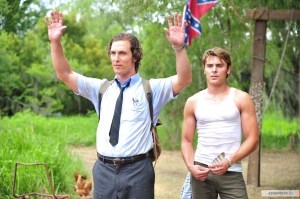
Reporter Ward Jansen (Matthew McConaughey) and his brother Jack (Zac Efron) in The Paperboy

Reporter Ward Jansen (Matthew McConaughey) and his brother Jack (Zac Efron) in The Paperboy

However, what starts out as a straightforward enough crime drama very swiftly gets churned up in the film’s wild vortex as its uncomfortable events play out.

While much of the attention and hoo-ha has been directed at the urination scene, there’s plenty else to get more innocent viewers squirming in their seats, including a ludicrously trashy moment when Bliss mimes a sex act for Van Wetter during visiting hours in front of a dumbfounded Ward, Jack and Acheman. It’s so ridiculous – and so sleazily filmed by Daniels – that you end up chuckling at the sheer brazenness of what you’re watching.

Redneck death row inmate Hillary Van Wetter (John Cusack) in The Paperboy

Redneck death row inmate Hillary Van Wetter (John Cusack) in The Paperboy

The film is narrated by the Jansens’ housemaid Anita (singer Macy Gray), who can barely disguise the contempt she has for her racist employers. She clearly feels protective toward Jack, however, and Daniels emphasises this when a sex scene involving him is cut short when she suggests “I think you’ve seen enough”.

A few exceptions aside (there’s something off about Gray’s performance in particular), a starry cast work their socks off. In her most outlandish role to date, Kidman somehow keeps a straight face throughout, a feat unto itself bearing in mind what’s expected of her.

Yardley Acheman (David Oyelowo), Charlotte Bless (Nicole Kidman) and Jack Jansen (Zac Efron) in The Paperboy

Yardley Acheman (David Oyelowo), Charlotte Bless (Nicole Kidman) and Jack Jansen (Zac Efron) in The Paperboy

Cusack has a great time chewing the scenery and playing against type as the reddest of rednecks, while Efron is a million miles from his High School Musical days (and all the better for it) and McConaughey continues the ‘McConassance’ (not my pun mores the pity) he’s been enjoying of late in such fare as The Lincoln Lawyer, Magic Mike and Killer Joe.

Set in the 1960s, the film uses a grainy lens and many of the visual tricks adopted at the time to give the film a suitably authentic look. At its best, The Paperboy brings to mind the twisted lunacy of Scorsese’s remake of Cape Fear and the woozy, hallucinatory nature of Night Of The Hunter, but in choosing to turn the dial up to 11 Daniels ends up losing the plot as the narrative gets sucked into the swamp and the whole endeavour takes leave of its senses.

There are many things to admire about The Paperboy, not least of which its sheer weirdness, but what in the hands of a David Lynch or Luis Buñuel could have been a real strength ends up here being the film’s most damaging weakness as you’re left scratching your head wondering whether it was all worth the bother.

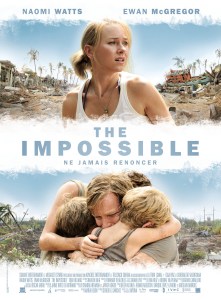
Review – The Impossible

Natural disasters are invariably so enormous in their scale the only way to avoid them becoming too overwhelming on screen is to chronicle the unfolding tragedy through the eyes of a small group of people.

The Impossible

“There are powerful moments, but too few and far between to elevate The Impossible into the awards contender is clearly aims to be”

The Indian Ocean earthquake and resulting tsunami that struck on Boxing Day in 2004 claimed the lives of more than 230,000 people, many of them in south-east Asia.

The scale of the catastrophe boggles the mind, so much so that Juan Antonio Bayona’s The Impossible seeks to narrow its focus by having the desperate plight of one stricken family symbolise the horror and anguish of those fateful days.

This isn’t the first film to deal with the tsunami; the HBO miniseries Tsunami: The Aftermath was screened less than two years after the tragedy. In spite of winning a cabinet full of awards, it drew criticism for leaning too heavily on the stories of white victims at the expense of the native population.

Young Lucas (Tom Holland) fights to save his stricken mother’s (Naomi Watts) life in The Impossible

A similar charge has also been levelled at The Impossible, which exclusively follows the Bennett’s – Henry (Ewan McGregor) and Maria (Naomi Watts) and their three sons, teenager Lucas (Tom Holland), middle child Tomas (Samuel Joslin) and youngest Simon (Oaklee Pendergast) – a white English-speaking family who are on holiday in Khao Lak, Thailand when the wave hits.

You know what’s coming, which makes the opening scenes of peaceful tranquility and tropical beauty all the more suspenseful. Although you’re left in no doubt this is a story of survival and the tenacity of the human spirit in the face of overwhelming odds, The Impossible will inevitably be judged by its audience for the way the tsunami itself is portrayed on screen.

The Impossible

Henry (Ewan McGregor) with his sons Tomas (Samuel Joslin) and Simon (Oaklee Pendergast) in The Impossible

In this, Bayona pulls out all the stops. Just as Steven Spielberg leaves you shell-shocked with his opening D-Day landing sequence in Saving Private Ryan, so too does Bayona, who pounds you into submission by showing the full, awesome power of nature as the tsunami tears through the resort, scoops up those in its path and tosses them around in the torrent of water like rag dolls before finally subsiding.

The Impossible

The terrifying moment the tsunami strikes in The Impossible

It’s a terrifying, dizzying sequence that serves as the launchpad for the rest of the movie as a badly injured Maria and determined Lucas must rely on the selfless generosity of the Thai people to get them to safety, while Henry, with Tomas and Simon in tow, begins a desperate search to reunite his family.

The problem with The Impossible is that the devastating impact of the tsunami is so powerfully depicted it proves impossible for the remainder of the film to match what has gone before (akin to Saving Private Ryan). Much of the blame for this must be levelled at Sergio G. Sánchez’s script, which falls back on heavy-handed symbolism and, in its closing minutes resorts to ham-fisted melodrama that’s as unnecessary as it is manipulative.

The Impossible

Mother and son Maria (Naomi Watts) and Lucas (Tom Holland) cling on for dear life in The Impossible

It’s a pity as the cast are largely superb. Holland is a real discovery and shows a maturity well beyond his years in his portrayal of the resourceful son who goes through hell and (literal) high water to help save his mum. McGregor gives his best performance for years as a father and husband wracked with guilt and fear at the thought of losing his wife and family.

The Impossible

A moment of peaceful tranquility before the family’s world is turn asunder in The Impossible

Bayona leans on Watts to deliver much of the emotional payoff and she doesn’t let her director down. It’s a draining performance, both physically and psychologically as we see Maria fighting to survive for the sake of her family. Bayona made his name as a horror director in the excellent Spanish-language The Orphanage and he brings that same sensibility to the moment when an exhausted, ailing Maria experiences the sting in the tsunami’s tail.

Although based on the experiences of a Spanish family, Bayona has come under fire for making them English-speaking. Setting aside the director’s rather unconvincing explanation that he chose not to specify their nationality in order to make The Impossible as universal as possible (it’s pretty obvious they’re supposed to be British), the fact they aren’t Spanish doesn’t detract from the story the film is telling.

There are powerful moments (the telephone call made by Henry to a relative back home is gut-wrenchingly played by McGregor), but too few and far between to elevate The Impossible into the awards contender is clearly aims to be.

Review – Life Of Pi

Digital effects have come a long way since Yann Martel’s adored novel Life of Pi was first published in 2001, without which director Ang Lee’s efforts to bring this supposedly unfilmable book to the big screen would have been scattered on the rocks.

Ang Lee's Life of Pi

Ang Lee’s Life of Pi – far from a shipwreck which, for an ‘unfilmable’ tale is no small achievement

It’s an achievement in itself by David Magee to turn Martel’s prose into a screenplay and Lee, in his first film since the passable Taking Woodstock (2009) deserves a lot of credit for realising on screen the many wonders Pi (Suraj Sharma) witnesses during his epic journey.

Certainly in the past, many effects-laden films have sacrificed the things which should come first – a good script and good performances – for the sake of an attention-grabbing shot or action sequence. Lee for his part seems to have learned a thing or two about finding the right balance since falling into that trap with the disengaging Hulk in 2003.

The biggest challenge facing Lee was to give us a convincing Richard Parker, a Bengal tiger that, like the titular Pi, finds itself on a Japanese cargo ship on its way across the Pacific to start a new life in Canada.

Pi (Suraj Sharma) braves the storm in Life of Pi

Pi (Suraj Sharma) braves the storm in Life of Pi

Except neither the teenage Pi nor Richard Parker have any say in this. Piscine Militor Patel, or Pi as he prefers to be known after being given the unwanted nickname ‘Pissing’ Patel at school is happy living in the zoo his family owns in Pondicherry, India. Seeking a new life for them all, his father closes the zoo and books passage on a ship for both his family and animals, which will be sold abroad.

In a scene both vivid and distressing, the ship sinks after getting caught in a terrible storm. Pi is the only human to make it off the vessel alive, but finds he isn’t alone in the small lifeboat; he’s joined on board by a zebra, a hyena, an orangutan – and Richard Parker.

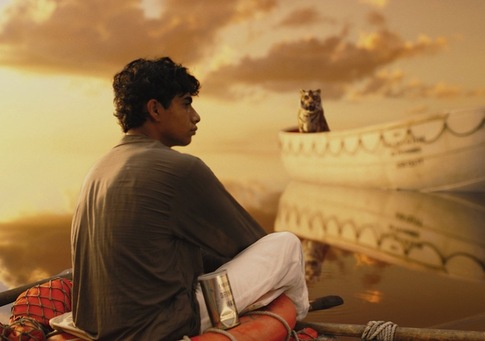
Pi (Suraj Sharma) adrift at sea with tiger Richard Parker in Life of Pi

Pi (Suraj Sharma) adrift at sea with tiger Richard Parker in Life of Pi

The storm is a stark reminder for the stricken Pi of nature at its most untamed and recalls an earlier scene when a younger Pi tries to feed Richard Parker and is chided by his father, who shows him that “a tiger is not your friend” by making him watch it kill a goat. Stuck in the lifeboat, he is given a further unpleasant reminder when he witnesses the law of the wild inevitably taking effect. After watching this, the knock-about opening credits which playfully show the zoo animals going about their daily business take on a rather different light.

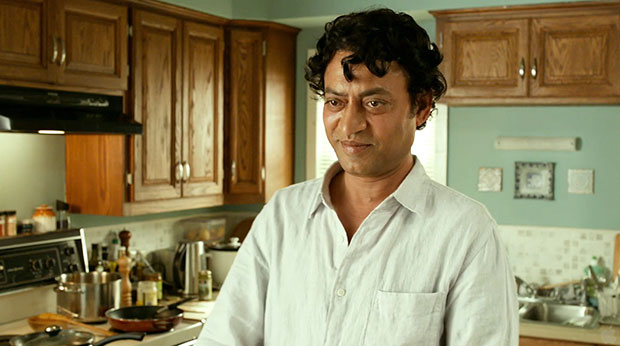
The adult Pi (Irrfan Khan) tells his incredible story in Life of Pi

The adult Pi (Irrfan Khan) tells his incredible story in Life of Pi

The teenager names the boat ‘Pi’s Ark’, one of many religious and spiritual references in the film. Pi is shown as a young boy embracing Christianity, Hinduism and Islam, much to the annoyance of his scientifically-minded father, and the extraordinary quest on which he embarks with Richard Parker aboard the boat is as much about spiritual self-discovery as it is about survival.

One of many extraordinary encounters Pi has while lost at sea in Life of Pi

One of many extraordinary encounters Pi has while lost at sea in Life of Pi

It’s when the boat is adrift at sea that the digital light show really takes over. In spite of falling back on the requisite ‘poke things at the screen’ trick to justify the use of 3D, Lee and his digital effects team conjure up myriad striking images. These range from the beautiful (the boat sat on perfectly still, glassy water) to the wonderfully bizarre (the moment hundreds of flying fish thunder by the boat is one of the film’s most memorable scenes).

The encounters Pi has are both frightening and fantastical – a belly flop from the biggest whale you’ve ever seen and the weirdest island (shaped like a woman) this side of Lost. They also speak to a key theme of Life of Pi, the power of faith. The adult Pi (played by Irrfan Khan) relates his story to a writer (Rafe Spall) devoid of ideas for a new book and bestows it on him to do with it as he pleases (“the story’s yours now”).

Setting aside all the remarkable computer work, Lee’s film works best as a simple buddy story between a teenager and a tiger. Although no masterpiece, Life of Pi is far from being a shipwreck and for an ‘unfilmable’ tale that’s an achievement in itself.

Review – Lincoln

There’s a moment at the start of Lincoln when you fear Steven Spielberg isn’t going to be able to resist going all Amistad on us and clubbing you over the head with the film’s message.

Steven Spielberg's Lincoln

Steven Spielberg’s Lincoln

The scene is thus: following a brief prologue of Civil War carnage involving black and white soldiers (proving that everyone is equal on the battlefield), a black union soldier respectfully gibes the President about inequality. Two white unionists approach separately and in worshipful tones quote Lincoln’s Gettysburg Address (“Four score and seven years ago…”) back to him, but stumble over the final words, leaving it to the African-American trooper to complete the recital before rejoining his company.

On the face of it, this opening four minutes or so brings to mind the sort of heavy-handed approach Spielberg has so often been guilty of in his historical epics. Yet, delve a little deeper and it becomes apparent Tony Kushner’s script and Spielberg’s direction are very cleverly revealing two contrasting perceptions of Lincoln; on one side is the saintly Honest Abe figure common to school textbooks, on the other the crafty politician with a gift for oratory who nevertheless knows that deeds, not words are what’s needed.

Lincoln focuses tightly on the final four months of the Republican president’s life, centring on the politicking and increasingly frantic horse-trading that took place in the darkened corridors of power in early 1865 to secure passage through the House of Representatives of the crucial 13th Amendment to the US Constitution to formally abolish slavery.

Lincoln

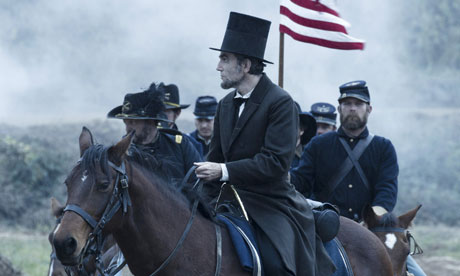
Honest Abe (Daniel Day-Lewis) mournfully surveys the battlefield in Lincoln

With the Civil War in its final death throes, time is of the essence for Lincoln, who is worried his 1863 Emancipation Proclamation decreeing that all slaves be freed will be thrown out by the courts once the war is over and the 13th Amendment defeated by the returning slave states of the south. Warned not to do it by those closest to him for fear of tarnishing his revered reputation, the President realises the opportunity could be lost and leans heavily on his colleagues to help him get the vote through.

Needing a two-thirds majority in the House, Lincoln and Secretary of State William Seward (David Straithairn) send lobbyists William Bilbo (James Spader), Robert Latham (John Hawkes) and Richard Schell (Tim Blake Nelson) out to procure the crucial votes of on-the-fence Democrats by any means necessary.

Tommy Lee Jones as fiery Republican Congessional leader Thaddeus Stevens in Lincoln

Tommy Lee Jones as fiery Republican Congressional leader Thaddeus Stevens in Lincoln

Three distinct threads run through the film – the war of words in the House between Democrats and Republican congressmen enjoying the sound of their own voice, the behind-the-scenes machinations, and the strain on Lincoln’s marriage to First Lady Mary Lincoln (Sally Field) – and it’s to Spielberg’s great credit that we never lose focus of any of them.

Kushner’s witty script is necessarily talky, and it pays not to lose attention, but the enormity of the stakes is always clear and the dialogue positively crackles in the hands of probably the greatest cast assembled for any Spielberg film to date.

Tommy Lee Jones, in his best role for years, has a ball as Republican Congressional leader Thaddeus Stevens, a radical anti-slavery advocate who can’t stop himself insulting Democratic leaders for sport, but knows when to keep his cards close to his chest when the need arises.

There’s a levity to the efforts of the lobbyists to curry the Democrats’ favour, although the grave seriousness of their task is not lost, and the vote itself is expertly handled by Spielberg, who ratchets up the tension like the old pro he is.

Daniel Day Lewis as Honest Abe in Lincoln

Daniel Day Lewis as Honest Abe in Lincoln

The ideologically led politics of Lincoln serves as a timely parallel to the entrenched state of today’s American party political system where petty in-fighting and belligerence can often push progress to the sidelines.

It seems appropriate that America’s most beloved President is played by arguably today’s greatest living actor and Daniel Day-Lewis is stupendous in the title role. He plays Lincoln as a kindly uncle who chooses to win people over with an amusing anecdote or a subtle observation and, ever the politician, engages in a lot of hand holding.

First Lady Mary Lincoln (Sally Field) in Lincoln

First Lady Mary Lincoln (Sally Field) in Lincoln

Day-Lewis makes it look effortless, finding a pause here or a change of tone there to give what will probably become the definitive take on this most adored of presidents. It’s a masterclass in the power of knowing when to underplay a role, to the extent that when some of the cast look in awe of the President you wonder whether it’s actually Day-Lewis they are marvelling at.

We see a more vulnerable Lincoln when he shares private moments with Mary, who has fallen apart following the death of their son and begs her husband to stop their other sibling Robert (Joseph Gordon-Levitt) from joining the war effort. Their pained arguments are powerfully wrought, and Field is excellent as a figure who, like Abe, must compartmentalise personal grief for the good of the country.

Despite this being Spielberg’s most mature and discliplined work to date, he still can’t help himself on occasion, whether it be the rather obvious symbolism of a ticking clock and Lincoln glancing at his watch to show how time is running out, or the saccharine moment when the President walks to a window bathed in light upon hearing the vote has been passed.

Bringing to life a significant moment in the turbulent history of the world’s only superpower, who’d have thought a film where little happens for long periods could be this engrossing?

Review – Les Misérables

The most exhilarating rollercoasters are the ones that feel like they’re about to go off the rails at any second and come crashing to the ground.

Les Misérables movie poster

Tom Hooper’s Les Misérables – “an epic spectacle on such a grandiose scale as to leave you exhausted”

An experience not too dissimilar is had sitting through Tom Hooper’s unashamedly grandiose and wholly cinematic version of the enormously popular and reverred stage musical (itself based on Victor Hugo’s 1862 novel) that begins in 1815 and culminates in the 1832 June rebellion in Paris.

Hooper certainly had his work cut out for him, if for no other reason than to deal with the pressure of meeting the heady expectations of countless thousands of theatregoers who have adored the musical since its premiere in 1985.

Despite working with a far larger canvas than he’s previously been used after The Damned United and The King’s Speech, Hooper has taken the decision not to play safe with the material and to go for it instead. It’s a brave approach and one that is vindicated throughout the film’s 158 engrossing minutes.

From the first scene, the camera (with the assistance of CGI) emerges from the sea and glides over a storm-ravaged ship before coming to rest (momentarily) on the soon-to-be ex-convict Jean Valjean (Hugh Jackman), part of a chain gang being forced to pull the vessel into dry dock. The camera then propels away to prison guard-turned policeman Javert (Russell Crowe), who makes it his life’s mission to hunt down Valjean after the former prisoner breaks parole.

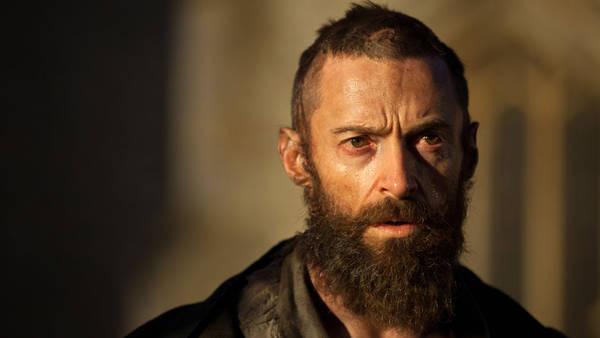
Jean Valjean (Hugh Jackman) searches for redemption in Les Misérables

Jean Valjean (Hugh Jackman) searches for redemption in Les Misérables

These first moments set the tone for what is to follow. This is no staid or stagey adaptation; Hooper wants you to know you’re watching a movie.

Just as the director seems to love attaching his camera to a bungy cord, so too does he delight in using that other device not available to a theatre production – the close up. When a scene calls for a confrontation or a big display of emotion, Hooper gets in tight, refusing to let go until every last drop of despair, grief, elation or anger is wrung out.

The angelic Fantine (Anne Hathaway) in Les Misérables

The angelic Fantine (Anne Hathaway) in Les Misérables

This is most affectingly handled in the scenes with factory worker Fantine (Anne Hathaway), who’s thrown on the street after she’s discovered sending money to her illegitimate daughter Cosette and desperately turns to prostitution to support her child. As Hathaway sings I Dreamed A Dream, Hooper locks the camera in close on her anguished, emaciated face in one continuous, bravura take.

The centrepiece of the film, it’s Hathaway’s Oscar-bait moment and she nails it. She gives it absolutely everything and delivers a shattering, show-stopping performance that runs the gamut from quiet grief to dead-eyed resignation that breaks the heart. If her delivery of the line “Life has killed the dream I dreamed” doesn’t have you welling up, nothing will.

There’s often a dishonesty in musicals as the vocals we hear are actually recorded in post-production. This may result in a cleaner sound, but the performances can lose their authenticity. Another brave move Hooper made was to have his cast sing  live on set, a decision that pays off handsomely and helps to draw out raw and believable turns from his fantastic ensemble. When the cast perform Do You Hear The People Sing?, in this instance you really can.

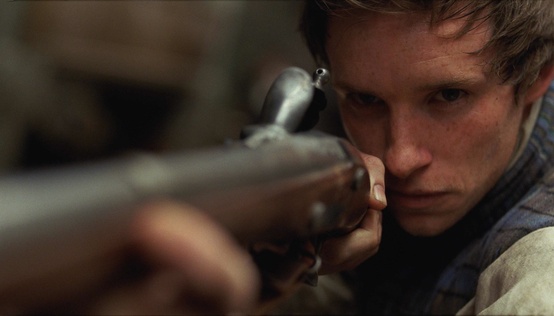
Idealistic revolutionary Marius (Eddie Redmayne) in Les Misérables

Idealistic revolutionary Marius (Eddie Redmayne) in Les Misérables

Previously best known for looking angry and chewing on a cigar as Wolverine, Jackman gives the performance of a lifetime as Valjean, who takes Cosette (Amanda Seyfried) into his care away from the unscrupulous Thénardiers (Sacha Baron Cohen and Helena Bonham Carter) and raises her as his own as a promise to Fantine – an act borne out of kindness and a quest for redemption.

Jackman’s experience in musical theatre is brought to bear, most prominently during his hugely impressive solo numbers Valjean’s Soliloquy, Bring Him Home and Suddenly. He’s matched by the brilliant Hathaway, whose selfless, tragic Fantine is so angelic as to give Mother Teresa a run for her money.

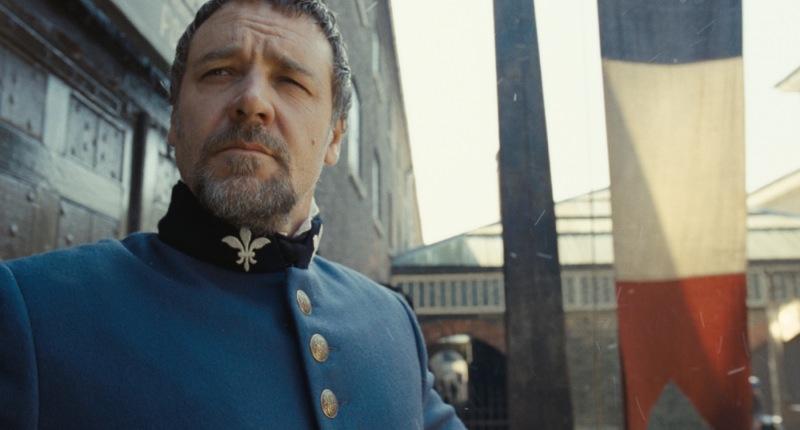
Obsessive lawman Javert (Russell Crowe) in Les Misérables

Obsessive lawman Javert (Russell Crowe) in Les Misérables

Equally impressive is Eddie Redmayne in what is sure to be a star-making turn as Marius, the idealistic student revolutionary who turns his back on his privileged upbringing to lead the rebellion, falling for Cosette in the process. Redmayne brings an intensity to the role that has you rooting for him and his rendition of the sorrowful Empty Chairs at Empty Tables is spine-tingling.

Crowe doesn’t have the singing chops of the others and it shows. There’s no question he gives it his all as the devoutly law-upholding Javert, but the role makes demands on him that he is unable to meet.

Hooper goes to town with the lighter moments involving the Thénardiers and Cohen’s and Carter’s outrageously colourful performances nicely counterpoint all that tragedy and suffering.

Special mention must go to Melanie Ann Oliver’s and Chris Dickens’ superb editing. Despite being over two-and-a-half hours, it moves along at a cracking pace, with the musical numbers bleeding into each other and cut in such a way as to leave you breathless.

Les Misérables at times almost overwhelms itself with its own bombasity, but Hooper somehow keeps the show on the road and delivers an epic spectacle on such a grandiose scale as to leave you exhausted. This is one rollercoaster ride you won’t want to get off.

Bravo!