Review – Rush

More than three decades after his feature debut Grand Theft Auto, Ron Howard once more feels the need for speed in this loud and proud biopic centred around one of motor sport’s greatest rivalries.

Rush Poster

Although too conventional for a story such as this, Ron Howard’s Rush nevertheless fires on enough cylinders to make it a worthy study of what drove two men to risk it all to win

Perhaps more than any other sport, Formula One deeply divides opinion between those who would rather sit in a traffic jam to those who live for race day.

A typically laid-back James Hunt (Chris Hemsworth) in Rush

A typically laid-back James Hunt (Chris Hemsworth) in Rush

Previously, motor sport movies such as Grand Prix and Le Mans generally tailored themselves towards the petrol head. That was until the 2010 British documentary Senna, a stunning and deeply moving film about the life and tragic death of Brazilian F1 driver Ayrton Senna. Crucially, Senna managed to make its subject accessible to the uninitiated and avoid dumbing itself down to the serious fans at the same time.

It’s a feat Howard just about carries off in Rush which, like Senna, chronicles an intense duel between two drivers – Britain’s James Hunt and Austria’s Niki Lauda.

Daniel Brühl as Niki Lauda in Rush

Daniel Brühl as Niki Lauda in Rush

The film charts their professional rivalry from their days as young Formula Three drivers in 1970 to the topsy-turvy 1976 F1 season, during which Hunt suffered multiple setbacks and Lauda was involved in a horrifying crash that resulted in severe burns, before it  all came down to the final race in Japan.

It-girl Suzy Miller turns James Hunt's head in Rush

It-girl Suzy Miller turns James Hunt’s head in Rush

Howard has a capacity to imbue his more prestigious projects (Apollo 13, Cinderella Man, Frost/Nixon) with an admirable authenticity and he tackles Rush with a similar mindset. The saturated colours and grainy lens lend the film a 1970s air that’s complemented by a close attention to detail in the costume and production design.

Australian actor Chris Hemsworth’s acting talents are still relatively unknown beyond his performances as Thor in the Marvel film series and he has a ball as Hunt, the larger-than-life playboy who’s as gifted behind the wheel as he is between the sheets (he’s rumoured to have slept with more than 5,000 women). Hunt isn’t a one-dimensional cartoon, though, and Hemsworth evokes the highs and lows that came with his excessive lifestyle, while also showing why he chose to risk life and limb each and every race.

Feeling the need for speed in Rush

Feeling the need for speed in Rush

Normally it’s the Brits who are the reserved ones, but here it’s Daniel Brühl’s Lauda, who’s all about maximising performance, methodical preparation and driving within acceptable levels of risk. Brühl does a smart job of garnering the audience’s empathy for a character who, on paper, is a cool, self-controlled jerk with a singular purpose to win. In one effectively staged scene, a honeymooning Lauda stares worriedly out the window, realising that with new wife Marlene (Alexandra Maria Lara) he now has something to lose; while in the corner of the shot a fire burns, cleverly foreshadowing the appalling accident that is to come.

The intense rivalry between Niki Lauda (Daniel Brühl) and James Junt (Chris Hemsworth) in Rush

The intense rivalry between Niki Lauda (Daniel Brühl) and James Junt (Chris Hemsworth) in Rush

Howard reteams with writer Peter Morgan following Frost/Nixon, another 70s drama about high stakes and intense rivalry. Although not as powerful a script, Morgan’s spiky dialogue keeps things racing along at a fast enough speed in spite of the incessant exposition-heavy commentary that threatens to overtake each and every race.

The races themselves are when the film high truly hits top gear. Howard keeps the camera tight on Hunt or Lauda or low to the track (including some engine-specific digital effects work) to give a convincing impression of the terrifying speeds these horse-powered coffins were capable of, and almost overwhelms the senses with a ear-bleeding wall of sound.

This is Hemsworth’s and Lauda’s show, but Olivia Wilde impresses as it-girl Suzy Miller, who turns Hunt’s head, while Christian McKay is wonderfully fruity as Alexander Hesketh, the colourful owner of Hunt’s first racing team.

Although too conventional for a story such as this, Rush nevertheless fires on enough cylinders to make it a worthy study of what drove two men to risk it all to win.

Directors Who Should Call It A Day

I recently ran the Debuts Blogathon with Chris at Terry Malloy’s Pigeon Coop which examined the first features of directors from the length and breadth of world cinema.

One of the areas I was keen for each entry to examine was whether a director’s early output matched their later work. It’s rare to find a director with an unblemished record, but there’s nothing sadder than seeing one whose work you once fervently followed becoming a shadow of their former selves.

In the same way that too many highly respected icons of the big screen gradually transform themselves into jobbing actors (I’m talking to you De Niro), there are unfortunately numerous examples of directors whose later films are a stark contrast to their early career.

You may disagree with some or all of these, but the following are five directors who really should call it a day for the sake of their professional credibility.

Who are the directors you wish would call it quits?

John Carpenter

John Carpenter

From his under-appreciated stoner sci-fi debut Dark Star, Carpenter went on a near-spotless run that included such undisputed genre classics as Assault On Precinct 13, Escape From New York, Halloween, Big Trouble In Little China, They Live and, of course, The Thing. It was always going to be a challenge to keep that sort of hit rate up, but the poorly received Escape From LA ushered in a slow, steady decline. Carpenter’s since limped on to direct a number of critical and commercial failures, including the ill-conceived Chevy Chase-starring Memoirs Of An Invisible Man, Ghosts Of Mars and, most recently, the little seen horror The Ward. Although Carpenter’s involvement in the numerous shoddy remakes/reimaginings of his best films seems to take up more of his time these days, one can only hope he decides not to tarnish his once great reputation by sitting himself down again in the director’s chair.

Francis Ford Coppola

Francis Ford Coppola

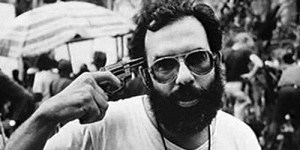
It can be argued that it’s a little unfair to include Francis Ford Coppola on this list as his last three projects – Youth Without Youth (2007), Tetro (2009) and Twixt (2011) – are smaller, more personal films, but the decline in the quality of his output is sad indeed when you consider what a titan he was. There was no greater filmmaker during the 1970s – The Godfather (1972), The Conversation (1974), The Godfather Part II (1974) and Apocalypse Now (1979) is as incredible a run as you’re ever likely to find – and Coppola recaptured some of this magic in his 80s movies Rumble Fish, The Cotton Club and Peggy Sue Got Married. But the wheels started to fall off with 1990’s The Godfather Part III (not a terrible film by any means, but a pale shadow of its earlier chapters) and by the time of the Robin Williams ‘comedy’ Jack Coppola had turned into what we hoped he’d never become – a hack-for-hire.

M. Night Shyamalan

M Night Shyamalan

What the hell happened to M. Night Shyamalan? Or was he nothing more than a one-trick pony? The Sixth Sense announced Shyamalan’s arrival in some style, while its superior follow-up Unbreakable (his best film) and alien invasion movie Signs seemed to suggest he was the real deal (let’s forget the final five minutes of Signs just for now). Even 2004’s The Village had its moments, but the cracks started to show in 2006’s Lady In The Water, which features a film critic being horribly killed (in case you wondered whether Shyamalan has a sense of humour, that was your answer). From there his movies have continued to soil a once-promising career, most notably 2008’s The Happening, a film so baffling in its concept and so inept in its execution you have to admire the fact it got made in the first place.

Brian De Palma

Brian De Palma

Five years before Robert De Niro exploded onto the big screen in Martin Scorsese’s Mean Streets he got his big break in De Palma’s 1968 satire Greetings. De Palma actually gave De Niro his first screen appearance in The Wedding Party, released in 1969, but made six years earlier. For this alone De Palma deserves credit, although he didn’t need Bobby’s help to direct some genuine classics of late 70s and 80s American cinema, including Carrie (1976), Blow Out (1981), Scarface (1983), The Untouchables (1986) and the troubling Casualties Of War (1989). His last great work – Carlito’s Way – was made 20 years ago and in the intervening period his career has gradually nose-dived, from clunky sci-fi Mission To Mars, to the heavy-handed War on Terror polemic Redacted and deeply disappointing The Black Dahlia, which merely underlined his status as the poor man’s Alfred Hitchcock. To make matters worse, his most recent film, 2012’s Passion pales in comparison to his earlier erotic thrillers. Time to bow out Brian.

Tim Burton

Tim Burton

There was a time when I awaited a new Tim Burton film with genuine anticipation. In the late 80s and 90s Burton was responsible for a whole new aesthetic in Hollywood moviemaking. Burton-esque even became a term to describe a certain brand of weird and wonderful cinema, while his surprising appointment as the director of 1989’s hugely successful Batman became the template used by Marvel two decades later (Kenneth Branagh being chosen to direct Thor, for example). Burton has generally been at his best when sticking to more personal material; the problem is that he doesn’t stick to this, choosing instead to clutter his filmography with ever-more disappointing big budget studio pictures, from the misguided Planet Of The Apes remake, to the lacklustre Charlie And The Chocolate Factory, woeful Alice In Wonderland and boring Dark Shadows. There was hope in 2012’s Frankenweenie, but when taken alongside his recent output this feels like a blip in an otherwise stalled career.

Great Films You Need To See – Jacob’s Ladder (1990)

This is my latest contribution to The Big Picture, the internationally-recognised magazine and website that offers an intelligent take on cinema, focussing on how film affects our lives. This piece about Adrian Lyne’s psychological horror Jacob’s Ladder was written as part of The Big Picture’s Lost Classics strand, although I am including it within my list of Great Films You Need To See.

Psychological horror has long been the neglected offspring of a genre that too often falls back on lazy shocks, recycled storylines and dismembered body parts.

While its unfortunate protagonist is unable to separate reality from demonic hallucination, the unique and relentlessly creepy Jacob's Ladder can be viewed through a prism of nightmarish perceptions, all as valid as each other

While its unfortunate protagonist is unable to separate reality from demonic hallucination, the unique and relentlessly creepy Jacob’s Ladder can be viewed through a prism of nightmarish perceptions, all as valid as each other

Yet, it’s through this underused sub-genre that some of horror’s finest hours have emerged, not least of which the largely forgotten Jacob’s Ladder.

Jacob (Tim Robbins) fights for his life in Jacob's Ladder

Jacob (Tim Robbins) fights for his life in Jacob’s Ladder

Directed by Adrian Lyne, Jacob’s Ladder may seem like an odd fit in a filmography dominated by such libidinous titles as 9½ Weeks and Indecent Proposal, but makes more sense when you consider it followed his 1987 smash Fatal Attraction, a psychological horror in all but name that scared the shit out of men and riled feminists the world over.

Vietnam vet Jacob Singer’s (Tim Robbins) nightmares/flashbacks of a horrific incident during the war begin to bleed into his waking life when he experiences demonic visions that grow ever more disturbing and threatening. Jacob’s slippery grasp on reality is further corroded by his unwitting involvement in what appears to be a deadly military conspiracy seeking to silence him.

Just one of the nightmarish images in Jacob's Ladder

Just one of the nightmarish images in Jacob’s Ladder

Much like his tortured protagonist, Lyne never lets the viewer settle for more than a few minutes before taking a further step down the ladder towards hell. Best known at the time for supporting turns in Bull Durham and Cadillac Man (not forgetting Howard the Duck and Erik the Viking), Robbins brings a tragic innocence to the tortured Jacob, a psychologically scarred war vet who’s as terrified as he is confused by what he’s being forced to endure.

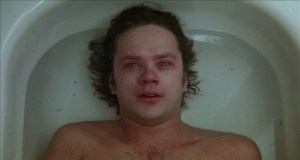
Jacob's (Tim Robbins) life falls apart in Jacob's Ladder

Jacob’s (Tim Robbins) life falls apart in Jacob’s Ladder

What makes Jacob’s visions more frightening is the plausibility in which Lyne presents them. One woman appears to have filed-down horns which only become apparent when her hat slips, while a car trying to run him down contains the violently shaking masked figure he glimpsed earlier at the back of a subway train. Cronenbergian body horror is also used to phantasmagorical effect at a party where Jacob’s girlfriend Jezebel (Elizabeth Peña) is seemingly violated by a grotesque demon; and the unnerving hospital scene when an incapacitated Jacob is confronted by doctors who really don’t seem to have his best interests at heart.

The angelic chiropractor Louis (Danny Aiello) in Jacob's Ladder

The angelic chiropractor Louis (Danny Aiello) in Jacob’s Ladder

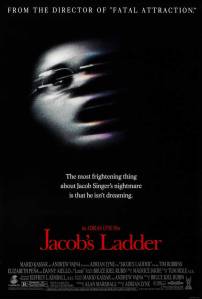
The film features a number of startling images, including a helicopter shot Oliver Stone would have been proud of and the haunting moment when a coin’s sudden movement spells doom for one character. Lyne’s inspirations for the film’s visual palette include the Oscar-winning 1962 short film An Occurrence at Owl Creek Bridge and the austere work of artist Francis Bacon (in particular the film’s poster which shows a ghostly Jacob seemingly trapped in an abyss).

Jacob's (Tim Robbins) war buddy Paul (Pruitt Taylor Vince) confides in Jacob's Ladder

Jacob’s (Tim Robbins) war buddy Paul (Pruitt Taylor Vince) confides in Jacob’s Ladder

Despite toning down Bruce Joel Rubin’s portentous script, the film is still cut through with Old Testament religious symbolism, from the title that refers to a chapter in Genesis in which the prophet Jacob dreams of a ladder ascending to heaven, to the overtly Biblical names (Jacob, Jezebel, his ex-wife Sarah, who in the Bible was Jacob’s grandmother, and son Gabe/Gabriel) and the angelic quality of Jacob’s chiropractor Louis (Danny Aiello).

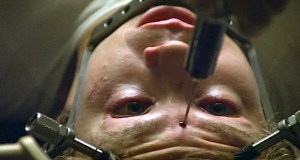
A nasty spot for Jacob (Tim Robbins) in Jacob's Ladder

A nasty spot for Jacob (Tim Robbins) in Jacob’s Ladder

Louis’ citation to Jacob of Christian philosopher Meister Eckhart about devils really being angels freeing a soul that isn’t ready to let go not only strikes at the heart of Jacob’s tortured psyche, but is also a breadcrumb left by Lyne that provides one explanation of the film’s wider context.

While its unfortunate protagonist is unable to separate reality from demonic hallucination, the unique and relentlessly creepy Jacob’s Ladder can be viewed through a prism of nightmarish perceptions, all as valid as each other.

Debuts Blogathon Wrap Up

Terry Malloy's Pigeon Coop's avatarTerry Malloy's Pigeon Coop

debuts collage 2

Well there we go, it’s all done and dusted. This blogathon, which I co-hosted with Mark from Three Rows Back, has been a great experience. I’ve had the pleasure of chatting with some great bloggers, some familiar, some not-so familiar and I think it’s been a great success. There have been some fantastic posts, covering a wide range of directors and films, which is exactly what Mark and I were hoping for. There are some classics in there and also some directors I hadn’t even heard of, which has helped me broaden my knowledge that little bit more.

Thanks

First of all I would like to say thanks to Mark for proposing the idea of doing the blogathon in the first place. I’d toyed with the idea of a blogathon for a while but didn’t really know what to do and how to go about organising it, but Mark…

View original post 396 more words

Debuts Blogathon: Stanley Kubrick – Fear and Desire (1953)

Terry Malloy's Pigeon Coop's avatarTerry Malloy's Pigeon Coop

debuts banner 2

This is the final post on my site in the Debuts Blogathon, which has been co-hosted by myself and Mark from Three Rows Back. Here I’m taking a look at my favourite filmmaker Stanley Kubrick and his debut feature, Fear and Desire.

STANLEY KUBRICK

Fear and Desire (1953)

To me, Stanley Kubrick is one of, if not the, greatest directors of all time. Obviously I’ve not sampled every director but of all the directors whose films I have seen, it’s Kubrick who stands head and shoulders atop the pile. I don’t think he’s made a bad film, despite what others may argue, and it was really interesting going back to see his first feature and looking at how he subsequently evolved and grew as a filmmaker.

The story of Fear and Desire is pretty simple and goes a little something like this: Four soldiers in the midst of an…

View original post 1,068 more words