Review – Her

It’s love Jim, but not as we know it in Spike Jonze’s prescient tale of one man’s unconventional relationship with his operating system.

Her treads a well worn path, but does so in such a wonderfully uncynical and sweet-natured way you'll be glad you went down it

Her treads a well-worn path, but does so in such a wonderfully uncynical and sweet-natured way you’ll be glad you went down it

Since his striking debut Being John Malkovich, Jonze has divided critical opinion between those who embrace his unique vision and those who deride his films as being painfully self-conscious.

It’s unlikely his new film will woo the naysayers, but anyone who writes off Her as a knowing exercise in hipsterism is blinding themselves to one of cinema’s most honest, painful and beautiful love stories since the 2007 Irish charmer Once.

Shanghai fills in for near future LA in Her

Shanghai fills in for near future LA in Her

The premise of Her sounds like an offshoot of Charlie Brooker’s tech-led anthology TV series Black Mirror. Set in a near future LA, lost and lonely Theodore Twombly (Joaquin Phoenix) is still coming to terms with the breakdown of his marriage to childhood sweetheart Catherine (Rooney Mara) and can’t bring himself to sign the divorce papers. The only really meaningful attachment he has is with Amy (Amy Adams), an old friend whom he once dated years back.

His life changes suddenly when he purchases a new highly advanced Operating System, which calls itself Samantha (voiced by Scarlett Johansson) and is soon conversing with Theodore either through his computer or via his phone linked to an earpiece like she’s flesh and blood.
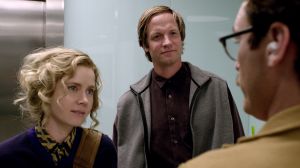
Theodore (Joaquin Phoenix) bumps into good friend Amy (Amy Adams) and her husband Charles (Matt Letscher) in Her

Theodore (Joaquin Phoenix) bumps into good friend Amy (Amy Adams) and her husband Charles (Matt Letscher) in Her

Theodore finds himself increasingly drawn to Samantha, who represents everything he could wish for in a woman… except to exist in physical form.

This is Her‘s big question – can a relationship work when two people aren’t physically together? In spite of the film’s digital age outlook, its central conceit has been a staple of screen romances for decades, from Ernst Lubitsch’s 1940 classic The Shop Around The Corner, to its e-make You’ve Got Mail.

Theodore (Joaquin Phoenix) in one of his more melancholic moments in Her

Theodore (Joaquin Phoenix) in one of his more melancholic moments in Her

Technology, specifically our slavish devotion to it, plays a key role in the film. Whether he’s on the train, in a lift or walking along the street Theodore, like everyone else it seems, is glued to their mobile devices (much like today in fact) or listening to something through their earpiece. It’s little wonder he’s so lonely; he’s surrounded by people who are as lost in their own little world as he is. Although not presented as a dystopia, we’re left to decide for ourselves if this is the kind of future world we’d be happy living in.

In a sad irony, Theodore’s job is to compose handwritten letters of love and devotion for people unable to find the words themselves. In a way, this doesn’t make him too dissimilar to Samantha in that the service he provides is there to help improve a stranger’s life; in some cases over the course of many years as he explains at one point.

Theodore's ex-wife Catherine (Rooney Mara) in Her

Theodore’s ex-wife Catherine (Rooney Mara) in Her

In spite of a few slight eccentricities, Theodore is a character we warm to and come to care about. Phoenix’s eyes convey a sadness and fear that break the heart, while his shuffling gait suggests a guy who’s sleepwalking nowhere in particular. However, with the introduction of Samantha his posture changes, his eyes light up and he radiates a positivity you suspect he hasn’t felt for a long time. Phoenix proved he could really act in The Master and here gives another fascinating take on detachment.

We buy into his relationship with Samantha and this is largely down to Johansson’s (excuse the ironic pun) full-bodied performance. The path they take is, for the large part, a believable one, even when Samantha drafts in a sex surrogate in order for them to enjoy ‘physical’ intimacy.

And happier times. Theodore (Joaquin Phoenix) shares a joke with Samantha (voiced by Scarlett Johannson) in Her

And happier times. Theodore (Joaquin Phoenix) shares a joke with Samantha (voiced by Scarlett Johannson) in Her

A big reason the film works is Jonze’s beautifully observed script. Many of us will identify with the melancholy Theodore feels at the passing of a cherished relationship, as well as the fear, happiness and scepticism he experiences when his once dormant heart reignites.

This being a Jonze joint, the film’s aesthetic is painterly. Shanghai steps in for near future LA (where the fashion appears to be for men to wear trousers almost up to their ribcage) and is a perfect fit for Theodore – gleaming surfaces paint a warm sheen over the sadness and remoteness that exists just beneath.

Her treads a well-worn path, but does so in such a wonderfully uncynical and sweet-natured way you’ll be glad you went down it.

Review – Robocop (2014)

The Paul Verhoeven remake train stops off at its next station with this toned-down reboot of the ultra-violent 80s classic that’s as enjoyable as it is disposable.

RoboCop falls flat too often and doesn't hold together, but it's got enough to say and does so in an entertaining enough way to make you want to comply

RoboCop falls flat too often and doesn’t hold together, but it’s got enough to say and does so in an entertaining enough way to make you want to comply

After the bodge-job that was the 2012 rehash of his Arnie-tastic sci-fi actioner Total Recall, Verhoeven would have been forgiven for rolling his eyes at the thought of 1987’s RoboCop being remade for a modern-day audience.

However, it’s with a certain amount of surprise to report that not only is director José Padilha’s robo-rebirth a solid action movie, but it also sneaks in a few sociopolitical points under the radar to keep lovers of the first film satisfied.

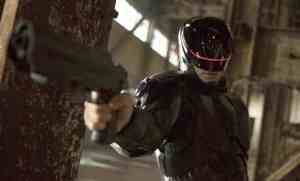
Go Robo! Alex Murphy (Joel Kinnaman), aka RoboCop, goes to work

Go Robo! Alex Murphy (Joel Kinnaman), aka RoboCop, goes to work

Set in the ‘near future’, the original was a gleefully sadistic shoot-em-up that, like his other sci-fi classic Starship Troopers, had a biting satirical edge.

We’re more than 25 years on and the future of law enforcement proposed in Verhoeven’s original remains just that, the future, although one that doesn’t feel that far off when you consider that we now live in a world where drone warfare exists (the film is set in 2028).

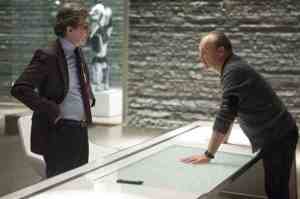
OmniCorp CEO Raymond Sellars (Michael Keaton) plots with Dr Dennett Norton (Gary Oldman) in RoboCop

OmniCorp CEO Raymond Sellars (Michael Keaton) plots with Dr Dennett Norton (Gary Oldman) in RoboCop

Padilha evidently has plenty of respect for the source material and retains the first film’s satirical slant, while also playing around with ideas of American imperialism in its impressive pre-credits sequence.

Giant multinational corporation OmniCorp has effectively privatised American foreign policy and wants to do the same with law enforcement; but is prevented from doing so by the Dreyfus Act. The American public is skeptical about robots patrolling the streets, so OmniCorp CEO Raymond Sellars (Michael Keaton) proposes a man be put in a machine to bring people onside.

Bill O'Reilly-esque TV host Pat Novak (Samuel L Jackson) sets the world to rights in RoboCop

Bill O’Reilly-esque TV host Pat Novak (Samuel L Jackson) sets the world to rights in RoboCop

That man is Alex Murphy (Joel Kinnaman), who is critically injured by a car bomb and, with the help of conflicted OmniCorp scientist Dr Dennett Norton (Gary Oldman), is transformed into RoboCop. As the tide of public opinion turns in OmniCorp’s favour thanks to RoboCop’s by-any-means-necessary arrest policy, Alex goes after those responsible for his near-death experience, while trying to reconnect with his wife (Abbie Cornish) and son.

While broadly speaking the same movie (some of the original’s more memorable dialogue is crowbarred in – “I’d buy that for a dollar”; “dead or alive, you’re coming with me”), Padilha and screenwriter Joshua Zetumer take enough detours to make the enterprise worthwhile, most notably the relationship between Alex and Dr Norton, which runs with the Frankenstein sub-text even more than the first movie. The CG-heavy scene in which Norton reveals the extent of what’s (not) left of Alex is effectively handled by Kinnaman and the ever-reliable Oldman.

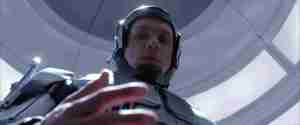
Alex Murphy (Joel Kinnaman) realises what's happened to him in RoboCop

Alex Murphy (Joel Kinnaman) realises what’s happened to him in RoboCop

Although the domestic drama between Alex and his family probably worked on paper, it isn’t sold terribly well on screen, to the extent that Cornish spends most of the film either crying or looking like she’s about to.

Likewise, the action set pieces involving RoboCop taking on swathes of robo-soldiers or human cannon fodder are too reminiscent of a computer game, right down to the digital readout on the top right of the screen that helpfully informs us how many people/machines there are left to decommission.

While Verhoeven satirised trashy American culture through TV adverts for such family fare as the board game Nuke ’em, Padilha takes aim at America’s politically biased news media, specifically Fox News. This is done through the abominable Bill O’Reilly-esque TV host Pat Novak (Samuel L Jackson, sporting one of his most memorable hairdos), whose show The Novak Element is effectively a mouthpiece for OmniCorp. Jackson, as he so often does, makes the most of a small-ish role with a gloriously over-the-top performance.

Is RoboCop circa 2014 necessary? Not really. More importantly, is it any good? It falls flat too often and doesn’t hold together, but it’s got enough to say and does so in an entertaining enough way to make you want to comply.

Review – Dallas Buyers Club

The McConaissance goes from strength to strength in this moving period drama that breaks free of its Oscar-grabbing shackles thanks to a pair of magnetic performances.

Dallas Buyers Club is a forthright and rousing tale of dogged determination in the face of death lifted by a pair of remarkably raw performances

Dallas Buyers Club is a forthright and rousing tale of dogged determination in the face of death lifted by a pair of remarkably raw performances

The dark days of Failure To Launch and other dire rom-coms that demanded he lean next to someone on the poster are thankfully an increasingly distant chapter in the career of Matthew McConaughey.

In the past couple of years, McConaughey has finally fulfilled the early promise he showed in the likes of Dazed And Confused (“well alright, alright, alright”) and Lone Star and in that relatively short time has become one of the most exciting screen actors working today.

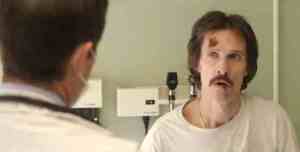
The moment Ron Woodroof (Matthew McConaughey) learns he has Aids in Dallas Buyers Club

The moment Ron Woodroof (Matthew McConaughey) learns he has Aids in Dallas Buyers Club

Hot on the heels of his memorable cameo in The Wolf Of Wall Street, McConaughey switches gears to play Ron Woodroof, the hard-living redneck electrician and rodeo cowboy whose world collapses from under his feet when he learns he is HIV-positive and in all likelihood will be dead in a month.

Set in 1985, myth and conjecture were still rife when it came to the growing Aids epidemic, not least of all in the mind of the homophobic Ron who, like many people at the time, thought it was a disease restricted to homosexuals. Shunned by friends and family and denied access to what Government-approved antivirals there were at the time, Ron takes matters into his own hands and seeks out whatever drugs he can find that might prolong his life.

Ron (Matthew McConaughey) forms an unlikely business partnership with Rayon (Jared Leto) in Dallas Buyers Club

Ron (Matthew McConaughey) forms an unlikely business partnership with Rayon (Jared Leto) in Dallas Buyers Club

Realising there are many more like him out there, he goes into business with Rayon (Jared Leto), a HIV-positive transgender woman who has the necessary contacts to facilitate the set-up of the Dallas Buyers Club wherein ‘members’ pay a month fee for unapproved medication. As business booms it attracts the unwanted attention of the Food and Drug Administration (FDA), which threatens legal action.

Much has been made of the weight both McConaughey (50 lbs) and Leto (30 lbs) lost for their roles and it’s admittedly startling at first to see just how emaciated each actor looks, McConaughey in particular. However, this dramatic weight loss should not distract from what are two of the most committed and honest performances you’ll see all year.

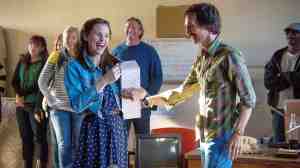
A bond is formed between the sweet-talking Ron (Matthew McConaughey) and his Doc Eve Saks (Jennifer Garner) in Dallas Buyers Club

A bond is formed between the sweet-talking Ron (Matthew McConaughey) and his Doc Eve Saks (Jennifer Garner) in Dallas Buyers Club

These are golden days for McConaughey and the actor disappears into the role to deliver his most complete performance to date. Ron’s journey from free-wheeling homophobic redneck to compassionate social campaigner never once feels false or ham-fisted and the actor maintains the character’s charm, humour and stubbornness even during his darkest moments.

In his first role for six years, Leto is a revelation. Male actors dressing up as women has largely been used as a tool for comedy in the past, but Leto finds a similar conviction and voraciousness to the remarkable performance given by Jaye Davidson in The Crying Game.

Jared Leto gives a wholly convincing performance as Rayon, a HIV-positive transgender woman, in Dallas Buyers Club

Jared Leto gives a wholly convincing performance as Rayon, a HIV-positive transgender woman, in Dallas Buyers Club

Likewise, Jennifer Garner does well in the tough role of Dr Eve Saks, who forms a bond with Ron and starts to question whether what she and her supervisor Dr Sevard (Dennis O’Hare) are doing to ‘help’ Aids sufferers is actually making a positive difference.

Where the film does fall down is in the black and white way it portrays the conflict between Ron on one side and the FDA and American health care system on the other.

Ron (Matthew McConaughey) in one of his numerous scrapes with the law in Dallas Buyers Club

Ron (Matthew McConaughey) in one of his numerous scrapes with the law in Dallas Buyers Club

Director Jean-Marc Vallée appears to ask Michael O’Neill’s FDA official Richard Barkley to just look angry and menacing the whole time, while O’Hare’s Dr Sevard is little more than a cipher to show how cuddly the health care system and big pharma are.

While the relationship Ron strikes up with Eve is sweetly affecting, it’s his bond with Rayon that’s Dallas Buyers Club‘s beating heart. The moment when Ron instinctively defends Rayon against a former buddy who’s ostracised him comes as much as a surprise to us as it does to the two of them. It’s a beautifully played moment that signals a turning point in their relationship from business associates to friends.

To the film’s credit it never wallows in grief or cynically pulls the heartstrings; what we get instead is a forthright and rousing tale of dogged determination in the face of death lifted by a pair of remarkably raw performances.

Review – The Wolf Of Wall Street

The ugly reality of what constitutes the modern day American Dream is writ large over Martin Scorsese’s outrageous and intelligent trawl through the moral sewer of a world fuelled by power, prostitutes and pesos.

Far from slowing down in his autumn years, Scorsese's The Wolf Of Wall Street finds the director back at his very best.

Far from slowing down in his autumn years, Scorsese’s The Wolf Of Wall Street finds the director back at his very best.

The Wolf Of Wall Street begins with an advert for Jordan Belfort’s (Leonardo DiCaprio) church of capitalism, Stratton Oakmont, espousing the firm’s “stability” and “integrity”, before cutting to its “trained professionals” betting huge sums of money on a dwarf throwing contest.

It’s none-too-subtle – like much of the film – but this observation of the unbridled hypocrisy and moral vacuum at the black heart of Belfort and his army of disciples runs through the core of Scorsese’s exhilarating and exhausting 22nd feature.

Jordan (Leonardo DiCaprio) gets taken under the wing of sulphurous boss Mark Hanna (Matthew McConaughey) in The Wolf Of Wall Street

Jordan (Leonardo DiCaprio) gets taken under the wing of sulphurous boss Mark Hanna (Matthew McConaughey) in The Wolf Of Wall Street

Scorsese revisits the dwarf tossing scene later in the film when Belfort, his best friend and Vice President Donnie Azoff (Jonah Hill), and a couple of other senior traders discuss how best to exploit the dwarf and agree not to “consider him a human”. It’s a cleverly symbolic moment – we are the ‘little people’ being taken advantage of by these monsters for financial gain and their own amusement.

These guys know they’re crooks but are having too much fun in their grotesque bubble to care. When a potential client remarks over the phone that Belfort seems like “a pretty sincere guy”, his team collapse into howls of laughter; while Belfort literally and figuratively ‘closes the deal’ by simulating having sex as he makes the sale.

Naomi (Margot Robbie), Jordan's trophy wife in The Wolf Of Wall Street

Naomi (Margot Robbie), Jordan’s trophy wife in The Wolf Of Wall Street

Told through Belfort’s unreliable eyes, we follow him from his wet-behind-the-ears early days through to his rebirth following the Wall Street crash of 1987 to become a wildly successful stockbroker making money hand over fist by selling worthless stocks to unwitting schumcks who have bought into the get rich quick mantra peddled to them by the ‘free’ market.

Belfort’s success leads to the creation of Stratton Oakmont, a boiler room where illegal activity and corruption go hand in hand with opprobrious excess and decadence on a scale that would make Caligula blush.

The best of times... stockbroker-turned-rock star Jordan Belfort (Leonardo DiCaprio) in The Wolf Of Wall Street

The best of times… stockbroker-turned-rock star Jordan Belfort (Leonardo DiCaprio) in The Wolf Of Wall Street

It’s easy to get blindsided by the film’s numerous scenes of drug taking, orgiastic partying and general debauchery, but those who claim the director gives Belfort a pass are completely missing the point of The Wolf Of Wall Street. It is politicians, the legal system and society in general who let – and continue to let – snake oil salesmen like Belfort off the hook by allowing ourselves to be seduced by empty promises of riches beyond the dreams of avarice.

A key scene takes place towards the start of the film involving Matthew McConaughey’s obscenely immoral broker Mark Hanna taking a young Belfort out to lunch to explain to him – and us  – that the name of the game is to “move the money from your client’s pocket into your pocket” and to “keep the clients on the ferris wheel and keep the park open 24/7/365”.

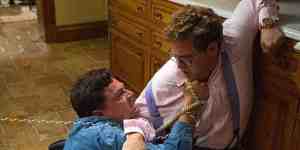
The worst of times... the wheels start coming off for Jordan Belfort (Leonardo DiCaprio) and partner-in-crime Donnie Azoff (Jonah Hill) in The Wolf Of Wall Street

The worst of times… the wheels start coming off for Jordan Belfort (Leonardo DiCaprio) and partner-in-crime Donnie Azoff (Jonah Hill) in The Wolf Of Wall Street

As appalling as Hanna’s pep talk is, we laugh in spite of ourselves, thanks in no small part to McConaughey’s inspired cameo. A similar reaction is had throughout what is at times a laugh-out-loud comedy. Belfort lives and breathes the words Hanna has taught him, which makes for numerous scenes of ridiculous comedy, most notably when he’s almost paralysed by an particularly strong batch of Quaaludes.

Based on Belfort’s book of the same name, the film follows in the ‘visual novel’ footsteps of Scorsese’s Goodfellas and Casino by relying heavily on narration to tell the tale. Just as Ray Liotta’s delivery sucked us in to a tale of New York gangsters, so too does DiCaprio, who builds an irresistible rapport with the audience through a mix of buddy-buddy repartee and matter-of-fact exposition.

FBI Agent Patrick Denham (Kyle Chandler) investigates Jordan Belfort (Leonardo DiCaprio) in The Wolf Of Wall Street

FBI Agent Patrick Denham (Kyle Chandler) investigates Jordan Belfort (Leonardo DiCaprio) in The Wolf Of Wall Street

It’s an electric performance from DiCaprio, arguably the highlight of his career and certainly his best under Scorsese’s mentorship. The over-the-top banter with his besotted staff and explosive physicality may be what grabs the headlines, but his more nuanced work, particularly opposite trophy wife Naomi (Margot Robbie) and FBI agent Patrick Denham (Kyle Chandler) are what sets the performance apart. DiCaprio is lent excellent support from all quarters, especially Robbie and a never-better Hill.

As you’d expect from a Scorsese picture, the needle-drop soundtrack is a music lover’s delight (although Rolling Stones’ Gimme Shelter is notable by its absence), while Terrence Winter’s volcanic script justifies the film’s three-hour running time.

Far from slowing down in his autumn years, Scorsese’s The Wolf Of Wall Street finds the director back at his very best.

Great Films You Need To See – Fail Safe (1964)

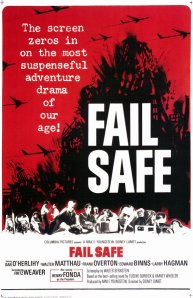
This is my latest contribution to The Big Picture, the internationally-recognised magazine and website that offers an intelligent take on cinema, focussing on how film affects our lives. This piece about Sidney Lumet’s Cold War thriller Fail Safe was written as part of The Big Picture’s Lost Classics strand, although I am including it within my list of Great Films You Need To See.

No doubt frazzled by the Cold War running ever hotter, it’s perhaps not surprising audiences in 1964 preferred their nuclear scare movies to be in the mould of the scabrously satirical Dr Strangelove rather than the grimly portentous Fail Safe.

No film before or since has played out the nightmarish endgame of Mutually Assured Destruction to quite such a chilling and methodical degree

No film before or since has played out the nightmarish endgame of Mutually Assured Destruction to quite such a chilling and methodical degree

As the cold horror of what is unfolding dawns on America’s top brass, the President (played by Henry Fonda) engages in an increasingly desperate exchange with his Russian counterpart via telephone to find a way to stop the bombers from triggering World War III before it’s too late.

The tension builds as the President (Henry Fonda) and his interpreter (Larry Hagman) talk to the Russians in Fail Safe

The tension builds as the President (Henry Fonda) and his interpreter (Larry Hagman) talk to the Russians in Fail Safe

Director Sidney Lumet stages the film in a similar fashion to his 1957 debut 12 Angry Men. The drama plays out in several locations, each of them boiler rooms of fetid tension where the temperature is mercilessly cranked up to the point where a number of characters crack under the strain. Even Fonda’s President loses his cool as the terrible reality of what is happening sinks in.

By doing relatively little with the camera and refusing to pull away, Lumet is able to poison the atmosphere with a thickening dread; so much so that when Larry Hagman’s interpreter’s hands start to shake as he drinks a glass of water we question whether he’s acting or not.

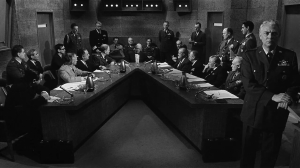
The pressure builds in the War Room in Fail Safe

The pressure builds in the War Room in Fail Safe

The only one who seems unphased is Walter Matthau’s coldly analytical civilian advisor Professor Groeteschele, who is seen at the start of the film at a dinner party calmly rationalising how 60 million deaths should be the highest price America is prepared to pay in a war. The ultimate utilitarian, Groeteschele sees the unfolding tragedy as a golden opportunity to wipe Russia off the map to ensure that American culture, whatever’s left of it, survives. Ironically, his uber-hawkish outlook shocks even the most senior military brass.

The film explores the duality we feel towards technology through the banks of dials, buttons and flashing lights at Strategic Air Command headquarters and the imposing screen displaying the whereabouts of military assets and targets across the world.

The detestable Professor Groeteschele (Walter Matthau) coldly rationalises nuclear war in Fail Safe

The detestable Professor Groeteschele (Walter Matthau) coldly rationalises nuclear war in Fail Safe

Implicit trust has been placed in the instruments, which General Bogan (Frank Overton) confidently states are so good “they can tell the difference between a whale breaking wind and a sub blowing its tanks”. However, it’s this same technology that betrays us by sending the ‘go code’ to the bombers. We are all of us Dr Frankensteins, Fail Safe implies, courting our own destruction through our insatiable hunger for ever more sophisticated technology (a concept more colourfully explored in the Terminator franchise).

Fail Safe concludes with a disclaimer courtesy of the Department of Defense and US Air Force that safeguards and controls are in place to ensure the film’s events can never come to pass. It’s unlikely that would have made anyone watching Fail Safe back in 1964 any more comfortable in their beds.