Review – Gone Girl

Anyone with nuptials on the horizon may be best steering clear of David Fincher’s pitch black mystery that takes he said/she said to a whole new level.
Gone Girl may not be the director's finest work, but even B-grade Fincher is better than most

Gone Girl may not be the director’s finest work, but even B-grade Fincher is better than most

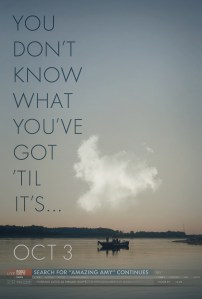
Gone Girl‘s tagline – ‘you don’t know what you’ve got till it’s gone’ – isn’t the only thing about the film that’s devilishly ambiguous; it keeps you guessing in a manner that would have made Hitchcock proud.

That said, an increasingly ludicrous final act and a missed opportunity to properly end the film, a la The Dark Knight Rises, denies Gone Girl the status of classic Fincher.

Nick (Ben Affleck) woos Amy (Rosamund Pike) in Gone Girl

Nick (Ben Affleck) woos Amy (Rosamund Pike) in Gone Girl

Adapted by Gillian Flynn from her own bestselling novel, Ben Affleck stars as Nick Dunne, a suburbanite and bar owner (of an establishment called ‘The Bar’ no less) who reports that his wife Amy (Rosamund Pike) has gone missing on their fifth wedding anniversary. What starts out as a straightforward missing person case takes on a far grislier tone as the truth about their seemingly blissful marriage emerges and the finger of suspicion points to Nick.

Fincher has long been one of US cinema’s most accomplished exponents of stylish darkness and Gone Girl gives him plenty of material to work with.

Nick (Ben Affleck) addresses the crowd and the media in Gone Girl

Nick (Ben Affleck) addresses the crowd and the media in Gone Girl

Affleck is perfectly cast as Nick, an everyday middle-class American who seemingly lucks out when he woos the beautiful Amy. The film spends its first act cutting between the spiralling events of Amy’s disappearance and flashbacks to their marriage, which gradually dissolves from romantic bliss (a moment when the two stroll past a bakery through a sugary mist is wonderfully photographed) to mistrust, fear and acrimony.

The film works best when it’s keeping you guessing as to which narrator is the most unreliable; whether it be the words written down by Amy in her diary which serves as the flashback device, or the story Nick tells tenacious Detective Rhonda Boney (Kim Dickens) and his twin sister Margo (a cracking turn by TV actor Carrie Coon in her feature debut).

Missing..? Amy (Rosamund Pike) in Gone Girl

Missing..? Amy (Rosamund Pike) in Gone Girl

Perhaps the most pernicious narrator of all, though, is the mainstream media and the film is as merciless as Missi Pyle’s cable TV host in its depiction of just how lurid it can be. It may be relatively easy to lambast the tackiness of so much of what passes as ‘news’ media, but it plays as important a character in the film as Nick and Amy and ultimately serves to define who they are to the millions who tune in.

Linked to this, social media also does its bit to decide Nick’s guilt or innocence. Ghoulish ambulance chasers hang around The Bar as if it’s Dealey Plaza and one particularly pathetic figure grabs a selfie with Nick in order to dine out on the notoriety.

Detective Rhonda Boney (Kim Dickens) gets to the bottom of Amy's disappearance with Nick (Ben Affleck), Amy's mother (Lisa Banes) and father (David Clennon) and fellow Detective Jim Gilpin (Patrick Fugit) in Gone Girl

Detective Rhonda Boney (Kim Dickens) gets to the bottom of Amy’s disappearance with Nick (Ben Affleck), Amy’s mother (Lisa Banes) and father (David Clennon) and fellow Detective Jim Gilpin (Patrick Fugit) in Gone Girl

While Affleck does a solid enough job, Pike is both luminous and electric as Amy. It’s a complex role and she makes the most of her juiciest role to date with a turn that Hitch would have loved. Pike goes from knockabout romantic lead to statuesque blonde in the flick of a switch and it’s only later that it becomes clear just how much is going on beneath the surface when she casts a simple glance towards her husband.

Meanwhile, Trent Reznor’s soundtrack, although not as memorable as his Oscar-winning work on Fincher’s The Social Network, does have its moments, most notably in one eye-watching scene in the film’s home stretch.

Gone Girl may not be the director’s finest work, but even B-grade Fincher is better than most.

Review – Frank

Anyone who begrudgingly comes to accept their true talent lies not in what they’d hoped will find a connection to this unique and idiosyncratic story about those blessed with artistic creativity and those who hitch along for the ride.

With a free will and an outsider's spirit all of its own, Frank is a wonderful one-of-a-kind

With a free will and an outsider’s spirit all of its own, Frank is a wonderful one-of-a-kind

It’s a fair bet to say that a good number of critics have at least entertained the idea of doing the very thing they write about. In most cases these dreams remain unfulfilled, consigned to the ‘what if’ section of our brain.

In Jon Ronson’s case, he did it the other way around, having played a purposefully cheap sounding keyboard for three years in Frank Sidebottom’s Oh Blimey Big Band in the 1980s before going on to become a highly respected gonzo journalist and writer of such books as The Men Who Stare At Goats, which went on to receive mediocre treatment in a film of the same name starring George Clooney and Ewan McGregor.

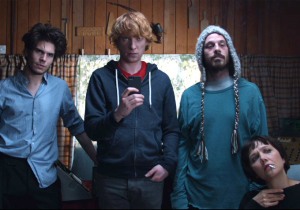
The various members of Soronprfbs, including François Civil's Baroque, keyboardist Jon (Domhnall Gleeson), manager Don (Scoot McNairy) and the erratic Clara (Maggie Gyllenhaal) in Frank

The various members of Soronprfbs, including François Civil’s Baroque, keyboardist Jon (Domhnall Gleeson), manager Don (Scoot McNairy) and the erratic Clara (Maggie Gyllenhaal) in Frank

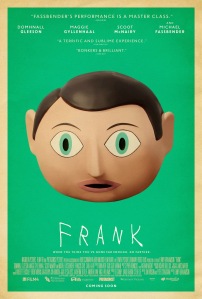
Ronson’s time with Frank and his real life alter-ego Chris Sievey inspired this bittersweet tale of Jon (Domhnall Gleeson), an office drone and wannabe songwriter whose monotonous existence spent living with his parents in a dead-end seaside town changes overnight when he stumbles across the members of Soronprfbs, an avant-garde band led by the larger-than-life Frank (Michael Fassbender), who constantly wears a giant papier-mache head that features an unblinking look of mild surprise.

Jon, like us, is fascinated by the man beneath the fake head and jumps at the chance to join Soronprfbs on a full-time basis as they take to a cottage in the middle of nowhere to record their new album, a year-long process that involves extreme levels of self-indulgence as anything and everything is toyed around with to create the perfect sound.

The band get busy working on their new album - toothbrushes included - in Frank

The band get busy working on their new album – toothbrushes included – in Frank

All the while, Jon chronicles Soronprfbs’ journey through Twitter and YouTube and creates a social media-fuelled monster that leads to a possible big break, but also threatens to destroy the soul of the band and damage the fragile Frank.

It’s not until a good way through the film that you realise just how many levels Frank is working on. In another picture, Jon’s voyage of self discovery would end in a very different – and predictable – way, but rather than helping to inspire the band to achieve deserved success, the actions he takes only end up serving his own deluded ambitions.

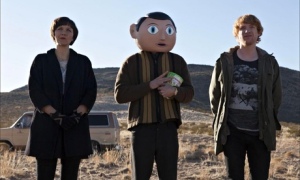
The ying and yang of Frank (Michael Fassbender) - Maggie Gyllenhaal's uncompromising Clara and Domhnall Gleeson's Jon, who just wants to be loved

The ying and yang of Frank (Michael Fassbender) – Maggie Gyllenhaal’s uncompromising Clara and Domhnall Gleeson’s Jon, who just wants to be loved

In a painfully well observed opening, Jon tries in vain to fashion a song out of his mundane experiences, only to take to social media to justify his banal existence through pointless tweets. His striving for validation is sought not only from his growing number of Twitter and blog followers whom he panders to with a running commentary of ‘aren’t I crazy’ posts, but also from his fellow band mates, who mostly look at him with indifference, in particular Maggie Gyllenhaal’s erratic theremin player Clara (who comes across like a Wes Anderson version of Karen O from the Yeah, Yeah, Yeahs).

Like Amadeus‘ Salieri, Jon knows his talent cannot match that of Frank, so instead becomes a leech in the hope his genius can somehow rub off on him. What Jon doesn’t factor in is Frank’s evident mental illness, which manifests itself through the character’s increasingly unstable behaviour.

Hello audience!! The titular Frank (Michael Fassbender) gets all dolled up

Hello audience!! The titular Frank (Michael Fassbender) gets all dolled up

It’s an admirable turn from Gleeson in a role that’s unlikable only in so much as it’s so painfully believable. Jon almost always means well, but loses his way and drags the band down with him when the prospect of fame and fortune rear their heads.

Considering we cannot see the character’s facial expressions, Frank is a captivating presence, thanks in no small part to Fassbender’s physical performance that lends the character a tragicomic edge which grows more troubling as the film nears its climax. Frank is a blank slate is many ways, a character defined by the ying of Jon’s desire to be loved and break big and the yang of Gylenhaal’s Clara, who has an indefatigable refusal to compromise for fear of selling out. Torn between both sides, the cracks in his personality threaten to break apart.

Frank’s static expression takes on a different inclination depending on the angle of Fassbender’s body and the way he turns his giant fake head, while the film’s final reel is given an extra wallop by the actor’s coiled delivery of the film’s signature tune I Love You All.

Working from a script by Ronson and fellow scribe Peter Straughn (who also penned the screenplay for The Men Who Stare At Goats), director Lenny Abrahamson skirts passed twee farce and instead hits us with a film that’s as moving as it is funny and painful.

With a free will and an outsider’s spirit all of its own, Frank is a wonderful one-of-a-kind.

Review – Starred Up

Just when you think you’ve seen all there is to offer from the well-worn prison genre, along comes this exhilarating and intelligent low-budget gem.

Starred Up Poster

Starred Up is as smart and uncompromising as it is ferocious. There’s a new daddy in town and this is it

From Cool Hand Luke (1967), to Midnight Express (1978), The Shawshank Redemption (1994) and about a million others, the prison movie lends itself to numerous different interpretations.

The most forgettable tend to be none-too-weighty action flicks that provide steady work for former wrestlers or MMA fighters, while the ones that stick in the memory are either allegorical (Cool Hand Luke‘s religious symbolism, for example) or have something to say about the world we live in.

Eric Love (Jack O'Connell) is Starred Up

Eric Love (Jack O’Connell) is Starred Up

One of the best prison movies in recent years was Jacques Audiard’s A Prophet (2009) which, apart from being genuinely nail-biting, was also overt in its politics. There are hints of A Prophet in David Mackenzie’s brutal and electrifying Starred Up as it closely follows the travails of Eric Love (Jack O’Connell), a young inmate prematurely incarcerated into an adult prison.

The film’s methodical opening reel is similar to Audiard’s masterpiece as it fixes its gaze on Eric as he is transported to jail and is processed by the guards in a deliberately intimidating fashion designed to reinforce the power structure. Unlike Tahir Rahim’s Malick from A Prophet, however, Eric is already a veteran of the penal system, having been ‘starred up’ (transferred early) from a Young Offender Institution and makes it is first act to fashion a weapon for himself.

Like father, like son... Neville (Ben Mendelsohn) discovers son Eric (Jack O'Connell) is inside in Starred Up

Like father, like son… Neville (Ben Mendelsohn) discovers son Eric (Jack O’Connell) is inside in Starred Up

Although clearly intelligent, Eric is also a caged animal and acts impulsively, more often than not out of a sense of fear. He must also deal with the discovery that he’s locked up alongside his father Neville (Ben Mendelsohn), a respected long-term convict, and forms a loose connection with the well-meaning Oliver (Rupert Friend), a therapist who wants a chance to help him.

Eric stands at a crossroads within the prison. His father represents a broken past that has led him to this place; the system, led by Sam Spruell’s loathsome Deputy Governor Hayes represents the walls that surround him in the present; while a possible future is represented by Oliver, who wants to help break the cycle of violence and self-destruction in the lives of Eric and other inmates.

Therapist Oliver Baumer (Rupert Friend) tries to help inmate Eric (Jack O'Connell) in Starred Up

Therapist Oliver Baumer (Rupert Friend) tries to help inmate Eric (Jack O’Connell) in Starred Up

The brutality of the prisoners is reflected by the guards and the authority that runs the facility. Jonathan Asser’s script (based on the writer’s own experience of having worked as a therapist in a prison) deftly lays bare the hypocrisy of a prison system that purports to want to rehabilitate its inmates, but in actuality sees the likes of Eric as nothing more than worthless scum not worth bothering with. Violence begets violence, from the bottom to the very top.

O’Connell gives a fearless performance as Eric. On his own in his cell, he betrays a pent-up look of fear that reminds us just how young he is, but around others adopts a puffed up arrogance that spills over into uncontrollable fury.

Convict Eric Love (Jack O'Connell) won't take things lying down in Starred Up

Convict Eric Love (Jack O’Connell) won’t take things lying down in Starred Up

Eric’s complicated relationship with his father is the heart of the film and both actors give it everything they’ve got. Eric initially cannot look Neville in the eye when they first encounter each other in the prison yard and the anger and disappointment felt by his father is palpable. Neville, whose impulse towards savagery is shared by Eric, is torn between looking out for his son and wanting to knock seven bells out of him, and it’s absorbing watching how one side slowly wins out over the other.

Needless to say the violence is shocking and visceral, but then it has to be when you consider the environment these people exist in.

Starred Up is as smart and uncompromising as it is ferocious. There’s a new daddy in town and this is it.

Review – Calvary

What does a world-weary man of faith do when those around him seek to drag him down to the moral cesspool?

This marks the middle chapter in a planned trilogy between director and actor. On the strength of Calvary, we should be spoiled indeed

This marks the middle chapter in a planned trilogy between director and actor. On the strength of Calvary, we should be spoiled indeed

The arduous journey taken by the imperiled Father James (Brendan Gleeson) is the focal point of John Michael McDonagh’s pitch perfect follow-up to his promising debut The Guard (2011).

McDonagh shares an envious talent for dialogue with his brother, the playwright and filmmaker Martin McDonagh (In Bruges, Seven Psychopaths) and on this occasion finds the visual panache that was sometimes lacking in his previous work.

Father James (Brendan Gleeson) receives a visit from his daughter Fiona (Kelly Reilly) in Calvary

Father James (Brendan Gleeson) receives a visit from his daughter Fiona (Kelly Reilly) in Calvary

There’s a striking power to the pit of anger and self-loathing that has engulfed the residents of this Irish coastal village, none more so than in the masterful opening scene; an unbroken four-minute take that rests on Gleeson’s wonderfully nuanced reactions to a faceless parishioner’s declaration during confession that he is going to kill him as retribution against the Catholic church for allowing the abuse he suffered as a child at the hands of a fellow priest to go unpunished.

James is told to put his affairs in order and spends what we believe are his last days meeting with his disaffected flock, including a butcher (played by Chris O’Dowd), a doctor (Aidan Gillen) and a successful businessman (Dylan Moran), and building bridges with his depressed daughter Fiona (Kelly Reilly), who has come to visit following a failed suicide attempt.

Father James (Brendan Gleeson) gets a butchers with Jack Brenan (Chris O'Dowd) in Calvary

Father James (Brendan Gleeson) gets a butchers with Jack Brennan (Chris O’Dowd) in Calvary

The whodunnit aspect of the story is a smoke screen for what the film is really about; specifically the loss of faith in both institutions and ourselves and the rage that stems from this towards those in power. Calvary is the Biblical location where Jesus was crucified and the comparison becomes clear as McDonagh’s film plays out.

High Noon is a clear influence (a newspaper he’s reading early in the film refers to Ireland’s “wild wild west”) while, much like Tommy Lee Jones’ sheriff in No Country For Old Men, James is bewildered by the peccancy that seeps out of the village.

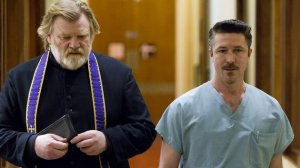
Father James (Brendan Gleeson) is joined by Dr Frank Harte (Aidan Gillen) in Calvary

Father James (Brendan Gleeson) is joined by Dr Frank Harte (Aidan Gillen) in Calvary

Each of the villagers he visits is a ‘sinner’ in some form; whether it be of a sexual or moralistic nature (Moran’s repugnant capitalist worships only materialism and believes there’s “no such thing as too much; there’s only not enough”); even his daughter is a sinner in the eyes of the church for having tried to take her own life.

Tellingly though, in spite of their ridicule and goading, most of the locals feel a compulsion to talk to James; as such the character is in essence a vessel to offload their self-loathing.

Someone is determined to make a point in Calvary

Someone is determined to make a point in Calvary

Calvary‘s heightened reality (the moon sits enormously in the sky, for example) and broadly brushed supporting characters can take you out of the film, but its pitch black humour (delivered more often than not by a sardonic James) and wry observations on the dirty affair between the church, its public image and money are on the nose.

The international cast (which includes Isaach de Bankolé and an ancient looking M. Emmet Walsh) are roundly excellent, but all pale in comparison against Gleeson’s supreme performance. Gleeson seems to get better with age and his effortlessly indomitable delivery belies the complexity of a role that one can only imagine this actor inhabiting.

This marks the middle chapter in a planned trilogy between director and actor. On the strength of Calvary, we should be spoiled indeed.

Review – Locke

On paper not the most enticing or exciting of prospects, it says a lot about the powerhouse performance of its sole operator that Locke is such an impressive feature.

The film's visual signature is understandably sparse (there's only so many ways you can film the inside of a car) but that only serves to focus attention further on one of the performances of the year. Locke is a long dark night of the soul you won't forget

The film’s visual signature is understandably sparse (there’s only so many ways you can film the inside of a car) but that only serves to focus attention further on one of the performances of the year. Locke is a long dark night of the soul you won’t forget

In recent years we’ve seen a growing number of experimental films based solely within a single location; movies that offer a welcome divergence from what is normally drip fed via the studios.

Standouts include the excellent Rodrigo Cortés nail-biter Buried (2010), the little seen psychological thriller Exam (2009) and zombie movie Pontypool (2008) and Steven Knight’s claustrophobic road movie is a strong addition to this micro-genre.

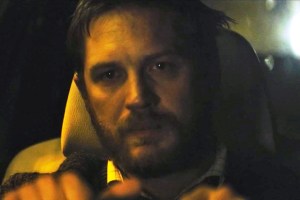
In the case of Locke, the restrictions it places on itself are particularly constraining. Its singular location is a BMW car being driven by construction foreman Ivan Locke (Tom Hardy), whose decision one evening to drive to London from Birmingham has far-reaching consequences not only on his professional career but also his marriage and family.

A long dark night of the soul awaits Ivan Locke (Tom Hardy) in Locke

A long dark night of the soul awaits Ivan Locke (Tom Hardy) in Locke

As Ivan makes his fateful drive, we see the consequences of his actions play out through the increasingly fraught telephone conversations he has with wife Katrina (Ruth Wilson), son Eddie (Tom Holland), work colleague Donal (Andrew Scott) and boss Gareth (Ben Daniels); as well as with another woman Bethan (Oliva Colman). Never has the cooly automated message “you have a call waiting” had such charged overtones.

It’s no surprise Hardy jumped at the chance to flex his acting muscles following a number of physically intimidating turns in the likes of The Dark Knight Rises (2012) and Warrior (2011) and he delivers a bravura performance of a man whose methodical existence is ripped asunder as the pressure mounts.

Tom Hardy gives a mesmerising performance in the central role of Locke

Tom Hardy gives a mesmerising performance in the central role of Locke

Shot in real-time, Hardy visibly ages and deteriorates. Even his body works against him as the effects of a cold virus take hold. Hardy’s Welsh accent and tightly coiled stoicism brings to mind early Richard Burton and it’s a testament to the strength of his presence on screen that the comparison is entirely appropriate.

Such a performance therefore doesn’t need a script that can’t help trowelling on the metaphor. We learn very early on that concrete plays a big part of Locke’s life and Knight doesn’t shy away from laying on the symbolism as the foundations begin to crumble under his character’s feet.

The foundations begin to crumble in Locke

The foundations begin to crumble in Locke

By using the wrong concrete, Locke informs Donal, “cracks appear and they will grow and grow until they collapse”.  And as if we haven’t deduced the analogy, he goes to say: “You make one little mistake and the whole world comes crashing down around you.”

As the walls close in, Locke’s fractured psyche reveals itself through one-way conversations he has with his neglectful dad through the rear view mirror. He’s determined not to repeat the sins of the father, but events seem to suggest otherwise and, tellingly, he subconsciously looks into the same mirror as he talks to his son.

The film’s visual signature is understandably sparse (there’s only so many ways you can film the inside of a car), but that only serves to focus attention further on one of the performances of the year. Locke is a long dark night of the soul you won’t forget.