Review: Me And Earl And The Dying Girl

The Sundance seal of approval may have put off some, but don’t let the prospect of yet another young adult adaptation deter you from this charming little indie.

Me And Earl And The Dying Girl is a wholly pleasant surprise that will charm and moves you in equal measure

Me And Earl And The Dying Girl is a wholly pleasant surprise that will charm and moves you in equal measure

It’s not too difficult to imagine just how painful Me And Earl And The Dying Girl could have turned out in the wrong hands, but Alfonso Gomez-Rejon avoids cranking the quirk-ometer up to 11 and instead draws affecting and appealing performances from his young leads.

That being said, the film takes a little while to find its feet as the angular camera moves (characters often deliberately appear at the side of a frame, for instance), Wes Anderson-friendly chapter headings and twee stop motion animation suggest a tough 105 minutes awaits.

However, Thomas Mann’s Greg, the “Me” of the title, soon wins you over with his hangdog self-deprecation.

Me and Earl: Greg (Thomas Mann) and Earl (Ronald Cyler II) IN Me And Earl And The Dying Girl

Me and Earl: Greg (Thomas Mann) and Earl (Ronald Cyler II) IN Me And Earl And The Dying Girl

Narrated in self-referentially cinematic fashion by Greg, we’re introduced to life in his small corner of Americana, which involves trying to ignore advice from his well-meaning parents (Connie Britton and Nick Offerman, who doesn’t seem to work which raises the question of how they are able to afford to live how they do), being on the periphery of the school’s various cliques and hanging out with Earl (Ronald Cyler II).

Greg doesn’t describe Earl as his friend, rather his “co-worker” due to the numerous movie pastiches they’ve filmed together, including Senior Citizen Cane, A Sockwork Orange and The 400 Bros. Greg’s obvious attachment issues are put to the test when he’s reluctantly persuaded to spend time with fellow student Rachel (Olivia Cooke), who has been diagnosed with leukemia. A frosty acquaintance gradually thaws into something altogether warmer, though, as Greg, Rachel and Earl form a sweet bond.

Me and the dying girl: Greag (Thomas Mann) and Rachel (Olivia Cooke) in Me And Earl And The Dying Girl

Me and the dying girl: Greg (Thomas Mann) and Rachel (Olivia Cooke) in Me And Earl And The Dying Girl

Me And Earl And The Dying Girl manages to work almost in spite of itself. The best teen movies are invariably the ones that try least hard to be teen movies. Jesse Andrews’ screenplay, based on his novel of the same name, doesn’t feed arch, ham-fisted dialogue to its characters; rather it creates a world which feels lived in and – largely – succeeds in avoiding overly saccharine life-lessons.

The film also benefits greatly from the excellent chemistry of its core triumverate; Cooke especially, who has a spikiness that hides a scared fragility that is refreshing in a character such as this and builds on the good work she’s done in TV series Bates Motel (also playing a sickly teen – don’t get yourself typecast Olivia).

A few of the movie pastiches in Me And Earl And The Dying Girl

A few of the movie pastiches in Me And Earl And The Dying Girl

Despite being served with the occasional duff line (“titties” gets mentioned more than once), Cyler’s Earl is arguably the most interesting character, if only because you are so keen to find out more about his upbringing, which has seemingly involved growing up in a desperately run-down neck of the woods.

The film is at its best when it indulges in its love of cinema, something that serves as catnip for movie lovers who can spot the various references to the likes of Powell and Pressburger, Herzog and Truffaut, alongside all the affectionately staged reproductions of many well-loved moving pictures.

Me And Earl And The Dying Girl is a wholly pleasant surprise that will charm and moves you in equal measure.

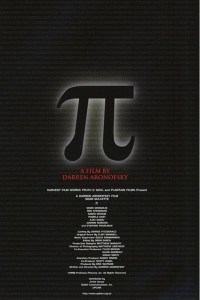
Great Films You Need To See – Pi (1998)

This is my latest contribution to The Big Picture, the visually focused film magazine that proves there’s more to film than meets the eye. The Big Picture is running a series of features and reviews throughout August with the theme of ‘outsiders, loners and losers’. This piece is part of the site’s Lost Classics section (featuring in my list of Great Films You Need To See), in this case Darren Aronofsky’s debut Pi.

It’s a trait that has remained constant throughout much of his career, but the dangerous consequences of obsession were never more strikingly explored than in Darren Aronofsky’s distinctive debut.

Filmed on jarring black and white reversal film stock, the high contrast it provides to Pi (1998) is emblematic of the madness/genius see-saw its gifted young mathematician Max Cohen (Sean Gullette) rides as he becomes progressively more consumed with finding a numerical pattern that unlocks the door to life, the universe and everything.

Aronofsky's Pi adds up to an absorbing and idiosyncratic calling card for its uncompromising director and a compulsive study in the destructive power of obsession

Aronofsky’s Pi adds up to an absorbing and idiosyncratic calling card for its uncompromising director and a compulsive study in the destructive power of obsession

As Max himself states: “One – mathematics is the language of nature. Two – everything around us can be represented and understood through numbers. Three – if you graph the numbers though any system, patterns emerge. Therefore there are patterns everywhere in nature.”

Shot through Max’s POV or in tight close up (occasionally through the disarming use of steadicam), we see the world through his repressed and paranoid perspective. He lives in a cramped apartment swallowed up by a vast computer system he’s built to reveal the pattern that exists behind the numbers of the New York Stock Exchange.

Do the math: Max Cohen (Sean Gullette) in Pi

Do the math: Max Cohen (Sean Gullette) in Pi

Despite keeping human contact to a bare minimum – his only acquaintance is former maths teacher Sol (Mark Margolis) – he attracts the unwanted attention of a Wall Street analysis firm keen to exploit him; and Lenny, part of a radical group of Hasidic Jews that believe Max is the vessel to reveal the 216-digit string of numbers hidden within the Torah that imparts the true name of God.

Max Cohen (Sean Gullette) finds the goden spiral pattern in the universe in Pi

Max Cohen (Sean Gullette) finds the golden spiral pattern in the universe in Pi

The conspiracy theories, mysticism and high level maths may make for a good thriller and feed the pre-millennial angst that was rife at the time of the film’s release, but Pi is at its strongest as an unnerving psychological horror of one man’s descent into the very spiral he believes represents the pattern to end all patterns.

Clint Mansell’s aggressive electro score, in turns intriguing and nightmarish, is the perfect soundtrack to the chaos that plays out in Max’s mind, most discordantly during the increasingly debilitating headaches he experiences.

Peek-a-boo: Max Cohen (Sean Gullette) in Pi

Peek-a-boo: Max Cohen (Sean Gullette) in Pi

Aronofsky takes a number of visual cues from the industrial horrors of David Lynch’s Eraserhead (1977), while the nod to Japanese cyberpunk classic Tetsuo: The Iron Man (1989) can be seen in Max’s search for the soul in the machine.

The director’s doffing of the cap to Twilight Zone creator Rod Serling as “the patron saint of the movie” also makes sense when considering how that TV show’s penchant for the cautionary tale fits neatly alongside the numerous references Max makes to Icarus; the tragic figure from Greek mythology who ignored the warnings and flew too close to the sun.

Driller killer: Maths genius Max Cohen (Sean Gullette) in Pi

Driller killer: Maths genius Max Cohen (Sean Gullette) in Pi

Max’s obsession with the golden spiral, meanwhile, is reflected in much of the film’s imagery, from the swirl of milk in a stirred cup of coffee, to the circular journey of a paper plane; and the 360-degree movement of the camera as it coils around him.

Aronofsky’s Pi adds up to an absorbing and idiosyncratic calling card for its uncompromising director and a compulsive study in the destructive power of obsession. Do the math.

Review – Mission: Impossible – Rogue Nation

In a summer that’s seen a car traverse skyscrapers and a woman in high heels managing to outrun a Tyrannosaurus Rex, the sight of Tom Cruise clinging onto the side of a plane as it takes off should be the most ridiculous of them all.

Finding the right balance of engaging espionage and flat-out action, Mission: Impossible - Rogue Nation is a Cruise missile that really delivers the goods

Finding the right balance of engaging espionage and flat-out action, Mission: Impossible – Rogue Nation is a Cruise missile that really delivers the goods

That Cruise insisted on doing his own stunt speaks to the star’s commitment to a franchise that has outlasted most actor’s entire careers.

John Woo’s dated and misjudged 2000 M:I 2 aside, each of the Mission: Impossible movies has forged its own identity and brought something different to a genre that’s well endowed with memorable figureheads.

Just another day at the office: Tom Cruise plays Ethan Hunt in Mission: Impossible - Rogue Nation

Just another day at the office: Tom Cruise plays Ethan Hunt in Mission: Impossible – Rogue Nation

A big reason for this is because each film is helmed by a different director and in Rogue Nation it’s Christopher McQuarrie’s turn to sit in the big chair. His association with Cruise can be traced back to Valkyrie (2008) and the pair have worked together numerous times since, most recently in 2012’s so-so Jack Reacher (McQuarrie’s previous film as director) and in the underappreciated Edge Of Tomorrow (2014), which McQuarrie wrote.

That partnership bears fruit in M:I 5, which sees Ethan Hunt (Cruise) and his cohort of fellow IMF-ers Benji (Simon Pegg), Luther (Ving Rhames) and Brandt (Jeremy Renner) going up against the Syndicate, a SPECTRE-like terrorist consortium that wants to bring Hunt down almost as much as CIA Director Hunley (Alec Baldwin) does. As Hunt tries to get to the bottom of who and what the Syndicate are, he encounters the mysterious Ilsa Faust (Rebecca Ferguson), an agent seemingly working for both sides.

Kick ass MI6 agent Ilsa Faust (Rebecca Ferguson) in Mission: Impossible - Rogue Nation

Kick ass MI6 agent Ilsa Faust (Rebecca Ferguson) in Mission: Impossible – Rogue Nation

The one area the M:I franchise has struggled with most has been with its villains, so it’s pleasing that in the Syndicate and its nefarious leader (played with psychotic calm by Brit Sean Harris) Hunt finally faces an opponent that is his match.

Where Mission: Impossible has never struggled has been in its set pieces and Rogue Nation delivers some of the best blockbuster action you’ll see all summer. The much-hyped plane dangling sequence would be the climax of most action movies, but here it’s merely the preamble for what’s to come; a rip-roaring adrenaline shot that Bond would be proud of.

Sardonic IMF agent Benji Dunn (Simon Pegg) in Mission: Impossible - Rogue Nation

Sardonic IMF agent Benji Dunn (Simon Pegg) in Mission: Impossible – Rogue Nation

While the prologue has garnered the most attention, the film’s best set pieces take place later in the film, the first and best being a stand out and nail-biting sequence at the Vienna Opera House that invokes Hitchcock’s The Man Who Knew Too Much and is soundtracked to suitably dramatic effect by the performance of Puccini’s Turandot taking place inside the hall. A later sequence involving an underwater break-in a Moroccan power station may not be as strong as the Langley infiltration from Brian De Palma’s 1996 original, but it’s the sort of material the Mission: Impossible franchise does so well.

While his personal belief system may be just this side of loony tunes, it’s hard not to be won over by Cruise the performer and once again he’s up to the task. Quite how long he can kep putting his aging body through the rigors that such a film as this demands is anyone’s guess, but for a guy who’s now settled into his early fifties, he handles himself as well as he did back when the franchise kicked off almost 20 years ago.

IMF-ers Luther Stickell (Ving Rhames) and William Brandt (Jeremy Renner) in Mission: Impossible - Rogue Nation

IMF-ers Luther Stickell (Ving Rhames) and William Brandt (Jeremy Renner) in Mission: Impossible – Rogue Nation

Mission: Impossible should never just be about Ethan Hunt, though and it’s good to see his co-stars getting a fair crack of the whip (Rhames’ Luther aside), most notably Ferguson who gives a star-making turn as an ass-kicking agent who can look after not only herself but Hunt too and has the wherewithal to take off her high heels when serious running is required.

Finding the right balance of engaging espionage and flat-out action, Mission: Impossible – Rogue Nation is a Cruise missile that really delivers the goods.

In Retrospect – Top Gun (1986)

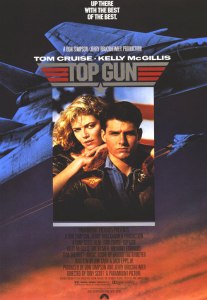
Product placement has been prevalent in the movies for decades; however, few can claim to have had their product so ingrained within each frame as the U.S military in Tony Scott’s Top Gun.

In spite of its many flaws, Top Gun remains an adrenalin shot to the stupid, nostalgic part of the brain that should know better

In spite of its many flaws, Top Gun remains an adrenalin shot to the stupid, nostalgic part of the brain that should know better

It’s no surprise the Navy set up recruitment booths in some cinemas showing what must have been a Fleet Admiral’s wet dream and it’s a marketing ploy that paid dividends; the number of impressionable young men wanting to enlist as Naval Aviators after watching the movie soared by 500 per cent – not to mention the boost in sales for aviator sunglasses and bomber jackets.

One scene set in a men’s shower room even has an actual recruitment poster prominently on display; somewhat ridiculous bearing in mind it takes place in Top Gun HQ, wherein everyone already works for Uncle Sam.

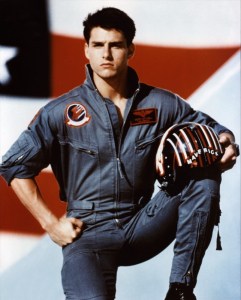
Maverick (Tom Cruise) in full-on flag waving fascist pose in Top Gun

Maverick (Tom Cruise) in full-on flag waving fascist pose in Top Gun

Jumping into bed with the U.S military normally results in a super serious square-jawed circle jerk like Act Of Valor (2012), but Top Gun is so unashamedly over-the-top and, well, 80s it somehow manages to get away with it.

Based on a magazine article, Top Gun promised to be the kind of sky high concept popcorn entertainment that Don Simpson and fellow super-producer Jerry Bruckheimer had already refined with Flashdance (1983) and Beverley Hills Cop (1984).

80s hair! 'Charlie' Blackwood (Kelly McGillis) in Top Gun

80s hair! ‘Charlie’ Blackwood (Kelly McGillis) in Top Gun

With up-and-coming Brit Scott (who would come to exemplify the brand of glossy action cinema so beloved of Simpson and Bruckheimer) at the helm, Top Gun was packaged in much the same way as Beverley Hills Cop – with one eye on the soundtrack sales and the other on the box office.

The film’s central figure is Naval Aviator Lt Pete Mitchell (Tom Cruise), who is  ‘Maverick’ by callsign and maverick by nature; a genius pilot deemed “dangerous” by rival pilot Tom ‘Iceman’ Kazanski (Val Kilmer) because he defies orders and is a lone wolf. Maverick and his partner-in-flying Nick ‘Goose’ Bradshaw (Anthony Edwards) are selected against their commanding officer’s better judgement to attend the Top Gun school to compete against “the best of the best” to see who is number one.

Iceman (Val Kilmer) dominates the beach volleyball arena in Top Gun

Iceman (Val Kilmer) dominates the beach volleyball arena in Top Gun

There he meets Top Gun instructor ‘Charlie’ Blackwood (Kelly McGillis), who succumbs to Maverick’s winning smile and cocky nature. However, after tragedy strikes, a guilt-ridden Maverick must once again find his edge when a crisis situation emerges.

It’s fair to say the script was probably not the important piece of the puzzle when it came to bringing Top Gun to the screen. The film is absolutely rammed with clunky dialogue; be it Jester (Michael Ironside) saying “I don’t know… I just don’t know” when Viper (Tom Skerritt) asks if he’d have Maverick on his side; Stinger (James Tolkan) informing Maverick that “your ego is writing checks your body can’t cash”; and Viper, during a heart-to-heart with Maverick saying “what I’m about to tell you is classified; it could end my career”.

"For the reord, I'm not gay": Maverick (Tom Cruise) and Goose (Anthony Edwards) in Top Gun

“For the record, I’m not gay”: Maverick (Tom Cruise) and Goose (Anthony Edwards) in Top Gun

As you’d imagine of a film whose script was altered at the Navy’s request, Top Gun flies the Stars and Stripes with fascistic gusto. Whilst the old Soviet Union is never named in the film, it’s abundantly obvious the unnamed enemy at the end of the movie is the ‘Evil Empire’ which you’d imagine would make the open warfare that breaks out in the skies a genuinely disturbing diplomatic development; however, it’s brushed under the carpet with a shot of Cruise’s trademark grin.

The movie’s homoeroticism (most famously dissected by Quentin Tarantino in 1994’s Sleep With Me) is comically rampant, from the (in)famous beach volleyball scene (soundtracked by Kenny Loggins’ Playing With The Boys no less), to the shower room confrontations and hilarious dialogue (“This gives me a hard on”/”Don’t tease me”).

There's that smile: Tom Cruise plays Maverick in Top Gun

There’s that smile: Tom Cruise plays Maverick in Top Gun

Dodgy discourse aside, Top Gun‘s money shot remains its excellent aerial sequences and it’s here where the filmmakers’ partnership with the Navy pays off. The odd dodgy special effect aside (Maverick’s inverted encounter with a MIG looks pretty lame), the shots of Tomcat aircraft leaving an aircraft carrier are still awesome, while the dogfighting sequences involving multiple planes are among the best since Howard Hughes’ Hell’s Angels (1930).

In spite of its many flaws, Top Gun remains an adrenalin shot to the stupid, nostalgic part of the brain that should know better.

Review – Ant-Man

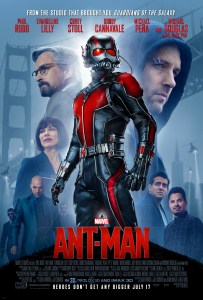
The smallest superhero on the block finally crawls onto the big screen – but is it an import-ant addition to the Marvel Cinematic Universe or just p-ants?

There's enough potential here for a fun and unpretentious franchise; Ant-Man proves that good things can come in small packages

There’s enough potential here for a fun and unpretentious franchise; Ant-Man proves that good things can come in small packages

The knives were being sharpened by many for Marvel’s latest when Edgar Wright, who had been attached to the project before The Avengers was a glimmer in head honcho Kevin Feige’s eye, left the project due to reported ‘creative differences’ and garnered plenty of sympathy in the process.

As is Marvel’s wont, the studio again went against convention by hiring the little known Peyton Reed, whose biggest hit until now had been the forgettable Jim Carrey vehicle Yes Man (2008) (he also helmed 2006’s The Break-Up; another one of Vince Vaughn’s painful ‘comedies’).

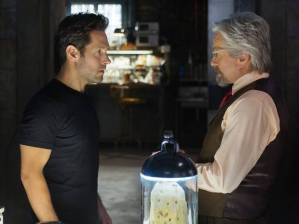
The Ant-Man mantle is passed from Hank Pym (Michael Douglas) to Scott Lang (Paul Rudd) in Ant-Man

The Ant-Man mantle is passed from Hank Pym (Michael Douglas) to Scott Lang (Paul Rudd) in Ant-Man

Bearing in mind the tight schedule Reed inherited to meet the film’s summer release date – as well as the fact its star Paul Rudd and Anchorman‘s Adam McKay weighed in on Wright and Joe Cornish’s initial script – it’s pleasantly surprising how well Ant-Man holds up.

The story itself is relatively lean. Newly released prisoner Scott Lang (Rudd) finds himself unwittingly recruited by former S.H.I.E.L.D super-scientist Hank Pym (Michael Douglas) to inherit the mantle of  the Ant-Man. Lang dons the suit and is trained by Pym and his estranged daughter Hope van Dyne (Evangeline Lilly) to properly use the powers inherent in the Ant-Man suit in order to stop Pym’s former protégé Darren Cross (Corey Stoll) from perfecting his own miniaturizing suit – the Yellowjacket – and using it to revolutionise warfare.

Nice bob: Hope van Dyne (Evangeline Lilly) in Ant-Man

Nice bob: Hope van Dyne (Evangeline Lilly) in Ant-Man

After the excessive bombast of Avengers: Age Of Ultron, it’s refreshing to watch a Marvel movie that manages to avoid its now familiar epic final act with something that, logically in this case, is much smaller in scale. Instead of duking it out on a giant airship or throwing a nondescript foreign city up in the air, Ant-Man‘s final battle takes place in the far more modest surroundings of a suburban house (involving a genuinely inventive and amusing train sequence).

The film also manages maintain a light and breezy tone in spite of the studio’s usual shenanigans; poking fun at the concept of a man being able to zap himself down to the size of an insect whilst avoiding the pitfall of descending into lame farce.

Can you guess which one is dodgy Darren Cross (Corey Stoll) in Ant-Man

Can you guess which one is dodgy Darren Cross (Corey Stoll) in Ant-Man

The casting of Rudd certainly signalled the direction the studio was going in for Ant-Man, although the transition from comic actor (with the occasional dramatic role) to superhero was never going to be a given and it’s to Rudd’s credit that he just about sells the action alongside the comedy.

This knowing self-deprecation comes to the fore when Lang comes up against an Avenger and can’t help apologising to his opponent when he somehow manages to get the better of him.

Scott Lang (Paul Rudd) dons the superhero suit in Ant-Man

Scott Lang (Paul Rudd) dons the superhero suit in Ant-Man

He’s lent great support from the ever-versatile Michael Peña, who plays Lang’s former cellmate and is part of the crew who gets dragged into the plan to steal the Yellowjacket. Peña’s comic timing is first-rate, while his character’s decision to save a security guard he knocked out earlier is a nice touch.

Douglas is given the heavy lifting script-wise with exposition-aplenty, but if there’s one actor you can rely on to deliver reams of dialogue with effortless charisma it’s Mr Gordon Gekko. Douglas’ presence adds heft to what is ultimately a light and frothy blockbuster and his scenes with Rudd are among the film’s highlights.

Luis (Michael Peña), Dave (Tip "T.I." Harris) and Kurt (David Dastmalchian) plan their next job in Ant-Man

Luis (Michael Peña), Dave (Tip “T.I.” Harris) and Kurt (David Dastmalchian) plan their next job in Ant-Man

Lilly, on the other hand, struggles to make much of the movie’s sole female part. Sporting a harsh black bobbed haircut which lazily exemplifies her cool exterior, Hope is clearly far more qualified than Lang to don the Ant-(Wo)Man suit, but is instead there to merely roll her eyes and serve the plot. Pity.

It will be interesting to see how the Ant-Man fits into the rest of the Marvel Cinematic Universe as it moves into its latest globe-swallowing phase. There’s enough potential here for a fun and unpretentious franchise; Ant-Man proves that good things can come in small packages.