Review – 10 Cloverfield Lane

Alfred Hitchcock may sadly no longer be with us, but the Master of Suspense would surely have approved of this absorbing psychological thriller.

So what next for this cross-genre film series after 10 Cloverfield Lane? A romantic comedy? Film noir? Either way, count me in

So what next for this cross-genre film series after 10 Cloverfield Lane? A romantic comedy? Film noir? Either way, count me in

It’s impressive in this day and age to produce a movie that’s so far under the radar it’s mysterious and intriguing trailer is pretty much all that anyone really knows about it prior to release.

The fact that it was renamed 10 Cloverfield Lane (developed from a script called The Cellar) and was touted as existing in the same universe as Cloverfield (2008) only served to whet the appetite even further.
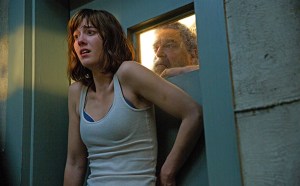
Just what you need - Roseanne's Dan Conner trying to get in

Just what you need – Roseanne’s Dan Conner trying to get in

While its association with Matt Reeves’ found footage creature feature (it’s been deemed a “blood relative”) has no doubt helped to raise the profile of what would otherwise have been a low-budget thriller, the move courtesy of marketing puppet master J.J. Abrams could so easily have backfired had Dan Trachtenburg’s debut feature not been as smart and tightly wound as it is.

Indeed, 10 Cloverfield Lane stands very firmly on its own two feet thanks to a confident narrative that’s as compelling as it is suffocating and uniformly excellent performances from its terrific trio of actors.

I think we know something bad's around the corner in 10 Cloverfield Lane

I think we know something bad’s around the corner in 10 Cloverfield Lane

Mary Elizabeth Winstead plays Michelle, who awakes from a nasty car accident to find she’s confined to an underground bunker owned by Howard (John Goodman). Howard claims that, rather than being her captor, he’s actually saved her from an apocalyptic event that has turned the outside air toxic; an assertion given credence by Emmett (John Gallagher Jr). However, is everything it seems to be; both inside and outside the bunker?

The Hitchcock homage is present from the first shot of the film – Michelle hurriedly packing a case and leaving town is straight out of the opening of Psycho (1960), while it’s no accident that Bear McCreary’s jittery score invokes Bernard Herrmann.

Michelle (Mary Elizabeth Winstead) does her best John McClane in 10 Cloverfield Lane

Michelle (Mary Elizabeth Winstead) does her best John McClane in 10 Cloverfield Lane

Likewise, the air of paranoia, mistrust and switching sympathies was present and correct in much of Hitch’s work, while the (mostly) single location brings to mind the psychological suspense of Rope (1948).

Goodman once again proves why he’s one of the most versatile characters actors at work today, delivering a performance that veers between creepy, sinister, misunderstood and sympathetic. Goodman’s imposing physical presence is often juxtaposed with a softness of touch that makes you question whether he’s nuts, canny or both.

Gallagher Jr also brings his A-game, playing a nice-but-somewhat-dim former jock who once had the chance to escape the clutches of his small town but chose to stay put (a nice analogy of his present predicament).

What's that? Godzilla's up there?

What’s that? Godzilla’s up there?

Winstead, meanwhile, is excellent as Michelle, a refreshingly resilient ‘final girl’ who makes smart, informed choices and proves herself to be far stronger than she first thought. A nicely played exchange with Emmett (in which the characters have their backs to each other whilst being separated by a concrete wall) reveals more about Michelle’s inclination towards flight rather than fight and is brought to mind during a pivotal moment at the very end of the film.

Trachtenburg weaves in plenty of neat touches, including a cute montage of the trio playing the perfect nuclear (bunker) family, which highlights the absurd ‘normality’ of their situation and is nicely reminiscent of the playful ‘life goes on’ montage amid the devastation of the outside world in Dawn Of The Dead (1978).

So what next for this cross-genre film series? A romantic comedy? Film noir? Either way, count me in.

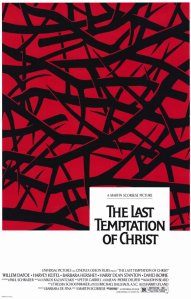
In Retrospect – The Last Temptation Of Christ (1988)

The life of Christ has never been more passionately – or controversially – depicted on screen than in Martin Scorsese’s long-held labour of love.

One of Scorsese's most underseen and undervalued works, The Last Temptation Of Christ demands to be seen

One of Scorsese’s most underseen and undervalued works, The Last Temptation Of Christ demands to be seen

The crippling weight of guilt and the quest for redemption imprint themselves on many of Scorsese’s leading men; an acknowledged product of a devout Catholic upbringing that lapsed into the shadows as his love of cinema burned brighter.

Scorsese’s complex relationship with religion (he seriously considered taking the cloth to become a priest for a time) manifests itself in this deeply personal and spiritual adaptation of Nikos Kazantzakis’s novel, whose doubting and fearful protagonist is the embodiment of the characters who have stumbled uncertainly through much of the director’s work.

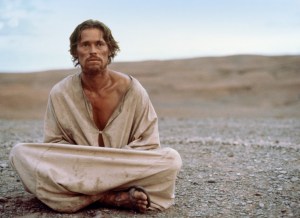
Jesus (Willem Dafoe) goes into the desert in The Last Temptation Of Christ

Jesus (Willem Dafoe) goes into the desert in The Last Temptation Of Christ

On its release, The Last Temptation Of Christ was met with fire and brimstone in certain sections of the Christian faith and media, most notably by one extremist group who set fire to the Saint Michel theatre in Paris for showing the film, injuring more than a dozen people in the process.

Whether any of these people took the time to watch the film before passing judgement is hard to say (it is a long movie to be fair), but it’s perhaps not hard to see why some took so vehemently against it considering the subject matter.

should their views be based on heresay or downright ignorance

No doubt realising its potentially combustible nature, the film opens with a statement making clear that, rather than being drawn from the Gospels it is, like Kazantzakis’s book, a work divorced from the events depicted in the Bible; a parallel universe where the life of Christ follows a similar path before embarking on a final act that is entirely its own.

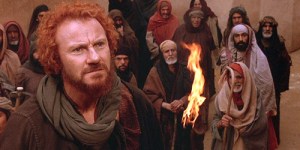
Judas (Harvey Keitel) and the disciples follow Jesus in The Last Temptation Of Christ

Judas (Harvey Keitel) and the disciples follow Jesus in The Last Temptation Of Christ

That final act is the eponymous last temptation when Jesus (Willem Dafoe) has a near-death vision of stepping down from the cross with the help of a figure claiming to be a guardian angel and leading the life of a normal man. Happiness (including consummating his relationship with Mary Magdalene (Barbara Hershey)) comes with a price, however, and it takes his most trusted follower Judas (Harvey Keitel, Brooklyn accent intact) to make him realise just what it is he has done.

Portrayals of Jesus almost overwhelmingly veer towards solemnity and reverence, which makes this depiction of Christ so fascinating. In the hands of Dafoe, this messiah is plagued with self-loathing, fear and doubt; a figure aware of his relationship with God but deeply unsure of whether he is up to the task or, indeed, what that task actually is.

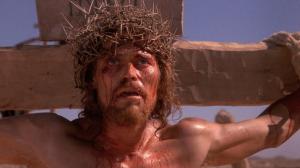
Jesus (Willem Dafoe) faces his last temptation in The Last Temptation Of Christ

Jesus (Willem Dafoe) faces his last temptation in The Last Temptation Of Christ

A pointed image at the start of the film comes as Jesus builds a cross for someone’s crucifixion and stretches his arms out across the wooden block to ensure it is fit for purpose. We discover, shockingly, that he is a Roman collaborator whose confederacy is looked upon with disgust by the turbulent Judas.

He confesses to Judas at one point that he is “a liar, a hypocrite, I’m afraid of everything, I don’t ever tell the truth; I don’t have the courage” before adding that “I want to rebel against God but I’m afraid. You want to know who my God is? Fear”.

As others are drawn to his inherent divinity, Jesus starts to believe in his calling, but that underlying doubt remains, not least when he performs the miracle of resurrecting Lazarus from the dead only to be struck by an inner apprehension that registers on Dafoe’s expressive face.

The late David Bowie plays Pilate opposite Willem Dafoe's Jesus in The Last Temptation Of Christ

The late David Bowie plays Pilate opposite Willem Dafoe’s Jesus in The Last Temptation Of Christ

Scorsese’s camera is more restrained than usual, although some of Marty’s trademark visual flourishes are here, including zooms and the familiar gliding of the camera from a one-shot to a two-shot.

The rushed production schedule (a necessity due to the limited budget) actually works to the film’s advantage, with certain scenes having a rough and ready feel that suits both the landscape and the narrative; particularly the hippyish gathering that takes place around John the Baptist (Andre Gregory) which brings to mind chaotic images of Woodstock.

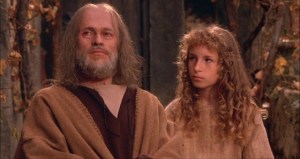
An elderly Jesus (Willem Dafoe) realises all is not as it appears to be in The Last Temptation Of Christ

An elderly Jesus (Willem Dafoe) realises all is not as it appears to be in The Last Temptation Of Christ

Alongside these moments, the film also takes the time to theologise about man’s place in this world and the nature of God. Jesus and John find themselves at loggerheads over whether the Almighty wishes his followers to be Old or New Testament, while a back and forth between a newly arrested Jesus and a blasé Pontius Pilate (David Bowie) doesn’t end well.

One of Scorsese’s most underseen and undervalued works, The Last Temptation Of Christ demands to be seen and remains an important chapter in the book of cinema’s treatment of religion.

Review – Deadpool

The huge success of Marvel’s latest arguably says more about the conveyor belt of A+B=C comic book superhero movies than it does about the quality of the Merc with a Mouth’s first solo outing.

Deadpool is fun and smart; just not as fun and smart as it thinks it is

Deadpool is fun and smart; just not as fun and smart as it thinks it is

That’s not to say Deadpool is a bad picture – it’s not. Rather, it’s carefully marketed ‘subversiveness’ and ‘different’ have highlighted just how hungry cinemagoers are for a comic book movie that claims to break the mould.

While Tim Miller’s directorial debut has a genuine spark and a leading man who’s clearly relishing the chance to finally mark his mark with a character who until now had been an ill-served side player in the mishap that was X-Men Origins: Wolverine (2009), Deadpool isn’t as anarchistic as it believes itself to be and ultimately gets in line with many of the movies it lampoons by falling back on an explosion-heavy final reel.

Can you guess who it is yet? Deadpool (Ryan Reynolds) wisecracks in Deadpool

Can you guess who it is yet? Deadpool (Ryan Reynolds) wisecracks in Deadpool

Deadpool sets out its stall from the get go with an enjoyably on-the-nose opening credits sequence that mocks the clichés of what anyone versed in comic book movies should expect (while still adopting them) before jumping into an opening reel set piece (as per the play book). The difference here is that Wade Wilson (Reynolds) knows we know this and is as much interested in showboating for the cheap seats as he is in seeing how many bad guys he can end the life of with a fistfull of bullets.

Through numerous flashbacks and regular fourth-wall breaking (“That’s like, sixteen walls!”), we learn that Wilson has revenge on his mind against evil Brit Francis Freeman (Ed Skrein), a mutant who subjected our anti-hero to experiments which left him horribly disfigured. Believing he can no longer be with his fiance Vanessa (Morena Baccarin), Wilson costumes up and adopts the alter-ego of Deadpool in order to deliver some Old Testament justice.

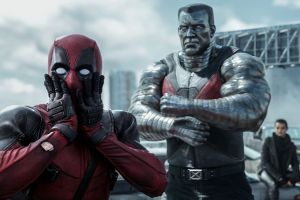
Deadpool (Ryan Reynolds), Colossus (Stefan Kapičić) and Negasonic Teenage Warhead (Brianna Hildebrand) in Deadpool

Deadpool (Ryan Reynolds), Colossus (Stefan Kapičić) and Negasonic Teenage Warhead (Brianna Hildebrand) in Deadpool

On a visceral level Deadpool delivers, with enough acrobatic action and one-liners to satisfy both fanboy and casual cinemagoer alike. The use of B-list X-Men Colossus (Stefan Kapičić) and Negasonic Teenage Warhead (Brianna Hildebrand) provides ample opportunities for Wilson/Reynolds to stick the boot in to the X-Men, from its HQ (“Neverland Mansion”), to Professor Xavier (“some creepy, old, bald, Heaven’s Gate-looking motherf***er”) and Wolverine in particular (a visual gag involving Hugh Jackman towards the end of the movie is particularly amusing).

The delight with which Reynolds spouts Rhett Reese and Paul Wernick’s expletive-laden meta dialogue is palpable and the scenes he shares especially with T.J Miller’s deadpan Weasel and Leslie Uggams’ elderly flatmate Blind Al are the film’s highlight.

Wade Wilson (Ryan Reynolds) in happier times with girlfriend Vanessa (Morena Baccarin) in Deadpool

Wade Wilson (Ryan Reynolds) in happier times with girlfriend Vanessa (Morena Baccarin) in Deadpool

However, Wilson’s romance with Vanessa, whilst gamely played by both actors, feels like it’s stapled on from a different movie and the character rather inevitably becomes a damsel in distress who’s there to be rescued from the clutches of the bad guy; a trope we’ve seen once or twice in the movies.

Reynolds, like the film itself, also veers too often into smugness; basking in its latest insult or ribaldry as if waiting for the audience to stop chuckling before moving on.

Wade Wilson (Ryan Reynolds) resmbling an avocado in Deadpool

Wade Wilson (Ryan Reynolds) resembling an avocado in Deadpool

It will be interesting to see whether the goldmine that Deadpool has unearthed will inspire the studios to take on riskier projects involving characters who operate on the fringes of the comic book universe. If this is the film’s legacy then so much the better.

Deadpool is fun and smart; just not as fun and smart as it thinks it is.

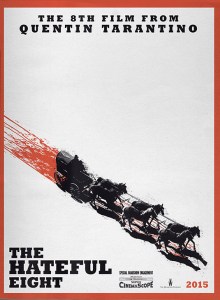
Review – The Hateful Eight

‘Event cinema’ is a term that has largely been reduced over the years to that of the tent pole picture, so it’s nothing if not refreshing to see a filmmaker so brazenly and assuredly resurrecting celluloid’s largest format when presenting his latest work.

The Hateful Eight is often provocative and brilliant, but Tarantino has let himself become his own worst enemy

The Hateful Eight is often provocative and brilliant, but Tarantino has let himself become his own worst enemy

Everything about writer/director Quentin Tarantino’s The Hateful Eight draws attention to itself, from the use of Ultra Panavision 70mm – a film connoisseur’s wet dream and a format so rare (barring Paul Thomas Anderson’s The Master) as to be virtually unheard of since Hollywood’s golden age – to the employment of an overture and intermission; giving the movie a brazen air of regality.

The promise of extra footage to entice people to seek out the film’s 70mm ‘Roadshow’ isn’t the first time QT has presented two different versions of the same movie; he did something similar with his grindhouse homage Death Proof back in 2007.

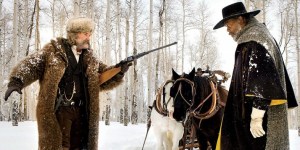
Violence is just around the corner in The Hateful Eight

Violence is just around the corner in The Hateful Eight

It’s fair to say The Hateful Eight is on a different scale; however, with great pomp and circumstance comes the risk of great pitfalls and while the director largely succeeds in his endeavour, it isn’t without the flaws that have come to be synonymous with Tarantino flicks.

Tarantino’s gift for movie dialogue is legendary and virtually unparalleled in modern cinema, but what the director hasn’t received enough credit for over the years is his inherent understanding of how to stage a scene and where to place the camera.

"The Little Man" (Tim Roth) questions "The Hangman" (Kurt Russell) and "The Prisoner" (Jennifer Jason Leigh) in The Hateful Eight

“The Little Man” (Tim Roth) questions “The Hangman” (Kurt Russell) and “The Prisoner” (Jennifer Jason Leigh) in The Hateful Eight

Filming in 70mm is a gamble as it can amplify bad technical decisions; but in the case of The Hateful Eight the use of Ultra Panavision serves to add an extra layer of complexity and subtext to what are already masterfully staged confrontations between his core characters.

The film has attracted comparisons to QT’s 1992 debut Reservoir Dogs (not least of which from the director himself) for sticking to a single location for much of the running time. However, it’s a full 30 minutes before we arrive at Minnie’s Haberdashery as the film patiently sets out its stall with an increasingly uneasy stagecoach journey involving bounty hunter John Ruth (Kurt Russell), who is transporting wanted criminal Daisy Domergue (Jennifer Jason Leigh) to Red Rock to be hanged, fellow bounty hunter Major Marquis Warren (Samuel L. Jackson) and Chris Mannix (Walton Goggins), who claims to be Red Rock’s new sheriff.

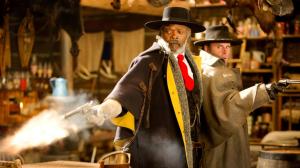
Gun-toting "Bounty Hunter" (Samuel L. Jackson) and "The Sheriff" (Walton Goggins) in The Hateful Eight

Gun-toting “Bounty Hunter” (Samuel L. Jackson) and “The Sheriff” (Walton Goggins) in The Hateful Eight

As wordy a chapter (or two) as this is, it establishes the mood of mistrust, paranoia and violence (filmed using a string a tight shots that juxtapose the vast and unforgiving wintry Wyoming landscape) that permeates much of the film. The suspicion that all is not as it seems is encapsulated in a single shot of Domergue, nursing a bust lip caused by a punch, who we see staring mischievously at Warren as if to shrug off the act of violence before turning away and letting her guard slip for a moment as the pain takes hold; only to laugh it off again as she realises she’s once again being looked upon.

The sense of foreboding and Old Testament justice (signaled by the evocative shot of a snow-covered crucifix) is ratcheted up in typical QT fashion as the action moves into Minnie’s Haberdashery and an increasingly bloodthirsty standoff slowly plays out among the odious octet – who also include Oswaldo Mobray (Tim Roth channeling Terry Thomas), Mexican Bob (Demián Bichir), Joe Gage (Michael Madsen) and Confederate General Sandford Smithers (Bruce Dern) – as a blizzard imprisons them to their fate.

There are moments here of the sort of brilliance that only the former video store clerk could conjure up. The disjointed narrative, so often a staple of Tarantino’s work, is employed to sterling effect and the performances, as ever, are uniformly excellent. Madsen and Roth haven’t been given this much to do for a good long while and Russell once again proves that the more unpredictable he is the better.

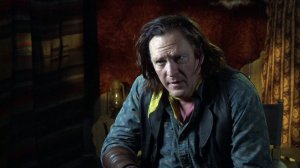
Are you gonna bark all day little doggie?: "The Cow Puncher" (Michael Madsen) in The Hateful Eight

Are you gonna bark all day little doggie?: “The Cow Puncher” (Michael Madsen) in The Hateful Eight

Goggins is on breakout form following a highly respected career in TV, while Leigh is arguably the best thing about the film, giving a shrewd and disarming performance that gets under your skin. However, it’s Jackson who once again lifts his game for a Tarantino picture and has a blast delivering the director’s typically colourful dialogue; in particular a comically nasty monologue an hour or so in that finally cranks the film into top gear.

The vice-like score by legendary composer Ennio Morricone fits the jittery mood of the film. Indeed, it’s rather fitting the majority of the score was originally written for The Thing (1982) as The Hateful Eight‘s creeping sense of paranoia between a small group of characters trapped by worsening weather is more than reminiscent of John Carpenter’s classic (minus the Thing of course). The score also fits the film’s whodunnit narrative that tips a wink to Hitchcock.

Too much of anything can be a bad thing, however, and the luxuriant running time cries out for a further edit. The opening hour, as satisfying as it is, spins its wheels and sees the director at his most indulgent. Tarantino is like a screenwriter’s equivalent of Dickens; a beautiful writer who can’t help penning a paragraph when a line will do.

Blood on the snow: "The Hangman" (Kurt Russell) and "The Bounty Hunter" (Samuel L. Jackson) in The Hateful Eight

Blood on the snow: “The Hangman” (Kurt Russell) and “The Bounty Hunter” (Samuel L. Jackson) in The Hateful Eight

The abundant use of the N-word has inevitably drawn heavy criticism and it’s certainly difficult to defend a movie that employs such a charged word so often. Jackson has defended Tarantino, pointing out his dialogue fits the characters and the time in which the film was made, while QT himself has spoken of how dealing with race in America is something he has to offer the western. Whether you buy that is up to you.

As Tarantino nears the self-imposed end of his career (10 films and he’s out), a question remains as to whether his best work is behind him. The Hateful Eight is often provocative and brilliant, but Tarantino has let himself become his own worst enemy.

Review – The Revenant

You have to give Alejandro González Iñárritu his due; few directors generate as many column inches and heated opinions as the Oscar-winning Mexican.

In the end, Iñárritu will always be an awards darling so long as he produces works such as The Revenant, but this work remains as cold as the snow-bound landscapes he portrays

In the end, Iñárritu will always be an awards darling so long as he produces works such as The Revenant, but this work remains as cold as the snow-bound landscapes he portrays

Whereas 2015’s Birdman caused a stir upon its release, Iñárritu’s latest has divided audiences like few other motion pictures of recent years.

Some have labelled The Revenant a masterpiece of epic proportions, while others have branded it nothing more than “pain porn”.

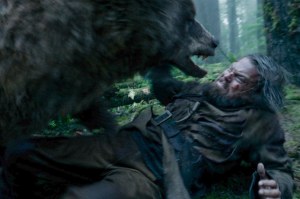
Hugh Glass (Leonardo DiCaprio) goes mano v mano against a grizzly in The Revenant

Hugh Glass (Leonardo DiCaprio) goes mano v mano against a grizzly in The Revenant

Whilst this reviewer wouldn’t go quite so far as that, The Revenant, though more effective than Birdman, is remarkably similar in its failure to generate more than respectful admiration for its technical artistry rather than the adoration the film and its director undoubtedly crave.

Iñárritu deserves credit and, yes, admiration for refusing to compromise on his artistic vision and for leading his cast and crew on what at times must have felt like an endeavour of Herzogian proportions.

It’s certainly hard to argue against the spectacle on show, courtesy of Oscar-winning cinematographer Emmanuel Lubezki (Gravity, Birdman), whose bleakly beautiful compositions give you an uncomfortable appreciation of how unforgiving – and cold – the vast wilderness of the American frontier (actually shot in Canada and Argentina) in 1823 must have been for those seeking to exploit its resources.

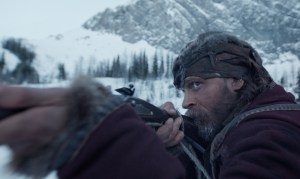
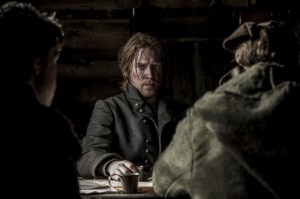
The unforgiving John Fitzgerald (Tom Hardy) in The Revenant

The unforgiving John Fitzgerald (Tom Hardy) in The Revenant

Among those in country are trappers Hugh Glass (Leonardo DiCaprio), his half-native son Hawk (Forrest Goodluck), the clearly unbalanced Fitzgerald (Tom Hardy in full on crazy eyes mode) and Andrew Henry (Domhnall Gleeson), who captains the party. An ambush by natives deals a severe blow, which is compounded when Glass is mauled by a bear and left clinging on to life.

Left for dead and with a thirst for vengeance following a brutal act of violence by Fitzgerald, Glass summons the will against all odds to claw his way back to life and go in search of retribution.

Capt Andrew Henry (Domhnall Gleeson) in The Revenant

Capt Andrew Henry (Domhnall Gleeson) in The Revenant

Much has been made in the media of the hardships visited upon cast and crew in bringing The Revenant to the screen and the several ‘makings of’ showing DiCaprio etc talking about eating raw bison liver or suffering near hypothermia that have appeared online are about as shameless an attempt at Oscar baiting as you’ll likely to see.

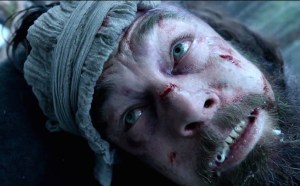
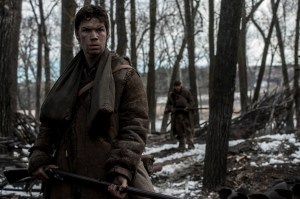
That being said, it’s nevertheless laudable watching the lengths the cast and DiCaprio especially put themselves through to achieve authenticity. Hardy mumbles and looks unhinged, while Will Poulter is excellent as fellow trapper Jim Bridger, ashamed at not having the strength of will to ignore self-preservation. This is Leo’s show, however, and the actor puts in a fully committed performance of foaming intensity, practically losing himself in the part; his every tortured expression blown up by the numerous extreme close-ups.

Give me an Oscar! Hugh Glass (Leonardo DiCaprio) in The Revenant

Give me an Oscar! Hugh Glass (Leonardo DiCaprio) in The Revenant

The film’s one obvious use of CGI (there are other less transparent moments) comes during the already infamous bear attack sequence, a horrifying, stomach-churning confrontation that has quite rightly earned its reputation. The attack on the trappers near to the start of the film is equally well staged, veering from one blood-spattered moment to the next as the men find themselves horribly outmatched.

All this spectacle sears itself on the corneas, but never penetrates the heart. Glass is visited on several occasions by ethereal visions of his dead wife, à la Gladiator (which the film owes a nod to), and while the narrative reasoning is understandable, these moments of strained spirituality fail to work because they feel crowbarred in to inject some form of emotional connection.

Mountain man: Jim Bridger (Will Poulter) in The Revenant

Mountain man: Jim Bridger (Will Poulter) in The Revenant

More often than not, you find yourself admiring a shot (the numerous slow motion pans of tree tops notwithstanding) and thinking of how wonderfully composed it is rather than being swept along.

In the end, Iñárritu will always be an awards darling so long as he produces works such as The Revenant, but this work remains as cold as the snow-bound landscapes he portrays.