At the start of the year I posted saying that I had been a bit quiet blog-wise due to having moved house and then, almost immediately afterwards heading away to Iceland for a break.
Not one to recycle old excuses, but apologies to everyone for my lax blog rate and dearth of comments on other sites of late. We all go through periods when a blog can feel more like a job than anything else and I’d be lying if I said that hadn’t played a part of late.
A crazy work schedule over the past 4-6 months hasn’t helped as I’ve often been too tired or had no time to even watch movies, let alone write about them.
By way of a ‘rest’, my other half and I are heading to Nepal for three weeks; most of which will be taken up with trekking through the Himalayas, reaching heights of over 5,000m! Here’s hoping altitude sickness doesn’t rear its ugly head!
Anyway, I just wanted to say thank you for continuing to be a splendid community of good folks – I speak for many I’m sure when I say that it’s my fellow bloggers who really make this whole thing worthwhile.
To my American friends, may I wish you an early Happy Thanksgiving. With the way the world has turned over this past year, what with the disastrous Brexit vote (#notinmyname), atrocities too numerous to mention and the pièce de résistance that is Trump’s election, we need to keep our friends and family close and be thankful for the little things.
Photos of my trip will follow, but in the meantime stay well.
It’s a shame in some ways that Ridley Scott’s Prometheus ended up being the title of his underwhelming prequel to Alien rather his imagining of Philip K. Dick’s short story Do Androids Dream Of Electric Sheep?
Cinema gives us too few examples of genuine transcendence – Blade Runner is one of them
As great a title as Blade Runner is, the influence of the mythical Greek figure who defied the natural order to play god is more appropriate to the maverick Brit’s masterpiece.
Like many masterpieces, however, Scott had to wait for the critical fraternity to come around to his way of thinking – audiences at the time were more interested in watching an extra terrestrial try to phone home than a rain-soaked noir set in a future teetering on the brink.
Admittedly, what audiences were presented with in 1982 was far from what Scott had originally intended. Unsure of what it was dealing with, Warner Bros insisted that a Blade Runner for dummies narration (supplied by a less-than-enthusiastic Harrison Ford) be included explaining what is, on paper, a pretty straightforward narrative. Even more galling to Scott was the bolted on happy ending (using outtakes from Kubrick’s The Shining, ironically) which flew against pretty much everything in the previous 116 minutes and led the director to consider disowning the movie.
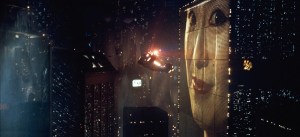
The rain-soaked dystopia on 2019-era LA in Blade Runner: The Final Cut
A reappreciation of the film led to a ‘director’s cut’ being released in 1992. Although much closer to Scott’s original vision, it wasn’t truly his edit, having been put together by film preservationist Michael Arick based on the director’s notes.
It would take a further 15 years before Scott finally received complete artistic control and this ‘final cut’ remains the last word in a sorry saga that has dredged up at least five different versions of what is still regarded as one of the greatest sci-fi films ever made.
Whilst the redundant voiceover and happy ending had been exorcised in the director’s cut, the final cut introduces fascinating new footage that, for many (me included), confirms a commonly held theory as to the background of lead character and titular Blade Runner Richard Deckard (Ford) and makes other, more subtle, digital alterations that could teach a thing or three to George Lucas about less sometimes being more.
Robot love: Deckard (Harrison Ford) and Rachael (Sean Young) in Blade Runner: The Final Cut
According to Scott, Blade Runner “is a film set 40 years hence, made in the style of 40 years ago”. The Los Angeles of 2019 as depicted is unlikely to come to pass in the next three years (President Trump may have other ideas), but the director’s vision of a future he feels many of us may bear witness to in our lifetimes is arguably the most immersive and detailed vision any sci-fi has ever put on screen.
The attention to detail remains astonishing, whether it be the swarms of people going about their business holding umbrellas with the shafts lit up, the multi-cultural fusion of Asian, industrial Britain and American design, or the giant electronic billboards that either seem to advertise soft drinks (some things never change) or feature geishas pushing cigarettes.
Scott’s background in visual design has never been put to better use and he’s helped by a team working at the top of their game, including special effects supervisor David Dryer who was heavily influenced by Fritz Lang’s Metropolis in realising the look of the city, in particular the pyramid-shaped Tyrell Corporation building that dominates the LA skyline.
The extraordinary soundtrack by Vangelis is another touchstone; at once, like the film itself, looking backwards and forwards – a woozy ambient composition that also features an unforgettable contribution from saxophonist Dick Morrissey. Indeed, the soundtrack makes even greater sense thanks to the more fully realised love affair between Deckard and Rachael (Sean Young) that is one of the final cut’s more prominent introductions.
He’s seen things, you know. Things you wouldn’t even imagine.
Deckard remains one of Ford’s richest performances, an often unlikable loner who isn’t afraid to get his hands dirty but unwittingly lets his guard down when confronted with someone who is as fascinated with him as he is with her. Young, in an early starring role, is far more than the femme fatales who so often populate noirs, imbuing Rachael with a vulnerability and stillness that both bely and reinforce her artificial origins.
Likewise, Darryl Hannah as the “basic pleasure model” Pris, Joanna Cassidy as the snake-loving Zhora (“beauty and the beast – she’s both”) and Brion James as the bug-eyed Leon play their parts in such a way as to be one small step removed from human – something only the elaborate Voight-Kampff polygraph-style machine can pick up.
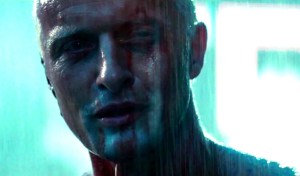
However, Blade Runner belongs to Rutger Hauer, who delivers a mesmeric performance as Roy Batty, the magnetic leader of the escaped Nexus 6 Replicant gang who arrive from off world on Earth looking for answers from their maker – Dr Tyrell (Joe Turkel sporting some of the best glasses in movie history). Both Philip K. Dick and Scott were reportedly sold on Hauer from the start, struck by his Aryan looks and piercing eyes, and the actor delivered on that faith, giving us one of cinema’s most memorable screen presences and one of its most oft-quoted speeches (famously written by the actor).
The eyes have it in Blade Runner: The Final Cut
Roy’s howl of rage against the ticking of a clock he has no control over, in spite of his best efforts, is an utterly human response, while the grace and mercy he displays in saving Deckard’s life come the final reel elevate the character into messianic territory – nail driven through hand and all.
The Tyrell Corporation’s motto of ‘more human than human’ could be used to describe not only Roy, but also Rachael and – dramatic pause – Deckard (their only physical giveaway of artificiality is an otherworldly eye reflection – indeed, eyes are a key symbol throughout).
The film’s influence is still being felt today, from the films of Christopher Nolan to The Matrix, anime and about a million other sci-fi movies. One need only watch HBO’s Westworld to see Blade Runner‘s visual imprint.
Cinema gives us too few examples of genuine transcendence – Blade Runner is one of them.
If ever a movie epitomised the unapologetic shoot-first-ask-questions-later meat-headedness of 80s action flicks then it’s Sylvester Stallone’s Cobra.
In spite of its many flaws, Cobra has become a cult classic and it’s not hard to see why
The 1980s was a curious time in film history, sandwiched as it was between the New Hollywood of the 70s and the rise of independent cinema in the 90s. Stallone was in the right place at the right time as the success of Jaws and Star Wars gave rise to the ‘event movie’, while the action-loving philosophy of newly elected President Ronald Reagan was embraced by the studio system.
Stallone’s career morphed in the 80s into the sort of movie star whose choice of roles were seemingly decided not by depth of character, but rather how alpha male they could be. His two films previous to Cobra were continuations of his most famous roles, 1985’s Rambo: First Blood Part II and Rocky IV – both textbook examples of 80s cinema.
Someone’s going to die in a minute
However, it’s in Cobra where Sly’s unique formula can perhaps be most crystalised; a right-wing time capsule that would probably end up straight on the DVD racks today, but which back in 1986 raked in $160m against a $25m budget, much to the bewilderment of the critical fraternity of the time.
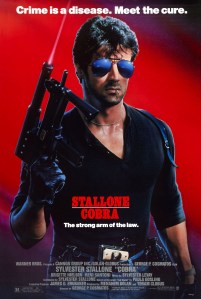
Audiences were no doubt drawn to the film’s pared-down poster, which features the toothpick-chewing Italian Stallion in moody black against a blood-red backdrop and holding a semi-automatic weapon with a cool-looking laser sight. Its memorable tagline – ‘crime is a disease; meet the cure’ – and description of its titular leading man as ‘the strong arm of the law’ undoubtedly had many cinemagoers champing at the bit to see Stallone dishing out bloody justice.
Andrew Robinson not playing psycho shocker – here he’s a by-the-book cop in Cobra
Sly plays Marion Cobretti (no wonder he prefers the sobriquet ‘Cobra’), an anti-establishment cop from the same police academy as ‘Dirty’ Harry, whose unconventional methods are apparently loved by many of his colleagues, tolerated by others and seemingly hated by only one – Andrew Robinson’s by-the-book Detective Monte (a canny bit of casting to get the actor who played the unhinged Scorpio in Don Siegel’s cop classic).
He ends a hostage situation at a supermarket by knifing and shooting the perpetrator after making a half-hearted effort at negotiation, later learning the no-gooder was a member of a cult of murderous nut jobs on a killing spree led by the Night Slasher (a terrifying looking Brian Thompson, graduated from bit part player in Schwarzenegger’s The Terminator).
Would you trust this man? Brian Thompson as The Night Slasher in Cobra
Cobretti is tasked with protecting model Ingrid Knudsen (Brigitte Nielsen), who witnessed the Night Slasher’s gang going to work and, as the bodies pile up, so too does their attraction towards each other.
Much of what became Cobra had originally been in Stallone’s mind for his rejected take on Beverly Hills Cop and while George P. Cosmatos is credited as director, this is absolutely Sly’s project.
His screenplay (loosely based on Paula Goslin’s book A Running Duck) makes sops towards respecting the rights of alleged criminals, before quickly dispensing with such trifles and turning the movie into a glorified shooting gallery (it’s something he’s revisited at various points in his career, in particular 2008’s Rambo which features one of the most bloodthirsty endings in movie history). Stallone also gives himself a generous number of one-liners to puncture the grim and foreboding mood of much of the film.
Alongside the biblical levels of bloodletting on screen is a series of barefaced product placements for the likes of a well-known brand of brown sugar water and brand of beer, while Sylvester Levay’s soundtrack is a time capsule in itself.
Perhaps the most 80s image in cinema history
Nielsen, sporting the ultimate in big hair, was never the most versatile of actors and is asked to shriek a lot while also appearing in a hilarious montage (soundtracked by some cracking synth power pop) in which she poses in various terrible 80s fashions next to a collection of homemade robots that resemble something out of Metal Mickey.
The tales of Stallone’s reported megalomania on set have entered cinema folklore. The supporting cast was supposedly forbidden from speaking to the Stallion, for example, while Nielsen was drafted in to play opposite the leading man as the pair were dating at the time.
In spite of its many flaws, Cobra has become a cult classic and it’s not hard to see why. An unapologetic exploitation flick, it takes no prisoners – preferring to just shoot them instead.
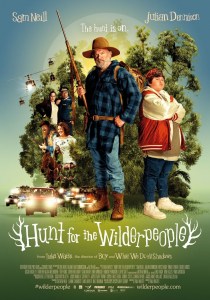
After revealing what a house full of vampires get up to in their spare time, Taika Waititi follows another set of mismatched misfits to equally hilarious effect in this perfectly judged boy’s own adventure.
The “Magical” Hunt For The Wilderpeople
Whilst Peter Jackson’s Lord Of The Rings no doubt remains the New Zealand Tourist Board’s favourite cinematic advert, Hunt For The Wilderpeople’s loving immersion in the land of the long white cloud’s unspoilt greenery is equally majestic.
This forms the stunning backdrop to an adventure that’s as fantastically offbeat as it is heart-warming; one which gives us 2016’s best buddy pairing in the form of Sam Neill’s prickly hunter Hector and Ricky, the hip hop-loving wannabe gangster played to charming effect by newcomer Julian Dennison.
Hec (Sam Neill), Ricky (Julian Dennison) and the beautiful NZ scenery in Hunt For The Wilderpeople
Ricky is a rebellious foster kid relocated from the city by child welfare services (led by Rachel House’s frightening looking Paula – “no child left behind”) to the country and into the arms of the loving Bella (Rima Te Wiata) and the less interested Hec (Neill).
When a series of unfortunate events sees Ricky and Hec (with dog in tow) go on the run, their begrudging tolerance of each other slowly transforms into something approaching a father and son relationship as they continue to evade the authorities while camped out in the great outdoors.
No child left alone: Andy the police officer (Oscar Kightley) and ‘Child Services’ (Rachel House) in Hunt For The Wilderpeople
Anyone with even a passing appreciation of 80s adventure flicks such as The Goonies will soon attune themselves to Hunt For The Wilderpeople‘s wavelength and the warm glow of nostalgia that comes with it. The references don’t stop there; Waititi has acknowledged the debt he owes to the likes of Paper Moon and Pixar’s Up, as well as numerous less well-known Australian movies of the 1980s.
The boy’s own wistfulness of the criminally underseen Son Of Rambow and Kings Of Summer have mined similar territory in recent years, but there’s an extra edge that plays out in the back and forth between Ricky and Hec.
Waititi has developed considerably as a director and the choices he makes with the camera are both confident and eye-catching in a fashion not dissimilar to Wes Anderson and Edgar Wright. Married to Lachlan Milne’s cinematography, the film looks beautiful.
Taika Waititi as a surreal minister in Hunt For The Wilderpeople
The surrealism present in so much of Australasian cinema can be found coursing through the veins of the movie, whether it be the hilariously odd supporting cast (including Waititi as a curious looking minister and Rhys Darby as Psycho Sam, a conspiracy-spouting hermit who disguises himself as a bush) or numerous visual choices, including a sweet moment when Ricky meets and instantly falls for Tioreore Ngatai-Melbourne’s Kahu and is reminded of an old Cadbury’s Flake advert when she gets on her horse.
Ricky Baker (Julian Dennison) on a boy’s own adventure in Hunt For The Wilderpeople
The shamelessly over-the-top finale (reminiscent of Thelma And Louise) may be a little much, but there are plenty of asides that only a Kiwi or Australian would fully appreciate, such as the references to food such as scroggin (a type of trail mix) and burger rings, as well as some of NZ’s more colourful TV personalities.
As Waititi moves up to the big leagues of Marvel for his next venture, one can only hope the magic of Hunt For The Wilderpeople will continue to rub off on this talented cinematic voice.
The DC cinematic universe is in danger of collapsing in on itself if its terrible run of big screen duds continues much longer.
The performances are among the only highlights of what is a mess of a film, one which flits about as wildly as its jukebox-laden soundtrack. Even the Joker would balk at the amount of chaos going on in Suicide Squad
Christopher Nolan’s Dark Knight trilogy may have been a critical and commercial smash for DC and Warner Bros, but its shadow has continued to loom large over its output ever since.
Entrusting the DCU to ‘visionary’ director Zack Snyder was their first and most fatal error. His ponderous and humourless approach mixed with an overtly storyboard style was no doubt a big selling point post-Nolan; however, substance and subtlety are things Snyder hasn’t been particularly blessed with as the misfiring Man Of Steel and this summer’s lumbering Batman vs Superman: Dawn Of Justice have proven.
The gang’s all here in Suicide Squad
The critical mauling and patchy box office for Batman vs Superman almost certainly set off panic alarms for DC and Warners, which undoubtedly explains the hasty reshoots that took place for David Ayer’s Suicide Squad to presumably inject the sort of levity that makes much of Marvel’s output so enjoyable.
One can see how the tone of the movie has shifted in its trailers, which started out at the start of the year employing the Snyder formula, before evolving over time to become a far more light-hearted affair. The problem is that in the process of bolting on extra jokes the film’s narrative thread has frayed to the point of incomprehensibility, while the direction chops and changes more than a Donald Trump speech.
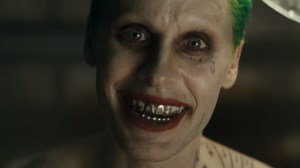
Jared Leto plays the Clown Prince of Crime in Suicide Squad
Ayer has insisted the cut of the film is entirely his, but it’s difficult to believe from the man who is evidently far more at ease making visceral, uncompromising flicks such as Fury and End Of Watch. There’s the germ of a good movie here and he’s assembled a talented enough cast, but the stink of recuts, drastic editing and compromise sinks Suicide Squad.
The most notable example is in the use of Jared Leto’s Joker. Leto hasn’t been shy in voicing his bewilderment at the sheer amount of footage involving the Clown Prince of Crime that has been left out of Suicide Squad and his extended cameo leaves you wondering what the hell he’s doing in the movie – financial reasoning notwithstanding of course.
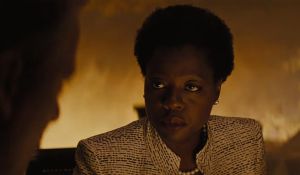
The wall: Viola Davis as the decidedly unpleasant Amanda Waller in Suicide Squad
Whilst some purists were never sold on Heath Ledger’s performance as the Joker in The Dark Knight, believing him to be too far removed from the comic book origins of the character, Leto’s Joker (in the limited screen time he’s given) is essentially nothing more than a glorified gangster with lots of tattoos and a loose screw. The power he has over his psychiatrist Dr Harleen Quinzel (Margot Robbie) to willingly throw herself into a vat of acid and transmogrify into Harley Quinn is frankly unbelievable.
Quinn, alongside a rogue’s gallery of super villains, including assassin Deadpool (Will Smith), fire starter El Diablo (Jay Hernandez) and thief Captain Boomerang (Jai Courtney), whose skill is to, err, throw boomerangs, are recruited by the stone cold Amanda Waller (Viola Davis) and soldier Rick Flag (Joel Kinnaman) to carry out super dangerous missions in exchange for leaner sentences.
Their first mission sees them going up against the ancient, powerful Enchantress (Cara Delevigne), who decides the world needs to be destroyed in order to save it (that old chestnut) and builds a huge machine made of trash to make it so.
Dr June Moone (Cara Delevigne) is positively enchanting in Suicide Squad
Suicide Squad‘s influences are front and centre, most prominently The Dirty Dozen and, to a lesser extent Escape From New York, and while certain scenes work, particularly the bar chat wherein the gang take a break from trying to save the world in order to learn a bit more about each other, they are few and far between among the myriad moments that singularly fail to hang together.
Robbie is fun as Harley Quinn, although a bit KER-azy, while Smith exudes an authority over proceedings that the likes of Courtney can’t hope to match. He’s given a run for his money by Davis though, who is the ice queen personified in a role that she digs her teeth into with relish.
The performances are among the only highlights of what is a mess of a film, one which flits about as wildly as its jukebox-laden soundtrack. Even the Joker would balk at the amount of chaos going on in Suicide Squad.


















 three rows back