In Retrospect – New York, New York (1977)

Analyzing De Niro

I’m delighted to have contributed this review to You Talkin’ To Me‘s excellent Analyzing De Niro Blogathon, run by Mark at Marked Movies and Tyson at Head In A Vice. As the title suggests, the Blogathon focusses entirely on the movies of Mr Robert De Niro and this post covers Bobby’s third collaboration with Martin Scorsese, 1977’s New York, New York.

The long and fruitful partnership between Robert De Niro and Martin Scorsese has spawned a multitude of enduring classics forever etched in our collective cinematic consciousness.

A misfire, but a fascinating one nonetheless, New York, New York is the oft neglected offspring of the formidable Scorsese/De Niro partnership

A misfire, but a fascinating one nonetheless, New York, New York is the oft neglected offspring of the formidable Scorsese/De Niro partnership

In the four years between the release of Taxi Driver and Raging Bull, De Niro and Scorsese collaborated on New York, New York, the oft neglected offspring of their remarkable relationship.

After the critical and surprising commercial success of the apocalyptically dark Taxi Driver, an emboldened Scorsese used the bigger budget he was able to command to break away from down and dirty depictions of the Big Apple to instead direct what amounted to a love letter, both to the city of his birth and to the old Hollywood musicals he grew up watching.

Start spreading the news, it's Francine Evans (Liza Minnelli) and Jimmy Doyle (Robert De Niro) in New York, New York

Start spreading the news, it’s Francine Evans (Liza Minnelli) and Jimmy Doyle (Robert De Niro) in New York, New York

Scorsese cast De Niro in the lead role of Jimmy Doyle, a smooth talking egotist with a zany streak and a gift for the saxophone. Audiences at the time were used to seeing Bobby play wiseguys and sociopaths, so to watch him clowning around on screen must have been a novelty.

The film opens in New York on V-J Day in 1945 and spends the first 20 minutes inside a nightclub in full swing, with Jimmy, sporting a Hawaiian shirt and a shiny pair of spats he won in a bet, trying to work his magic on Liza Minnelli’s demobbed singer Francine. Through sheer force of will it seems, Jimmy eventually manages to woo Francine and the pair discover that her voice and his sax are made for each other.

Robert De Niro learned how to play the sax to play Jimmy Doyle in New York, New York

Robert De Niro learned how to play the sax to play Jimmy Doyle in New York, New York

A marriage and a child follow but, as Francine becomes more successful in her own right, Jimmy’s inherent insecurities, bullying nature and jealousy threaten to tear both their personal and professional ties apart.

De Niro could do no wrong at the time and prepared for the role in typically methodical fashion by learning to play the sax (although the arrangements were actually dubbed in post-production by the esteemed Georgie Auld). As such, he looks at home on stage leading his band and handles the sax with aplomb instead of looking like he picked it up five minutes before the cameras rolled.

New York, New YorkWe now know that De Niro can ‘do’ comedy almost as well as he does drama, but at the time it was uncertain if the actor, renowned for his on-screen intensity, would be able to sell funny. Minnelli’s reaction to some of De Niro’s goofing is priceless, while the scene with Jimmy feigning a war wound to get out of paying a hotel bill is pure slapstick.

The comedy gradually wears off as the picture becomes more of a relationship drama and it’s here Bobby spreads his wings. De Niro is a master of the long silent stare (the one where you’re unsure whether he’s going to explode with violent rage or not) and employs it to disquieting effect here on more than one occasion. Minnelli’s genuine unease in these moments is palpable.

Jimmy Doyle (Robert De Niro) gets into a spot of trouble in New York, New York

Jimmy Doyle (Robert De Niro) gets into a spot of trouble in New York, New York

As Cabaret had shown back in 1972, there was still an audience for musicals. However, unlike the Hollywood greats it was hoping to emulate, New York, New York suffers from confused plotting and a flabby narrative (the film is almost three hours long). Apparently, the actors ad-libbed much of the movie and it shows; scenes are allowed to play out for far too long and things aren’t helped by the tepid on-screen chemistry between De Niro and Minnelli.

A typically memorable Martin Scorsese shot in New York, New York

A typically memorable Martin Scorsese shot in New York, New York

Sandwiched between Travis Bickle and Jake Lamotta, De Niro’s Jimmy Doyle ain’t all that, but when considered as part of his overall career it’s a notable chapter for opening up audiences’ eyes to a part of his repertoire that he’s since gone on to enjoy considerable success with.

If for nothing else, the film gave Frank Sinatra one of his most iconic hits and provided nightclubbers with an end-of-evening drunken anthem.

Scorsese’s description of New York, New York as a ‘film noir musical’ is apt one –  both Old Hollywood (the lovely moment Jimmy watches a sailor dancing with his girl under the subway tracks is an affectionate wink to On The Town) and New Hollywood are fused into what might end up being a misfire, but a fascinating one nonetheless.

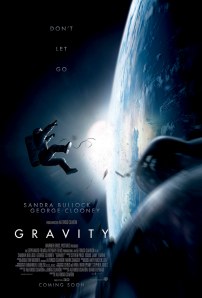
Review – Gravity

It’s one small step for visual effects and one giant leap for cinema in Alfonso Cuarón’s extraordinary survival thriller where astronauts Sandra Bullock and George Clooney have a very serious problem.

Gravity is nothing short of a game-changer and a fully immersive motion picture experience that raises the bar to dizzying new heights

Gravity is nothing short of a game-changer and a fully immersive motion picture experience that raises the bar to dizzying new heights

Not since 1995’s Apollo 13 has a film delivered the stomach-churning sense of what it must truly be like to be lost in space and have to rely on ingenuity and bravery to survive against all the odds.

The film’s overwhelming box office success is richly deserved recompense for the four years Cuarón spent bringing Gravity to the big screen.

Dr Ryan Stone on her first - and possibly last - shuttle mission in Gravity

Dr Ryan Stone on her first – and possibly last – shuttle mission in Gravity

Cuarón revealed himself to be a technical director par excellence in his under-appreciated 2006 dystopian sci-fi masterpiece Children Of Men and held out on making Gravity until visual effects technology had finally caught up with his vision for the film.

His, and our, patience has been rewarded as the film is nothing short of a game-changer and a fully immersive motion picture experience that raises the bar to dizzying new heights.

Grizzled veteran astronaut Matt Kowalski (George Clooney) takes command in Gravity

Grizzled veteran astronaut Matt Kowalski (George Clooney) takes command in Gravity

Gravity‘s plot is the highest of high concepts. Rookie astronaut Dr Ryan Stone (Bullock) and grizzled veteran Matt Kowalski (Clooney) are on a routine spacewalk to service the Hubble telescope when Mission Control (voiced by Apollo 13‘s Ed Harris) warns of a Russian missile strike on an out-of-service satellite that has caused a chain reaction of debris heading their way fast. Before they have time to properly react the debris tears through their shuttle, leaving them cut off from everything and everyone.

From the moment a shimmering Planet Earth majestically appears, swallowing the tiny shuttle that slowly becomes our focus, we’re putty in Cuarón’s hands. It’s a stunning opening shot, lasting about 15 minutes (Cuarón has also shown to be a past master in the art of the tracking shot too), that introduces us to the nervous Stone and relaxed and charismatic Kowalski before all hell breaks loose.

"Houston, we have a problem" in Alfonso Cuarón's Gravity

“Houston, we have a problem” in Alfonso Cuarón’s Gravity

We’ve grown so used as moviegoers to hearing sound effects for films set in space that the (scientifically accurate) silence of the shuttle being torn to pieces is actually more disconcerting and terrifying.

These sequences are Gravity‘s tour de force as the line between what is real and what is digitally rendered is almost completely removed. Rather than being some lazy 3-D device, the moment when pieces of debris fly towards the screen will have you flinching and ducking out the way, such is the all-consuming effect the film has on the senses.

The only sound we do hear, apart from Stone’s panicked panting, is Steven Price’s urgent and ominous score, which sounds like it’s been beamed in from another planet.

The terrifying moment when the void beckons in Gravity

The terrifying moment when the void beckons in Gravity

Another of the film’s strengths is to emphasise just how vulnerable and helpless we are when setting foot off our planet despite all of our technology. Stone and Kowalski spend much of their time desperately tethering themselves to chunks of metal or each other in a frantic effort to survive.

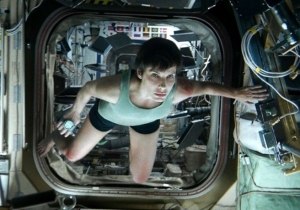
Dr Ryan Stone (Sandra Bullock) reaches the relative safety of the International Space Station in Gravity

Dr Ryan Stone (Sandra Bullock) reaches the relative safety of the International Space Station in Gravity

Bullock is on impressive form as the damaged Stone, who’s put through the wringer and must reach her lowest ebb before finally finding the emotional and physical strength to carry on. Although unsubtle, the scene when she makes it inside the womb of the International Space Station and huddles weightless in the foetal position (still tethered as if umbilically attached) may be an unsubtle metaphor for rebirth, but is a striking one nonetheless.

While Bullock brings an admirable range to her role, Clooney might as well be playing himself. It’s not necessarily the actor’s fault; Cuarón’s script, co-written with his son Jonás, provides the sort of dialogue that suggests it’s Clooney in orbit rather than Matt Kowalski. That said, I’ll take Clooney on autopilot over most other actors any day.

James Cameron, no stranger to sci-fi, has called Gravity “the best space film ever done”. Although there’s stiff competition for that particular accolade, such high praise is justified for a film that sets a new benchmark in what cinema is visually capable of.

Review – Saving Mr Banks

The story behind one of cinema’s most magical family classics is told in a shamelessly self-congratulatory, but ever-so  supercalifragilisticexpialidocious way in Disney’s warm-spirited love letter.

Saving Mr Banks may be a giant spoonful of sugar, but it's charm and outstanding performances certainly help the medicine to go down

Saving Mr Banks may be a giant spoonful of sugar, but it’s charm and outstanding performances certainly help the medicine to go down

From the moment Julie Andrews flew in to the lives of the Banks family courtesy of her magic umbrella, generations of moviegoers young and old were swept away by Walt Disney’s beloved 1964 adaptation of P.L Travers’ iconic Mary Poppins.

Walt Disney (Tom Hanks) promises he won't let Mrs Travers (Emma Thompson) down in Saving Mr Banks

Walt Disney (Tom Hanks) promises he won’t let Mrs Travers (Emma Thompson) down in Saving Mr Banks

Saving Mr Banks chronicles the tireless efforts of Mr Disney (Tom Hanks) to persuade Mrs Travers (Emma Thompson) to relinquish the rights to her hugely popular children’s novel. Flown over to LA at the Mouse House’s expense, she attends a two-week workshop with co-writer Don DaGradi (Bradley Whitford) and composer/lyricists Richard M Sherman (Jason Schwartzman) and Robert B Sherman (BJ Novak) to determine whether she’s happy (or not) with the direction the studio wants to take with the picture.

Mrs Travers (Emma Thompson) seems unimpressed with LA when picked up by her chauffeur Ralph (Paul Giamatti) in Saving Mr Banks

Mrs Travers (Emma Thompson) seems unimpressed with LA when picked up by her chauffeur Ralph (Paul Giamatti) in Saving Mr Banks

As Walt and co work on winning over Mrs Travers, the experience stirs up memories to her childhood spent in Australia at the turn of the century with her mother Margaret (Ruth Wilson) and alcoholic, but deeply loving bank manager father Robert (Colin Farrell).

Walt Disney (Tom Hanks) himself at Disneyland in Saving Mr Banks

Walt Disney (Tom Hanks) himself at Disneyland in Saving Mr Banks

Disney has wallowed in the syrup of sentiment and schmaltz more than once, so it shouldn’t come as much of a surprise to learn a film in which the Mouse House raises a glass of milk to itself and celebrates the genius of its founder is unadulterated whimsy. But it’s whimsy with a heart and an old-fashioned charm that’s irresistible to resist.

Walt Disney (Tom Hanks) promises he won't let Mrs Travers (Emma Thompson) down in Saving Mr Banks

Walt Disney (Tom Hanks) promises he won’t let Mrs Travers (Emma Thompson) down in Saving Mr Banks

The cast is truly splendid. Thompson, who’s seen too rarely on our screens, is terrific as the prim and proper sourpuss Mrs Travers, who must learn to let go of her painful past and trust in Mr Disney in order to finally move forwards. It’s a masterfully restrained performance, one that thaws authentically as she gets taken in by the genuine love and respect Disney and the gang have for the material.

Mrs Travers remembers her youth with her father (played by Colin Farrell) in Saving Mr Banks

Mrs Travers remembers her youth with her father (played by Colin Farrell) in Saving Mr Banks

She’s matched by Hanks’ charming turn as ol’ Walt, a character that’s far removed from his recent turn as Captain Phillips. Hanks is perfect and brings a charismatic authority to the role that hints at the steely businessman who’s built an empire out of the vision of a friendly little mouse. The scene he shares with Mrs Travers late in the film when he talks about his difficult childhood and the significance her story has had both to his family and countless others is a textbook example of great acting by both Hanks and Thompson.

"Gawd bless Mary Poppins!"

“Gawd bless Mary Poppins!”

Paul Giamatti also gets a great cameo as Mrs Travers’ kind-hearted chauffeur Ralph. It’s the sort of turn that could drip with saccharine, but Giamatti gives it just enough bite.

The recurring flashbacks to Oz are perhaps the film’s weakest point and the parallel narratives between 1907 Queensland and 1961 LA are a little too neat and tidy, but John Lee Hancock’s thoughtful direction is both moving and genuinely funny.

Saving Mr Banks may be a giant spoonful of sugar, but it’s charm and outstanding performances certainly help the medicine to go down.

Review – Thor: The Dark World

It’s hammer time once again as the Marvel juggernaut rolls into town for a universe-ending epic of god-like proportions that’s more akin to Lord Of The Rings on party pills.

Thor: The Dark World Poster

After watching The Dark World, one wonders where the franchise can go from here. There’s nothing Thor-some this time around and not even Loki can change that

This sequel had an awful lot to live up to, not only in light of the surprisingly enjoyable Thor, but also following the box office dynamite of Avengers Assembled (as it was called in these here parts) and this summer’s Iron Man 3.

Thor (Chris Hemsworth) and Odin (Anthony Hopkins) share a father-son moment in Thor: The Dark World

Thor (Chris Hemsworth) and Odin (Anthony Hopkins) share a father-son moment in Thor: The Dark World

A major factor behind Thor‘s success was the tongue-in-cheek approach it took towards what’s, let’s face it, is pretty ridiculous material. It also struck gold with the chemistry between Thor (Chris Hemsworth), astrophysicist Jane Foster (Natalie Portman) and, in particular, Thor’s adopted brother Loki (Tom Hiddleston).

Loki stole the show in both Thor and Avengers Assembled, so it should come as no surprise to see him front and centre here. However, not even the wonderful Hiddleston can save The Dark World from ending up as an unengaging and leaden experience and the worst film in the Marvel canon since Iron Man 2.

Jane Foster (Natalie Portman) finally meets her man again in Thor: The Dark World

Jane Foster (Natalie Portman) finally meets her man again in Thor: The Dark World

In trying so hard to rekindle the spark that brought Thor so brightly to life and build on the world that was so imaginatively created first time around, the sequel gets bogged down in unnecessary exposition, a confusing narrative and a mind-boggling amount of special effects.

God of Mischief Loki (Tom Hiddleston) in Thor: The Dark World

God of Mischief Loki (Tom Hiddleston) in Thor: The Dark World

The hiring of Game Of Thrones director Alan Taylor, who replaced Sir Kenneth Branagh, makes sense when watching the film as it has a distinctly Tolkienesque look and feel, from the long, flowing costumes to the Howard Shore-inflected score and the presence of elves.

The elves in question here are The Dark World‘s chief baddies, led by Dark Elf overlord Malekith (a barely recognisable Christopher Eccleston). Malekith was thwarted by the Asgardians in his last attempt to bring darkness to the universe by taking possession of the all-powerful Aether. Centuries later, however, he’s given another chance when Jane, who’s now living in London, enters another realm (don’t ask) and unwittingly becomes the Aether’s vessel. Thor takes Jane to Asgard for her own protection and must turn to the imprisoned Loki for help when Malekith unleashes his forces on the city.

The evil Dark Elves ruler Malekith (Christopher Eccleston) in Thor: The Dark World

The evil Dark Elves ruler Malekith (Christopher Eccleston) in Thor: The Dark World

When Hiddleston’s on screen, the film springs to life and thrives on the mischief the Brit thesp brings to the part. The scenes he shares with Hemsworth are head and shoulders above anything else in and when he’s not around you find yourself counting the minutes until his next appearance.

The Dark Elves invade Asgard in Thor: The Dark World

The Dark Elves invade Asgard in Thor: The Dark World

This rather speaks volumes about the film as a whole, as the scenes without Loki fail to grab the audience in spite of the valiant attempts of the cast. Anthony Hopkins is given more to do this time around as Odin, while Idris Elba’s all-seeing, all-hearing gatekeeper Heimdall gets to take off his helmet and have a drink with Thor.

All-seeing, all-hearing Heimdall (Idris Elba) in Thor: The Dark World

All-seeing, all-hearing Heimdall (Idris Elba) in Thor: The Dark World

However, Portman’s Foster is nothing more than a distressed damsel to be rescued and is so underwritten it brings to mind her turn as Queen Amidala in the Star Wars prequels. She’s saddled with a couple of irritating sidekicks in the form of Kat Dennings’ teeth-grinding Darcy (whose role was expanded from the first film for some reason) and nice-but-dim Ian (Jonathan Howard), although the scenes she shares with Stellan Skarsgård’s eccentric Dr Erik Selvig make for some nice comic relief.

"Nooooooo!!!!" Chris Hemsworth plays Thor in Thor: The Dark World

“Nooooooo!!!!” Chris Hemsworth plays the godlike superhero in Thor: The Dark World

Hemsworth, meanwhile, does his best to bring some depth to the semi-omnipotent superhero and gets a few moments to play up the ridiculousness of the character, most notably when he’s sans hammer and must make his way to Greenwich to stop Malekith’s evil plans via the London Underground. Alas, these are not nearly frequent enough to lift proceedings.

After watching The Dark World, one wonders where the franchise can go from here. There’s nothing Thor-some this time around and not even Loki can change that.

Review – Blue Jasmine

There’s nothing finer than a fine Woody Allen film and Blue Jasmine finds the bespectacled one in his richest form for many years.

Allen may never again reach the dizzy heights of Manhattan or Annie Hall, but Blue Jasmine is a compelling character study and proves there's plenty of life in the old dog yet

Allen may never again reach the dizzy heights of Manhattan or Annie Hall, but Blue Jasmine is a compelling character study and proves there’s plenty of life in the old dog yet

Allen’s mercurial career has seen more than its fair share of peaks and troughs over the past 50-odd years. When he’s good, he can be great as he was throughout the 70s and much of the 80s, but when’s he’s bad he can be terrible (2001’s The Curse Of The Jade Scorpion being one inglorious example).

Jasmine (Cate Blanchett) hits the bottle again in Blue Jasmine

Jasmine (Cate Blanchett) hits the bottle again in Blue Jasmine

After decades of largely New York-based movies, Allen embarked on a European tour which, like much of his filmography, was a decidedly hit and miss affair. Blue Jasmine is his first US-set production since 2009’s forgettable Whatever Works and the return to home soil (all be it in San Francisco instead of the Big Apple) has served him well.

Left penniless following her high-flying husband Hal’s (Alec Baldwin) arrest for fraud, former one-percenter Jasmine (Cate Blanchett) arrives on her adopted sister Ginger’s (Sally Hawkins) doorstep fallen from grace and with nowhere else to go.

Jasmine's (Cate Blanchett) wealthy husbad Hal (Alec Baldwin) woos Augie (Andrew Dice Clay) and Ginger (Sally Hawkins) in Blue Jasmine

Jasmine’s (Cate Blanchett) wealthy husbad Hal (Alec Baldwin) woos Augie (Andrew Dice Clay) and Ginger (Sally Hawkins) in Blue Jasmine

Although welcoming, there is an underlying tension between them which is exacerbated by Ginger’s new boyfriend, red-blooded greasemonkey Chili (Bobby Cannavale). Now forced to join the other 99 per cent, the stiff-necked Jasmine still maintains an aloofness fuelled by Martini and Xanex. She attempts to rebuild her life and spies in wealthy widower Dwight (Peter Sarsgaard) an opportunity to rejoin the social elite; however, her past can’t stay locked up forever.

Jasmine (Cate Blanchett) finds the chance of a new life with Dwight (Peter Sarsgaard) in Blue Jasmine

Jasmine (Cate Blanchett) finds the chance of a new life with Dwight (Peter Sarsgaard) in Blue Jasmine

The problem with so many of Allen’s films over the past two decades has been that they end up becoming weighed down by the baggage of being ‘a Woody Allen film’; whether it be the clunky narrative (the overrated Match Point, Scoop, Anything Else), recycled dialogue or faux-Allen twitchiness of some of his actors (Larry David in Whatever Works or, worst of all, Kenneth Branagh in 1998’s Celebrity).

Blue Jasmine succeeds because it features believable characters instead of Allen caricatures and has one of his very best scripts. The film’s structure, which flits between the present and flashbacks to New York that reveal how Jasmine ended up in the here and now, is particularly effective.

Ginger (Sally Hawkins) tries to calm down volatile boyfriend Chili (Bobby Cannavale) in Blue Jasmine

Ginger (Sally Hawkins) tries to calm down volatile boyfriend Chili (Bobby Cannavale) in Blue Jasmine

The film is also incredibly well served by the excellent cast, led by Blanchett’s tour de force performance. It’s hard to believe it’s taken quite so long for her and Allen to work together, but it was most definitely worth the wait.

Woody Allen directs Cate Blanchett and Alec Baldwin in Blue Jasmine

Woody Allen directs Cate Blanchett and Alec Baldwin in Blue Jasmine

Jasmine is one of Allen’s most memorable creations and Blanchett fully inhabits the character in a warts-and-all turn that’s equal parts pathetic and self-destructive. Like a bull in a china shop, Jasmine is a ticking time bomb of delusional self-entitlement, self-loathing and toxic depression. When she’s not babbling to herself and railing at the injustice she perceives she’s suffered, she’s trying her best to persuade Ginger to ditch Chili in favour of someone more refined.

Hawkins holds her own against Blanchett and turns in a perceptive and subtle performance. Ginger isn’t just a working class girl with a heart of gold; she makes mistakes and has a difficult past to contend with, as shown through her failed marriage to Augie (an unusually restrained Andrew Dice Clay).

The self-destructive Jasmine (Cate Blanchett) in Blue Jasmine

The self-destructive Jasmine (Cate Blanchett) in Blue Jasmine

Bobby Cannavale is a lot of fun as Chili, although the comparisons to A Streetcar Named Desire‘s Stanley Kowalski are a little off; for one thing Chili’s tear ducts get more of a workout than Brando’s ever did. That being said, Blue Jasmine‘s similarity to Streetcar… is difficult to ignore.

One area where the film falls down is in the soundtrack. As usual, Allen goes for a jazz score, but when a jaunty number suddenly plays over a dramatic scene, as is the case towards the end of the film, it has a habit of taking you out of the moment and undermining the fine work being done by Blanchett and company.

Allen may never again reach the dizzy heights of Manhattan or Annie Hall, but Blue Jasmine is a compelling character study and proves there’s plenty of life in the old dog yet.