Review – Nebraska

The desperate search for fulfillment that so preoccupies the leading men of Alexander Payne’s films finds its zenith in this beautifully crafted elegy to small town America.
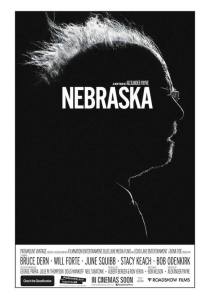
Tragic and melancholy; funny and touching, Nebraska is another triumph from one of cinema's most richly distinctive voices

Tragic and melancholy; funny and touching, Nebraska is another triumph from one of cinema’s most richly distinctive voices

A corrosive thread of sadness and frustration connects Matthew Broderick’s high school teacher in Election (1999), Jack Nicholson’s retired widower in About Schmidt (2002), Paul Giamatti’s wannabe novelist and wine obsessive in Sideways (2004) and George Clooney’s Hawaii-based attorney in The Descendants (2011).

Life has worn each of them down, but not as much as Woody Grant (Bruce Dern), the grizzled geriatric at the centre of Payne’s bittersweet and understated sixth feature Nebraska.

Father and son, Woody (Bruce Dern) and David (Will Forte) hit the road in Nebraska

Father and son, Woody (Bruce Dern) and David (Will Forte) hit the road in Nebraska

We’re first introduced to Woody as he’s shuffling along the highway – as lost and enigmatic a figure as Paris, Texas‘ Travis Henderson. The reason for his wanderings reveals itself when he explains to his son David (Will Forte) that he was on his way to Lincoln, Nebraska, to collect a $1m sweepstake prize he has supposedly won.

Against his better judgement, David agrees to drive his father to Lincoln despite knowing the letter he received is almost certainly a scam. Their trip takes them through Hawthorne, Woody’s dead-end home town, where they visit relatives and bump into his old business partner Ed (Stacey Keach), before being joined by Woody’s outspoken wife Kate (June Squibb) and David’s brother Ross (Bob Odenkirk).
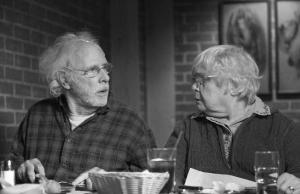
Woody (Bruce Dern) and Kate (June Squibb) squabble in Nebraska

Woody (Bruce Dern) and Kate (June Squibb) squabble in Nebraska

Following the fine tradition of the road movie, an emotional journey is taken alongside the physical one as the wall of ice that has built up around Woody and David begins to thaw and the son begins to understand and come to terms with the father.

The film may be gloriously shot by Payne’s longtime DP Phedon Papamichael in magnificent monochrome, but that’s the only thing black and white about Nebraska.

Family time for David (Will Forte) and brother Ross (Bill Odenkirk) in Nebraska

Family time for David (Will Forte) and brother Ross (Bill Odenkirk) in Nebraska

Payne’s blacky comic script doesn’t pull any punches and makes subtle observations about self-entitlement and the quiet desperation many of us feel for something to go our way.

Asked what he would do with the $1m, Woody shrugs his shoulders and can only think of buying a new truck and an air compressor. In spite of having a limited shopping list, what really motivates Woody is the thought of finally having something substantial that’s his and no-one else’s.

The quietly desperate Woody (Bruce Dern) in Nebraska

The quietly desperate Woody (Bruce Dern) in Nebraska

When Woody lets slip his impending payday while in Hawthorne, he becomes an overnight local celebrity; a development he appears both confused and quietly pleased about. While many are genuinely pleased for Woody, others, Ed in particular, try to pressure him into making good on old debts he’s supposedly accrued.

It’s a rich and nuanced performance from Dern, easily the best he has given for many, many years. Woody isn’t a terribly likeable character, but he’s all-too-human. We, along with David, discover what a flawed man he is through the many mistakes he’s made over the course of a long life; but equally we get a sense of the terrible childhood he must have endured and the scars left by war that carved him into the man he has become.

Like father, like son... David (Will Forte) in Nebraska

Like father, like son… David (Will Forte) in Nebraska

David sees the road trip as a chance to finally get to know his father. Certain home truths are tough to hear; most notably Woody’s matter-of-fact explanation that love “never came up” when it came to marriage to Kate and that they had kids because he “liked to screw”. David is also more alike to his father than he would care to admit; both are stubborn and lead unfulfilled lives.

A veteran of Saturday Night Live, Forte navigates the demands of a dramatic role with ease and plays wonderfully off Dern. The looks of mild confusion and annoyance he shoots at Woody are nicely counterbalanced later in the film by the pride and childlike love he displays.

Payne has a natural skill in handling actors and also helps to bring out great performances from Keach, Odenkirk and Squibb, who gets to let her hair down (and lift her skirt up, but we won’t go into that) with a wonderfully written role.

Tragic and melancholy; funny and touching, Nebraska is another triumph from one of cinema’s most richly distinctive voices.

Review – Killer Joe

Some directors mellow in their old age; not so William Friedkin, as his grisly and grimy take on Tracy Letts’ grand slice of southern gothic Guignol shows.

Killer Joe certainly isn't to everyone's tastes, but for those who enjoy their movies trashy it's finger lickin' good

Killer Joe certainly isn’t to everyone’s tastes, but for those who enjoy their movies trashy it’s finger lickin’ good

Friedkin’s controversy-baiting style has won him an army of devotees and led to a back catalogue that many filmmakers would sell their soul for. The French Connection (1971) and The Exorcist (1973) have rightly earned their place in cinema’s Valhalla, while pictures like Sorcerer (1977), Cruising (1980) and To Live And Die In LA (1985) may be lesser known, but are equally absorbing.

He made a welcome return to horror in his disturbing 2007 adaptation of Letts’ suffocating play Bug and collaborated again with the celebrated playwright four years later for what, according to the poster, is “a totally twisted deep fried Texas redneck trailer park murder story”.

Dumb Chris (Emile Hirsch) makes a play too far in Killer Joe

Dumb Chris (Emile Hirsch) makes a play too far in Killer Joe

The film centres around the Smith clan, a less-than-functional trailer trash brood who make the family from The Texas Chainsaw Massacre look sweet in comparison. Chris (Emile Hirsch) is a drug dealer who’s got himself into debt with the wrong people and, with the help of his simple-minded dad Ansel (Thomas Haden Church), makes a pact with the devil in the shape of Mephistophelean hitman-cop Joe Cooper (Matthew McConaughey) to murder his mother and collect on the life insurance.

Dottie (Juno Temple) takes her retribution in Killer Joe

Dottie (Juno Temple) takes her retribution in Killer Joe

Chris is unable to provide a down-payment to the dark and mysterious Joe, who decides instead to take a retainer in the form of Chris’ childlike sister Dottie (Juno Temple) until the cash is forthcoming.

Friedkin has never been one to shy away from down and dirty filmmaking and is at his most gleefully scuzzy here in what’s effectively a good old-fashioned exploitation B-movie. There’s something of the 1980s here, especially in the montage of close-ups as we’re introduced to Joe, who’s such a badass even the chained-up psycho dog sat outside the family trailer goes quiet when he strolls past.

'Angel of death' Joe Cooper (Matthew McConaughey) in Killer Joe

‘Angel of death’ Joe Cooper (Matthew McConaughey) in Killer Joe

Furthermore, a pretty good clue of what to expect comes early on when the first sign we get of Chris’ loathsome stepmother Sharla (Gina Gershon) is of her naked from the waist down. Subtle it ain’t.

The film’s blackly comic tone adds fuel to the argument that Friedkin is mocking the characters; the only one who seems remotely redeemable is Dottie, although you’re left with the sneaking suspicion she knows more than she’s letting on.

Redneck Ansel (Thomas Haden Church) and trailer trash wife Sharla (Gina Gershon) in Killer Joe

Redneck Ansel (Thomas Haden Church) and trailer trash wife Sharla (Gina Gershon) in Killer Joe

Killer Joe has been likened to a fairytale, with Dottie as the princess looking for her Prince Charming and Joe the wolf at the door, yet no-one emerges from this particular tale with a happy ending. The Smiths’ murderous greed and back-stabbing comes back to bite them hard as the evil they’ve invited into their home arrives for its pound of flesh in the film’s closing scenes, most notoriously involving a fried chicken drumstick.

The film is held together by McConaughey’s shark-eyed turn as Joe, who glides around like some Stetson-wearing angel of death and remains unnervingly calm until his thirst for violence takes over.

Killer Joe certainly isn’t to everyone’s tastes, but for those who enjoy their movies trashy it’s finger lickin’ good.

Review – Her

It’s love Jim, but not as we know it in Spike Jonze’s prescient tale of one man’s unconventional relationship with his operating system.

Her treads a well worn path, but does so in such a wonderfully uncynical and sweet-natured way you'll be glad you went down it

Her treads a well-worn path, but does so in such a wonderfully uncynical and sweet-natured way you’ll be glad you went down it

Since his striking debut Being John Malkovich, Jonze has divided critical opinion between those who embrace his unique vision and those who deride his films as being painfully self-conscious.

It’s unlikely his new film will woo the naysayers, but anyone who writes off Her as a knowing exercise in hipsterism is blinding themselves to one of cinema’s most honest, painful and beautiful love stories since the 2007 Irish charmer Once.

Shanghai fills in for near future LA in Her

Shanghai fills in for near future LA in Her

The premise of Her sounds like an offshoot of Charlie Brooker’s tech-led anthology TV series Black Mirror. Set in a near future LA, lost and lonely Theodore Twombly (Joaquin Phoenix) is still coming to terms with the breakdown of his marriage to childhood sweetheart Catherine (Rooney Mara) and can’t bring himself to sign the divorce papers. The only really meaningful attachment he has is with Amy (Amy Adams), an old friend whom he once dated years back.

His life changes suddenly when he purchases a new highly advanced Operating System, which calls itself Samantha (voiced by Scarlett Johansson) and is soon conversing with Theodore either through his computer or via his phone linked to an earpiece like she’s flesh and blood.

Theodore (Joaquin Phoenix) bumps into good friend Amy (Amy Adams) and her husband Charles (Matt Letscher) in Her

Theodore (Joaquin Phoenix) bumps into good friend Amy (Amy Adams) and her husband Charles (Matt Letscher) in Her

Theodore finds himself increasingly drawn to Samantha, who represents everything he could wish for in a woman… except to exist in physical form.

This is Her‘s big question – can a relationship work when two people aren’t physically together? In spite of the film’s digital age outlook, its central conceit has been a staple of screen romances for decades, from Ernst Lubitsch’s 1940 classic The Shop Around The Corner, to its e-make You’ve Got Mail.

Theodore (Joaquin Phoenix) in one of his more melancholic moments in Her

Theodore (Joaquin Phoenix) in one of his more melancholic moments in Her

Technology, specifically our slavish devotion to it, plays a key role in the film. Whether he’s on the train, in a lift or walking along the street Theodore, like everyone else it seems, is glued to their mobile devices (much like today in fact) or listening to something through their earpiece. It’s little wonder he’s so lonely; he’s surrounded by people who are as lost in their own little world as he is. Although not presented as a dystopia, we’re left to decide for ourselves if this is the kind of future world we’d be happy living in.

In a sad irony, Theodore’s job is to compose handwritten letters of love and devotion for people unable to find the words themselves. In a way, this doesn’t make him too dissimilar to Samantha in that the service he provides is there to help improve a stranger’s life; in some cases over the course of many years as he explains at one point.

Theodore's ex-wife Catherine (Rooney Mara) in Her

Theodore’s ex-wife Catherine (Rooney Mara) in Her

In spite of a few slight eccentricities, Theodore is a character we warm to and come to care about. Phoenix’s eyes convey a sadness and fear that break the heart, while his shuffling gait suggests a guy who’s sleepwalking nowhere in particular. However, with the introduction of Samantha his posture changes, his eyes light up and he radiates a positivity you suspect he hasn’t felt for a long time. Phoenix proved he could really act in The Master and here gives another fascinating take on detachment.

We buy into his relationship with Samantha and this is largely down to Johansson’s (excuse the ironic pun) full-bodied performance. The path they take is, for the large part, a believable one, even when Samantha drafts in a sex surrogate in order for them to enjoy ‘physical’ intimacy.

And happier times. Theodore (Joaquin Phoenix) shares a joke with Samantha (voiced by Scarlett Johannson) in Her

And happier times. Theodore (Joaquin Phoenix) shares a joke with Samantha (voiced by Scarlett Johannson) in Her

A big reason the film works is Jonze’s beautifully observed script. Many of us will identify with the melancholy Theodore feels at the passing of a cherished relationship, as well as the fear, happiness and scepticism he experiences when his once dormant heart reignites.

This being a Jonze joint, the film’s aesthetic is painterly. Shanghai steps in for near future LA (where the fashion appears to be for men to wear trousers almost up to their ribcage) and is a perfect fit for Theodore – gleaming surfaces paint a warm sheen over the sadness and remoteness that exists just beneath.

Her treads a well-worn path, but does so in such a wonderfully uncynical and sweet-natured way you’ll be glad you went down it.

Review – Robocop (2014)

The Paul Verhoeven remake train stops off at its next station with this toned-down reboot of the ultra-violent 80s classic that’s as enjoyable as it is disposable.

RoboCop falls flat too often and doesn't hold together, but it's got enough to say and does so in an entertaining enough way to make you want to comply

RoboCop falls flat too often and doesn’t hold together, but it’s got enough to say and does so in an entertaining enough way to make you want to comply

After the bodge-job that was the 2012 rehash of his Arnie-tastic sci-fi actioner Total Recall, Verhoeven would have been forgiven for rolling his eyes at the thought of 1987’s RoboCop being remade for a modern-day audience.

However, it’s with a certain amount of surprise to report that not only is director José Padilha’s robo-rebirth a solid action movie, but it also sneaks in a few sociopolitical points under the radar to keep lovers of the first film satisfied.

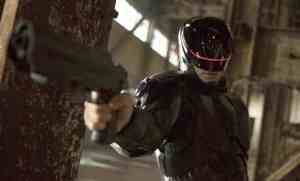
Go Robo! Alex Murphy (Joel Kinnaman), aka RoboCop, goes to work

Go Robo! Alex Murphy (Joel Kinnaman), aka RoboCop, goes to work

Set in the ‘near future’, the original was a gleefully sadistic shoot-em-up that, like his other sci-fi classic Starship Troopers, had a biting satirical edge.

We’re more than 25 years on and the future of law enforcement proposed in Verhoeven’s original remains just that, the future, although one that doesn’t feel that far off when you consider that we now live in a world where drone warfare exists (the film is set in 2028).

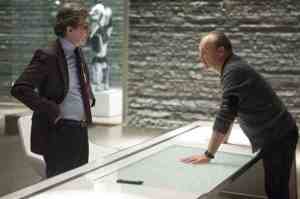
OmniCorp CEO Raymond Sellars (Michael Keaton) plots with Dr Dennett Norton (Gary Oldman) in RoboCop

OmniCorp CEO Raymond Sellars (Michael Keaton) plots with Dr Dennett Norton (Gary Oldman) in RoboCop

Padilha evidently has plenty of respect for the source material and retains the first film’s satirical slant, while also playing around with ideas of American imperialism in its impressive pre-credits sequence.

Giant multinational corporation OmniCorp has effectively privatised American foreign policy and wants to do the same with law enforcement; but is prevented from doing so by the Dreyfus Act. The American public is skeptical about robots patrolling the streets, so OmniCorp CEO Raymond Sellars (Michael Keaton) proposes a man be put in a machine to bring people onside.

Bill O'Reilly-esque TV host Pat Novak (Samuel L Jackson) sets the world to rights in RoboCop

Bill O’Reilly-esque TV host Pat Novak (Samuel L Jackson) sets the world to rights in RoboCop

That man is Alex Murphy (Joel Kinnaman), who is critically injured by a car bomb and, with the help of conflicted OmniCorp scientist Dr Dennett Norton (Gary Oldman), is transformed into RoboCop. As the tide of public opinion turns in OmniCorp’s favour thanks to RoboCop’s by-any-means-necessary arrest policy, Alex goes after those responsible for his near-death experience, while trying to reconnect with his wife (Abbie Cornish) and son.

While broadly speaking the same movie (some of the original’s more memorable dialogue is crowbarred in – “I’d buy that for a dollar”; “dead or alive, you’re coming with me”), Padilha and screenwriter Joshua Zetumer take enough detours to make the enterprise worthwhile, most notably the relationship between Alex and Dr Norton, which runs with the Frankenstein sub-text even more than the first movie. The CG-heavy scene in which Norton reveals the extent of what’s (not) left of Alex is effectively handled by Kinnaman and the ever-reliable Oldman.

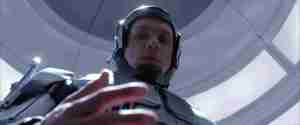
Alex Murphy (Joel Kinnaman) realises what's happened to him in RoboCop

Alex Murphy (Joel Kinnaman) realises what’s happened to him in RoboCop

Although the domestic drama between Alex and his family probably worked on paper, it isn’t sold terribly well on screen, to the extent that Cornish spends most of the film either crying or looking like she’s about to.

Likewise, the action set pieces involving RoboCop taking on swathes of robo-soldiers or human cannon fodder are too reminiscent of a computer game, right down to the digital readout on the top right of the screen that helpfully informs us how many people/machines there are left to decommission.

While Verhoeven satirised trashy American culture through TV adverts for such family fare as the board game Nuke ’em, Padilha takes aim at America’s politically biased news media, specifically Fox News. This is done through the abominable Bill O’Reilly-esque TV host Pat Novak (Samuel L Jackson, sporting one of his most memorable hairdos), whose show The Novak Element is effectively a mouthpiece for OmniCorp. Jackson, as he so often does, makes the most of a small-ish role with a gloriously over-the-top performance.

Is RoboCop circa 2014 necessary? Not really. More importantly, is it any good? It falls flat too often and doesn’t hold together, but it’s got enough to say and does so in an entertaining enough way to make you want to comply.

Review – Dallas Buyers Club

The McConaissance goes from strength to strength in this moving period drama that breaks free of its Oscar-grabbing shackles thanks to a pair of magnetic performances.

Dallas Buyers Club is a forthright and rousing tale of dogged determination in the face of death lifted by a pair of remarkably raw performances

Dallas Buyers Club is a forthright and rousing tale of dogged determination in the face of death lifted by a pair of remarkably raw performances

The dark days of Failure To Launch and other dire rom-coms that demanded he lean next to someone on the poster are thankfully an increasingly distant chapter in the career of Matthew McConaughey.

In the past couple of years, McConaughey has finally fulfilled the early promise he showed in the likes of Dazed And Confused (“well alright, alright, alright”) and Lone Star and in that relatively short time has become one of the most exciting screen actors working today.

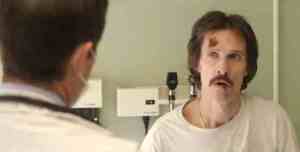
The moment Ron Woodroof (Matthew McConaughey) learns he has Aids in Dallas Buyers Club

The moment Ron Woodroof (Matthew McConaughey) learns he has Aids in Dallas Buyers Club

Hot on the heels of his memorable cameo in The Wolf Of Wall Street, McConaughey switches gears to play Ron Woodroof, the hard-living redneck electrician and rodeo cowboy whose world collapses from under his feet when he learns he is HIV-positive and in all likelihood will be dead in a month.

Set in 1985, myth and conjecture were still rife when it came to the growing Aids epidemic, not least of all in the mind of the homophobic Ron who, like many people at the time, thought it was a disease restricted to homosexuals. Shunned by friends and family and denied access to what Government-approved antivirals there were at the time, Ron takes matters into his own hands and seeks out whatever drugs he can find that might prolong his life.

Ron (Matthew McConaughey) forms an unlikely business partnership with Rayon (Jared Leto) in Dallas Buyers Club

Ron (Matthew McConaughey) forms an unlikely business partnership with Rayon (Jared Leto) in Dallas Buyers Club

Realising there are many more like him out there, he goes into business with Rayon (Jared Leto), a HIV-positive transgender woman who has the necessary contacts to facilitate the set-up of the Dallas Buyers Club wherein ‘members’ pay a month fee for unapproved medication. As business booms it attracts the unwanted attention of the Food and Drug Administration (FDA), which threatens legal action.

Much has been made of the weight both McConaughey (50 lbs) and Leto (30 lbs) lost for their roles and it’s admittedly startling at first to see just how emaciated each actor looks, McConaughey in particular. However, this dramatic weight loss should not distract from what are two of the most committed and honest performances you’ll see all year.

A bond is formed between the sweet-talking Ron (Matthew McConaughey) and his Doc Eve Saks (Jennifer Garner) in Dallas Buyers Club

A bond is formed between the sweet-talking Ron (Matthew McConaughey) and his Doc Eve Saks (Jennifer Garner) in Dallas Buyers Club

These are golden days for McConaughey and the actor disappears into the role to deliver his most complete performance to date. Ron’s journey from free-wheeling homophobic redneck to compassionate social campaigner never once feels false or ham-fisted and the actor maintains the character’s charm, humour and stubbornness even during his darkest moments.

In his first role for six years, Leto is a revelation. Male actors dressing up as women has largely been used as a tool for comedy in the past, but Leto finds a similar conviction and voraciousness to the remarkable performance given by Jaye Davidson in The Crying Game.

Jared Leto gives a wholly convincing performance as Rayon, a HIV-positive transgender woman, in Dallas Buyers Club

Jared Leto gives a wholly convincing performance as Rayon, a HIV-positive transgender woman, in Dallas Buyers Club

Likewise, Jennifer Garner does well in the tough role of Dr Eve Saks, who forms a bond with Ron and starts to question whether what she and her supervisor Dr Sevard (Dennis O’Hare) are doing to ‘help’ Aids sufferers is actually making a positive difference.

Where the film does fall down is in the black and white way it portrays the conflict between Ron on one side and the FDA and American health care system on the other.

Ron (Matthew McConaughey) in one of his numerous scrapes with the law in Dallas Buyers Club

Ron (Matthew McConaughey) in one of his numerous scrapes with the law in Dallas Buyers Club

Director Jean-Marc Vallée appears to ask Michael O’Neill’s FDA official Richard Barkley to just look angry and menacing the whole time, while O’Hare’s Dr Sevard is little more than a cipher to show how cuddly the health care system and big pharma are.

While the relationship Ron strikes up with Eve is sweetly affecting, it’s his bond with Rayon that’s Dallas Buyers Club‘s beating heart. The moment when Ron instinctively defends Rayon against a former buddy who’s ostracised him comes as much as a surprise to us as it does to the two of them. It’s a beautifully played moment that signals a turning point in their relationship from business associates to friends.

To the film’s credit it never wallows in grief or cynically pulls the heartstrings; what we get instead is a forthright and rousing tale of dogged determination in the face of death lifted by a pair of remarkably raw performances.