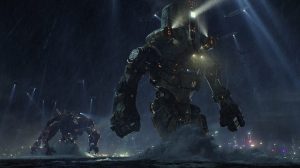
Review – Prisoners

The mark of Scandinavian crime drama seeps into every gloomy frame of this brutal and nihilistic English language debut from director Denis Villeneuve.

Prisoners may retreat into traditional thriller territory, especially in its final act, but it offers no easy answers and paints a very troubling picture of God-fearing American suburbia

Prisoners may retreat into traditional thriller territory, especially in its final act, but it offers no easy answers and paints a very troubling picture of God-fearing American suburbia

Prisoners opens with carpenter Keller Dover (Hugh Jackman) uttering the Lord’s Prayer before his son (Dylan Minnette) shoots his first deer. It’s a symbolic moment – a violent act performed in God’s name, one in which forgiveness is spoken of but ultimately ignored.

Keller Dover (Hugh Jackman) demands action from Detective Loki (Jake Gyllenhaal) to find his daugher in Prisoners

Keller Dover (Hugh Jackman) demands action from Detective Loki (Jake Gyllenhaal) to find his daugher in Prisoners

Keller is a deeply religious man whose New Testament nature gives way to Old Testament retribution when his young daughter Anna (Erin Gerasimovich) goes missing along with the daughter of his good friend Franklin Birch (Terrence Howard) during a Thanksgiving dinner. Panic and grief give way to murderous vengeance for Keller when the police, led by Detective Loki (Jake Gyllenhaal), are forced to release their chief suspect, the mentally challenged Alex (Paul Dano).

Prime suspect Alex (Paul Dano) is interrogated by Detecive Loki (Jake Gyllenhaal) in Prisoners

Prime suspect Alex (Paul Dano) is interrogated by Detecive Loki (Jake Gyllenhaal) in Prisoners

Loki implores Keller and his wife Grace, who’s become virtually catatonic through grief, to let him do his job, which involves methodically following whatever leads the case throws up. But blinded by rage and convinced that Alex knows where the girls are being held, an obsessive Keller takes it upon himself to act as judge, jury and, if necessary, executioner to find the ‘truth’, sucking Franklin and his wife Nancy (Viola Davis) into his increasingly disturbing descent.
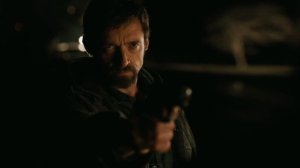
Keller Dover takes the law into his own hands in Prisoners

Keller Dover takes the law into his own hands in Prisoners

Cinematographer par excellence Roger Deakins infuses Prisoners with an almost suffocating dread – woods haven’t looked this spine-tingling since The Blair Witch Project. Not only does the film coldly nod in the direction of Scandi-drama, it also owes a lot to the slate-grey creepiness of David Fincher (in particular Seven and Zodiac), whose most recent film is, of course, his remake of The Girl With The Dragon Tattoo. Another Scandi-connection can be found in the atmospheric soundtrack provided by Icelandic composer Jóhann Jóhannsson.

As well as the obvious religious overtones, it’s also easy to find a 9/11 allegory in Prisoners – a wounded America (religious everyman Keller) goes in search of revenge against its quarry (Alex) and is prepared to sacrifice its moral superiority to quench its thirst for vengeance.
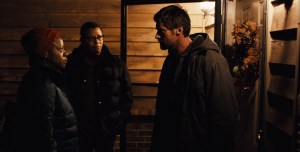
Franklin and Nancy Birch (Terrence Howard and Viola Davis) are dragged into Keller Dover's quest for vengeance in Prisoners

Franklin and Nancy Birch (Terrence Howard and Viola Davis) are dragged into Keller Dover’s quest for vengeance in Prisoners

Aaron Guzikowski’s script asks some troubling questions, most notably, to what lengths would you as a parent go when your worst nightmares are realised. Given the right material, Jackman can really act and shows he’s far more than the Wolverine with a raw and powerful performance as Keller. Jackman’s natural physicality lends a ticking time bomb nature to his character, someone who you believe will do anything to get his daughter back.

Aunt Holly (Melissa Leo) protects Alex (Paul Dano) in Prisoners

Aunt Holly (Melissa Leo) protects Alex (Paul Dano) in Prisoners

Gyllenhaal, who played a political cartoonist dragged into tracking down a serial killer in Zodiac, gives Loki (another Scandinavian connection) a stoical implacability that nicely mirrors Keller’s bull-in-a-china-shop aggressiveness. His pronounced blinking suggests an appalled bewilderment at what his character is investigating and contributes to what is the latest in a line of fine performances from Gyllenhaal.
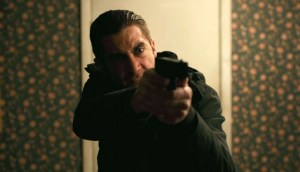
Detective Loki (Jake Gyllenhaal) on the case in Prisoners

Detective Loki (Jake Gyllenhaal) on the case in Prisoners

The heavyweight supporting cast are uniformly excellent. Dano, normally a little too over-the-top, dials it right down as the tragic Alex; Howard and Davis are entirely believable as a couple who suddenly find themselves on the wrong side of the moral line and don’t know what to do; while Melissa Leo is reliably great as Alex’s impassive Aunt Holly.

It’s not until you watch the film that you realise just how rare a commodity it is in American studio cinema these days. Prisoners may retreat into traditional thriller territory, especially in its final act, but it offers no easy answers and paints a very troubling picture of God-fearing American suburbia.

Review – Pain & Gain

The American Dream gets a serious steroid pump in Michael Bay’s black comedy based on a true story as knuckle-headed as its protagonists.

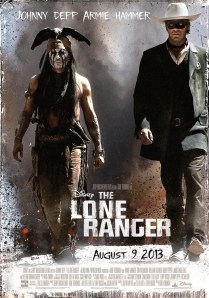
Pain & Gain Poster

In many ways, Pain & Gain is the perfect vehicle for Bay’s testosterone-fuelled style. However, following an unnecessarily long 129 minutes you’re left wondering what another director with more vision and discipline and less bombast would have done with such promising material

Hardly the most well-respected director to ever step behind the camera, Bay’s reputation in recent years has sunk to uncharted depths with the mind-numbing Transformers movies. Ahead of the fourth installment of a franchise that’s about as hotly anticipated as an axe to the head, he’s knocked out Pain & Gain, his cheapest film since his 1995 debut Bad Boys.

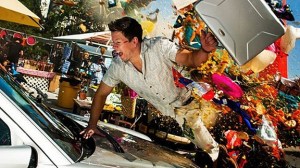
The wheels come off for disgruntled bodybuilder Daniel Lugo (Mark Wahlberg) in Pain & Gain

The wheels come off for disgruntled bodybuilder Daniel Lugo (Mark Wahlberg) in Pain & Gain

As slick as it is amoral, Pain & Gain has the look and feel of a 1990s Tony Scott film, wherein ultra-ambitious bodybuilder and Sun Gym staffer Daniel Lugo (Mark Wahlberg) teams up with fellow personal trainer Adrian Doorbal (Anthony Mackey) and ex-con and recovering cocaine addict Paul Doyle (Dwayne Johnson) to kidnap obnoxious businessman Victor Kershaw (Tony Shalhoub) and force him to sign over his considerable wealth to them. However, they don’t count on wily private detective Ed Du Bois III (Ed Harris) sniffing around, while greed gets the better of them when they decide to go after another target.

Ex-con Paul Doyle (Dwayne Johnson) gets himself in hot water in Pain & Gain

Ex-con Paul Doyle (Dwayne Johnson) gets himself in hot water in Pain & Gain

As is the way with most films ‘based’ on a true story, Pain & Gain plays fast and loose with the real life events that took place in Miami more than 15 years ago and adopts an exploitative tone all-too familiar in Bay’s films.

Adrian Doorbal (Anthony Mackey) consults flirty nurse Robin Peck (Rebel Wilson) in Pain & Gain

Adrian Doorbal (Anthony Mackey) consults flirty nurse Robin Peck (Rebel Wilson) in Pain & Gain

Billed as an action comedy, the film can’t seem to decide where its sympathies lie. It portrays Lugo as a meathead with delusions of criminal intelligence and a sense of entitlement to what he sees as the American Dream (ie having lots of cash), but Wahlberg’s likeably wide-eyed performance is such that you find yourself siding with him in spite of the murderous chain of events he sets off.

Doyle (Dwayne Johnson), Lugo (Mark Wahlberg) and Doorbal (Anthony Mackey) live it up in Pain & Gain

Doyle (Dwayne Johnson), Lugo (Mark Wahlberg) and Doorbal (Anthony Mackey) live it up in Pain & Gain

There’s no doubt that as an experience it’s head and shoulders above the lowest common denominator flatulence of Transformers, but Bay is too one-dimensional a director not to throw in big-breasted babes and violence-for-laughs when he can.

It’s a shame too, as Pain & Gain has moments that really spark, not least of which the sequence in Doorbal’s house in which Bay shows the wheels coming off for the gang by inventively gliding the camera back and forth between Lugo losing it in one room and Doyle and Doorbal getting increasingly out of control in the other.

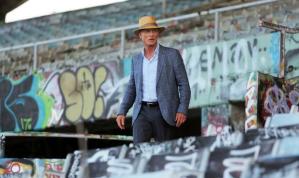
Private detective Ed Du Bois III (Ed Harris) on the case in Pain & Gain

Private detective Ed Du Bois III (Ed Harris) on the case in Pain & Gain

Wahlberg has one of those faces that lends itself to playing normal working class guys and he does what he does best here as the naive ringleader Lugo. Mackay plays dumb without winking to the audience as Doorbal; a willing participant in Lugo’s scheme who’s too cowardly and greedy to escape when things get out of hand. There’s an amusing irony in the fact the steroids he’s abused to artificially pump up his body have given him erectile dysfunction, although it doesn’t seem to bother flirty nurse Robin (a great turn by Rebel Wilson).

Sun Gym owner John Mese (Rob Corddry) in Pain & Gain

Sun Gym owner John Mese (Rob Corddry) in Pain & Gain

The star of the show, though, is Johnson as the simple-minded Doyle. Originally pegged as a Schwarzenegger wannabe, Johnson has shown himself to be an actor with a lot more range than he’s often given credit for and here finds the right balance between gentleness and psychosis without ever going too big.

The supporting turns are also largely excellent, from Harris’ kind-hearted detective (bringing to mind Fargo‘s Marge Gunderson) to Shalhoub’s deeply unpleasant victim (“you know who invented salads? Poor people”) and Rob Corddry’s pathetic Sun Gym owner John Mese.

In many ways, Pain & Gain is the perfect vehicle for Bay’s testosterone-fuelled style. However, following an unnecessarily long 129 minutes you’re left wondering what another director with more vision and discipline and less bombast would have done with such promising material.

Review – The Lone Ranger

Johnny Depp and Gore Verbinski turn their big budget sights from the high seas to the high plains in this revisionist reboot of the TV serial featuring the sort of running time that would put even a Kevin Costner horse opera to shame.

Better than some knife-wielding critics would have you believe, The Lone Ranger still feels like a missed opportunity to reinvigorate a dying genre for a modern blockbuster audience

Better than some knife-wielding critics would have you believe, The Lone Ranger still feels like a missed opportunity to reinvigorate a dying genre for a modern blockbuster audience

Actually, strictly speaking, this is their second western following the critically acclaimed 2011 animated movie Rango, in which Depp played a chameleon (appropriate considering the diversity of roles he’s had over the years) who becomes the new sheriff of a town called Dirt.

Tonto (Johnny Depp) and John Reid (Armie Hammer) give a nod to John Ford in The Lone Ranger

Tonto (Johnny Depp) and John Reid (Armie Hammer) give a nod to John Ford in The Lone Ranger

Considerably more ambitious, The Lone Ranger desperately tries to cook up the same mix of humour and action that made Pirates Of The Caribbean: The Curse Of The Black Pearl such a massive hit, but while there are glimmers of a superior summer blockbuster here, it ultimately shoots itself in the foot.

The film seeks to reimagine the origin story of The Lone Ranger, a heroic masked ex-Texas Ranger who fights injustice on the American frontier astride his regal horse Silver and with his trusty Native American sidekick Tonto in tow.

Tonto (Johnny Depp) and "weird" horse Silver in The Lone Ranger

Tonto (Johnny Depp) and “weird” horse Silver in The Lone Ranger

Using the framing device of an aged Comanche Tonto (Depp, a la Little Big Man) relating events to a young boy, his narration tells of how he first met John Reid (Armie Hammer) and how the young lawyer was the sole survivor of a brutal massacre by the feared outlaw Butch Cavendish (William Fichtner) and his gang. Befriending a comedy horse, Reid is persuaded by Tonto to become the masked Lone Ranger and help him seek justice against Cavendish and a wider, more insidious corruption.

The ruthless outlaw Butch Cavendish (William Fichtner) in The Lone Ranger

The ruthless outlaw Butch Cavendish (William Fichtner) in The Lone Ranger

One of the issues with The Lone Ranger is the rather odd and sudden deviation in tone from eyebrow-raising violence to broad humour, sometimes in the same scene. Following the brutal massacre, for instance, that leaves Reid barely alive, the mood is swiftly lightened by a comic interlude involving Tonto and Silver that feels out-of-place in light of what you’ve just seen.

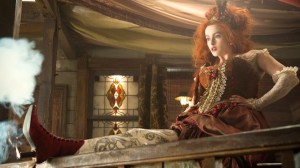
Ivory-legged brothel madam Red Harrington (Helena Bonham-Carter) in The Lone Ranger

Ivory-legged brothel madam Red Harrington (Helena Bonham-Carter) in The Lone Ranger

It’s a problem that blighted Verbinski’s Pirates… sequels, especially At World’s End (still the most expensive movie ever made), which couldn’t decide what type of film it wanted to be. A reason for this is the presence of Depp, a gifted comic actor whose iconic Jack Sparrow became the foundation on which the Pirates… series was built. Inherently a comic character, Sparrow and the film’s serious storylines created an imbalance (not helped by Depp’s increasingly self-indulgent performances) and it’s an issue that affects The Lone Ranger.

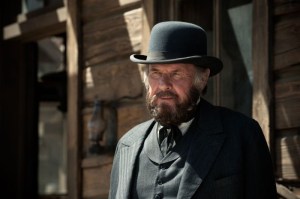
Railroad tycoon Latham Cole (Tom Wilkinson) in The Lone Ranger

Railroad tycoon Latham Cole (Tom Wilkinson) in The Lone Ranger

Depp is terrific as Tonto, channeling Buster Keaton in both his mannerisms and physical performance, not least in the film’s impressively staged final set piece on board a train (bringing to mind Keaton’s The General). If this were a film solely about Tonto and his quest for justice I would be the first in line, but once again Verbinski tries too hard by weaving the Native American around an unengaging plot involving Reid (to be fair to Hammer he’s pretty decent in the title role, but doesn’t stand a chance next to Depp). Verbinski got the balance right with Rango and, as such, produced his most successful and satisfying film to date.

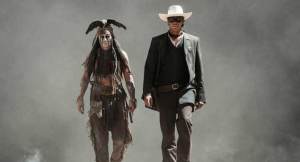
Tonto (Johnny Depp) and John 'Lone Ranger' Reid (Armie Hammer) stride purposefully in The Lone Ranger

Tonto (Johnny Depp) and John ‘Lone Ranger’ Reid (Armie Hammer) stride purposefully in The Lone Ranger

In what must be his umpteenth film this year, composer Hans Zimmer shows here why he’s one of the very best in the business, delivering a soundtrack that gallops along and brings to mind the Saturday morning TV serials the Lone Ranger previously appeared in. Needless to say, Rossini’s William Tell Overture (used as the theme song in the TV show) brings a smile to the face when it’s finally used in the film’s closing moments.

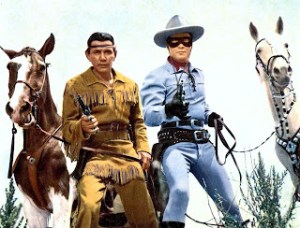
The original Lone Ranger (Clayton Moore) and Tonto (Jay Silverheels)

The original Lone Ranger (Clayton Moore) and Tonto (Jay Silverheels)

Fichtner delivers a typically great performance as the loathsome Cavendish, as does Wilkinson whose railroad tycoon Latham Cole is the sort of role he delivers in his sleep. Helena Bonham-Carter is wasted, however, as ivory-legged brothel owner Red Harrington, who gets too little screen time to make an impact, while British actress Ruth Wilson fares little better as Reid’s love interest Rebecca.

The Lone Ranger wouldn’t be a western if it didn’t tip its pearly white hat to John Ford and does so by filming in the iconic Monument Valley. Cinematographer Bojan Bazelli, whose previous credits haven’t been great (last year’s Rock Of Ages being one example) excels himself here with a number of stunning location shots.

Better than some knife-wielding critics would have you believe, The Lone Ranger still feels like a missed opportunity to reinvigorate a dying genre for a modern blockbuster audience.

Review – Only God Forgives

Rarely has a film divided critical opinion in recent years as much as Nicolas Winding Refn’s ultra-violent, religiously symbolic and uncompromising journey into hell.

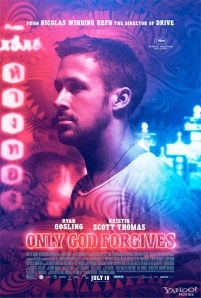
A bleak nightmare, Nicolas Winding Refn's Only God Forgives doesn't so much enter the void as dives headlong into it

A bleak nightmare, Nicolas Winding Refn’s Only God Forgives doesn’t so much enter the void as dive headlong into it

Following the surprising success of Refn’s man-with-no-name neo-noir Drive, he’s reteamed with star Ryan Gosling, relocated to Thailand and revved up the experimentalism in Only God Forgives.

Although Refn has connected his latest to Drive,  alluding to the fact they both exist in a heightened reality, it actually bears a closer kinship to his lesser-seen 2009 work Valhalla Rising. With its brutal acts of violence, minimalist style, and preponderance for mood over dialogue, the two films share a lot in common.

The ghost-like Angel of Vengeance Chang (Vithaya Pansringarm) in Only God Forgives

The ghost-like Angel of Vengeance Chang (Vithaya Pansringarm) in Only God Forgives

Critics rounded on the film at its Cannes premiere earlier this year, possibly out of confusion that Refn and Gosling hadn’t given them Drive 2,  but those who balk at the director’s use of violence and stripped-back approach (most notably his fascination with silence) forget these are the qualities that he’s built his career on. His Pusher trilogy, Bronson and Valhalla Rising are all stylistic works punctuated by moments of shocking ferocity.

Julian (Gosling) is an expat living in Bangkok whose boxing club is a front for an industrial-scale drug operation. When his brother murders a prostitute and is himself killed out of vengeance, the monosyllabic Julian must not only contend with his domineering and contemptuous mother Crystal (Kristin Scott Thomas), but also samurai sword-wielding cop Chang (Vithaya Pansringarm).

Julian (Ryan Gosling) on hisslow descent in Only God Forgives

Julian (Ryan Gosling) on his slow descent in Only God Forgives

If Drive was a pared-down story of heroism akin to a dream, Only God Forgives is its mirror image, a bleak nightmare whose self-loathing lead character is waiting to embrace his own damnation with open arms.

Crystal (Kristin Scott Thomas), a modern-day Lady Macbeth in Only God Forgives

Crystal (Kristin Scott Thomas), a modern-day Lady Macbeth in Only God Forgives

Indeed, arms feature regularly in the film, be they stretched out with hands open to represent helplessness and a plea for forgiveness, or with clenched fists to show rage and repression. Refn also attaches an Old Testament religious symbolism to these shots wherein Julian is welcoming punishment for his past misdeeds.

This theological inflection is as present as the hellish crimson lighting Refn drenches over many of the scenes. Corridors are given an extra menace, while the empty nightclub in which Julian meets Chang is a barely concealed metaphor for hell’s anteroom.

Crystal (Kristin Scott Thomas) gets gangster Bryon (Byron Gibson) on side in Only God Forgives

Crystal (Kristin Scott Thomas) gets gangster Bryon (Byron Gibson) on side in Only God Forgives

As well as being a cop, Chang exudes a supernatural force. Somehow able to produce his samurai sword as if it’s attached to his spine, Chang is referred to as the Angel of Vengeance. During filming, Refn apparently whispered into Pansringarm’s ear that “you’re God”. If he is God, he’s more of the Old Testament kind, the sort who has the power of forgiveness but doesn’t intend on showing any.

Mai (Rhatha Phongam) and Julian (Ryan Gosling) in Only God Forgives

Mai (Rhatha Phongam) and Julian (Ryan Gosling) in Only God Forgives

Thomas is deliciously repellant as Crystal, a modern day Lady Macbeth consumed by a thirst for revenge at the death of her son and a weirdly incestuous love/hate relationship with Julian. When Julian points out that his brother raped and killed a 16-year-old girl, she replies: “I’m sure he had his reasons.”

Pansringarm is eerily non-expressive as the ghost-like Chang, who seems conjured up from Julian’s tortured subconscious. With only 17 lines of dialogue in the while film, Gosling delivers a tightly coiled performance that deviates between submissive catatonia to moments of explosive rage. He has some of the most expressive eyes in modern cinema which can emote pained puppy dog one second and barely restrained psychosis the next.

Accompanied by Cliff Martinez’s typically excellent score (one that weaves in Eastern influences without ever coming across as rote or lazy), Only God Forgives doesn’t so much enter the void as dive headlong into it.

Review – Pacific Rim

Michael Bay’s never-ending Transformers franchise may have given giant robots a bad name, but Guillermo del Toro’s epic monsters vs aliens mash-up delivers robo-spectacle on an eye-popping scale.

Leave your cynicism at the door and Guillermo del Toro's Pacific Rim will reward you two hours of monster mayhem that'll overload your senses

Leave your cynicism at the door and let Guillermo del Toro’s Pacific Rim reward you with two hours of monster mayhem that’ll pulverise your senses

Best known until now for modern Spanish-language horror-fantasy classics Pan’s Labyrinth and The Devil’s Backbone, as well as his two Hellboy films, del Toro has taken a (literal) giant step up with Pacific Rim.

Now that's a footprint, in Pacific Rim

Now that’s a footprint, in Pacific Rim

Pacific Rim has a long tradition of giant monster films in its wake and owes a tremendous debt to both legendary creature effects wizard Ray Harryhausen and iconic Japanese film director Ishirō Honda, whose 1954 classic Godzilla was the most influential monster movie since King Kong (1933).

Godzilla launched the Kaiju (“giant monster”) genre, which exploded in popularity in its native Japan and led to a slew of creature features, each more bonkers than the last. Rather a point of reference than a direct homage, Pacific Rim‘s giant bad guys are referred to as Kaiju, invading aliens from an underwater portal between dimensions that have only one thing on their mind – to take over the planet.

Brothers Yancy (Diego Klattenhoff) and Raleigh Becket (Charlie Hunnam) pilot their Jaeger in Pacific Rim

Brothers Yancy (Diego Klattenhoff) and Raleigh Becket (Charlie Hunnam) pilot their Jaeger in Pacific Rim

Faced with annihilation, mankind works together to build a series of 25 storey-high fighting machines called Jaegers (“hunters”), whose human pilots must share a mind link called The Drift in order to become one with the giant mechas.

A Kaiju goes to work on Sydney, in Pacific Rim

A Kaiju goes to work on Sydney, in Pacific Rim

Del Toro and Travis Beacham’s script ain’t much interested in the human characters; their back stories are perfunctory, or in some cases non-existent, and they trade-off with each other using the sort of dialogue that’s only ever found in special effects-laden summer blockbusters.

The cast is also predominately made up of familiar TV faces (mostly British), including Charlie Hunnam (Sons Of Anarchy) as Raleigh Becket, a gifted Jaeger pilot who’s lost his way since a tragic stand-off against a Kaiju (think Tom Cruise from Top Gun); Idris Elba (The Wire, Luthor) as tough, but fair Jaeger force commander Stacker Pentecost (who gets to utter the class line: “Today, we are cancelling the apocalypse!”); and Robert Kazinsky, who until now is best known for appearing in British soap EastEnders and here plays arrogant Australian Jaeger pilot Chuck Hansen.

Wannabe Jaeger pilot Mako Mori (Rinko Kikuchi) in Pacific Rim

Wannabe Jaeger pilot Mako Mori (Rinko Kikuchi) in Pacific Rim

In a film with delusions of grandeur, the paper-thin characterisation (with the exception of Rinko Kikuchi’s wannabe Jaeger pilot Mako Mori) and stilted dialogue would be too much of an issue, but what saves Pacific Rim is its self-awareness. Lest we forget, this is a film about enormous man-made robots laying into massive alien lizards; characterisation and dialogue doesn’t really matter when you’ve got that sort of spectacle on screen. The squabbling interplay between the chalk and cheese scientists Dr Newton Geiszler (Charlie Day) and Dr Hermann Gottlieb (Burn Gorman) is so heightened as to be cartoonish, but that’s exactly what del Toro is going for.

The Jaeger's go to war in Pacific Rim

The Jaegers go to war in Pacific Rim

That’s not to say the film is completely devoid of any depth (pun intended). While the creature Godzilla represented the unforeseen consequences of the Atomic Age, the Kaiju in Pacific Rim have only made it to our planet due to the effects of global warming on our oceans.

"Today, we are cancelling the apocalypse!" - tough, but fair Jaeger force commander Stacker Pentecost (Idris Elba) in Pacific Rim

“Today, we are cancelling the apocalypse!” – tough, but fair Jaeger force commander Stacker Pentecost (Idris Elba) in Pacific Rim

The special effects themselves are nothing less than jaw-dropping. When the Kaiju first attack in the lengthy, exposition-heavy pre-title sequence it’s a moment that will have you sat bolt upright in your seat. Bringing to mind Cloverfield (rather than 1998’s forgettable Hollywood remake of Godzilla), there’s nothing quite like watching a giant lizard tearing into a bridge.

The fact that it’s robots vs lizards certainly helps when it comes to working out who’s hitting whom. While Bay isn’t interested in whether you can follow which Decepticon is hitting which Autobot, del Toro keeps the action well-defined and, most importantly, epic in scale. The big problem with another of this summer’s tent pole movies, Man Of Steel, came in its final act where loud noises and mass destruction did not equal nose-bleeding entertainment; here the noise is deafening and the destruction is ultra-massive, but the difference comes in the fact you actually care about what’s happening and, in my case anyway, love every moment.

Leave your cynicism at the door and let Pacific Rim reward you with two hours of monster mayhem that’ll pulverise your senses.