Review – The Butler

Forrest Gump may have been referring to life and boxes of chocolates when he remarked that “you never know what you’re gonna get”, but he could just have easily been talking about the films of Lee Daniels.

In trying to tick too many boxes and pull in too may directions The Butler only serves to weaken its message

In trying to tick too many boxes and pull in too may directions The Butler only serves to weaken its message

Following the little-seen crime thriller Shadowboxer (in which Helen Mirren stars as a contract killer – RED doesn’t seem so odd now), Daniels broke out with the rough and tough Precious before going completely off the reservation with 2012’s tawdry slice of American gothic The Paperboy.

The wild excesses and craziness of The Paperboy have been reigned in and sanitised with his latest offering, The Butler, loosely based on the true story of long-serving White House butler Eugene Allen.
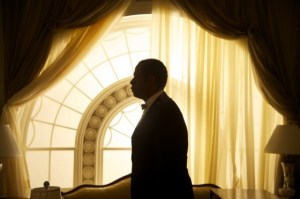
Cecil Gaines (Forest Whitaker) within his second home - the White House - in The Butler

Cecil Gaines (Forest Whitaker) within his second home – the White House – in The Butler

The Forrest Gump analogy works on another level also, as The Butler is reminiscent of that film’s decade-spanning central character who finds himself brushing shoulders with America’s most powerful and influential figures. However, whilst Forrest’s encounters were largely down to fortuitous timing and dumb luck, Cecil Gaines (Forest Whitaker) becomes part of the fabric of the White House over the course of seven presidencies.

The film charts Cecil’s life from a brutal upbringing on a Georgia cotton farm in the 1920s, in which his father is murdered and his mother raped by the plantation’s sociopathic owner, through to his training as a servant which leads to him being employed as a butler at the White House in 1957 under Dwight D Eisenhower. 1600 Pennsylvania Avenue becomes a second home for Cecil, much to the chagrin of his devoted, but frustrated wife Gloria (Oprah Winfrey). Meanwhile, Cecil’s eldest son Louis (David Oyelowo) becomes a committed civil rights campaigner, while his other son Charlie (Elijah Kelley) chooses to fight in Vietnam.

Cecil's mother Hattie (Mariah Carey) toils away in the cotton fields in The Butler

Cecil’s mother Hattie (Mariah Carey) toils away in the cotton fields in The Butler

The Butler feels like a movie pulling in several different directions, with Daniels never quite sure which way to go. One minute it’s a sweeping historical epic, the next a hard-hitting depiction of the civil rights movement, while a minute later it’s a tear-jerking relationship drama between father and son.

Its opening scenes are a difficult watch and suggest a possible explanation as to why Cecil is so averse to speaking out or picking a fight as an adult. The film is at its strongest when dealing directly with the civil rights movement, which it does in an angry and harrowing way by portraying the shameful physical and verbal abuse meted out to those brave enough to smash through the petty racism that still existed in much of the South.

Cecil's volatile eldest son Louis (David Oyelowo) in The Butler

Cecil’s volatile eldest son Louis (David Oyelowo) in The Butler

Oyelowo does an excellent job as Louis, who risks his life and being ostracised from his father to fight for a more enlightened America, but only through peaceful means. His journey is arguably the most compelling in the film and it’s to Oyelowo’s credit that he doesn’t give in to Oscar-grabbing temptation.

Winfrey is also wonderful as Gloria, a complex character who dearly loves her husband but makes mistakes of judgement that etch themselves on her face. It’s performances like these that make you wish she’d spend less time interviewing people and more in front of the camera for different reasons.

Cecil (Forest Whitaker) and fellow White House butlers James Holloway (Lenny Kravitz) and Carter Wilson (Cuba Gooding Jr) in The Butler

Cecil (Forest Whitaker) and fellow White House butlers James Holloway (Lenny Kravitz) and Carter Wilson (Cuba Gooding Jr) in The Butler

As Gary Oldman so memorably proved in Tinker, Tailor, Soldier, Spy, the hardest performances to pull off are the ones that are dialled down almost to zero and Whitaker is similarly restrained as the ghost-like Cecil. Taught early on to silently blend into the background in order to become a successful butler, Cecil goes about his everyday business with the utmost professionalism while presidents come and go and the world moves on around him.

Despite being the headquarters of a world superpower, Daniels shows that very little actually changes within the White House, be it the Downton Abbey-esque stately formality or the attitudes among some senior White House staff towards the black servants.

Cecil Gaines (Forest Whitaker) and his wife Gloria (Oprah Winfrey) in The Butler

Cecil Gaines (Forest Whitaker) and his wife Gloria (Oprah Winfrey) in The Butler

A gamut of stars portray the various presidents, with the most notable being John Cusack’s clammy and paranoid turn as Nixon (including a slightly comical prosthetic nose) and Alan Rickman’s uncanny take on Ronald Regan.

Each president appears only briefly on camera, which lends weight to the argument that The Butler would probably have worked better as a mini-series. With so much to squeeze in, the film inevitably feels rushed and softens its impact as a result.

Daniels should be congratulated for bringing a serious film to the big screen  about the long and arduous journey African-Americans took before a black president finally occupied the White House, but in trying to tick too many boxes and pull in too may directions The Butler only serves to weaken its message.

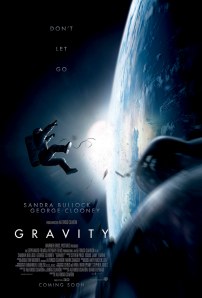
Review – Gravity

It’s one small step for visual effects and one giant leap for cinema in Alfonso Cuarón’s extraordinary survival thriller where astronauts Sandra Bullock and George Clooney have a very serious problem.

Gravity is nothing short of a game-changer and a fully immersive motion picture experience that raises the bar to dizzying new heights

Gravity is nothing short of a game-changer and a fully immersive motion picture experience that raises the bar to dizzying new heights

Not since 1995’s Apollo 13 has a film delivered the stomach-churning sense of what it must truly be like to be lost in space and have to rely on ingenuity and bravery to survive against all the odds.

The film’s overwhelming box office success is richly deserved recompense for the four years Cuarón spent bringing Gravity to the big screen.

Dr Ryan Stone on her first - and possibly last - shuttle mission in Gravity

Dr Ryan Stone on her first – and possibly last – shuttle mission in Gravity

Cuarón revealed himself to be a technical director par excellence in his under-appreciated 2006 dystopian sci-fi masterpiece Children Of Men and held out on making Gravity until visual effects technology had finally caught up with his vision for the film.

His, and our, patience has been rewarded as the film is nothing short of a game-changer and a fully immersive motion picture experience that raises the bar to dizzying new heights.

Grizzled veteran astronaut Matt Kowalski (George Clooney) takes command in Gravity

Grizzled veteran astronaut Matt Kowalski (George Clooney) takes command in Gravity

Gravity‘s plot is the highest of high concepts. Rookie astronaut Dr Ryan Stone (Bullock) and grizzled veteran Matt Kowalski (Clooney) are on a routine spacewalk to service the Hubble telescope when Mission Control (voiced by Apollo 13‘s Ed Harris) warns of a Russian missile strike on an out-of-service satellite that has caused a chain reaction of debris heading their way fast. Before they have time to properly react the debris tears through their shuttle, leaving them cut off from everything and everyone.

From the moment a shimmering Planet Earth majestically appears, swallowing the tiny shuttle that slowly becomes our focus, we’re putty in Cuarón’s hands. It’s a stunning opening shot, lasting about 15 minutes (Cuarón has also shown to be a past master in the art of the tracking shot too), that introduces us to the nervous Stone and relaxed and charismatic Kowalski before all hell breaks loose.

"Houston, we have a problem" in Alfonso Cuarón's Gravity

“Houston, we have a problem” in Alfonso Cuarón’s Gravity

We’ve grown so used as moviegoers to hearing sound effects for films set in space that the (scientifically accurate) silence of the shuttle being torn to pieces is actually more disconcerting and terrifying.

These sequences are Gravity‘s tour de force as the line between what is real and what is digitally rendered is almost completely removed. Rather than being some lazy 3-D device, the moment when pieces of debris fly towards the screen will have you flinching and ducking out the way, such is the all-consuming effect the film has on the senses.

The only sound we do hear, apart from Stone’s panicked panting, is Steven Price’s urgent and ominous score, which sounds like it’s been beamed in from another planet.

The terrifying moment when the void beckons in Gravity

The terrifying moment when the void beckons in Gravity

Another of the film’s strengths is to emphasise just how vulnerable and helpless we are when setting foot off our planet despite all of our technology. Stone and Kowalski spend much of their time desperately tethering themselves to chunks of metal or each other in a frantic effort to survive.

Dr Ryan Stone (Sandra Bullock) reaches the relative safety of the International Space Station in Gravity

Dr Ryan Stone (Sandra Bullock) reaches the relative safety of the International Space Station in Gravity

Bullock is on impressive form as the damaged Stone, who’s put through the wringer and must reach her lowest ebb before finally finding the emotional and physical strength to carry on. Although unsubtle, the scene when she makes it inside the womb of the International Space Station and huddles weightless in the foetal position (still tethered as if umbilically attached) may be an unsubtle metaphor for rebirth, but is a striking one nonetheless.

While Bullock brings an admirable range to her role, Clooney might as well be playing himself. It’s not necessarily the actor’s fault; Cuarón’s script, co-written with his son Jonás, provides the sort of dialogue that suggests it’s Clooney in orbit rather than Matt Kowalski. That said, I’ll take Clooney on autopilot over most other actors any day.

James Cameron, no stranger to sci-fi, has called Gravity “the best space film ever done”. Although there’s stiff competition for that particular accolade, such high praise is justified for a film that sets a new benchmark in what cinema is visually capable of.

Review – Blue Jasmine

There’s nothing finer than a fine Woody Allen film and Blue Jasmine finds the bespectacled one in his richest form for many years.

Allen may never again reach the dizzy heights of Manhattan or Annie Hall, but Blue Jasmine is a compelling character study and proves there's plenty of life in the old dog yet

Allen may never again reach the dizzy heights of Manhattan or Annie Hall, but Blue Jasmine is a compelling character study and proves there’s plenty of life in the old dog yet

Allen’s mercurial career has seen more than its fair share of peaks and troughs over the past 50-odd years. When he’s good, he can be great as he was throughout the 70s and much of the 80s, but when’s he’s bad he can be terrible (2001’s The Curse Of The Jade Scorpion being one inglorious example).

Jasmine (Cate Blanchett) hits the bottle again in Blue Jasmine

Jasmine (Cate Blanchett) hits the bottle again in Blue Jasmine

After decades of largely New York-based movies, Allen embarked on a European tour which, like much of his filmography, was a decidedly hit and miss affair. Blue Jasmine is his first US-set production since 2009’s forgettable Whatever Works and the return to home soil (all be it in San Francisco instead of the Big Apple) has served him well.

Left penniless following her high-flying husband Hal’s (Alec Baldwin) arrest for fraud, former one-percenter Jasmine (Cate Blanchett) arrives on her adopted sister Ginger’s (Sally Hawkins) doorstep fallen from grace and with nowhere else to go.

Jasmine's (Cate Blanchett) wealthy husbad Hal (Alec Baldwin) woos Augie (Andrew Dice Clay) and Ginger (Sally Hawkins) in Blue Jasmine

Jasmine’s (Cate Blanchett) wealthy husbad Hal (Alec Baldwin) woos Augie (Andrew Dice Clay) and Ginger (Sally Hawkins) in Blue Jasmine

Although welcoming, there is an underlying tension between them which is exacerbated by Ginger’s new boyfriend, red-blooded greasemonkey Chili (Bobby Cannavale). Now forced to join the other 99 per cent, the stiff-necked Jasmine still maintains an aloofness fuelled by Martini and Xanex. She attempts to rebuild her life and spies in wealthy widower Dwight (Peter Sarsgaard) an opportunity to rejoin the social elite; however, her past can’t stay locked up forever.

Jasmine (Cate Blanchett) finds the chance of a new life with Dwight (Peter Sarsgaard) in Blue Jasmine

Jasmine (Cate Blanchett) finds the chance of a new life with Dwight (Peter Sarsgaard) in Blue Jasmine

The problem with so many of Allen’s films over the past two decades has been that they end up becoming weighed down by the baggage of being ‘a Woody Allen film’; whether it be the clunky narrative (the overrated Match Point, Scoop, Anything Else), recycled dialogue or faux-Allen twitchiness of some of his actors (Larry David in Whatever Works or, worst of all, Kenneth Branagh in 1998’s Celebrity).

Blue Jasmine succeeds because it features believable characters instead of Allen caricatures and has one of his very best scripts. The film’s structure, which flits between the present and flashbacks to New York that reveal how Jasmine ended up in the here and now, is particularly effective.

Ginger (Sally Hawkins) tries to calm down volatile boyfriend Chili (Bobby Cannavale) in Blue Jasmine

Ginger (Sally Hawkins) tries to calm down volatile boyfriend Chili (Bobby Cannavale) in Blue Jasmine

The film is also incredibly well served by the excellent cast, led by Blanchett’s tour de force performance. It’s hard to believe it’s taken quite so long for her and Allen to work together, but it was most definitely worth the wait.

Woody Allen directs Cate Blanchett and Alec Baldwin in Blue Jasmine

Woody Allen directs Cate Blanchett and Alec Baldwin in Blue Jasmine

Jasmine is one of Allen’s most memorable creations and Blanchett fully inhabits the character in a warts-and-all turn that’s equal parts pathetic and self-destructive. Like a bull in a china shop, Jasmine is a ticking time bomb of delusional self-entitlement, self-loathing and toxic depression. When she’s not babbling to herself and railing at the injustice she perceives she’s suffered, she’s trying her best to persuade Ginger to ditch Chili in favour of someone more refined.

Hawkins holds her own against Blanchett and turns in a perceptive and subtle performance. Ginger isn’t just a working class girl with a heart of gold; she makes mistakes and has a difficult past to contend with, as shown through her failed marriage to Augie (an unusually restrained Andrew Dice Clay).

The self-destructive Jasmine (Cate Blanchett) in Blue Jasmine

The self-destructive Jasmine (Cate Blanchett) in Blue Jasmine

Bobby Cannavale is a lot of fun as Chili, although the comparisons to A Streetcar Named Desire‘s Stanley Kowalski are a little off; for one thing Chili’s tear ducts get more of a workout than Brando’s ever did. That being said, Blue Jasmine‘s similarity to Streetcar… is difficult to ignore.

One area where the film falls down is in the soundtrack. As usual, Allen goes for a jazz score, but when a jaunty number suddenly plays over a dramatic scene, as is the case towards the end of the film, it has a habit of taking you out of the moment and undermining the fine work being done by Blanchett and company.

Allen may never again reach the dizzy heights of Manhattan or Annie Hall, but Blue Jasmine is a compelling character study and proves there’s plenty of life in the old dog yet.

Review – Escape Plan

The godfathers of testosterone-fuelled old school action cinema are back to show the young pretenders how they did it in the 80s in this infectiously entertaining slice of nonsense.

Although nowhere near Sly and Arnie's best, Escape Plan does enough to satisfy anyone rubbing their hands with nostalgic anticipation at the prospect of finally seeing these two heavyweights of action cinema let rip together

Although nowhere near Sly and Arnie’s best, Escape Plan does enough to satisfy anyone rubbing their hands with nostalgic anticipation at the prospect of finally seeing these two heavyweights of action cinema let rip together

It may not carry the same dramatic heft as the famous scene in Heat when Robert De Niro and Al Pacino finally appeared together, but watching the iconic Arnold Schwarzenegger and Sylvester Stallone trading one-liners and wielding big guns has its own guilty pleasure.

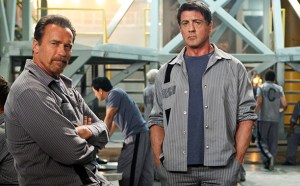
Emil Rottmayer (Arnold Schwarzenegger) and Ray Breslin (Sylvester Stallone) realise it's not the 1980s anymore in Escape Plan

Emil Rottmayer (Arnold Schwarzenegger) and Ray Breslin (Sylvester Stallone) realise it’s not the 1980s anymore in Escape Plan

This may not be the first movie where they’ve shared screen time – that came in truncated form in The Expendables and its forgettable sequel – but Escape Plan has the bragging rights of being the first time these two former enemies-turned best buddies have shared top billing.

Stallone plays Ray Breslin, a security expert who tests the reliability of prisons by breaking out of them. He’s offered a challenge (and a big payday) he can’t resist; namely to escape from a top-secret, ultra-secure jail called ‘The Tomb’. His partners Abigail (Amy Ryan) and tech wiz Hush (Curtis ’50 Cent’ Jackson) don’t like it, but his business partner Lester Clark (Vincent D’Onofrio) can already smell the cash and urges Ray to accept.

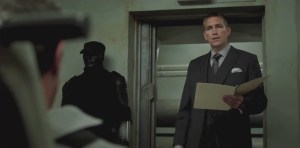
Jim Caviezel couldn't be bothered learning his lines as Warden Willard Hobbs in Escape Plan

Jim Caviezel couldn’t be bothered learning his lines as Warden Willard Hobbs in Escape Plan

No sooner is Ray inside, though, he realises he’s been set up and so must recruit fellow inmate Emil Rottmayer (Schwarzenegger) to devise a cunning escape plan to break out of The Tomb. However, he must not only contend with the sadistic guards, who look like extras from Westworld, but also evil warden Willard Hobbs (Jim Caviezel).

One of the Westworld-style prison guards in Escape Plan

One of the Westworld-style prison guards in Escape Plan

Anyone (myself included) who grew up watching Sly and Arnie taking down whole armies single-handed or saving the world from unstoppable robots were generally more interested in the hilariously over-the-top violence and corny one-liners than unimportant things like ‘acting’ or ‘characterisation’.

Inmates Ray Breslin (Sylvester Stallone) and Emil Rottmayer (Arnold Schwarzenegger) get acquainted in Escape Plan

Inmates Ray Breslin (Sylvester Stallone) and Emil Rottmayer (Arnold Schwarzenegger) get acquainted in Escape Plan

That fine tradition has been maintained in Escape Plan, which knows its audience and doesn’t try to do anything more sophisticated than serve up a healthy portion of buddy movie clichés and geriaction set pieces.

Ray Breslin (Sylvester Stallone) brings the pain in Escape Plan

Ray Breslin (Sylvester Stallone) brings the pain in Escape Plan

That’s certainly not to say it’s a bad film – far from it. Mikael Håfström may not be the most inspiring of directors (his style can probably be best described as ‘functional’), but he’s smart enough to give moviegoers what they want, namely plenty of Sly and Arnie.

Schwarzenegger in particular looks like he’s having a ball and does a nice job wringing the laughs out of the script. If The Expendables franchise has proved anything, it’s that Stallone works better these days playing opposite someone instead of trying to carry a film by himself and looks relaxed and energised as the straight man opposite Arnie.

Vincent D'Onofrio channeling Marlon Brando (physically anyway) as Lester Clark in Escape Plan

Vincent D’Onofrio channeling Marlon Brando (physically anyway) as Lester Clark in Escape Plan

Both Ryan and Sam Neill, who plays Dr Emil Kyrie, look like they’re waiting for their pay cheque to arrive, while D’Onofrio seems to be going for Touch Of Evil-era Orson Welles in his white hat and expanding waistline. Meanwhile, Jackson can’t act if his rap career depended on it; Britain’s Vinnie Jones goes through his usual repertoire of angry faces as head screw Drake; and Caviezel provides a seriously hammy turn as Hobbs, a counterpoint to his role as Number 6 in the 2009 TV miniseries The Prisoner based on the classic 1960s show.

Hobbs’ chief hobby, aside from tormenting the inmates, is trapping butterflies in clear  boxes, which is as deep and symbolic as it gets.

Although nowhere near Sly and Arnie’s best, Escape Plan does enough to satisfy anyone rubbing their hands with nostalgic anticipation at the prospect of finally seeing these two heavyweights of action cinema let rip together.

Review – Captain Phillips

Jack Sparrow is thankfully nowhere to be seen in this buttock-clenching high seas hijack thriller from shaky-cam supremo Paul Greengrass.

Captain Phillips lands so many gut punches you'll be left an exhausted, staggering mess come the end of a mesmerising masterclass in white-knuckle filmmaking.

Captain Phillips lands so many gut punches you’ll be left an exhausted, staggering mess come the end of a mesmerising masterclass in white-knuckle filmmaking.

No longer the preserve of men with ridiculous beards, pet parrots and a penchant for rum, piracy nevertheless remains a very clear and present danger to seafarers. And whil globalisation may have helped many, for those left behind, such as the Somali fishermen in Captain Phillips, poverty can lead to desperate measures.

One of Greengrass’ many strengths is that he understands there are two sides to every story; a trait he honed as first a journalist and then a documentary filmmaker. It’s this skill, assisted by Barry Ackroyd’s visceral cinematography and Billy Ray’s largely excellent script (based on the book A Captain’s Duty by Richard ‘Captain’ Phillips), that sets this absorbing film apart from the likes of Ridley Scott’s Black Hawk Down.

Pirates make their move on the American container vessel commanded by Captain Phillips (Tom Hanks)

Pirates make their move on the American container vessel commanded by Captain Phillips (Tom Hanks)

Merchant Marine Captain Phillips (Tom Hanks) is tasked with getting American container vessel Maersk Alabama from Yemen to Mombasa through the Horn of Africa, a stretch of water synonymous with piracy. Not long into their voyage the Alabama is targeted by a band of Somali bandits, led by Abduwali Muse (Barkhad Abdi), who manage to get aboard and take command of the boat by force. As Greengrass turns the screw ever tighter, it becomes clear both Phillips and Muse are way out of their depth and at the mercy of forces beyond their control.

The pirates in search of loot in Captain Phillips

The pirates in search of loot in Captain Phillips

Structurally, Captain Phillips bears a close similarity to Greengrass’ remarkable 9/11 film United 93 – both concern a real life hijacking that takes on geopolitical ramifications and ratchet up a claustrophobic dread. He has that rare ability to wring every last drop of tension and drama from a script and here revels in locking the door behind you, throwing away the key and watching your anxiety build.

"I'm the captain now..." - Richard Phillips (Tom Hanks) is confronted by Somali fisherman turned pirate Abduwali Muse (Barkhad Abdi) in Captain Phillips

“I’m the captain now…” – Richard Phillips (Tom Hanks) is confronted by Somali fisherman turned pirate Abduwali Muse (Barkhad Abdi) in Captain Phillips

Although from very different parts of the world, Phillips and Muse are not so different really. Both are doing what they can to make ends meet and find themselves embroiled in a “real world situation” they soon cannot escape from.  Greengrass is at pains not to paint the hijackers as ‘villains’. Muse and his men are only doing what they’re doing to satisfy the demands of a local warlord; they know it’s foolhardy and potentially deadly, but desperation has forced their hand.

The lifeboat that sets up the film's second half in Captain Phillips

The lifeboat that sets up the film’s second half in Captain Phillips

This reaches home most poignantly when, challenged by Phillips that “there’s gotta be something other than kidnapping people”, a fateful Muse responds resignedly: “Maybe in America.”

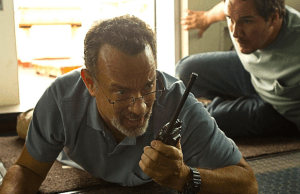
Desperate times for Richard Phillips (Tom Hanks) in Captain Phillips

Desperate times for Richard Phillips (Tom Hanks) in Captain Phillips

Captain Phillips isn’t perfect; the drop in pace in the middle section feels more pronounced following the heart-stopping opening act, while Muse’s makeshift band of pirates are a little too stereotypical (the ultra-agressive one, the naive youngster). But it’s by spending time getting to know these men that gives the final act its dramatic and emotive weight. To that end, the film resembles the little-seen Brazilian documentary Bus 174, which tells the tragic story of a bungled robbery that turns into a hostage crisis.

Abdi, in his film debut, gives an astonishing performance, at turns frightening, frightened and all-too-human. His first encounter with Phillips is brilliantly acted and chilling to watch (no doubt given a greater impact by the fact Greengrass kept Abdi and Hanks apart until the day the scene was filmed). But despite holding all the cards at that moment, when Muse says “I’m the captain now”, you’re unsure who he’s trying to convince more, Phillips or himself.

The screw turns ever tighter in Captain Phillips

The screw turns ever tighter in Captain Phillips

In what could well be the performance of his career, Hanks is superb. Hanks is this generation’s James Stewart, an everyman who’s just as at home playing an all-American astronaut in Apollo 13 or a mob enforcer in Road To Perdition. Phillips feels like the role he was born to play and allows Hanks to stretch himself to breaking point, most notably when Phillips does indeed break down in what is undoubtedly one of the scenes of the year.

Captain Phillips lands so many gut punches you’ll be left an exhausted, staggering mess come the end of a mesmerising masterclass in white-knuckle filmmaking.