Review – Enemy

There’s double trouble to be had in Denis Villeneuve’s compulsive and uncompromising psychological descent into a world of neurosis, nightmares and arachnids.
Enemy is bold and beguiling filmmaking and a puzzle that will linger in the memory long after the closing credits

Enemy is bold and beguiling filmmaking and a puzzle that will linger in the memory long after the closing credits

Loosely based on José Saramago’s 2002 novel The Double as opposed to Dostoyevsky’s novel of the same name (which Richard Ayoade adapted to moderate acclaim in 2014), Enemy is one of those puzzle box films that reward repeat viewings.

Ostensibly, the movie follows unfulfilled history lecturer Adam Bell (Jake Gyllenhaal) down the rabbit hole following the shock discovery that a bit player in a movie he’s watching is his apparent doppelgänger. Adam seeks out actor Anthony Claire (also Gyllenhaal), who may be his physical duplicate but appears more narcissistic and charismatic than the nervous and emotionally repressed Adam. Their encounter has unforeseen repercussions for both men, as well as for Adam’s girlfriend Mary (Mélanie Laurent) and Anthony’s pregnant wife Helen (Sarah Gadon).

The left hand doesn't know what thr right hand's doing for Adam/Anthony (Jake Gyllenhaal) in Enemy

The left hand doesn’t know what the right hand’s doing for Adam/Anthony (Jake Gyllenhaal) in Enemy

Scratch beneath the surface, however, and Villeneuve’s absorbing picture is a spider’s nest of different interpretations and perspectives in which individuality has become as precarious as one man’s collapsing mind.

The film’s opening intertitle “Chaos is order yet undeciphered” – a line taken from Saramago‘s novel – is given form by the numerous long shots of a city (in this case Toronto); that most chaotic yet fully formed of human creations that here is infected with a yellow, hazy sickliness, beautifully realised by cinematographer Nicolas Bodluc.

Anthony's pregnant wife Helen (Sarah Gadon) in Enemy

Anthony’s pregnant wife Helen (Sarah Gadon) in Enemy

It has been argued (convincingly in my mind) the spiders seen throughout the film are both a visual and subtextual metaphor for a loss of freedom.

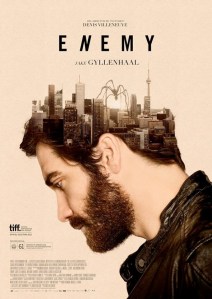
Adam teaches his class about the larger impact of this loss of freedom through his lectures on dictatorships, specifically their obsession with control and “censoring any means of individual expression”. On a more personal scale, Villeneuve shows us Adam/Anthony’s fractured psychological state and as the film continues it becomes apparent (at least to this reviewer) that Adam and Anthony are one in the same person, battling it out to see which side of his personality wins out. As a poster for the film implies: “You can’t escape yourself.”

Anthony (or is it Adam?) (Jake Gyllenhaal)  spies on Mary (Mélanie Laurent) in Enemy

Anthony (or is it Adam?) (Jake Gyllenhaal) spies on Mary (Mélanie Laurent) in Enemy

Shots of overhead electrical cables and a cracked window signify a spider’s web and lend extra weight to the suggestion that Adam/Anthony is trapped and must confront his own identity.

In many ways, Prisoners, the title of Villeneuve’s and Gyllenhaal’s other collaboration would be a more fitting title for this film, although the name Enemy, like the rest of the movie, works on more than one level.

Since breaking out with 2001’s Donnie Darko, Gyllenhaal has freed himself from the spider’s web of big budget nonsense like The Day After Tomorrow (2004) and Prince Of Persia: The Sands Of Time (2010) to set himself apart as an actor who commands serious respect. Gyllenhaal has had his fair amount of detractors in the past, but the choices he’s making with the likes of this and Nightcrawler are genuinely exciting.
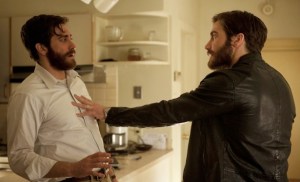
Double trouble in Enemy

Double trouble in Enemy

Gyllenhaal is tremendous in the dual role of two men both separate and conjoined and, crucially, makes you forget about the novelty factor almost immediately. Laurent and Gadon don’t have an awful lot to do, but lend themselves to the overall sense of disquiet. The influence of Vertigo has been acknowledged by Villeneuve and the fact that both Laurent and Gadon are striking blonds in the picture is presumably a nod to Hitchcock’s preference for women in his movies with that hair colour.

Furthermore, the film’s ominous visual palette is lent extra impact by the disquieting score by Daniel Bensi and Saunder Jurriaans which pulls you around as much as Bodluc’s camera.

Enemy is bold and beguiling filmmaking and a puzzle that will linger in the memory long after the closing credits.

Review – ’71

The Troubles serve as a suitably murky backdrop to this taut and absorbing thriller that a young John Carpenter would be proud of.

One of the year's most suspensful thrillers, '71 is edge-of-the-seat stuff and another feather in the cap for its leading man

One of the year’s most suspenseful thrillers, ’71 is edge-of-the-seat stuff and another feather in the cap for its leading man

It’s been quite a year for Jack O’Connell, the rising star of the superb prison drama Starred Up and Angelina Jolie’s latest Unbroken.

What makes O’Connell stand out is the honesty of his performances and the physical and emotional spectrum he’s able to tap into. He brings that range to bear in his portrayal of Gary Hook, a recent army recruit whose regiment is shipped off to Belfast during the height of the Troubles – the political and sectarian conflict between Irish nationalists and unionists loyal to the Queen.

You're in the army now: Soldier Gary Hook (Jack 'O'Connell) in '71

You’re in the army now: Soldier Gary Hook (Jack ‘O’Connell) in ’71

The regiment (and the viewer, of course) are reminded that, by being deployed to Northern Ireland, they “are not leaving this country”, but when they arrive and are sent to support the Royal Ulster Constabulary’s search for guns along the Falls Road – the fault line that largely separated unionists and nationalists – director Yann Demange potently illustrates just how far away from ‘home’ these young men suddenly feel.

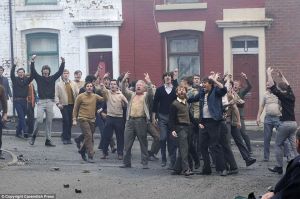
Essentially thrown in at the deep end, their disorientation and fear spirals as they are confronted first by women banging dustbin lids on the ground (to warn fellow Republicans that British soldiers are approaching) and then by an increasingly angry mob. Hook gets cut off from his fellow soldiers when he’s sent after a boy who has snatched a rifle and, following the regiment’s hasty retreat, must fight for survival behind enemy lines.

I predict a riot: things turn ugly in '71

I predict a riot: things turn ugly in ’71

And while the solider tries to evade capture by hiding out (and gets a lesson in soldiering from Richard Dormer’s kindly Eamon, who describes it as “posh c***s telling thick c***s to kill poor c***s”), he becomes a pawn in a larger game being played between senior IRA members and shadowy British operatives led by Sean Harris’ Captain Browning.

Escape from Belfast: Hook (Jack O'Connell) tries to think of a way out in '71

Escape from Belfast: Hook (Jack O’Connell) tries to think of a way out in ’71

The Troubles have inspired some absorbing cinema and ’71 can sit proudly alongside the likes of Alan Clarke’s Elephant (1989), Ken Loach’s Hidden Agenda (1990) and Paul Greengrass’ Bloody Sunday (2002).While not as overtly political as those films, Gregory Burke’s economical script doesn’t ignore it either, although the briefing to senior officers prior to all hell breaking loose does come across as a little too ‘are you paying attention?’.

The film is at its strongest when following the hapless Hook as he stumbles from one terrifying episode to the next. A heart-pounding cat and mouse chase between the fleeing soldier and two gun-toting young IRA members is brilliantly done, while an explosive scene in a pub and its nightmarish aftermath as Hook staggers through what resemble the streets of hell makes you question whether he’ll make it out of there.

Troubles, troubles: Life in Belfast circa '71

Troubles, troubles: Life in Belfast circa ’71

Anthony Radcliffe’s immersive and atmospheric cinematography, the murky nighttime setting, David Holmes’ retro-inflected score and the questionable loyalties of its characters bring to mind Carpenter’s Assault On Precinct 13 (1976), while the against-the-odds battle to survive tips a wink to Escape From New York (1981); comparisons not made lightly, but ones that speak very highly of just how impressive ’71 is.

One of the year’s most suspenseful thrillers, ’71 is edge-of-the-seat stuff and another feather in the cap for its leading man.

Review – The Hobbit: The Battle Of The Five Armies

As good a writer as JRR Tolkien was, he wouldn’t have got very far in Hollywood if his description of the epic battle of orcs, elves, dwarfs, men and anyone else lying around was anything to go by.

And so we come to the end of Jackson's Middle Earth fellowship. LOTR-lite it may be, but fantasy cinema is all the richer for The Hobbit having been in it

And so we come to the end of Jackson’s Middle Earth fellowship. LOTR-lite it may be, but fantasy cinema is all the richer for The Hobbit having been in it

Passed off by Tolkien in just a few words, Peter Jackson obviously had other ideas when imagining how he’d like to conclude his stint as Middle Earth’s resident director.

It’s a decision in keeping with the whole exercise of making three movies out of a 300-page book, which is ironic when you consider he originally envisaged making two films out of The Lord Of The Rings; a three-book saga spanning more than 1,000 pages.

The loyal band of dwarfs prepare for war in The Hobbit: The Battle Of The Five Armies

The loyal band of dwarfs prepare for war in The Hobbit: The Battle Of The Five Armies

That said, Jackson has thrown everything and the kitchen sink into this final chapter of his prequel trilogy and, while there is much to enjoy, it won’t change anyone’s opinion that The Hobbit ultimately remains the poor cousin of LOTR.

We pick up where we left off last time, with the dragon Smaug (voiced by Benedict Cumberbatch) on his way from the Lonely Mountain to smite Laketown and its terrified folk. It’s a breathless opening salvo, arguably the best sequence in the entire trilogy as Bard (Luke Evans) desperately tries to bring the beast down as the town is incinerated around him.

Watching on helplessly are hobbit Bilbo Baggins (Martin Freeman) and his dwarf companions, led by Thorin Oakenshield (Richard Armitage), who disturbed Smaug’s slumber in search of untold wealth and the coveted Arkenstone, a precious gem Thorin is desperate to reclaim.

Gandalf (Ian McKellen) looks on worried in The Hobbit: The Battle Of The Five Armies

Gandalf (Ian McKellen) looks on worried in The Hobbit: The Battle Of The Five Armies

When word spreads of Smaug’s death, an elf army under Thranduil (Lee Pace) marches to the Lonely Mountain to reclaim lost treasure, while a separate force of orcs led by Azog the Defiler (Manu Bennett) also approaches. While all hell breaks loose outside the mountain, as men, dwarfs and elves go to war against the vast numbers of orcs, inside the mountain an increasingly unstable Thorin exasperates his fellow dwarfs and Bilbo by refusing to see sense.

Just as Jackson coiled the spring in the first half of The Return Of The King before unleashing CGI-infused mayhem, he employs a similar approach in The Battle Of The Five Armies. Characters look either pensive or defiant as they talk of impending war, while Jackson cranks up the expectation by regularly cutting to the orc hordes drawing ever nearer to the Lonely Mountain.

Azog the Defiler (Manu Bennett) looks his usual grumpy self in The Hobbit: The Battle Of The Five Armies

Azog the Defiler (Manu Bennett) looks his usual grumpy self in The Hobbit: The Battle Of The Five Armies

When it finally does come, the battle is everything you expect; brutal and frenzied, with seemingly endless waves of orcs pitted against the dwindling alliance. However, as visually impressive as it is, it doesn’t involve you as much as the epic battle of Helm’s Deep in The Two Towers.

The stakes may be just as high, but the clammy terror of a band of brothers fighting for their lives against an implacable army of Urak Hai is what sets Helm’s Deep apart. Too often, Jackson is content to pit CGI army against CGI army; an impressive enough site to be sure but one that will never grab you as much as seeing real people at each other’s throats.

Bilbo Baggins (Martin Freeman) and Thorin Oakenshield (Richard Armitage) look worried in The Hobbit: The Battle Of The Five Armies

Bilbo Baggins (Martin Freeman) and Thorin Oakenshield (Richard Armitage) look worried in The Hobbit: The Battle Of The Five Armies

While the skirmish is the film’s key selling point, it works best when boiling things down to the struggle going on inside Thorin’s mind. Overcome by ‘dragon sickness’, his slide into mental illness is convincingly played by Armitage, who shows enough of the old Thorin to convince Bilbo (a conversation between the two that starts with an acorn is a standout) and co that he’s not gone completely off the deep end. Jackson has brilliantly played up the possessive effects ‘precious’ treasure can have on otherwise strong-willed characters throughout his Middle Earth saga and the lightning bolt moment Thorin experiences during a surreal hallucination is particularly effective.

Freeman does his best with the limited screen time Bilbo is given and lights up every scene he’s in, but once the battle kicks in he’s pretty much sidelined in favour of head-butting dwarves and snarling orcs.

Legolas (Orlando Bloom) and fellow elf Tauriel (Evangeline Lilly) go in search of orcs in The Hobbit: The Battle Of The Five Armies

Legolas (Orlando Bloom) and fellow elf Tauriel (Evangeline Lilly) go in search of orcs in The Hobbit: The Battle Of The Five Armies

Also left on the sidelines is Ian McKellen’s Gandalf, whose rescue from the clutches of Sauron by his fellow White Council members (most notably Cate Blanchett’s luminous Galadriel) is an early highlight, but feels rushed (ironic, I know). Once Gandalf joins the party at the Lonely Mountain he soon gets swallowed up in the rest of the action.

And so we come to the end of Jackson’s Middle Earth fellowship. LOTR-lite it may be, but fantasy cinema is all the richer for The Hobbit having been in it.

Review – Gone Girl

Anyone with nuptials on the horizon may be best steering clear of David Fincher’s pitch black mystery that takes he said/she said to a whole new level.

Gone Girl may not be the director's finest work, but even B-grade Fincher is better than most

Gone Girl may not be the director’s finest work, but even B-grade Fincher is better than most

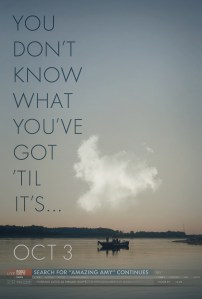
Gone Girl‘s tagline – ‘you don’t know what you’ve got till it’s gone’ – isn’t the only thing about the film that’s devilishly ambiguous; it keeps you guessing in a manner that would have made Hitchcock proud.

That said, an increasingly ludicrous final act and a missed opportunity to properly end the film, a la The Dark Knight Rises, denies Gone Girl the status of classic Fincher.

Nick (Ben Affleck) woos Amy (Rosamund Pike) in Gone Girl

Nick (Ben Affleck) woos Amy (Rosamund Pike) in Gone Girl

Adapted by Gillian Flynn from her own bestselling novel, Ben Affleck stars as Nick Dunne, a suburbanite and bar owner (of an establishment called ‘The Bar’ no less) who reports that his wife Amy (Rosamund Pike) has gone missing on their fifth wedding anniversary. What starts out as a straightforward missing person case takes on a far grislier tone as the truth about their seemingly blissful marriage emerges and the finger of suspicion points to Nick.

Fincher has long been one of US cinema’s most accomplished exponents of stylish darkness and Gone Girl gives him plenty of material to work with.

Nick (Ben Affleck) addresses the crowd and the media in Gone Girl

Nick (Ben Affleck) addresses the crowd and the media in Gone Girl

Affleck is perfectly cast as Nick, an everyday middle-class American who seemingly lucks out when he woos the beautiful Amy. The film spends its first act cutting between the spiralling events of Amy’s disappearance and flashbacks to their marriage, which gradually dissolves from romantic bliss (a moment when the two stroll past a bakery through a sugary mist is wonderfully photographed) to mistrust, fear and acrimony.

The film works best when it’s keeping you guessing as to which narrator is the most unreliable; whether it be the words written down by Amy in her diary which serves as the flashback device, or the story Nick tells tenacious Detective Rhonda Boney (Kim Dickens) and his twin sister Margo (a cracking turn by TV actor Carrie Coon in her feature debut).

Missing..? Amy (Rosamund Pike) in Gone Girl

Missing..? Amy (Rosamund Pike) in Gone Girl

Perhaps the most pernicious narrator of all, though, is the mainstream media and the film is as merciless as Missi Pyle’s cable TV host in its depiction of just how lurid it can be. It may be relatively easy to lambast the tackiness of so much of what passes as ‘news’ media, but it plays as important a character in the film as Nick and Amy and ultimately serves to define who they are to the millions who tune in.

Linked to this, social media also does its bit to decide Nick’s guilt or innocence. Ghoulish ambulance chasers hang around The Bar as if it’s Dealey Plaza and one particularly pathetic figure grabs a selfie with Nick in order to dine out on the notoriety.

Detective Rhonda Boney (Kim Dickens) gets to the bottom of Amy's disappearance with Nick (Ben Affleck), Amy's mother (Lisa Banes) and father (David Clennon) and fellow Detective Jim Gilpin (Patrick Fugit) in Gone Girl

Detective Rhonda Boney (Kim Dickens) gets to the bottom of Amy’s disappearance with Nick (Ben Affleck), Amy’s mother (Lisa Banes) and father (David Clennon) and fellow Detective Jim Gilpin (Patrick Fugit) in Gone Girl

While Affleck does a solid enough job, Pike is both luminous and electric as Amy. It’s a complex role and she makes the most of her juiciest role to date with a turn that Hitch would have loved. Pike goes from knockabout romantic lead to statuesque blonde in the flick of a switch and it’s only later that it becomes clear just how much is going on beneath the surface when she casts a simple glance towards her husband.

Meanwhile, Trent Reznor’s soundtrack, although not as memorable as his Oscar-winning work on Fincher’s The Social Network, does have its moments, most notably in one eye-watching scene in the film’s home stretch.

Gone Girl may not be the director’s finest work, but even B-grade Fincher is better than most.

Review – Frank

Anyone who begrudgingly comes to accept their true talent lies not in what they’d hoped will find a connection to this unique and idiosyncratic story about those blessed with artistic creativity and those who hitch along for the ride.

With a free will and an outsider's spirit all of its own, Frank is a wonderful one-of-a-kind

With a free will and an outsider’s spirit all of its own, Frank is a wonderful one-of-a-kind

It’s a fair bet to say that a good number of critics have at least entertained the idea of doing the very thing they write about. In most cases these dreams remain unfulfilled, consigned to the ‘what if’ section of our brain.

In Jon Ronson’s case, he did it the other way around, having played a purposefully cheap sounding keyboard for three years in Frank Sidebottom’s Oh Blimey Big Band in the 1980s before going on to become a highly respected gonzo journalist and writer of such books as The Men Who Stare At Goats, which went on to receive mediocre treatment in a film of the same name starring George Clooney and Ewan McGregor.

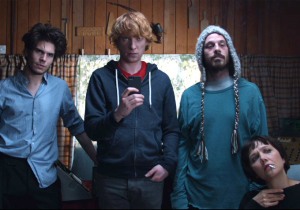
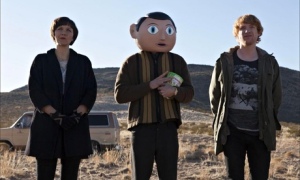
The various members of Soronprfbs, including François Civil's Baroque, keyboardist Jon (Domhnall Gleeson), manager Don (Scoot McNairy) and the erratic Clara (Maggie Gyllenhaal) in Frank

The various members of Soronprfbs, including François Civil’s Baroque, keyboardist Jon (Domhnall Gleeson), manager Don (Scoot McNairy) and the erratic Clara (Maggie Gyllenhaal) in Frank

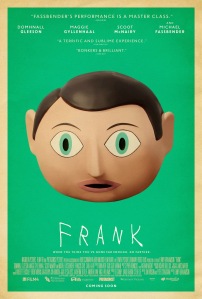
Ronson’s time with Frank and his real life alter-ego Chris Sievey inspired this bittersweet tale of Jon (Domhnall Gleeson), an office drone and wannabe songwriter whose monotonous existence spent living with his parents in a dead-end seaside town changes overnight when he stumbles across the members of Soronprfbs, an avant-garde band led by the larger-than-life Frank (Michael Fassbender), who constantly wears a giant papier-mache head that features an unblinking look of mild surprise.

Jon, like us, is fascinated by the man beneath the fake head and jumps at the chance to join Soronprfbs on a full-time basis as they take to a cottage in the middle of nowhere to record their new album, a year-long process that involves extreme levels of self-indulgence as anything and everything is toyed around with to create the perfect sound.

The band get busy working on their new album - toothbrushes included - in Frank

The band get busy working on their new album – toothbrushes included – in Frank

All the while, Jon chronicles Soronprfbs’ journey through Twitter and YouTube and creates a social media-fuelled monster that leads to a possible big break, but also threatens to destroy the soul of the band and damage the fragile Frank.

It’s not until a good way through the film that you realise just how many levels Frank is working on. In another picture, Jon’s voyage of self discovery would end in a very different – and predictable – way, but rather than helping to inspire the band to achieve deserved success, the actions he takes only end up serving his own deluded ambitions.

The ying and yang of Frank (Michael Fassbender) - Maggie Gyllenhaal's uncompromising Clara and Domhnall Gleeson's Jon, who just wants to be loved

The ying and yang of Frank (Michael Fassbender) – Maggie Gyllenhaal’s uncompromising Clara and Domhnall Gleeson’s Jon, who just wants to be loved

In a painfully well observed opening, Jon tries in vain to fashion a song out of his mundane experiences, only to take to social media to justify his banal existence through pointless tweets. His striving for validation is sought not only from his growing number of Twitter and blog followers whom he panders to with a running commentary of ‘aren’t I crazy’ posts, but also from his fellow band mates, who mostly look at him with indifference, in particular Maggie Gyllenhaal’s erratic theremin player Clara (who comes across like a Wes Anderson version of Karen O from the Yeah, Yeah, Yeahs).

Like Amadeus‘ Salieri, Jon knows his talent cannot match that of Frank, so instead becomes a leech in the hope his genius can somehow rub off on him. What Jon doesn’t factor in is Frank’s evident mental illness, which manifests itself through the character’s increasingly unstable behaviour.

Hello audience!! The titular Frank (Michael Fassbender) gets all dolled up

Hello audience!! The titular Frank (Michael Fassbender) gets all dolled up

It’s an admirable turn from Gleeson in a role that’s unlikable only in so much as it’s so painfully believable. Jon almost always means well, but loses his way and drags the band down with him when the prospect of fame and fortune rear their heads.

Considering we cannot see the character’s facial expressions, Frank is a captivating presence, thanks in no small part to Fassbender’s physical performance that lends the character a tragicomic edge which grows more troubling as the film nears its climax. Frank is a blank slate is many ways, a character defined by the ying of Jon’s desire to be loved and break big and the yang of Gylenhaal’s Clara, who has an indefatigable refusal to compromise for fear of selling out. Torn between both sides, the cracks in his personality threaten to break apart.

Frank’s static expression takes on a different inclination depending on the angle of Fassbender’s body and the way he turns his giant fake head, while the film’s final reel is given an extra wallop by the actor’s coiled delivery of the film’s signature tune I Love You All.

Working from a script by Ronson and fellow scribe Peter Straughn (who also penned the screenplay for The Men Who Stare At Goats), director Lenny Abrahamson skirts passed twee farce and instead hits us with a film that’s as moving as it is funny and painful.

With a free will and an outsider’s spirit all of its own, Frank is a wonderful one-of-a-kind.