Review – The Croods

Throw in the Yabba-Dabba Doo domesticity of The Flintstones and a sprinkling of Ice Age cutesiness and you’re well on your way to summing up DreamWorks Animation’s latest.

The Croods

“The Croods may be prehistoric when it comes to offering up anything even vaguely original, but there’s just about enough here to make their animated antics an entertaining diversion”

The discovery of  perfectly preserved cave paintings in France dating back more than 30,000 years ago could well have acted as the springboard for The Croods.

A smart montage of crude cave drawings is used at the start of the film to illustrate rebellious Eep’s (voiced by Emma Stone) narration explaining the reasons why her overprotective father Grug (Nicolas Cage) insists the family “never leave the cave”, while Grug uses the cave walls to sketch out the stories he tells the clan every night.
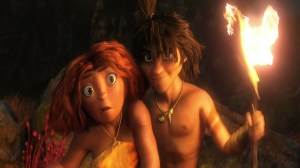
Eep (Emma Stone) and Guy (Ryan Reynolds) in The Croods

Eep (Emma Stone) and Guy (Ryan Reynolds) in The Croods

Despite Grug’s best efforts to shield his family from the dangers of the outside world, an earthquake destroys the cave and leaves them with little choice but to explore the world beyond. As they try to find a new home, they are joined by the smart, but lonely Guy (Ryan Reynolds), who is convinced the world as they know it is coming to an end and the only way to avoid certain death is to reach a distant mountain.

The one major problem with The Croods is, well, the Croods themselves. The family are made up of such generic stereotypes – anxious, overbearing father, understanding mother, inquisitive daughter, dumb son, unruly baby and annoying mother-in-law – they could be flat-packed and reassembled into any movie, animated or otherwise.

The Croods

The Croods in, well, The Croods

Much like Grug, the team behind the film (randomly, John Cleese is credited as one of the team behind the story) insist on playing it safe instead of trying something original or daring.

We’re used to seeing impressive visuals in computer-generated animations these days, but The Croods is particularly stunning and a big reason for this can probably be put down to Oscar-nominated cinematographer Roger Deakins being drafted in as ‘visual consultant’.

The wonderful visuals are The Croods' trump card

The wonderful visuals are The Croods’ trump card

The use of fire (and the look of bewilderment, confusion and fear on Eep and co’s faces when they first set eyes on it) is beautifully rendered, while the moment the characters stare up in wonder at a perfectly clear galaxy of stars (for the family this is the first time they have seen a night sky) is breathtaking.

Aimed more squarely at tweens and below, there are enough cute animals (in particular Guy’s pet sloth Belt) to keep kids entertained, although adults will struggle to find much to latch onto.
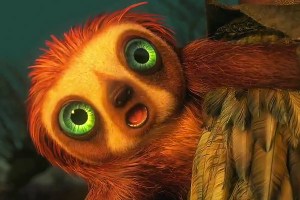
Guy's trusty pet sloth Belt in The Croods

Guy’s trusty pet sloth Belt in The Croods

The characters themselves are slightly exaggerated versions of humanity (even allowing for the fact they’re neanderthals) in the way that so many animations are, while Eep’s appearance (and feisty nature) is remarkably similar to that of Merida from Pixar’s Brave, right down to the big red hair.

Cage brings his usual manic energy to patriarch Grug (this being an animated film, the kids are spared his mad staring eyes and loony grin), and Stone and Reynolds work nicely off each other as the hormonal teenagers whose inquisitiveness  regularly lands the clan in danger.

The Croods may be prehistoric when it comes to offering up anything even vaguely original, but there’s just about enough here to make their animated antics an entertaining diversion.

Review – Flight

The poster for Robert Zemeckis’ first foray into live action filmmaking for a dozen years captures everything that’s good – and not-so-good – about Flight.

in Robert Zemeckis' Flight

A towering performance by Denzel Washington is almost ruined by a clumsily heavy-handed symbolism in Robert Zemeckis’ Flight

Denzel Washington’s airline pilot ‘Whip’ Whitaker conveys an authority befitting his vocation, but the rain pouring down suggests something is very wrong.

It’s a simple image that tells you all you need to know about the film. At its core is a towering central performance of one man’s painful journey towards redemption, but that odyssey is marred by a style of direction that’s about as subtle as taking a sledgehammer to crack a walnut.

The signs are there from the first few moments when flight attendant Katerina (Nadine Velazquez) wanders naked around the hotel room she’s sharing with lover Whitaker after a heavy night on the booze to the strains of the Barenaked Ladies’ Alcohol. Then, after a pick-me-up and a snort of cocaine a swaggering Whitaker emerges from the room with Joe Cocker’s Feelin’ Alright playing in the background.

Whip Whitaker (Denzel Washington) prepares for take off in Flight

Whip Whitaker (Denzel Washington) prepares for take off in Flight

This clumsiness is further compounded when the plane Whitaker miraculously pilots symbolically clips the top of a church before it crash lands, killing six (including Katerina) but crucially saving almost 100 other passengers and crew.

Zemeckis has proven himself a master filmmaker of the plane crash following 2000’s Cast Away (his last live action film), which showed it from the terrified perspective of Tom Hanks’ Chuck Noland. Here, we see the action from the cockpit as Whitaker confidently takes charge and rolls the plane upside down to bring it out of a nose dive. It’s heart-pounding stuff that will have you on the edge of your seat.

Whip Whitaker (Denzel Washington) performs a miraculous manoeuvre in Flight

Whip Whitaker (Denzel Washington) performs a miraculous manoeuvre in Flight

He’s saluted as a hero by both the media and friends, including union rep Charlie Anderson (Bruce Greenwood) and his flamboyant dealer Harling Mays (John Goodman), whose musical cue is the Rolling Stones’ Sympathy For The Devil lest we forget his chosen profession. But Whitaker’s world begins to crumble when he discovers a blood sample was taken in hospital which, if it were to become public would reveal he was drunk at the controls and land him in jail.

Harling Mays (John Goodman) comes to an unusual rescue in Flight

Harling Mays (John Goodman) comes to an unusual rescue in Flight

It’s an intriguing story, extremely well scripted by John Gatins that has you rooting for an anti-hero who isn’t just flawed, but plain unlikable for stretches. It also examines the lengths people and corporations will go to distort the facts to maintain a story so long as it has a happy ending, while also pointing a finger at the media for endlessly speculating and editorialising when there’s little or nothing to report.

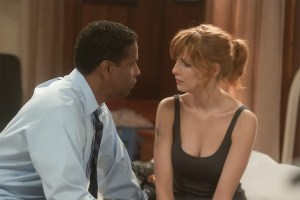
Whip Whitaker (Denzel Washington) finds a connection with fellow addict Nicole (Kelly Reilly) in Flight

Whip Whitaker (Denzel Washington) finds a connection with fellow addict Nicole (Kelly Reilly) in Flight

Whitaker is that familiar movie cipher, the flawed genius, but Washington in his best performance since winning an Oscar for 2001’s Training Day (an equally unlikable role) adds layers of nuance to give us one of the most expressive and fascinating portrayals of functioning alcoholism yet seen on screen.

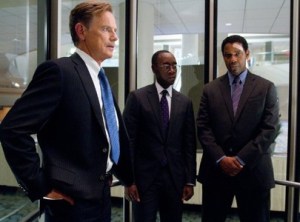
It's judgement time for union rep Charlie Anderson (Bruce Greenwood), company lawyer Hugh Lang (Don Cheadle) and "unstable pilot Whip" Whitaker (Denzel Washington) in Flight

It’s judgement time for union rep Charlie Anderson (Bruce Greenwood), company lawyer Hugh Lang (Don Cheadle) and “unstable pilot Whip” Whitaker (Denzel Washington) in Flight

Furthermore, Flight asks the uncomfortable question of whether it’s the drink and drugs that bring out the real brilliance in Whitaker; the film certainly seems to suggest so.

Goodman’s blunderbuss performance is out-of-place and more in keeping with his Walter Sobchak from The Big Lebowski, although Don Cheadle is excellent as the morally dubious lawyer trying to paper over the cracks and Brit Kelly Reilly does a lot with a thin role as a heroin addict who Whitaker befriends after meeting in hospital (just in case we didn’t know she’s an addict, the Red Hot Chilli Peppers’ drug anthem Under The Bridge helpfully plays on the soundtrack).

In many ways Flight is a welcome return to the ‘real’ world for Zemeckis following his triumvirate of motion-capture uncanny valley animations The Polar Express, Beowulf and A Christmas Carol, but in his zealousness for proper, adult drama he serves up a film so heavy-handed in its use of symbolism and music he almost ruins it.

Review – Amour

“Life’s a bitch and then you die,” said Bertolt Brecht (sort of) in his musical The Threepenny Opera and it’s a pithy label often pinned on the work of Austrian filmmaker Michael Haneke.

Amour

Amour – “a film for the ages, one that will bring with it fresh meanings and insights into life with each viewing”

Haneke is probably the most effective exponent of slow, claustrophobic, dread-filled cinema at work today and his protaganists invariably have pain and suffering thrust upon them, sometimes self-inflicted (Caché, The Piano Teacher), but more often not (Funny Games, Code Unknown, Time of the Wolf).

His previous film The White Ribbon portrayed a German community collapsing in on itself and earned the director the Palme d’Or at Cannes in 2009, a feat he repeated last year with his latest Amour (Love).

The title raised some eyebrows when it was first announced as cinephiles aware of Haneke’s previous output wondered whether he had gone soft in his old age.

This is a love story, but like none that have gone before it. Compared to the sentimentalised and unrealistic romances of Hollywood, Haneke’s unvarnished honesty may be distressing to watch, but its frank depiction of one elderly couple’s slow, unwinnable battle against the rising tide of chronic ill health and old age sets it out as one of the greatest and most essential films about love and death ever made.

Eva (Isabelle Hupert) and her father Georges (Jean-Louis Trintignant) in Amour

Eva (Isabelle Hupert) and her father Georges (Jean-Louis Trintignant) in Amour

This story of love begins at the end, with the body of Anne (Emmanuelle Riva) discovered on her deathbed by firefighters called because she and her husband Georges (Jean-Louis Trintignant) have not been heard from for several days. It’s an image equal parts beautiful and morbid and remains in the mind as the film travels back to show how she came to rest.

Georges first observes there’s something wrong with his beloved wife Anne when, sat at the kitchen table she suddenly goes into a trance. When she snaps out of it several minutes later she reacts as if nothing’s happened. Soon after she suffers a stroke, an unsuccessful surgery and then another, more devastating stroke that leaves her partially paralysed. As Anne’s physical state degrades she also succombs to the ravages of dementia.

Jean-Louis Trintignant as Georges in Amour

Jean-Louis Trintignant as Georges in Amour

No spring chicken himself, Georges promises Anne “no hospitals” and vows to take care of her himself. In spite of his obvious devotion to his wife, the physical and mental toll it takes on Georges is palpable. He knows he’s fighting a losing battle and Anne’s slow decline from feisty spiritedness to a child-like helplessness is both painful and exhausting, to the extent that in one shocking scene his patience finally evaporates when she refuses to eat and he slaps her across the face.

Michael Haneke, director of Amour

Michael Haneke, director of Amour

A chamber piece in every sense, Amour features a stunning cast. Trintignant’s refusal to turn on the waterworks or to curry sympathy is exactly what makes him sympathetic in a role he totally inhabits. Riva gives a performance of outstanding physicality and her heart-breaking transformation is a master class in restraint.

The apartment, once filled with joy and music (Georges and Anne are music teachers) gradually takes on the feel of a prison. A pigeon flies in, possibly representing a freedom neither will ever know again, and what follows is a scene both comical and incredibly sad as the decrepit Georges tries to capture it.

Haneke’s black humour is also present near the start of the film when the couple discover burglars have attempted to break in while they were out. Anne’s observation: “Imagine if we were lying in bed and somebody broke in … I think I would die of fright” is starkly ironic bearing in mind we know that firefighters will break into their apartment and discover her body on the bed.

Amour is a tough and often painful watch but there are many, many moments of beauty to be found here too. It’s a film for the ages, one that will bring with it fresh meanings and insights into life with each viewing.

Review – Django Unchained

For a writer and director who’s the unashamed king of the movie homage there really isn’t anyone else out there making films quite like Quentin Tarantino.

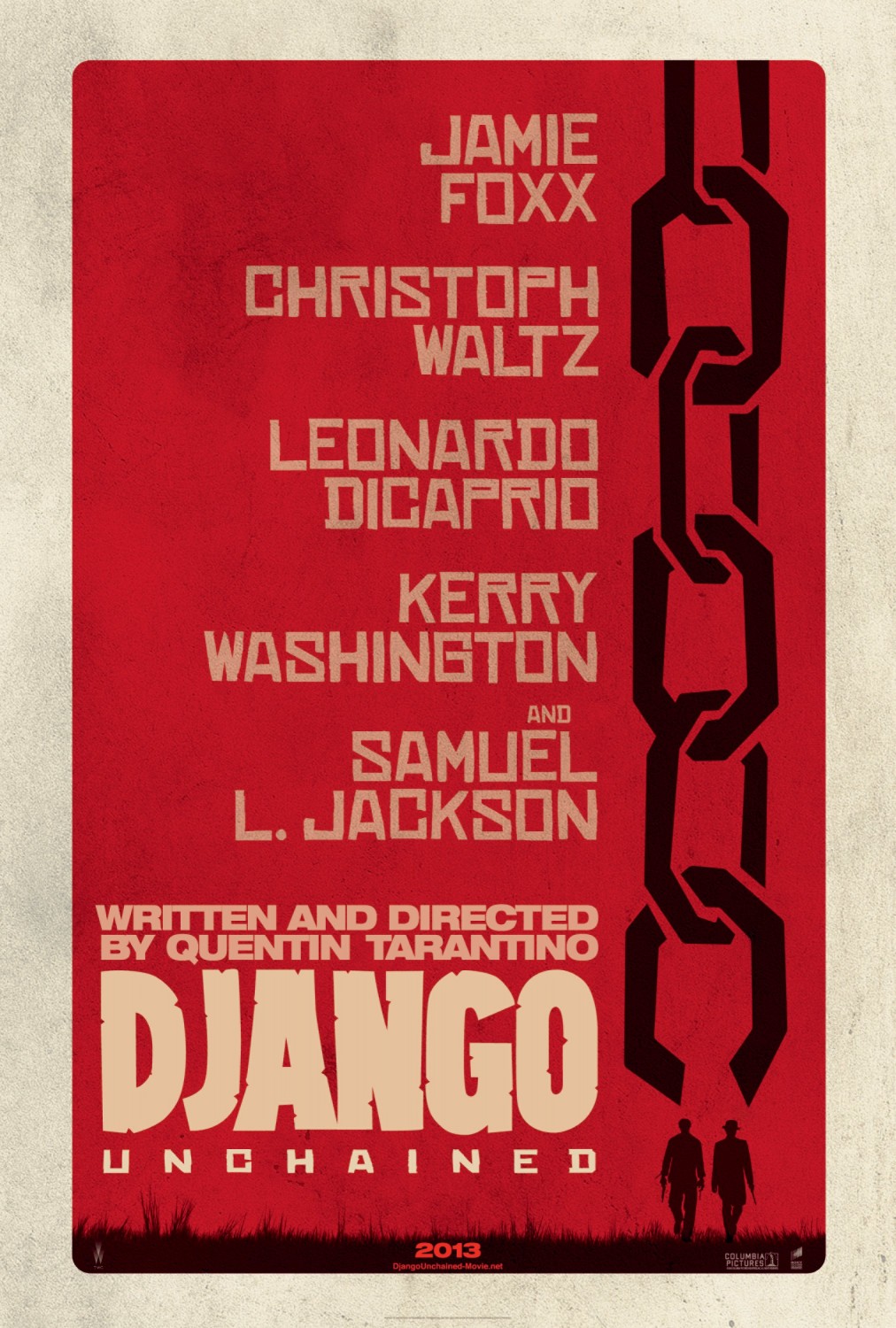
Quentin Tarantino's Django Unchained

Quentin Tarantino’s Django Unchained – arguably his most outrageous film yet

Django Unchained, Tarantino’s eighth feature is arguably his most outrageous yet and serves up a similar stylistic mash-up as his previous film Inglourious Basterds.

In that movie, he somehow got away with making a World War Two spaghetti western (complete with Ennio Morricone music) where a squadron of Jewish-American soldiers give the Nazis a taste of their own medicine.

Here, Tarantino uses a similar mould for his most fully realised and satisfying film since Jackie Brown, jettisoning the episodic structure that has been so familiar throughout his filmography.

Django Unchained is a western with extra spaghetti sauce and features a blaxploitation hero even cooler than Shaft. From the title, which directly references the 1966 spaghetti western Django starring Franco Nero (who makes a cameo here), to the red-painted opening credits, music, ultra violence and theme of revenge (common to virtually all of Tarantino’s work), the film sends the homage-o-meter up to 11.

Dr King Schultz (Christoph Waltz) shows Django (Jamie Foxx) the way of the gun in Django Unchained

Dr King Schultz (Christoph Waltz) shows Django (Jamie Foxx) the way of the gun in Django Unchained

It’s also the writer-director’s most overtly political work to date, addressing the still thorny subject of slavery in a frank and often brutal way. Our hero is Django (Jamie Foxx), a slave in 1858 Texas who wins his freedom thanks to the intervention of Christoph Waltz’s German dentist-turned bounty hunter Dr King Schultz (it can’t be a coincidence that a character who abhors slavery shares his name with Dr Martin Luther King).

The sadistic Calvin Candie (Leonardo DiCaprio) in Django Unchained

The sadistic Calvin Candie (Leonardo DiCaprio) in Django Unchained

Schultz takes Django under his wing and trains him in the art of bounty hunting (“like slavery, it’s a flesh for cash business”) and, in return for assisting him, Schultz agrees to help Django win the freedom of his wife, Broomhilda (Kerry Washington), a slave forced to work at the perversely named Candyland, owned by the despicable sadist and racial supremacist Calvin Candie (Leonardo DiCaprio, sporting horribly blackened teeth).

Tarantino has never been one to shy away from throwing in the kitchen sink when it comes to on-screen violence. It’s a facet of his work that has attracted considerable consternation from critics and commentators throughout his career, but while he no doubt takes great pleasure in seeing how far he can go he also never lets you forget that violence and bullets hurt – a lot. When we see slaves being killed in the most vicious of ways at the hands of Candie, we’re left in no uncertain terms that this is no laughing matter.

The deplorable house slave Stephen (Samuel L Jackson) in Django Unchained

The deplorable house slave Stephen (Samuel L Jackson) in Django Unchained

That being said, just as the Nazis have it coming in Inglourious Basterds, there’s a certain gleeful satisfaction in seeing a black man administer justice of the most merciless kind to the racist white trash who have profited from and exploited the slave trade.

In the film’s most amusing scene , a group of proto-Ku Klux Klansmen led by Big Daddy (Don Johnson) go in search of Schultz and Django, only to bicker among themselves because they can’t see properly out of their white hoods. It’s a nicely observed comment on the absurdity and cowardice of racism.

Tarantino also nods to classic John Ford westerns, framing his heroes against a series of expansive vistas, beautifully filmed by cinematographer Robert Richardson, and conjures up a number of arresting images, most strikingly when blood splattters over pure white cotton on a plantation.

Quentin Tarantino directs and unfortunately stars in Django Unchained

Quentin Tarantino directs and unfortunately stars in Django Unchained

As verbose as Tarantino’s scripts are, his rich dialogue is a gift for the superlative cast he’s assembled here. Waltz almost steals the show as the kind-but-deadly Schultz, as memorable a screen presence as his diabolical Hans Landa from Inglourious Basterds.

Foxx does a nice line in man-with-no-name quiet intensity (can you imagine what Will Smith, Tarantino’s original choice, would have done with the role?), while DiCaprio has a whale of a time tearing it up as the dapper southern aristocrat out of control in his own private fiefdom.

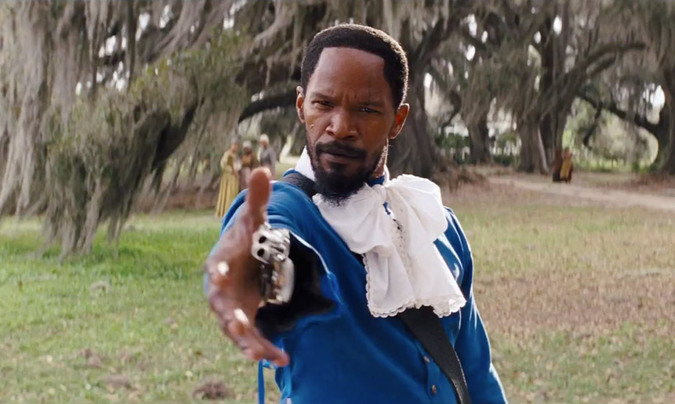
The colourfully dressed Django (Jamie Foxx) kicks ass and takes names in Django Unchained

The colourfully dressed Django (Jamie Foxx) kicks ass and takes names in Django Unchained

However, all pale in comparison to the quite brilliant Samuel L Jackson as Stephen, Candie’s house slave who’s so servile he makes Uncle Tom look like a Black Panther. Hidden behind that frail, shuffling walk lies a truly abominable human being who, when he isn’t perched on Candie’s shoulder like a parrot repeating his every line, is punishing his fellow slaves and conspiring against them to get in his white master’s good books. It’s a very disturbing performance that only Tarantino and Jackson could have dreamt up.

What Tarantino still has some trouble with, however, is acting and he’s truly terrible as an Australian (!) slave driver. He can’t even resist affording himself the film’s most colourful death. This entire section is the only weak spot in the whole movie. There’s a natural end point before this, but Tarantino (who has previously admitted to not showing enough discipline when it comes to a script) gives himself another half an hour before he finally wraps things up, all be it in a pleasingly brutal way.

The thing you have to admire about Tarantino is that he’s a rock’n’roll director in the truest sense, a film geek who wants to share his love of cinema’s outer margins and with Django Unchained he hits it out of the park.

Review – Berberian Sound Studio

There’s something wonderfully outrageous about fruit and vegetables being used by serious, technically-gifted individuals to represent the sound of a body slamming onto the ground or a neck being broken.

It’s a side of filmmaking normally hidden from the audience, a process that takes place long after the cameras have stopped rolling and the actors have moved on to other projects.

Berberian Sound Studio

Peter Strickland’s Berberian Sound Studio – “a masterclass in sustained dread”

In director Peter Strickland’s astonishing Berberian Sound Studio, this is turned completely on its head, wherein the mechanics of sound reproduction (known as foley) take precedence. Moreover, Strickland sets the film in the 1970s, when warm and fuzzy analogue equipment like tape recorders and magnetic tape was used, in contrast to the clinical digital apparatus employed today.

Strickland used a modest inheritance and relocated to Transylvania to shoot Katalin Varga, a striking, outré revenge drama that marked him out as one to watch. The writer/director has taken a massive leap forward with his sophomore feature, a head-spinning psychological horror-thriller that plunges buttoned up sound engineer Gilderoy (Toby Jones) into a frenzied whirlpool of his own making.

Gilderoy has flown from Britain to Italy to work on The Equestrian Vortex, what he assumes is the sort of nature documentary he has made his stock in trade from his garden shed in Dorking.

Unbeknownst to him, The Equestrian Vortex is in actuality a sadistic, stomach-churning giallo horror film, the sort of supernaturally-charged splatter-fests made famous by such maestros of the genre as Dario Argento and Mario Bava.

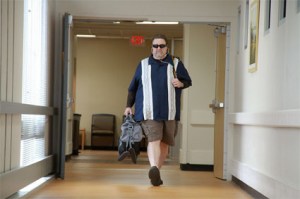
Toby Jones as Gilderoy in Berberian Sound Studio

Toby Jones as Gilderoy in Berberian Sound Studio

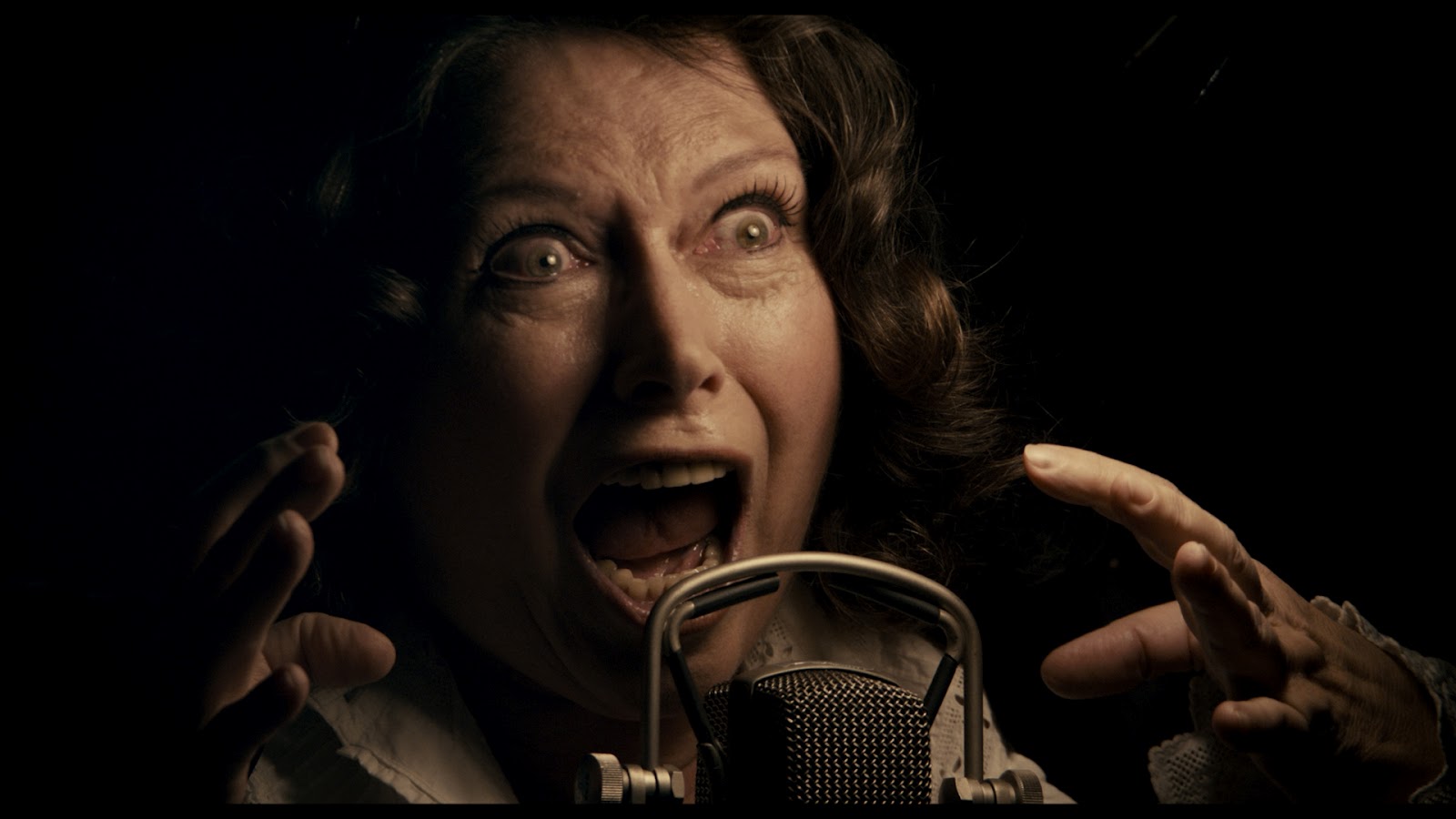
As the images of torture, rape and mutilation are projected to Gilderoy for the first time, we see his facial reaction contort between voyeuristic intrigue and disgust. All the audience sees of the film are its opening credits, with its blood-red palette and shots of terrified women.

Sitting alongside the film’s irritable, unforgiving producer Francesco (Cosimo Fusco) in the claustrophobic sound studio, he goes to work recording marrows being hacked to pieces, cabbages being stabbed and radishes having their tops violently ripped off (all of which are left to rot in a none-too subtle moment of symbolism). He also records the bone-chilling screams of several women, in particular the paranoid Elena (Tonia Sotiropoulou), who is angry for allowing herself to be exploited by the film’s suave, oily director Santini (Antonio Mancino) and warns Gilderoy against making the same mistake.

A homesick stranger in a strange land, he gradually finds himself being dragged deeper into the cesspool of moral filth and degradation that is playing out on screen and clings onto letters from his mother describing the untainted day-to-day mundanities his increasingly fractured psyche is losing a grip of.

Gilderoy allows his work to overwhelm him, in much the same way as Gene Hackman’s suveilance expert Harry Caul in The Conversation, and before long he’s no longer able to differentiate between reality and his nightmarish paranoia where each disturbing sound is amplified and the silence is almost as deafening.

Psychological horror at its very best in Berberian Sound Studio

Psychological horror at its very best in Berberian Sound Studio

Strickland fearlessly takes his protaganist  into a vortex of his own making and nods to David Lynch and Ingmar Bergman’s Persona in the way he portrays Gilderoy’s mental breakdown on screen. It’s deeply unsettling stuff, rivetingly played by Jones in a career-best turn. Jones has one of those faces that can exude gentility and cruelty at the same time (if ever a remake of 10 Rillington Place was made, he would be perfect as unassuming serial killer John Christie) and we’re left to make our own mind up as to whether Gilderoy’s experiences have corrupted him or merely held a mirror to the darkness he (and we) fear has always been there.

The process of producing the sounds are as lovingly shot as the equipment on which they are recorded (Strickland holds the camera on tape spools or the analogue sound desk). In spite of the film’s suffocating grip, there are many moments of black humour and scenes of real beauty, in particular when Gilderoy shows his colleagues how he can create the sound of a UFO by scraping a light bulb against a wire brush.

For a film where sound is everything, foley artist Heikki Kossi must get special mention, while ethereal electro band Broadcast provide a suitably haunting score.

Utterly unique, Berberian Sound Studio is a masterclass in sustained dread and the first of what could well be a slew of masterpieces from this vital, gifted filmmaker.