Review – Get Out
In a perfect world, a film such as Get Out wouldn’t need to exist, so it’s deeply satisfying that Jordan Peele’s debut feature is as deliciously satirical as it is sinister.
Horror has long been a cipher for the ills of society, whether it be mindless consumerism (1978’s Dawn Of The Dead), the fear of technology (1982’s Videodrome) or class division (1989’s Society).
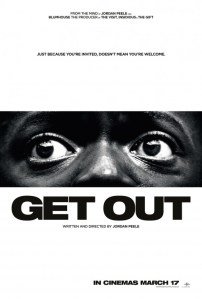 One of the most celebrated voices in socially conscious horror is the novelist Ira Levin, whose Rosemary’s Baby and The Stepford Wives have both received excellent adaptations. The ugly underbelly of polite society that’s so memorably exposed in Stepford was no doubt an influence for Peele when writing Get Out (Wes Craven’s racially charged The People Under The Stairs (1991) also feels like a touchstone).
Whilst Stepford is primarily about gender, Get Out concerns itself with race, specifically the attitudes of white, upper middle class ‘liberals’ who say one thing but whose actions reveal another. This is no mere polemic, however – its razor-sharp script also isn’t afraid to challenge some of the attitudes held by our protagonist Chris Washington (Daniel Kaluuya).
 Peele has spoken of the seeds for the film being sown in the wake of Barack Obama becoming US President when any optimism over the country finally moving past race as an issue proved sadly naive. The election of his successor has compounded this misconception and lent Get Out the added distinction of arguably being the first film to truly address Trump-era America.
Chris is somewhat uneasy about accompanying his white girlfriend Rose (Allison Williams) to meet her parents. Located in a wealthy rural idyll, Dean and Missy (The West Wing‘s Bradley Whitford – nice casting – and Catherine Keener, also excellent) are suffocatingly nice to Chris, who is told they would have “voted for Obama a third time” if they’d had the chance. Alarm bells start ringing when he’s introduced to Walter and Georgina (Marcus Henderson and Betty Gabriel), the couple’s black servants whose ceaseless pleasantries are unsettling to say the least, while Rose’s verbally confrontational brother Jeremy (Caleb Landry Jones) is equally odd. Needless to say things are not what they seem and soon Chris is wishing he’d heeded the warning of one individual to “get out”.
 It’s impossible to overstate how refreshing it is to be presented with a film that makes you think as much as it churns the guts. An early encounter between Chris, Rose and a casually racist patrol cop who demands to see his driving licence despite the fact he wasn’t behind the wheel is an indication of what’s to come. Likewise, when Chris informs Dean about hitting a deer on the way to their home, the metaphor is left to hang when Dean expresses satisfaction at the thought of controlling the burgeoning population of these creatures in such ways.
A party involving the seemingly well-meaning, but overtly racist local community is wonderfully excruciating, including one pensioner who tells Chris that his favourite golfer is Tiger Woods.
 Events unsurprisingly take a more disturbing turn as the film sets out its stall for a final act that can’t sustain the smartly staged intrigue and sociopolitical prowess of its first hour or so, but is nevertheless hugely entertaining in its reliance on gore.
Whilst there is much to praise about Get Out, not everything works. Lil Rey Howery’s over-the-top performance as Chris’ suspicious best friend Rod, although amusing, often feels like it belongs in another movie (a scene involving him being laughed off by a bunch of cops doesn’t work). The plot twists are also a little obvious, although they don’t spoil the film.
Small gripes aside, the hypnotically potent Get Out blends provocative social satire and bloody horror to sublime effect.
On a closing note, I normally embed the trailer for the film I’m reviewing. However, due to the sheer amount of plot detail revealed in the trailer for Get Out, on this occasion I will be leaving it off.

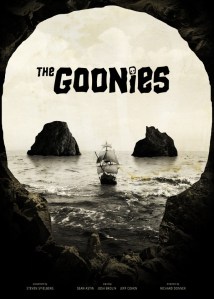 The Goonies was, in writer Chris Columbus’ words “Indiana Jones for kids”, a movie that not only stars youngsters, but is also fundamentally about them – about the scrapes that young friends get into before the complications of adult life get in the way.
 The term ‘Spielbergian’ was coined to describe a certain type of popcorn-friendly feature and Richard Donner’s The Goonies (1985) perfectly fits the mould. Executive produced (and co-directed according to some) by the bearded one, the film is fantastical, fun and acutely sentimental in equal measure.
 Donner encouraged improvisation on set, which perhaps inevitably led to the excited young actors (some of whom like Astin and Brolin were starring in their first feature) speaking over each other in an effort to get the last line in. Although subsequently defended by a number of the cast, it often leads to scenes becoming cacophonous as dialogue gets drowned out by screams and shouts.
 Less successful are the interactions between the Goonies and the dastardly Fratelli clan. Their initial encounter in a run down old restaurant (the starting point for the treasure quest) is clumsily handled and the film can’t seem to decide just how threatening to make its family of criminals.
 Thrown into the mix is the character of Sloth (John Matuszak), the horribly disfigured brother of Davi and Pantoliano’s Fratellis, who is chained away and later befriends Chunk. Largely ignoring the darkly disturbing aspects surrounding such a tragic character who only wants to be loved, the film instead plays Sloth for light-hearted fun, even going so far as to throw in a Superman gag (a nod to Donner’s 1978 big screen take on the Man of Steel).












 three rows back