Great Films You Need To See – 24 Hour Party People (2002)

Never let the truth get in the way of a good story, especially when it’s told with as much, well, ecstasy as Michael Winterbottom’s chaotically crazy paean to the high watermark of the Manchester music scene.

One of the best British movies of this century's first decade, 24 Hour Party People has pills, thrills, bellyaches and plenty more besides

One of the best British movies of this century’s first decade, 24 Hour Party People has pills, thrills, bellyaches and plenty more besides

Paraphrasing John Ford’s The Man Who Shot Liberty Valance, local TV reporter and music impresario (and the ultimate unreliable narrator) Tony Wilson would rather “print the legend” given the choice between that and the truth and Winterbottom and screenwriter Frank Cottrell Boyce are happy to go along.

Wilson is a singular figure and, played by Steve Coogan as Alan Partridge’s cooler, more successful brother, is as clever as he is funny, arrogant, pseudo-intellectual and eccentric. Although claiming at one point that “this is not a film about me; I’m a minor character in my own story” (in one of the film’s many fourth wall-breaking moments), 24 Hour Party People, like Madchester itself, wouldn’t exist without him.

Tony Wilson (Steve Coogan) and wife Lindsay (Shirley Henderson) attend the Sex Pistols' seminal 1976 gig at Manchester Lesser Free Trade Hall in 24 Hour Party People

Tony Wilson (Steve Coogan) and wife Lindsay (Shirley Henderson) attend the Sex Pistols’ seminal 1976 gig at Manchester Lesser Free Trade Hall in 24 Hour Party People

Winterbottom and Coogan gleefully pull the rug from under the audience right from the beginning of the movie, which starts in 1976 with Wilson throwing himself off a hill while attached to a hand-glider. After the elation comes the danger and finally the inevitable crash. Before we can work out the scene’s a metaphor for what’s to come, Wilson gets there ahead of us, saying straight to camera “obviously it’s symbolic, it works on both levels”. He goes on to add: “All I’ll say is … Icarus – If you know what I mean, great. If you don’t, it doesn’t matter; but you probably should read more.”

When not presenting quirky items that generally show up on the “And finally…” section of news programmes, Wilson fronted So It Goes, one of the only avenues in which to discover exciting new music before the days of the world wide web. In June 1976 he and 41 other people (including his first wife Lindsay, played by Shirley Henderson) attended the Sex Pistols’ seminal Manchester Lesser Free Trade Hall gig (which Winterbottom cleverly films by intermingling archive footage for the close-ups of the Pistols) alongside the future movers and shakers of Manchester music (as well as Simply Red’s Mick Hucknall, who doesn’t count).

Ian Curtis (Sean Harris) on stage in 24 Hour Party People

Ian Curtis (Sean Harris) on stage in 24 Hour Party People

Through that gig, Wilson met Ian Curtis (Sean Harris) and the other members of soon-to-become post-punk poster boys Joy Division and created Factory Records. The film follows the crazy highs and the crazier lows of Factory’s turbulent existence, from Joy Division through to New Order (formed by the surviving members of Joy Division after Curtis’ suicide in 1980), the Happy Mondays, the Hacienda nightclub, the birth of rave culture and the inevitable implosion.

The no-nonsense Rob Gretton (Paddy Considine) and unconventional producer Martin Hannett (Andy Serkis) in 24 Hour Party People

The no-nonsense Rob Gretton (Paddy Considine) and unconventional producer Martin Hannett (Andy Serkis) in 24 Hour Party People

Winterbottom purposefully splits 24 Hour Party People into two distinct sections – everything that went on prior to Curtis hanging himself and everything that happened after. Curtis is given the respect he deserves; it’s through his band that Wilson formed Factory in the first place and his suicide is dealt with sensitively and suddenly. Harris’ portrayal of the troubled singer is excellent and particularly captures his intense and contorted on-stage persona (he’s even better than Sam Riley in 2007’s Control, the more autobiographical film about Curtis).

Following Curtis’ death, the film gets increasingly anarchic, reflecting both the times and the head space of Wilson, who doesn’t help himself by making a series of rash financial decisions in the name of art. He doesn’t care, for instance, when told Factory will lose money on every copy of New Order’s elaborately designed gatefold 12″ of Blue Monday as he thinks it won’t sell – only to be proved disastrously wrong when it goes on to become the highest-selling 12″ single in history.

Paul (Paul Popplewell) and Shaun Ryder (Danny Cunningham) up to no good in 24 Hour Party People

Paul (Paul Popplewell) and Shaun Ryder (Danny Cunningham) up to no good in 24 Hour Party People

Likewise, in spite of the fact the Hacienda is haemorrhaging cash he invests in new offices, which include a zinc roof that can only be observed from a helicopter and a £30,000 boardroom table that’s as pointless as it is cheap-looking. That was the dichotomy of Wilson; a can-do entrepreneur Thatcher would undoubtedly have been proud of had he not helped to usher in rave culture.

The film is strengthened by a rogue’s gallery of new and established talent, including Paddy Considine as the no-nonsense Joy Division/New Order manager Rob Gretton, John Simm as New Order singer Bernard Sumner, Andy Serkis as unpredictable genius producer Martin Hannett and Danny Cunningham as Happy Mondays frontman Shaun Ryder.

The seminal Hacienda nightclub brought back to life in 24 Hour Party People

The seminal Hacienda nightclub brought back to life in 24 Hour Party People

It also features a whole host of cameos, many of whom are used imaginatively in the movie, not least of which the real Tony Wilson as a TV producer lambasting the other Wilson’s presentation skills. In another inspired moment, Wilson recalls his wife having sex in a public toilet with Buzzcocks frontman Howard Devoto. As he walks out the camera pans to a cleaner who happens to be the real Howard Devoto, who turns to the camera and says: “I definitely don’t remember this happening.”

Despite the nods to Partridge, Coogan gives the role far more nuance than he’s credited for and clearly relishes the opportunity to flex his acting muscles. He’s arguably never been better.

Needless to say, if you’re a fan of Manchester’s music scene from the late 70s to the early 90s you’ll be in seventh heaven when it comes to the soundtrack (there’s no Stone Roses or Oasis here, however; they’re not part of the Factory story).

One of the best British movies of this century’s first decade, 24 Hour Party People has pills, thrills, bellyaches and plenty more besides.

Great Films You Need To See – Punishment Park (1971)

This is my second contribution to The Big Picture, the internationally-recognised magazine and website that offers an intelligent take on cinema, focussing on how film affects our lives. This piece about Peter Watkins’ controversial docudrama Punishment Park was written as part of The Big Picture’s self-explanatory Lost Classics section, although I am including it within my list of Great Films You Need To See.

The Boston Phoenix may have predicted Peter Watkins’ potent philippic on the frightening consequences of unchecked power was a “cult hit waiting to happen”, but 40 years after its controversial release it’s still twiddling its thumbs waiting for the world to catch on.

Peter Watkins' Punishment Park - "it's striking just how resonant the issues of the film still remain"

Peter Watkins’ Punishment Park – “it’s striking just how resonant the issues of the film still remain”

Watkins’ pioneering brand of radical pseudo-documentary filmmaking was always going to leave him shouting at the world from the sidelines.

His 1965 BBC nuclear war docudrama The War Game was judged “too horrifying for the medium of broadcasting” by Auntie and shelved for 20 years. Set in a dystopic America that Watkins could see on the horizon, Punishment Park never recovered from the hostile critical reaction it mostly received and sank without trace.

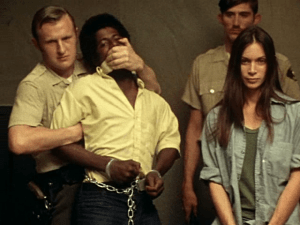
The 'prisoners' find the going tough in Punishment Park

The ‘prisoners’ find the going tough in Punishment Park

Dismissed at the time as nothing more than hyperbolic paranoia on the part of the director (The New York Times described it as “the wish-fulfilling dream of a masochist”), seen today it’s striking just how resonant the issues of the film still remain.

With the Vietnam War escalating, Nixon invokes legislation authorising a police state wherein those deemed “a risk to internal security” can be arrested and tried by a civilian tribunal. Presumed guilty, the hippies, draft dodgers and seditious types arrested for “hindering the war effort” are offered long jail time or three gruelling days in Punishment Park (or the option of signing a Hitler oath-style pledge of loyalty).

They fought the law, the law won in Punishment Park

They fought the law, the law won in Punishment Park

Promised liberty if they evade the police and National Guard and make it across scorching hot desert to capture the US flag 53 miles away, the ‘subversives’ who choose this option little realise their blood-thirsty pursuers have no intention of letting them gain their freedom (or, in some cases, letting them live).

The screw is turned as the film, comprised of faux BBC news footage narrated by an increasingly splenetic Watkins, cuts between the one-sided kangaroo court (its chairman, a politician, gags a prisoner for getting on his nerves bringing to mind Bobby Seale), the terrified rebels in Punishment Park and law enforcement officers hungry for action. In a cruel irony one runner tells the camera crew “I don’t think they’re trying to kill us”, before Watkins cuts to a sheriff describing how best to shoot someone.

The spectre of Bobby Seale looms large in Punishment Park

The spectre of Bobby Seale looms large in Punishment Park

Interestingly, the non-professional actors were cast based on their own political beliefs and were told by Watkins to let rip against each other as if the situation were real. As a result the scenes within the tribunal tent crackle with tension as the prisoners and tribunal members have what might be called “a failure to communicate” and end up screaming at each other.

Echoes of Punishment Park (and Watkins’ previous diatribe The Gladiators) can be seen in such variable fare as The Running Man, Battle Royale and The Hunger Games.

Filmed in the aftermath of and coloured by the Kent State massacre when the US was ripping itself apart over Vietnam, Watkins’ hellish vision of an America consumed by war and whose citizens are judged by their loyalty to the state may have been branded paranoia, but 40 years on looks pretty prescient when taking into account the War on Terror, Patriot Act and Guantanamo Bay and lends credence to that old proverb ‘the more things change, the more they stay the same’.

Great Films You Need To See – Exit Through The Gift Shop (2010)

There’s a moment during slippery, chameleonic (mock?) documentary Exit Through The Gift Shop when someone says: “I think the joke’s on … actually, I don’t know if there’s even a joke.”

In Exit Through The Gift Shop, Banksy has conjured up a playfully provocative work of art in and of itself

In Exit Through The Gift Shop, Banksy has conjured up a playfully provocative work of art in and of itself

It’s a revealing admission that sums up (as much as anything can) street artist Banksy’s directorial debut, a true one-off that will leave you questioning whether you’ve been conned as much as the hype-happy media and gullible sycophants who fawn over the art world’s self-proclaimed next big thing, Mr Brainwash.

Asked at the start of the film what it’s about, Banksy responds: “It’s about a guy who tried to make a documentary about me, but he was a lot more interesting than I am, so now the film is kind of about him.”

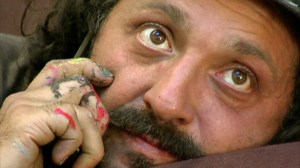
Thierry Guetta, aka Mr Brainwash, in Exit Through The Gift Shop

Thierry Guetta, aka Mr Brainwash, in Exit Through The Gift Shop

That man is Frenchman Thierry Guetta, an LA-based compulsive videographer who we learn from Rhys Ifans’ incredulous narration stumbles across the burgeoning street art movement through his cousin, an internationally recognised graffiti artist called Invader. He documents Invader going about his legally dubious business and is introduced to many of its major players, in particular Shepard Fairey, whose trademark tag of ex-wrestler Andre the Giant with the word ‘Obey’ underneath has been become so iconic “it gains real power from perceived power” (he’s equally well-known for designing the famous Obama ‘Hope’ poster which came to represent their 2008 presidential campaign).

The enigmatic Banksy in Exit Through The Gift Shop

The enigmatic Banksy in Exit Through The Gift Shop

When Banksy arrives in LA, Thierry excitedly hooks up with the elusive artist and, following a colourful episode in Disneyland involving a Guantanamo Bay detainee doll, the two become trusted friends. After documenting Banksy’s wildly successful show Barely Legal (part of which involves painting an elephant pink as a statement about how we ignore the things right in front of us, apparently), Thierry turns the thousands of hours of footage he has into a 90-minute street art film called Life Remote Control (trailer below), which Banksy writes-off as “shit” and made by someone “with mental problems”.

The highlight of Banksy's Barely Legal LA show in Exit Through The Gift Shop

The highlight of Banksy’s Barely Legal LA show in Exit Through The Gift Shop

He takes the footage off Thierry’s hands and suggests he give street art a go. Running with the idea, Thierry reinvents himself as ‘Mr Brainwash’ and, with the help of a team doing all the work, a promotional soundbite from Banksy (“Mr Brainwash is a force of nature, he’s a phenomenon. And I don’t mean that in a good way”) and a ravenous media, slaps together the show Life Is Beautiful that’s as creatively bankrupt as it is crowd-pleasing.

Opinions are split on whether the film – marketed as ‘The world’s first street art disaster movie’ – is one giant prank on Banksy’s part or that Thierry really did suddenly transform himself into Mr Brainwash and become an overnight sensation. Some have even posited the theory that Thierry is actually Banksy hiding in plain sight, a pink elephant so to speak.

Street art in full effect in Exit Through The Gift Shop

Street art in full effect in Exit Through The Gift Shop

Banksy has always maintained the film is real, although Thierry in an interview with the LA Times admitted of his Mr Brainwash persona: “In the end, I became [Banksy’s] biggest work of art.”

That being said, a revealing moment at the start of the film suggests there’s plenty of Thierry in Mr Brainwash. Talking about his time as the owner of a retro clothes store in LA, Thierry admitted he would buy items cheap, rebrand them as designer and sell them on to the hipster brigade (including alt-rock musician Beck, who’s caught on camera) at hugely marked up prices. It’s an approach he adopts for Life Is Beautiful and one that cleverly throws a spotlight on the value we place on art, especially when it’s in fashion.

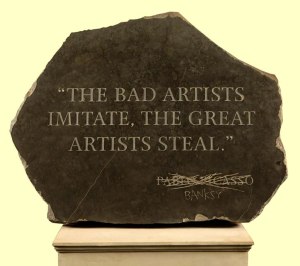
Words that Banksy may not choose to apply to Mr Brainwash, however, in Exit Through The Gift Shop

Words that Banksy may not choose to apply to Mr Brainwash, however, in Exit Through The Gift Shop

The influence of hype on a gullible public is also satirised. One punter queuing for the show says “I’m not quite sure what I’m here for, but I’m excited about it,” while another gets a bad case of hyperbole when she ecstatically calls Life Is Beautiful “a triumph … it will go down in history”.

Away from the vacuous sycophancy, Thierry comes across as a buffoon, all be it a likeable one. When he isn’t walking into lamp-posts or accidentally tipping paint over the back of his car he’s described as “retarded” or a waste of space and lambasted for not having a clue, which kind of adds to his charm.

Whether Thierry/Mr Brainwash is the real deal or an elaborate practical joke is ultimately irrelevant, what counts is that Banksy has conjured up a playfully provocative work of art in and of itself.

“Maybe it means art’s a bit of a joke,” he says. Watch Exit Through The Gift Shop and make your own mind up.

Great Films You Need To See – Primer (2004)

We’ve all wished at least once in our lives for the opportunity to go back and do things differently.

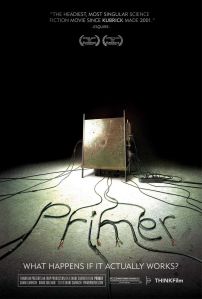
Shane Carruth's Primer

Shane Carruth’s Primer – “a film that puts the science into science fiction and is quite possibly the last word in time travel”

We have to contend ourselves with the fact that hindsight  is all we have, but in the movies where anything is possible, that wish can be fulfilled.

The gift that keeps on giving when put in the right hands, time travel has provided the backdrop to lots of great motion pictures over the years, most recently Rian Johnson’s action flick Looper.

Movies like Looper and the Back to the Future and Terminator franchises use the concept of time travel as the springboard to a popcorn-fuelled rollercoaster ride. On the flip side we have Shane Carruth’s serious, occasionally impenetrable but always absorbing Primer, a film that puts the science into science fiction and is quite possibly the last word in time travel.

The mode of time travel used in Primer (pic taken from the film's Wikipedia page)

The mode of time travel used in Primer (pic taken from the film’s Wikipedia page)

Made for just $7,000 and released to award-winning acclaim at the 2004 Sundance Film Festival, Carruth’s debut feature remains as much of an enigma today as it did when it first left critics and moviegoers scratching their heads almost 10 years ago.

At its heart a cautionary tale about the dangers of possessing ingenuity and an insatiable curiosity, Primer concerns itself with Aaron (Carruth) and Abe (David Sullivan), white-collar engineers by day and amateur inventors by night who stumble on a means of time travel.

Aaron (Shane Carruth) and Abe (David Sullivan) with their time travel boxes in Primer

Aaron (Shane Carruth) and Abe (David Sullivan) with their time travel boxes in Primer

Primer is as far removed from big budget bombast as you can get. Aaron and Abe work from a suburban garage, while the device itself is nothing more than a box (no DeLoreans here), hidden away in a self storage lock-up. Carruth frequently shoots his characters in long shot, as if he’s eavesdropping on their rapid-fire, tech-heavy dialogue and this is reflected in the actions of Aaron and Abe, who coolly observe events around them from a safe distance.

Described by Abe as “the most important thing that any living organism has ever witnessed”, the pair are nervous at first, unsure of how best to proceed with their momentous invention. However, it doesn’t take long before greed and ambition take over and their “reverse engineering” of the past gets out of control.

Aaron (Shane Carruth) can't quite believe who he's warching in Primer

Aaron (Shane Carruth) can’t quite believe who he’s watching in Primer

The film’s tagline – ‘what happens if it actually works?’ – speaks to Carruth’s documentary-style approach while the decision to film on grainy 16mm, financial constraints not withstanding (this was before digital had become all-pervasive), lends a matter-of-fact realism.

The director (who also wrote, produced, edited and wrote the music for the film) cleverly shows how even the extraordinary can become routine with lines such as “Are you hungry? I haven’t eaten until later this afternoon”, and “I think my body’s getting used to the 36-hour days”.

Aaron (Shane Carruth) and Abe (David Sullivan) wonder where to go next in Primer

Aaron (Shane Carruth) and Abe (David Sullivan) wonder where to go next in Primer

Primer‘s cerebral, scientific approach to time travel will certainly infuriate many and leave most others discombobulated. Carruth makes no concessions to his audience and what little action there is centres on the two tech heads talking excitedly among themselves whilst tweaking a large metal box.

That being said, like most time travel films it largely avoids dealing with the thorny issues of causality and paradox (Looper, for example, jokingly shrugs it off by having Bruce Willis’ Old Joe Simmons refusing to talk about it to his younger self (Joseph Gordon Levitt) because they’d end up spending hours “drawing diagrams with straws”). Aaron refers to the age-old question of whether you’d exist if you went back in time and killed your mother before shrugging it off and stating that “it has to work itself out somehow”.

Primer is a  fascinating puzzle that expects you to keep up (the final 20 minutes are almost maddening in their complexity). Those looking for crazy-haired scientists, killer robots or cool time machines are barking up the wrong tree here, but give yourself in to Carruth’s unique vision and it’s sure to stick in the mind long into the future.

Great Films You Need To See – Battle Royale (2000)

Teenagers are forced by a paranoid, dystopian government to compete in all-or-nothing game where they must use whatever weapons are at their disposal to kill each other in order to win.

You’d be forgiven for thinking a review of The Hunger Games would be forthcoming off the back of that premise. However, more than a decade before that acclaimed blockbuster made it to the big screen, director Kinji Fukasaku unleashed this ultra-violent black comedy.

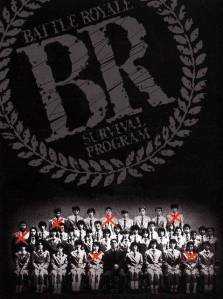
Battle Royale

The ultra-violent black comedy Battle Royale

Subsequently re-released in 3D (in 2010 in Japan and this year in the United States, presumably to cash-in on the hysteria surrounding The Hunger Games), Battle Royale was as successful in its native Japan as it was controversial (there’s no such thing as ‘bad’ news when it comes to drumming up box office receipts, after all).

Adapted from Koushon Takami’s novel of the same name, the film begins with a prologue explaining how high unemployment, mass truancy, escalating juvenile crime and peadophobia led to the adoption of The Battle Royale Act, wherein a class of ninth grade kids are selected at random to participate in an epic bloodletting against their will. Ferried to a deserted island, the 40-plus friends and classmates are fitted with explosive neck braces and told they have three days to ensure they are the last one standing or face certain death.

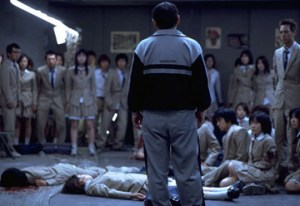
They are given this unwelcome news by their former teacher Kitano (played by Japanese actor/director ‘Beat’ Takeshi Kitano), who casually informs his ex-students that “today’s lesson is you kill each other off till there’s only one of you left; nothing is against the rules”. Kitano is a metaphor for the system; an implacable tyrant who stamps his authority by killing two of the terrified teens before the game has even started, one for whispering and the other for talking back. “You don’t respect adults”, he states, by way of explanation.

Some of the students choose to commit suicide rather than play along, while others either go it alone or fall back on the friendships they had in school and team up. Although class heart-throb Shuya (Tatsuya Fujiwara) emerges as the hero and Noriko (Aki Maeda) the plucky heroine, the film gives ample screen time to the other students to work together, turn on each other or die tragically (often all three).

Battle Royale

Kitano (‘Beat’ Takeshi Kitano) gives his former pupils a lesson they won’t forget in Battle Royale

Fukasaku displays a clever understanding both of the overtly emotional, naive rebelliousness of many teens and the Dawson’s Creek-esque soap operas that have embellished these traits with lashings of post-modernist melodrama.

Scenes of eye-popping gore are followed by characters declaring their love as they lie dying in each other’s arms, punctuated by Masamichi Amano’s knowingly over-the-top score. Others wallow in reductive woe-is-me angst, usually just before killing or being killed.

Battle Royale definitely has plenty of fun with its subject matter. One girl’s amusing last words to the boy she loves are “you look really cool”, while another boy unsuccessfully attempts to convince the girl he likes to have sex with him, shortly before he’s stabbed to death by her. Classroom rivalries are also allowed to reach their natural conclusion when the characters concerned each have a weapon in hand.

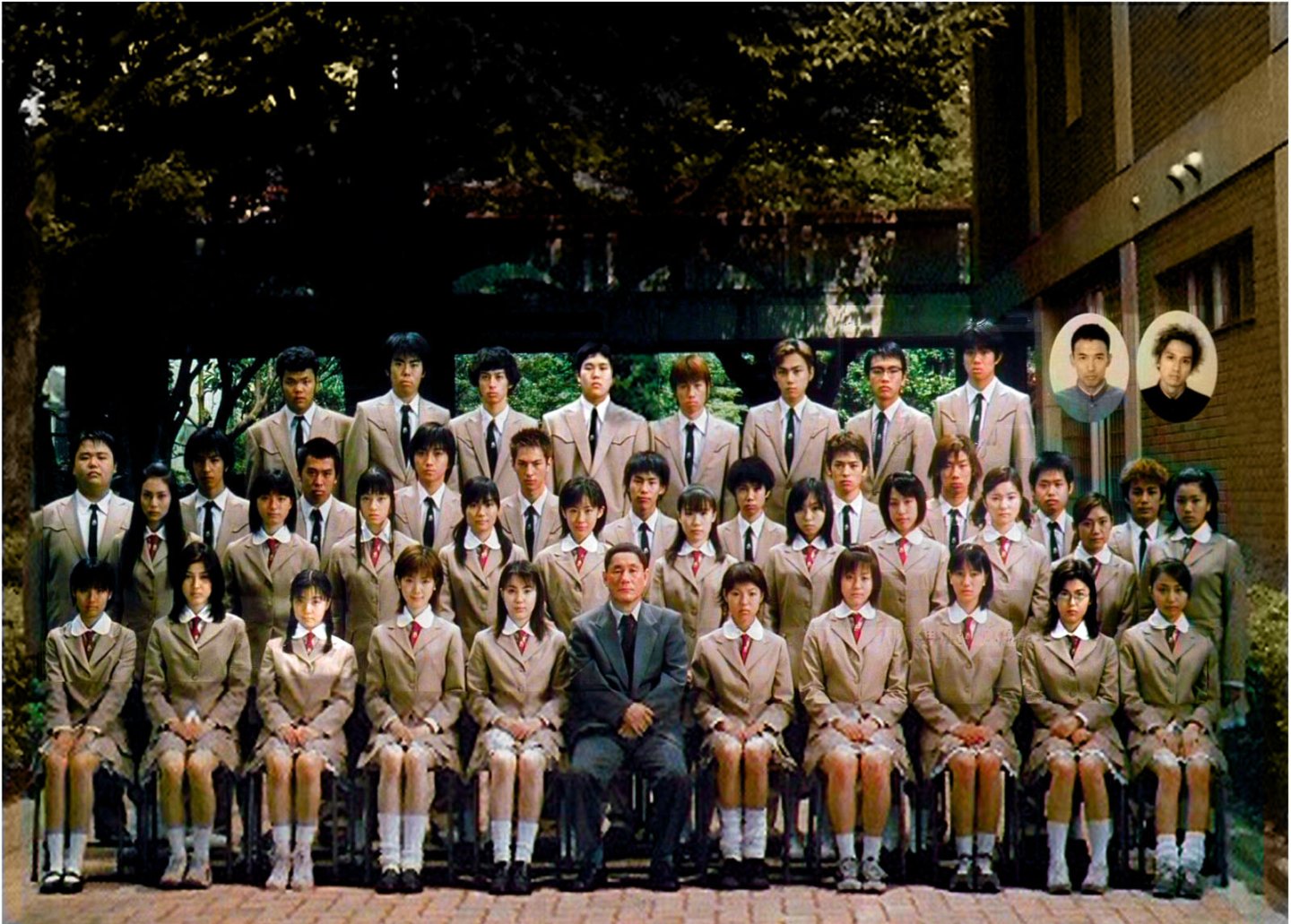
The class in happier, less-deadly times in Battle Royale

The class in happier, less-deadly times in Battle Royale

That being said, there’s no winking at the audience by the young cast, who equip themselves admirably and play it straight. Only the psychopathic Kiriyama (Masanobu Ando) feels a little out-of-place, his killer-who-just-won’t-die routine more suited for slasher films.

Although the events taking place on the island aren’t screened on television for mass consumption, the media is seen scrambling over itself to cover the story – the ultimate example of the ‘if it bleeds it leads’ axiom.

Sequels to dystopian dramas such as this tend to switch focus to the resistance that is born in its wake.  Battle Royale II: Requiem adheres to this formula, but does so to full effect with a daring, post-9/11 narrative that courts controversy even more gleefully than its predecessor and should also be sought out.

Battle Royale is ultimately a story about the loss of innocence and its young cast can be seen as a microcosm of where Fukasaku possibly felt society was headed. Adults are presented here as a different species, afraid and confused in equal measure of a generation they have spectacularly failed to understand and engage with. Like all those who live in fear, the walls go up and the consequences be damned.