Review – Captain America: The Winter Soldier

After seriously dropping the hammer with the disappointing Thor: The Dark World, Marvel has got its mojo back with this superheroic espionage thriller that packs a real biff, pow and bang.

Although on paper a two-dimensional relic of 1940s flag-waving propaganda comics, Captain America's onscreen adventures are fast becoming the Marvel movies to look out for

Although on paper a two-dimensional relic of 1940s flag-waving propaganda comics, Captain America’s onscreen adventures are fast becoming the Marvel movies to look out for

On its 2011 release, Captain America: The First Avenger was an unexpected pleasure, skillfully mixing pulpy action and period nostalgia with a World War Two setting that perfectly suited the old school heroics of Captain Steve Rogers (Chris Evans, a great fit for the role).

His appearance alongside Iron Man, Thor et al in Avengers Assemble (as it was called over here) was largely about him trying to come to terms with the modern world and it’s an issue that inevitably permeates through The Winter Soldier.

Steve 'Cap' Rogers (Chris Evans) forms a valuable friendship with fellow veteran Sam Wilson (Anthony Mackie) in Captain America: The Winter Soldier

Steve ‘Cap’ Rogers (Chris Evans) forms a valuable friendship with fellow veteran Sam Wilson (Anthony Mackie) in Captain America: The Winter Soldier

However, screenwriters Christopher Markus and Stephen McFeeley (who also wrote the first movie) deserve a lot of credit for crafting a story that transcends fish-out-of-water narrative tropes and instead gives the character something he can really get his shield stuck into.

While the bad guys he’s fighting this time around aren’t as clear-cut as the uber-Nazis he was battling in The First Avenger, Cap’s inherent goodness and staunch belief in the enduring power of freedom are traits that prove just as necessary in The Winter Soldier.
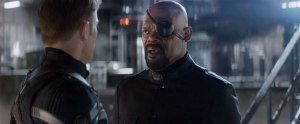
Cap (Chris Evans) expresses his concerns as to the direction S.H.I.E.L.D is taking to Nick Fury (Samuel L Jackson) in Captain America: The Winter Soldier

Cap (Chris Evans) expresses his concerns as to the direction S.H.I.E.L.D is taking to Nick Fury (Samuel L Jackson) in Captain America: The Winter Soldier

Since being thawed out from cryogenic stasis at the end of The First Avenger, Rogers has allied himself with S.H.I.E.L.D, the labyrinthine spy and law-enforcement network led by Nick Fury (Samuel L Jackson, given more to do this time) – but is growing ever-more sceptical about its true motives. Rogers is forced to go on the run from S.H.I.E.L.D after finding himself in the middle of a massive conspiracy and, with the help of deadly assassin Natalia Romanoff, aka Black Widow (Scarlett Johannson, also with more to do this time), and fellow war veteran Sam Wilson (Anthony Mackie, underused) sets about uncovering the truth.

While Thor’s second solo outing got lost in an Asgardian vortex of Dark Elves and cod-Lord Of The Rings nonsense, Cap’s big return has a far more engaging narrative.

Cap (Chris Evans) must work with deadly assassin Natasha Romanoff, aka Black Widow (Scarlett Johannson) in Captain America: The Winter Soldier

Cap (Chris Evans) must work with deadly assassin Natasha Romanoff, aka Black Widow (Scarlett Johannson) in Captain America: The Winter Soldier

The central plot makes no bones about its nods to 1970s conspiracy cinema classics like The Parallax View (1974) and Three Days Of The Condor (1975), right down to the casting of Condor‘s Robert Redford, who effortlessly raises the level of the film every time he’s on screen as senior S.H.I.E.L.D figure Alexander Pierce.

The juxtaposition of Cap’s clearly defined outlook of right and wrong with the murky, compromised ideology of S.H.I.E.L.D is a nice idea and a very contemporary concept, but the film doesn’t trust the audience to work it out for themselves. When he witnesses just how far S.H.I.E.L.D is willing to go to “neutralise threats”, a rattled Rogers tells Fury “This isn’t freedom, this is fear”; to which Fury replies the agency “takes the world as it is, not as we’d like it to be”. The point is made several more times in case we haven’t picked it up.

Nick Fury (Samuel L Jackson) with old buddy and fellow S.H.I.E.L.D colleague Alexander Pierce (Robert Redford) in Captain America: The Winter Soldier

Nick Fury (Samuel L Jackson) with old buddy and fellow S.H.I.E.L.D colleague Alexander Pierce (Robert Redford) in Captain America: The Winter Soldier

In spite of the lack of subtlety, it’s undoubtedly the most interesting element of both this and any other Marvel picture to date, and one you feel directors Anthony and Joe Russo would rather have concentrated on more. This being a superhero movie, however, it’s a prerequisite that things go boom sooner or later.

That being said, an early set piece involving an ambush on Fury’s S.H.I.E.L.D mobile is exhilarating stuff, while a fight involving Rogers and a dozen or so S.H.I.E.L.D goons in a lift gets the pulse racing. It’s when the scale of the action is amped up that the film – especially in the final act – loses its way and turns into just another Marvel movie involving a stack of CGI explosions in the sky.

The mysterious Winter Soldier in Captain America: The Winter Soldier

The mysterious Winter Soldier in Captain America: The Winter Soldier

In spite of being part of the title, we’re given only a brief taste of who and what the Winter Soldier is. It’s a plot thread you suspect had more meat on it during early drafts and is left dangling for Cap’s third solo movie. At 136 minutes, the film is too long anyway, so it’s not surprising this wasn’t developed more.

Although on paper a two-dimensional relic of 1940s flag-waving propaganda comics, Captain America’s onscreen adventures are fast becoming the Marvel movies to look out for.

Review – Rush

More than three decades after his feature debut Grand Theft Auto, Ron Howard once more feels the need for speed in this loud and proud biopic centred around one of motor sport’s greatest rivalries.

Rush Poster

Although too conventional for a story such as this, Ron Howard’s Rush nevertheless fires on enough cylinders to make it a worthy study of what drove two men to risk it all to win

Perhaps more than any other sport, Formula One deeply divides opinion between those who would rather sit in a traffic jam to those who live for race day.

A typically laid-back James Hunt (Chris Hemsworth) in Rush

A typically laid-back James Hunt (Chris Hemsworth) in Rush

Previously, motor sport movies such as Grand Prix and Le Mans generally tailored themselves towards the petrol head. That was until the 2010 British documentary Senna, a stunning and deeply moving film about the life and tragic death of Brazilian F1 driver Ayrton Senna. Crucially, Senna managed to make its subject accessible to the uninitiated and avoid dumbing itself down to the serious fans at the same time.

It’s a feat Howard just about carries off in Rush which, like Senna, chronicles an intense duel between two drivers – Britain’s James Hunt and Austria’s Niki Lauda.

Daniel Brühl as Niki Lauda in Rush

Daniel Brühl as Niki Lauda in Rush

The film charts their professional rivalry from their days as young Formula Three drivers in 1970 to the topsy-turvy 1976 F1 season, during which Hunt suffered multiple setbacks and Lauda was involved in a horrifying crash that resulted in severe burns, before it  all came down to the final race in Japan.

It-girl Suzy Miller turns James Hunt's head in Rush

It-girl Suzy Miller turns James Hunt’s head in Rush

Howard has a capacity to imbue his more prestigious projects (Apollo 13, Cinderella Man, Frost/Nixon) with an admirable authenticity and he tackles Rush with a similar mindset. The saturated colours and grainy lens lend the film a 1970s air that’s complemented by a close attention to detail in the costume and production design.

Australian actor Chris Hemsworth’s acting talents are still relatively unknown beyond his performances as Thor in the Marvel film series and he has a ball as Hunt, the larger-than-life playboy who’s as gifted behind the wheel as he is between the sheets (he’s rumoured to have slept with more than 5,000 women). Hunt isn’t a one-dimensional cartoon, though, and Hemsworth evokes the highs and lows that came with his excessive lifestyle, while also showing why he chose to risk life and limb each and every race.

Feeling the need for speed in Rush

Feeling the need for speed in Rush

Normally it’s the Brits who are the reserved ones, but here it’s Daniel Brühl’s Lauda, who’s all about maximising performance, methodical preparation and driving within acceptable levels of risk. Brühl does a smart job of garnering the audience’s empathy for a character who, on paper, is a cool, self-controlled jerk with a singular purpose to win. In one effectively staged scene, a honeymooning Lauda stares worriedly out the window, realising that with new wife Marlene (Alexandra Maria Lara) he now has something to lose; while in the corner of the shot a fire burns, cleverly foreshadowing the appalling accident that is to come.

The intense rivalry between Niki Lauda (Daniel Brühl) and James Junt (Chris Hemsworth) in Rush

The intense rivalry between Niki Lauda (Daniel Brühl) and James Junt (Chris Hemsworth) in Rush

Howard reteams with writer Peter Morgan following Frost/Nixon, another 70s drama about high stakes and intense rivalry. Although not as powerful a script, Morgan’s spiky dialogue keeps things racing along at a fast enough speed in spite of the incessant exposition-heavy commentary that threatens to overtake each and every race.

The races themselves are when the film high truly hits top gear. Howard keeps the camera tight on Hunt or Lauda or low to the track (including some engine-specific digital effects work) to give a convincing impression of the terrifying speeds these horse-powered coffins were capable of, and almost overwhelms the senses with a ear-bleeding wall of sound.

This is Hemsworth’s and Lauda’s show, but Olivia Wilde impresses as it-girl Suzy Miller, who turns Hunt’s head, while Christian McKay is wonderfully fruity as Alexander Hesketh, the colourful owner of Hunt’s first racing team.

Although too conventional for a story such as this, Rush nevertheless fires on enough cylinders to make it a worthy study of what drove two men to risk it all to win.