Debuts Blogathon: Frank Henenlotter – Basket Case (1982)
Today it’s the turn of Elwood over at From the Depths of DVD Hell to contribute to the ‘Debuts’ Blogathon with a dissection of Frank Henenlotter’s 1980s horror classic Basket Case. I’ll be honest; Elwood’s site was new to me before he got in touch requesting to join the Blogathon club, but since then I’ve become a fan. As well as an impressive review archive, he’s also gradually working through the 1001 Movies to See Before you Die list; something I think a lot of us out there have thought about doing at some point.
Frank Henenlotter
Basket Case (1982)
It’s safe to say that there are few directors who embrace the sleazy side of cinema as much as Frank Henenlotter who, while not the most prolific of directors with only six films to his credit since unleashing this debut film in 1982, has retained his exploitation inspired style throughout.
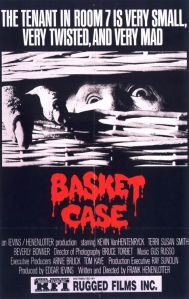 While other directors such as those who came through the Roger Corman film school, including Joe Dante, John Landis and James Cameron, moved onto making more mainstream movies and moved away from their exploitation cinema beginnings, Henenlotter has remained true to his grimey 42nd Street-inspired roots. He’s even continued his passion for exploitation cinema through the website Something Weird Video, where he has been instrumental in rescuing numerous titles from being destroyed, including Bloodthirsty Butchers and the truly random The Curious Dr. Humpp, as well as this debut film from Henenlotter himself.
Opening with what could almost be described as a video postcard of New York’s 42nd Street (true, not one that anyone would want to receive) as cinema marquee’s advertise kung fu movies and sleaze, the softly spoken and awkward Duane (Kevin Van Hentenryck) wanders down the neon lit sidewalk carrying a larger wicker basket. Unsurprisingly, everyone wants to know what’s in the basket, from the cackling street walkers to the residents of the seedy hotel were Duane decides to stay. Unknown to them all, though is that this wicker basket is home to Duane’s monstrous twin brother Belial, who is deeply resentful at being surgically separated from his brother, so much so that the two brothers are now on a mission of revenge to kill the doctors who separated them.
 Henenlotter’s vision of New York has always been one caked in grime and sleaze which he established with this debut, where the residents are either sleazy or just plain oddballs. Even Duane’s love intrest Sharon (Terri Susan Smith) seems to not be quite all there, especially when she frequently talks so breathlessly and wide eyed. This film establishes a lot of Henenlotter’s favourite themes, including bodily mutation and over-the-top violence, as well as his now trademark scuzzy sense of humour. They craft a unique film to say the least, but one which wears its exploitation colours proudly, with Henenlotter himself classifying his films as exploitation films rather than Horror films.
Here he crafts a tale full of sleaze, gore and sheer randomness, yet one which also surprisingly has quite a few touching moments as well, such as the boy’s aunt reading them The Tempest. Despite Belial only being able to communicate telepathically with his brother the two share a clear bond for each other. Even if it might seem that Duane is being led by his monstrous brother’s lust for revenge, the rage at being detached from each other is clear to see in them both.
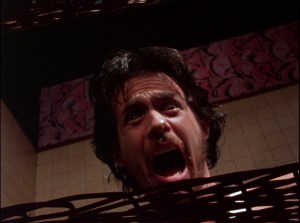 Still, despite these tender moments the tone throughout is decidedly schizophrenic, especially when Belial starts to demonstrate a serious jealously streak, which soon sees him soon setting off to pursue his own perverse pleasures, including one scene which managed to offend even the crew to the point where they walked off the production, something that would also happen again on Henenlotter’s next film Brain Damage.
Warped tastes aside, this film remains a master class in low budget filmmaking with a measly budget of $35,000. This fact is only further highlighted by the roll of cash Duane carries with him actually being the film’s budget, while Henenlotter’s crew was so small he made up most of the names listed on the credits to make it seem like a bigger crew than he actually had.
 Still, despite the lack of budget the film has still dated well, with the stop motion effects used to animate Belial having a real charm to them which CGI just doesn’t have. Equally not hampered is the healthy gore quota on hand here, as we get a head pushed into a drawer of surgical equipment and bloody maulings amongst the bloody delights, as well as some gooey looking surgical scenes as we see in one flashback the two brothers being separated.
Despite Belial’s murderous tendancies, he is still a restrained killer and only kills for revenge. The only time he breaks from this is in a fit of jealousy towards the end of the film, almost as if Henenlotter was keen to show that while he might look like a monster he possesses none of the usual monster psychology, though at the same time he is unquestionably a pervert as seen in several of the more questionable scenes, where Belial decides to explore the world outside of his basket.
 More focused than some of his later films, the film has a quick pace and outside of some truly questionable acting there is a lot to enjoy here. At this point Henenlotter is still not as caught up in his themes as he becomes in his later films, which frequently seem to be more about shocking the audience than crafting an intelligible story, as his last film Bad Biology only serves to highlight.
Still for anyone looking for a starting point for Henenlotter’s film this is certainly a gentle entry point and for many this remains the favourite of his six films, so much so that it would spawn two sequels despite the ending of this film being pretty final. But then, like any good exploitation movie, if there is a chance to make money there is always a way.
Over at Terry Malloy’s Pigeon Coop, Nick from The Cinematic Katzenjammer casts his critical gaze over Duncan Jones’ acclaimed 2009 debut Moon. Head over to Chris’s site now by clicking here.
For your next slice of Blogathon gold, Elroy from The Silver Screener will be examining Christopher Nolan’s devious debut Following (1998). Don’t miss it.




















 three rows back