London Film Festival 2011 – Chapter 4

After a cracking day of documentary it’s back to planet fiction, starting with the Scandinavian thriller Headhunters.

Once thought of as an enlightened, peaceful part of Europe, Scandinavia has become something of a hotbed of nastiness  in recent years if the glut of grisly crime fiction is anything to go by.

Steig Larsson’s best-selling Millennium trilogy has already been adapted for film once and is getting the Hollywood remake treatment courtesy of David Fincher for those who struggle/can’t be bothered to read subtitles on screen. Danish series The Killing was a massive hit for the BBC (an American TV adaptation soon followed), which also had a stab at the Kurt Wallander series of books (hot on the heels of the Swedish TV series).
Headhunters

Now it’s the turn of award-winning Norwegian author Jo Nesbo to have his work brought to the screen. Famous for his Harry Hole detective novels and Doctor Proktor children’s series, it’s actually his 2008 stand-alone book Hodejegerne (The Headhunters) which director Morten Tyldum has brought to the screen.

While The Girl With the Dragon Tattoo and its two sequels were filmed in a very muted, televisual way, with no visual flourishes, Headhunters immediately feels like something different; sexier, fresher and with a cool and glossy visual style that fits the character of Roger Brown (Aksel Hennie).

One of Norway’s most successful headhunters, reputation means everything to Roger, whether it’s earned or manufactured. Away from work, Roger lives in a beautiful house with beautiful trophy wife Diana (Synnøve Macody Lund). He seems to have it all, but in reality he’s hopelessly in debt and has turned to art theft to keep the wolves from the door.

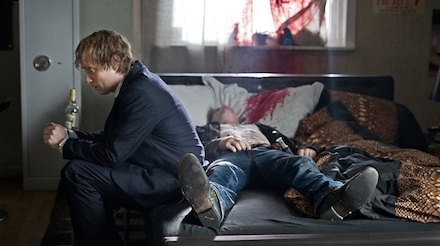
When Diana introduces him to the charismatic Clas Greve (Nikolaj Coster-Waldau from American TV series Game of Thrones), Roger sniffs not one, but two opportunities; to headhunt Clas for a high-flying position he needs filling, but also to solve his financial woes once and for all. For Clas is in possession of an extremely valuable painting and so Roger sets into motion with his partner in crime, security firm employee Ove (Eivind Sander) a plan to swipe the artwork and sell it on.

But the best laid plans of Roger and Ove go horribly, horribly wrong and soon Roger is running for his life and in the middle of an industrial conspiracy he can barely understand.

Headhunters is an intriguing recipe of styles; with a smattering of The Thomas Crown Affair here and a dash of Enemy of the State there before turning into what it ultimately is – a rollicking good roller-coaster ride with more twists and turns than a Hitchcock thriller.

Unlike The Girl With… films, Headhunters also knows when to poke fun at itself and the humorous vignettes, most absurdly when Roger drives down the road in a tractor with a domestic animal stuck on the end of it, manage to sit comfortably with the moments of intense violence because they are so blackly comic.

Sometimes Headhunters can be too clever for its own good and it’s hard not to turn your nose up at some of the more unlikely plot twists (the moment when Roger makes a phone call to his wife only to get a rude awakening feels like exactly what it is, a necessary moment to move us into Act Two), but it’s equally difficult not to get swept along by the film’s kinetic energy. If this doesn’t get remade in America as well I’ll cut off my own head.

Just as the struggle to return to a normal life after the Vietnam War was addressed in films such as Coming Home (1978) and The Deerhunter (1978), so the Iraq and Afghanistan conflicts have seen their fair share, with the likes of In the Valley of Ellah (2007), Stop Loss (2008) and, to a lesser extent, The Hurt Locker (2008).

It’s virtually impossible to avoid politics in films such as these, but that’s what Liza Johnson tries to do in her debut feature Return.

Return

Not one mention is made of George W Bush and no-one beats their chest questioning the reason as to why our boys and girls are over there. As the title suggests, Johnson instead focuses solely on how Kelli (Linda Cardellini) copes with civvie life, beginning with the moment she is reunited with her husband Mike (Michael Shannon) and their two daughters in the airport after a year’s tour of duty (it’s not specified where, reinforcing it’s irrelevancy in Johnson’s eyes).

The community is delighted to have Kelli back, and following a welcome home party she returns to work at the local factory, seemingly well-adjusted and unaffected by her year away. Gentle questioning by her friends as to what is was like over there prompts the broken-record reply of “others had it much worse than me”, a mantra that becomes increasingly meaningless the more she says it.

It’s only a matter of time though before her outwardly happy exterior begins to crack and the alienation, confusion and sense of purposelessness starts seeping out. First she walks out on her job, then her marriage begins to fall apart as she discovers Mike has been seeing another woman in her absence, before a moment’s stupidity leads to her getting caught drink-driving. And when she receives a piece of devastating news, she’s left with stark choices as to where to go next.

Johnson directs with a suitably stripped down palette, a wise move bearing in mind the often painful subject matter. She’s assembled a sturdy cast, with Shannon more restrained than he’s been on screen before and Tony Slattery swapping the fine tailoring of Mad Men for a sweatshirt and battered old baseball cap as a fellow war vet and damaged soul.

However, this is former ER cast member Cardellini’s film and she doesn’t drop the ball in what is her biggest role to date. There are no histrionics, instead she reigns it in, only allowing her eyes to show the anguish and confusion Kelli is going through.

That being said, Johnson’s script can feel very clunky at times, throwing in narrative jumps that aren’t properly explained or believably handled (the breakdown of Kelli and Mike’s marriage happens very quickly, especially as he seems so keen to go back to the way things were before). Mike’s being a plumber also feels a little heavy-handed (he can fix everything except her).

The fact that it’s a woman returning from a tour is refreshing – the only other film dealing with this subject from a female perspective that comes to mind is the British indie In Our Name (2010) – but it’s not enough to give Return an honourable discharge.

London Film Festival 2011 – Chapter 3

Normally at this point of the festival I’m starting to wish I wasn’t sitting in a darkened room surrounded by spluttering, deep-breathing people eating their own weight in popcorn or nachos.

“Hell is other people”, Sartre once said. I can only imagine these words popped into his head when he was sat in a cinema next to two old people gassing on about their day after he shelled out good money to be entertained for a couple of hours.

That being said (the festival ain’t over yet, mind), the number of imbeciles is noticeably down on previous years, while the amount of food being carted into the screenings I’ve attended is on the wane. This pleasant fact mixed nicely with the two fantastic documentaries I managed to catch.

Since winning his Oscar for 1991’s Silence of the Lambs, director Jonathan Demme has, with a couple of exceptions (most notably the Tom Hanks-starring Philadelphia (1993)), stepped away from the spotlight.

Demme has now become more of a documentary film-maker than anything else and, following his two concert films with Neil Young and his acclaimed portrait of ex-US President Jimmy Carter, he returns with I’m Carolyn Parker.

I’m Carolyn Parker

I’m Carolyn Parker marks a return to post-Hurricane Katrina New Orleans for Demme following his 2007 TV mini-series New Home Movies From the Lower 9th Ward.

The plight of the residents of New Orleans after that devastating storm in 2005 which led to great swathes of the city being flooded and the deaths of more than 1,800 people, is clearly something close to Demme’s heart.

He’s not the first film-maker to cover the subject; Spike Lee’s When the Levees Broke (2006) was widely considered a documentary milestone. However, the ace up Demme’s sleeve is the main subject of his film – Carolyn Parker.

The film opens with friends of Mrs Parker praising her to the hilt, pointing out that she was one of the very last to leave the Lower 9th ward, one of the worst hit areas of the city, and among the first to return after the storm waters subsided.

In Demme’s eyes, Mrs Parker is a symbol of the Lower 9th itself, a determined, resourceful person who doesn’t abide politicians or church leaders if she doesn’t feel they have the community’s best interests at heart.

Demme first meets her in 2006 – her house is a wreck but she, and those nearest and dearest to her aren’t going anywhere and begin their fight to see the house, the beating heart that keeps her going, brought back to its former state.

Little did Mrs Parker, and Demme it’s pretty safe to say, think it would take another four years before this dream could finally be realised. During this time, the director and his small crew return time and again to check on her progress and, while putting a brave face on it, it’s clear to see the struggle has taken its tole. Snatches of footage of Mrs Parker sat in church, surrounded by people singing and looking happy, see a woman lost in her thoughts and without the smile that’s otherwise there for the cameras.

Crystallising a massive, devastating event into one person’s plight is hardly original, but then none of those films had Mrs Carolyn Parker in them and Demme should be congratulated for getting this inspirational woman’s story out into the world.

Another inspirational story, albeit of a very different nature entirely is told in Alex Gibney’s fantastic new documentary Magic Trip.

Magic Trip

Gibney has become one of America’s most important documentary film-makers in recent years, from Enron: The Smartest Guys in the Room (2005), to Taxi to the Dark Side (2007), his searing examination of the US’s policy of torture post 9/11, and Client 9: The Rise and Fall of Elliot Spitzer (2010).

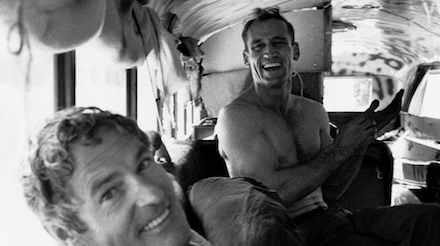
Gibney and co-director Alison Ellwood worked with three archival institutions to put together the hours of raw footage filmed by Ken Kesey and his Merry Band of Pranksters as they journeyed across America in 1964 in a clapped out old school bus they named ‘Further’ to attend the World’s Fair in New York.

Greatly inspired by Jack Kerouac’s generation-defining book On the Road, Kesey had already achieved national attention for his classic novel One Flew Over the Cuckoo’s Nest and, with John F Kennedy’s assassination still locked in people’s minds and nuclear annihilation an ever-looming threat , he wanted to turn his back on the present and see what the future had in store.

To this end he and a group of friends embarked on a cross-country road trip from California to New York and back again, laden down with barrel loads of LSD and a mischievous, free-wheeling spirit to match. It was fitting they were joined on the way to NYC by the real-life Dean Moriarty, the one and the same from Kerouac’s On the Road, who drove the bus.

Although certain they were making waves, little did they know their trip would effectively instigate the counter-culture and become the stuff of legend thanks to Tom Wolfe’s book The Electric Kool-Aid Acid Test.

Using archive footage shot on the road by Kesey and the Pranksters, Gibney and Ellwood have assembled a fascinating chronicle of a key moment in America’s history.

Eschewing the standard way these kinds of historical documentaries are put together (experts offering pearls of wisdom), Magic Trip contains no talking heads. In fact the only nod to the present day is a slightly fruity narration by Stanley Tucci, although even this is done in such a way as to make it sound as if the narrator is embedded with the gang, with Tucci asking questions of the Pranksters who reply giving us on the road reportage.

Featuring a great soundtrack of early-Sixties classics, including The Grateful Dead (which is appropriate, as they joined the fun with the Pranksters), Gibney and Ellwood have managed to do what Kesey and co were unable to for so many years – to bring sense to a crazy time while still capturing the whacked-out spirit of a lost generation.

London Film Festival 2011 – Chapter 2

After the hit and miss of the previous day, I was pretty sure I would be on safer ground for my next two cinematic excursions.

One of the most eagerly awaited films of the festival for me was Yorgos Lanthimos’s Alps – and I’m pleased to report that it didn’t let me down.

Alps

Lanthimos broke out from the cudgels of the festival circuit with his 2009 film Dogtooth, a highly original, visually striking and often disturbing satirical drama that was nominated for Best Foreign Language Film at last year’s Oscars.

Often, the weight of expectation on a director to strike gold again and follow-up a critically lauded film with something equally as impressive is too much to handle and the result can end up as too self-indulgent for its own good. But Lanthimos clearly understands these pitfalls and in Alps has employed much of the same formula that made Dogtooth so fascinating, while also creating a whole new beast.

Alps begins by introducing each of the main characters at work, whether that be in a hospital, caring for a blind, elderly woman or training to become a rhythmic gymnast. At first it appears there is no connection between these people, but then they assemble together to form a new group called Alps.

Why Alps? As the group’s leader (Aggeliki Papoulia) explains, the mountains of the Alps cannot be replaced by any other mountain; however, these peaks can replace other mountains – the perfect metaphor for the purpose of the group; namely to act as substitutes for the deceased in order to help their grieving loved ones. For a price of course.

It’s an absurd notion, but Lanthimos creates a  world where such things seem eminently possible, logical even. After all, why not assist in the grieving process if people choose to pay for such a service?

However, it’s not as easy as that, of course, especially when the members of Alps (who all name themselves after its mountains – the leader naturally snaps up the title Mont Blanc, its tallest peak) are damaged souls in their own right. The adage “you don’t have to be crazy to work here, but it helps” has never been more appropriately applied.

They spend so much of their time pretending to be other people, be it a woman’s dead husband, or a talented young  female tennis player who has died following a car wreck, that they begin to lose all sense of self identity, to the extent where one of the group can no longer live her ‘real’ life and instead chooses to exist as a dead person, whether the deceased girl’s grieving parents want her or not.

Just as in Dogtooth, Lanthimos shows no fear, giving us a set of characters who exist in the bubbles they have created, or have been created for them. The blackly comic dialogue, often delivered in a totally deadpan fashion speaks to the absurdity of the situations these characters find themselves in, without ever winking at the audience.

Although Lanthimos may not have intended it, the mood of Alps rather speaks to what is happening in the director’s native Greece at the moment, where its citizens must feel that another reality, any other reality is preferable to the one they are being forced to live through right now.

Although world cinema is becoming a far easier concept to embrace thanks to film festivals and, more significantly, the digital age there remains a bias towards American film – or rather movies in the English language. Sure, there are new waves crashing in from eastern Europe (specifically Romania), South America and South East Asia, but the directors who helm these acclaimed films are still largely unknown outside of their native countries, and can struggle to make a name for themselves unless they suck it up and come to Hollywood.

One director who broke out a long time ago and has garnered a truly international reputation – without ever feeling the need to work abroad – is Japan’s Takashi Miike. Miike has been more prolific than Woody Allen in his 20-plus years as a director, regularly churning out two or three movies a year.

He rose to international prominence with his gut-churning 1999 masterpiece Audition, and in the intervening years has been rattling cages with a series of controversial films, most notably the jaw-dropping Ichi The Killer (2001).

Then in 2010 he had his biggest international hit for years with Thirteen Assassins (check out my blog for last year’s LFF to read a review). Restrained by Miike’s standards, Thirteen Assassins was nevertheless a gloriously violent samurai flick, reminiscent of Akira Kurosawa’s seminal Seven Samurai and which featured one of the most awe-inspiring set-piece battles ever seen on screen.

Miike treads similar ground with Hara-Kiri: Death of a Samurai, based on a story by Yasuhiko Takiguchi and a loose remake of  Masaki Kobayahi’s 1962 film Harkiri, regarded as one of the greatest films ever to come out of Japan.

Hara-Kira: Death of a Samurai

The outbreak of peace during the early 17th Century in the castle town of Edo (now Tokyo) under the Shogun has meant  disaster for the samurai, who have been reduced to penniless, impoverished ronin. Times are so tough that some have seen no alternative but to approach noble houses and request that they be allowed to use their premises to perform ritual suicide.

Many nobles are sympathetic to the plight of these samurai and talk them out of it, providing them with money and quietly ushering them away. However, as news of this quick cash solution gets out, some samurai employ the tactic of  ‘suicide bluffing’ – pretending to ask for hara-kari, while secretly hoping and expecting to be bought off.

When ronin Hanshiro (Ebizo Ichikawa) arrives at the House of Li, making this same request, feudal lord Kageyu (Koji Yakusho) tells him a story of another warrior, Motome (Eita) who got far more than he bargained for when his bluff was called and his ‘wish’ granted.

Realising he has no choice, the terrified Motome unsheathes not a metal sword, but one made of bamboo, leading to a quite horrific and prolonged death for the tragic samurai.

However, it transpires that Hanshiro is all-too aware of Motome’s fate and has come to the House of Li to exact his revenge on Kageyu and the senior lieutenants who sealed the young warrior’s fate.

With Thirteen Assassins and now Hari-Kiri, Miike is moving forward in his career by looking back to a classical period in Japanese cinema. But that’s not to say Miike is necessarily aping his forebears, he’s simply too daring a film-maker for that and here presents a familiar story of love, betrayal, tragedy and death in a bold and striking way.

One fluffed note, however, is the pointless use of 3D. It’s not surprising that Miike has employed Hollywood’s favourite new toy – he’s as keen as any director out there – but Hara-Kiri wasn;t the wisest choice frankly as the 3D adds nothing to the experience of watching the film; a sentiment that can be applied to 99% of 3D films, but that’s a separate conversation.

London Film Festival 2011 – Chapter 1

I’m pretty sure I’m not the only one out there to feel a sense of crushing inevitability when browsing what’s on for the week ahead at my local multiplex.

If it ain’t got cigarette paper-thin characterisation, CGI-a-plenty and a script that’s been cooked up by ZX Spectrum then the chances of finding it playing at the World of Cine down the road are slim to none. Sure, there are exceptions to this broadly-brushed rule (awards season usually throws up something) but these are mostly needles in enormously oversized haystacks.

So when the London Film Festival comes around every October I, like so many others, gleefully part with too much cash to experience what else, beyond summer tent pole releases, exists out there on Planet Cinema.

When I say “like so many others” I really mean it as purchasing tickets for the LFF is becoming increasingly difficult. Gone are the days when you could make your selections and be virtually guaranteed of a seat. Tickets for certain films this year went ridiculously quickly. My hopes of seeing The Artist, We Need to Talk About Kevin, David Cronenberg’s A Dangerous Method and Steve McQueen’s Shame were dashed pretty swiftly, but one of the joys of the LFF is that there’s so much to choose from, you’re hardly struggling to pick something that intrigues.

One such film is Rampart.

Rampart

Rampart

The police corruption genre isn’t one that’s been mined much in recent years (the most notable examples have been found on the small screen in such series as The Shield), but Hollywood hasn’t a bad history in the field, with the likes of Internal Affairs (1990), Bad Lieutenant (1992) and Martin Scorsese’s Oscar-winner The Departed (2006).

However, one man more than any other has stood out as a seal of quality – James Ellroy. This master of crime fiction saw his 1950s-set Los Angeles potboiler L.A Confidential turned into a one of the best American films of the 1990s, while he also penned the screenplay for the under-rated Dark Blue (2003) starring Kurt Russell.

Dark Blue was set in a LA barely in control following the beating of Rodney King and the subsequent riots that tore parts of the city apart. Although set in 1999, seven years after the riots, the LA of Rampart (based on a story by Ellroy, who also co-wrote the screenplay) is a cesspool of distrust.

The LAPD is barely keeping a lid on the city, a situation not helped by the fact that it is the source of so much hatred in the city. Part of the reason for this is because of cops like Dave Brown (Woody Harrelson). When Over we first meet Brown he’s patrolling the streets, not afraid of dispensing a very particular brand of justice to those who step out of line in his little kingdom. The control he feels he has at work extends to his personal life, wherein he picks up women in bars without a second’s thought while living next door to his two ex-wives (Anne Heche and Cynthia Nixon), sisters who are the mothers of his two disaffected daughters.

When he is caught on camera beating half to death a man who drove into the side of his car, Brown’s superiors see an opportunity to show they are cleaning house by burying a bad cop. Convinced he’s being set up, Brown decides to make life difficult for his bosses and threatens a messy lawsuit. But this is an enemy this Vietnam veteran doesn’t fully understand and as the pressure inexorably builds, Brown starts making irrational choices and gradually digs himself ever deeper into a pit there is no escape from.

Working with Harrelson again following the Oscar-nominated The Messenger (2009), Oren Moverman clearly understands his material, having had a hand in the script. Moverman also understands Harrelson, still one of the most under-rated actors of his generation, as he draws out a performance of such brutal honesty it’s sometimes difficult to watch. Harrelson’s never been one to shy away from exposing himself bare, physically and emotionally, on screen given the right material and here turns in a career-defining performance of a man who is overwhelmed on all sides and too stuck in his ways and self-destructive to carve a way out.

Harrelson is ably supported by a superb star-studded cast, including Heche, Nixon and Robin Wright as an emotionally damaged lawyer who, like others, is drawn to and repulsed by Brown in equal measure.

One of the best crime movies this century, Rampart deserves to find an audience. Hell, it might even make it to my local multiplex.

One film that I guarantee won’t be making its way there is The Loneliest Planet – and to be honest the multiplex crowd won’t be missing much.

The Loneliest Planet

The Loneliest Planet

A loving couple, played by Gael Garcia Bernal and Hani Furstenberg, are travelling in Georgia hoping to get off the beaten path. Used to getting by with a smile and one or two words of the local lingo, theirs is a happy existence and the travelling you suspect is a final opportunity to see the world and live independently before marriage and babies get in the way.

They hire a local guide (Bidzina Gujabidze) to take them into the Caucasus Mountains. With the exception of the odd sheep or goat, they are seemingly all alone in this vast wilderness. But when a chance encounter goes awry following a misconstrued comment, the trust between these two young lovers is suddenly pushed to breaking point as they discover things about themselves they wished they hadn’t.

There have been a glut of films in recent years in which innocents abroad are deceived/trapped/hunted/tortured by the locals, and when you sit down to watch The Loneliest Planet you could be forgiven for half expecting it to follow in the same footsteps as the likes of Hostel.

The fact it doesn’t is a good and bad thing; good in that there’s only so much torture porn one can take, but bad in that the film is so teeth-grindingly slow you kind of wish the protagonists were being hunted/tortured etc.

There’s nothing wrong with slow-burn mood pieces where little of anything happens when those films contain characters you engage with.

The problem with The Loneliest Planet is that you feel little of anything towards Bernal’s or Furstenberg’s characters aside from a wish for see them get off screen as quickly as possible. Unfortunately, director Julia Loktev isn’t one to oblige and it’s almost two hours before she brings up the end credits.

Numerous shots of the couple and their guide dwarfed by their surroundings, presumably symbolising how insignificant we are in nature’s hands, promise much and the discordant, jarring strings that accompany these shots work well, but the sense of unease created fizzles out and you’re left with what is ultimately an empty exercise.

London Film Festival 2010 – Chapter 11

And now the end is here and so I’ve reached the final curtain of what has been a splendid London Film Festival.

Regrets? Yeah, there’s been a few I guess. When I got my LFF catalogue through the post and began planning what I wanted to watch, Russian film How I Ended This Summer was on my list but had to be dropped due to a clash with another movie.

How I Ended This Summer

It sounded intriguing enough, so it was a source of frustration to learn it had scooped Best Film of the festival. I managed to catch the Best Film at last year’s LFF – the quite superb A Prophet (my favourite of 2009) – and kind of hoped I would manage to get it right again. Never mind.

I really wanted to watch the Danish documentary Armadillo about a group of young Danish recruits sent to Afghanistan and found out of their depth. The Tillman Story which I did catch and enjoyed lost out to Armadillo in the Best Documentary category. Oh well.

At some point I’ll try to make an effort to watch some of the more experimental stuff the LFF has to offer. But the thing with these events is that you could end up spending 12 hours a day shuttling from screening to screening and still not see everything you want.

Unless you’re a member of the press and, as such have an access all areas pass into any screening, the cost can become prohibitively expensive. While we’re talking turkey, and in case any LFF organiser is reading this (unlikely I know), it makes no sense to me that a festival pass hasn’t been introduced yet. Most festival goers I suspect are like me and wish to see multiple films, so why there isn’t a pass offering a discount for big bookings is a bit dumbfounding.

Right at the start of this series of blogs I railed against people who got on my nerves in screenings. To be fair, this year hasn’t been as bad, but there have still been numerous occasions when some irritating swine seems to think they are watching a film in their own living room and, as such, have carte blanche to talk/text/breathe too loudly/spread themselves out too much etc.

The most irritating thing way too many people have done this year though is turn up after the film has started. The worst I clocked was a couple who arrived an hour after a film started. I mean, what’s the point of that? You might as well go and have a drink instead, for f*ck’s sake.

The situation was made worse when a foreign language film was being shown and, instead of feeling embarrassed and taking their seat extra quick, many people would stand in the aisle watching the film and slowly take their coats off, blocking the view for the likes of me. There’s a word for people like this and I think you might know what that word is.

Cinemas (and I mean this as a general rule) should enforce a system which doesn’t allow anyone arriving for a screening to be allowed in 10 minutes after the film has started. That’s a fair timescale I think and it might make people think twice, especially when they arrive late carrying their own body weight in popcorn and enough soft drink to fill a swimming pool.

So ends a strong LFF for another year. It’s events like this that belie that tired old moan from people who complain films aren’t as good as they used to be. They are, you just have to be prepared to root them out and the LFF gives you ample opportunity to do this.

Long may this festival continue and I’ll be sitting three rows back hoping no-one will get on my nerves.