Review – Moonlight
Anyone doubting the power of cinema to break free from the shackles of its self-imposed stereotypes should bask in Barry Jenkins’ Moonlight and think again.
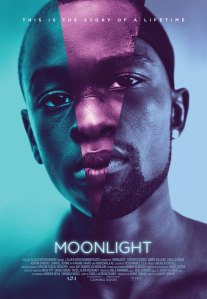 Films about the grim reality of existing within some of America’s most damaged neighbourhoods are hardly uncommon and more often than not check off a list that includes drugs and violence.
While Moonlight isn’t devoid of these, they are merely window dressing for what is a deeply personal work about the confusion, pain and pleasure that childhood and adolescence bestows and the importance of accepting who you are.
 It chronicles three key stages in the painful path to adulthood for the introverted Chiron, a poor kid living in a run-down district of Miami who must contend with a drug-addled mother (played by Naomi Harris), bullying at school and the feelings he develops for best friend Kevin.
Alongside this is the complicated relationship he forms with Blue/Juan (Mahershala Ali), a drug dealer who becomes something of a father figure to young Chiron, but whose choice of career ends up having an adverse affect on his and his mother’s lives.
These early scenes between Ali and Alex Hibert as “Little” Chiron set the tone for what is to come. We are at first wary of Blue’s interest in the child, but his intentions to bring Chiron out of his shell and to show him the fatherly affection Chiron has presumably been missing for much of his life win through.
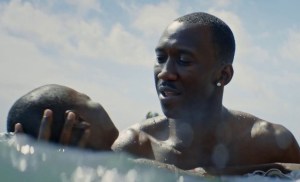 A beautifully played scene in which Blue teaches Chiron to swim is poetic in its grace and suggests a baptism of some sort is taking place for both characters. It is here where the reason for Blue’s fascination with Chiron becomes clear – for it is in this moment when he can be the man you suspect he wants so desperately to be.
As Blue says to Chiron in an exchange that strikes right at the heart of the film : “At some point you got to decide who you want to be; don’t let nobody make that decision for you.”
These words echo throughout Moonlight, not least of which during a devastating dinner table conversation in which a confused and heartbreakingly innocent Chiron, believing he is somehow ‘different’ from the rest, asks Blue “what’s a faggot?” before cutting to the core of Blue by putting two and two together to suggest that, as a drug dealer, he might be complicit in his mother’s addiction.
 While the physical similarity of the three actors who play Chiron as a boy (Hibbert), a scrawny teenager (Ashton Sanders) and a bulked up adult (Trevante Rhodes) is not immediately apparent, the character’s awkwardness in his own skin, expressed through hunched shoulders and a downcast, forlorn expression is a baton seamlessly passed on from one to the next.
The repressed anger that shuts Chiron down as a boy bubbles away in Sanders’ eyes, while the feelings he has for Kevin gain in strength. The tragic consequence of the bullying he experiences pushes Chiron away from Kevin, his mother and Miami.
Years later, the weedy teen has developed into a muscle-bound man (wonderfully played by Rhodes in a star-making turn), made in the image of his surrogate father – even down to the vehicle he drives and the crown dashboard decoration. However, he has yet to heed Blue’s earlier advice and presents a version of himself that’s at odds with his true self (he even wears a set of gold teeth, called ‘fronts’).
 Jenkins has spoken of how much Tarrell Alvin McCraney’s source novel In Moonlight Black Boys Look Blue spoke to him (they grew up in the same Miami neighbourhood, although were never acquainted) and this manifests itself in his screenplay which imbues each character with a depth and history that actors of the calibre of Ali and Harris plunder to rousing effect.
The strength of the performances and the richness of the characters is matched only by James Laxton’s masterful cinematography, which glides the camera in and out in a style that’s reminiscent of Terrence Mallick. A playground football game involving Chiron and a number of other children is turned into a balletic symphony, while a key encounter between Chiron and Kevin on the beach is magnetic to watch.
 Laxton’s camerawork is lent greater poetry by Nicholas Brittell’s glorious score, which is centred on a recurring six-note refrain and applies the ‘chopped and screwed’ technique to hip hop and orchestral music to create a slowed down and wholly original sound that submerges the viewer and exacerbates the holding pattern Chiron finds himself in.
Moonlight‘s message of tolerance, acceptance and compassion in the face of hate, repression and cruelty is both urgent and powerful. We need films like this, now more than ever.

 Back in 2013, I wrote a
  The renewed promise of that movie is largely realised in this, their latest colaboration, which gifts James McAvoy the role of his career as Kevin, a man who exhibits 23 different personalities due to his being diagnosed with dissociative identity disorder (DID).
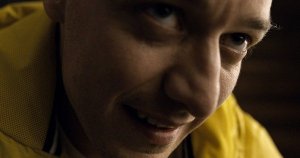 This self-entitled ‘horde’ are compelled to abduct teens Casey (Anna Taylor-Joy), Claire (Haley Lu Richardson) and Marcia (Jessica Sula) for a purpose that becomes disturbingly clear as ‘Kevin”s visits to specialist psychologist Dr Fletcher (Betty Buckley) reveal a 24th personality known only as ‘the Beast’ is waiting in the wings to show himself.
 Tight close-ups are used throughout, focusing on McAvoy’s saucer-like eyes and trapping us in Kevin’s fractured psyche along with his trio of victims.
 While Taylor-Joy’s blood raw performance is excellent, it’s overshadowed by McAvoy giving it his all and then some in a dizzying turn. It’s the role of a lifetime for anyone brave enough to seize it with both hands and McAvoy unpacks what he brought to the table as a corrupt, mentally evaporating cop in 2013’s Filth and lets rip with a mesmeric barrage of verbal dexterity, contorted body language and unnerving unpredictability that somehow avoids falling into the pit of comical caricature.













 three rows back