Review – Berberian Sound Studio

There’s something wonderfully outrageous about fruit and vegetables being used by serious, technically-gifted individuals to represent the sound of a body slamming onto the ground or a neck being broken.

It’s a side of filmmaking normally hidden from the audience, a process that takes place long after the cameras have stopped rolling and the actors have moved on to other projects.

Berberian Sound Studio

Peter Strickland’s Berberian Sound Studio – “a masterclass in sustained dread”

In director Peter Strickland’s astonishing Berberian Sound Studio, this is turned completely on its head, wherein the mechanics of sound reproduction (known as foley) take precedence. Moreover, Strickland sets the film in the 1970s, when warm and fuzzy analogue equipment like tape recorders and magnetic tape was used, in contrast to the clinical digital apparatus employed today.

Strickland used a modest inheritance and relocated to Transylvania to shoot Katalin Varga, a striking, outré revenge drama that marked him out as one to watch. The writer/director has taken a massive leap forward with his sophomore feature, a head-spinning psychological horror-thriller that plunges buttoned up sound engineer Gilderoy (Toby Jones) into a frenzied whirlpool of his own making.

Gilderoy has flown from Britain to Italy to work on The Equestrian Vortex, what he assumes is the sort of nature documentary he has made his stock in trade from his garden shed in Dorking.

Unbeknownst to him, The Equestrian Vortex is in actuality a sadistic, stomach-churning giallo horror film, the sort of supernaturally-charged splatter-fests made famous by such maestros of the genre as Dario Argento and Mario Bava.

Toby Jones as Gilderoy in Berberian Sound Studio

Toby Jones as Gilderoy in Berberian Sound Studio

As the images of torture, rape and mutilation are projected to Gilderoy for the first time, we see his facial reaction contort between voyeuristic intrigue and disgust. All the audience sees of the film are its opening credits, with its blood-red palette and shots of terrified women.

Sitting alongside the film’s irritable, unforgiving producer Francesco (Cosimo Fusco) in the claustrophobic sound studio, he goes to work recording marrows being hacked to pieces, cabbages being stabbed and radishes having their tops violently ripped off (all of which are left to rot in a none-too subtle moment of symbolism). He also records the bone-chilling screams of several women, in particular the paranoid Elena (Tonia Sotiropoulou), who is angry for allowing herself to be exploited by the film’s suave, oily director Santini (Antonio Mancino) and warns Gilderoy against making the same mistake.

A homesick stranger in a strange land, he gradually finds himself being dragged deeper into the cesspool of moral filth and degradation that is playing out on screen and clings onto letters from his mother describing the untainted day-to-day mundanities his increasingly fractured psyche is losing a grip of.

Gilderoy allows his work to overwhelm him, in much the same way as Gene Hackman’s suveilance expert Harry Caul in The Conversation, and before long he’s no longer able to differentiate between reality and his nightmarish paranoia where each disturbing sound is amplified and the silence is almost as deafening.
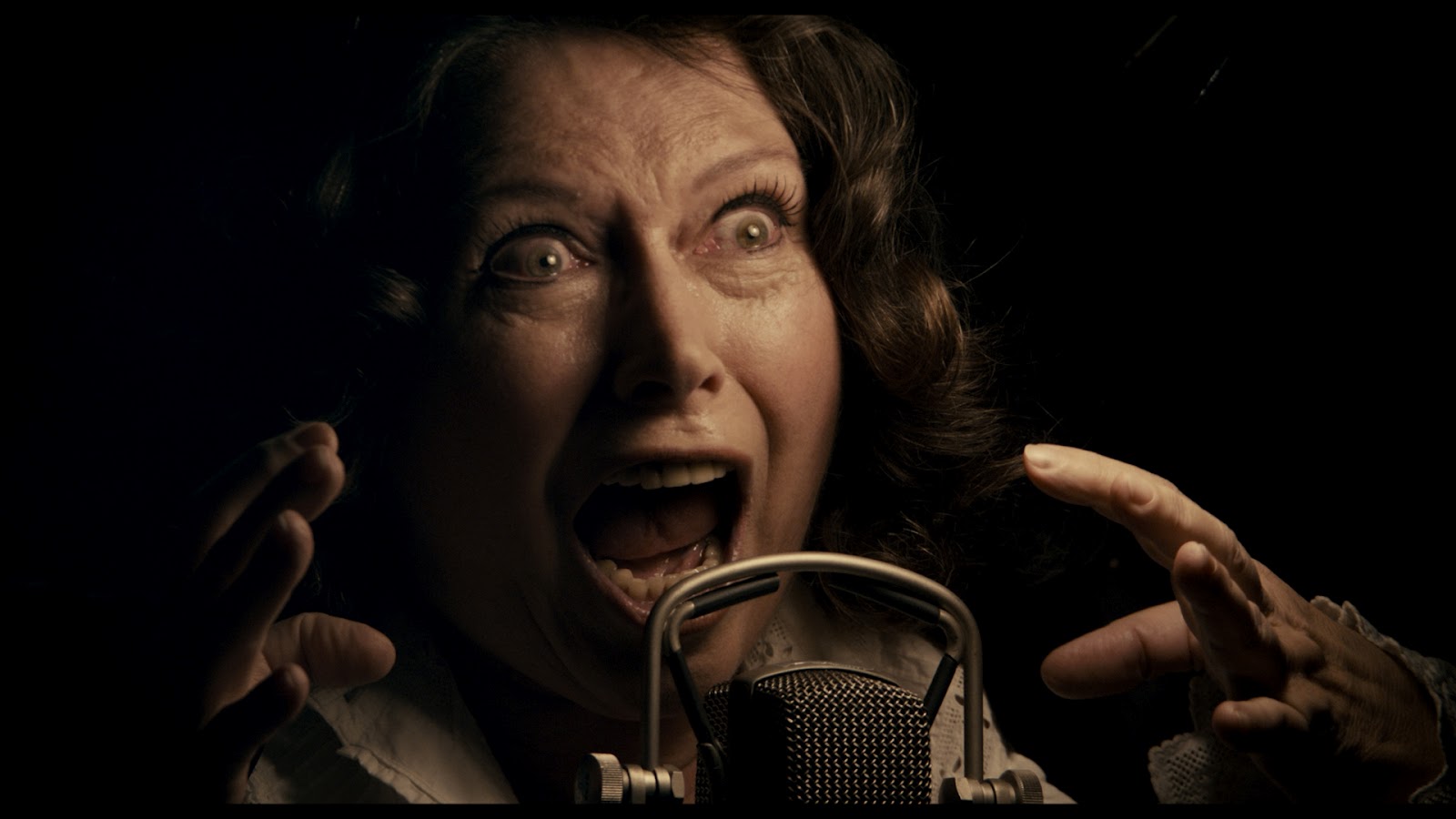
Psychological horror at its very best in Berberian Sound Studio

Psychological horror at its very best in Berberian Sound Studio

Strickland fearlessly takes his protaganist  into a vortex of his own making and nods to David Lynch and Ingmar Bergman’s Persona in the way he portrays Gilderoy’s mental breakdown on screen. It’s deeply unsettling stuff, rivetingly played by Jones in a career-best turn. Jones has one of those faces that can exude gentility and cruelty at the same time (if ever a remake of 10 Rillington Place was made, he would be perfect as unassuming serial killer John Christie) and we’re left to make our own mind up as to whether Gilderoy’s experiences have corrupted him or merely held a mirror to the darkness he (and we) fear has always been there.

The process of producing the sounds are as lovingly shot as the equipment on which they are recorded (Strickland holds the camera on tape spools or the analogue sound desk). In spite of the film’s suffocating grip, there are many moments of black humour and scenes of real beauty, in particular when Gilderoy shows his colleagues how he can create the sound of a UFO by scraping a light bulb against a wire brush.

For a film where sound is everything, foley artist Heikki Kossi must get special mention, while ethereal electro band Broadcast provide a suitably haunting score.

Utterly unique, Berberian Sound Studio is a masterclass in sustained dread and the first of what could well be a slew of masterpieces from this vital, gifted filmmaker.

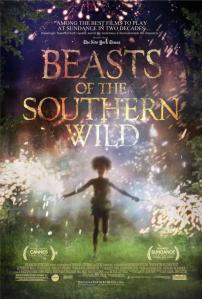
Review – Beasts Of The Southern Wild

New Orleans and the wider gulf coast of Louisiana have been forced to endure more than their fair share of disaster, grief and suffering since the terrible devastation wrought by Hurricane Katrina.

The impact of the hurricane has been the foundation of numerous documentaries, including Spike Lee’s exhaustive When the Levees Broke and the superb TV series Treme.

Beasts of the Southern Wild

Beasts of the Southern Wild – “a gothic fairytale of real beauty”

The city was front and centre of Werner Herzog’s The Bad Lieutenant: Port of Call New Orleans, while other films have used the area’s devastated locations as backdrops to the story they are telling, whether it be the moral decay that permeates the Brad Pitt-starring Killing Them Softly or the apocalypse in The Road.

However, none have found such beauty in decay as Benh Zeitlin’s Beasts of the Southern Wild, a beguiling, magical fairytale that must count as one of the most striking directorial debuts of recent years.

The film follows Hushpuppy (Quvenzhané Wallis), a strong-willed six-year-old girl who lives with her ailing, hard-drinking fisherman father Wink (Dwight Henry). The two live hand-to-mouth in separate rickety shacks that look like they’re about to collapse, surrounded by a menagerie of animals.

They live in a tiny bayou community of eccentric souls called the ‘Bathtub’, so called because it has been cut off from the outside world by a levee, with the “dry world” as Hushpuppy calls it on the other side. Hushpuppy and the other children are taught by the charismatic Miss Bathsheba on how to survive in the face of impending global warming, a consequence of which, little do they realise, will be the release of the giant prehistoric boar-like Aurochs from the melting ice caps.

Beasts of the Southern Wild

Hushpuppy (Quvenzhané Wallis) out-guns her daddy (Dwight Henry) in Beasts of the Southern Wild

Miss Bathsheba points to her cave painting tattoos of the Aurochs, something that inspires Hushpuppy to draw her own images so that “in a million years, when kids go to school, they’re gonna know once there was a Hushpuppy and she lived with her daddy in the Bathtub”.

When a giant Katrina-style storm floods the Bathtub, the resilient Hushpuppy realises the universe as she knows it has been thrown off balance and she must do all she can, including searching out her mother, to save her dying father.

Beasts of the Southern Wild is as beloved to some as it is infuriating to others. Although entitled to hold their opinions, the naysayers are missing the point.

Beasts of the Southern Wild

Hushpuppy (Quvenzhané Wallis) comes face-to-face with a prehistoric Auroc in Beasts of the Southern Wild

Any film featuring a child as the protaganist and narrated by that same youngster will instrinsically be equal parts illogical and fantastical. In the wrong hands, a film such as this can bury itself under an avalanche of too-cute whimsy, but Zeitlin admirably walks the tightrope and produces a gothic fairytale of real beauty.

The world of the Bathtub is so convincingly realised by Zeiltlin, you can almost smell the cajun spices and feel the water lapping under your feet. When you’re removed from it, as the characters are against their will by the authorities following the storm (evacuated to the ironically-titled Open Arms shelter), you feel as desperate to get back as they do.

Wallis is a force of nature as the headstrong, enchanting Hushpuppy, more adult than the grown-ups at times, in other moments a needy child who wants nothing more than to be held by her father, or mother if she can find her. You accept without reservation the father-daughter relationship she has with Henry, a non-professional actor who owned the bakery Zeitlin would use for breakfast while casting the film. Henry gives a raw, heart-breaking performance as the weakening Wink who loves his daugher dearly but struggles to find the proper words or deeds.

Credit must also be given to the wondrous score, heavily influenced by Michael Nyman and Philip Glass, which serves as another way into this magical kingdom.

Does everything work here? No; the whole side narrative involving the Aurochs feels like a step too far, while some of the characters are a little too eccentric for their own good.

However, Beasts of the Southern Wild remains a bewitching, poetic fable, a real one-off that, as Hushpuppy puts it is a “little piece of a big, big universe, and that makes things right”.

Bringing ‘Unfilmable’ Books To The Big Screen

For as long as the movie industry has existed as a popular art form, books in all their forms have been the subject of cinematic adaptation.

Whether it’s an old or modern classic or a schlocky best-seller, literature has been the source of some of the most loved films in history.

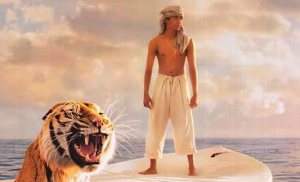
Ang Lee's Life of Pi

Ang Lee’s Life of Pi

In spite of cinema’s basic, inherent function to take words from the page and visualise them there are certain books, some have argued, that are simply impossible to film and as such will never be seen on the silver screen.

Never say never, though, especially in the movie industry, as time and again the critics are confounded and what was once written-off as ‘unfilmable’ ends up going before the cameras – all be it to varying levels of success.

This has never been more true than today, with several adaptations of books that have previously been deemed too complex or challenging to work as films reaching our cinemas. Just recently, we’ve seen an admirable take on Jack Kerouac’s defining beat generation work On The Road by Walter Salles, Ang Lee’s version of Yann Martel’s beloved novel Life of Pi and a bold adaptation of David Mitchell’s sprawling epic Cloud Atlas by the Wachowski brothers and Tom Tykwer, while this month also sees the cinematic release of Salman Rushdie’s critically lauded book Midnight’s Children.

Michael Winterbottom's A Cock and Bull Story

Michael Winterbottom’s ingenious adaptation of Tristam Shandy, A Cock and Bull Story

This is hardly a new phenomenon, however. Stanley Kubrick’s adaptation of Vladimir Nabokov’s controversial tome Lolita arrived in 1962 (the film poster even states “How did they ever make a movie of Lolita?”). Mike Nicholls faced major challenges bringing Joseph Heller’s satirical anti-war classic Catch-22 to the big screen in 1970, while more recently Peter Jackson finally delivered a truncated, but no less epic production of J.R.R Tolkien’s The Lord of the Rings to huge acclaim.

David Cronenberg's Naked Lunch

David Cronenberg’s unique Naked Lunch

Some directors have taken a more metatextual approach, including David Cronenberg who brilliantly weaved events from William Burroughs’ life into a unique adaptation of the writer’s drug-addled opus Naked Lunch. Michael Winterbottom’s A Cock and Bull Story inventively (and hilariously) acknowledged the difficulty of realising Laurence Sterne’s 18th century novel Tristam Shandy on screen by adopted the film-within-a-film approach, while Charlie Kaufman channeled his head-banging struggle to write a script for The Orchard Thief to ingenious effect in Spike Jonze’s Adaptation.

As Cronenberg, Winterbottom and Kaufman/Jonze have proved, the book is merely the beginning of the process, it needn’t have to be the end. For years movies have been ‘printing the legend’ and playing fast and loose with ‘true’ stories, so why shouldn’t the adaptation of novels be any different?

Midnight's Children

The supposedly ‘unfilmable’ Midnight’s Children

As Lee has stated on adapting Life of Pi: “We can never write a book or make a movie as good as how it plays in the audience’s mind.”

Once published, a book no longer belongs to the writer, it becomes the intellectual property of each and everyone who visualises the words they are reading in their own heads. A film is just another visualisation of the material, it just happens to be the one that gets the most attention.

When the source is a graphic novel, problems can occur as the author/illustrator have already set down how it should look. Zack Snyder was on a hiding to nothing when he adapted Alan Moore’s seminal Watchmen, thought to be one of the medium’s most unfilmable works.

Mixed reaction greeted Zack Snyder's adaptation of Watchmen

A mixed reaction greeted Zack Snyder’s adaptation of Watchmen

Snyder tried to stay as close to Moore’s vision as he could, but compromises inevitably needed to be made, incurring the ire of both the author and some within the fan community.

Directors and screenwriters will invariably tell you it’s not their job to come up with an ultra-faithful translation of the source. An adaptation is exactly that, an interpretation of the material that should be taken on its own merits.

So-called ‘unfilmable’ books should be treated no differently; we can only hope screenwriters and directors continue to have the vision necessary to bring these texts to the big screen. After all, the books aren’t going anywhere.

Review – Taken 2

The man with “a very particular set of skills” returns to remind another cabal of evil-looking Eastern Europeans why messing with Americans is never a good idea.

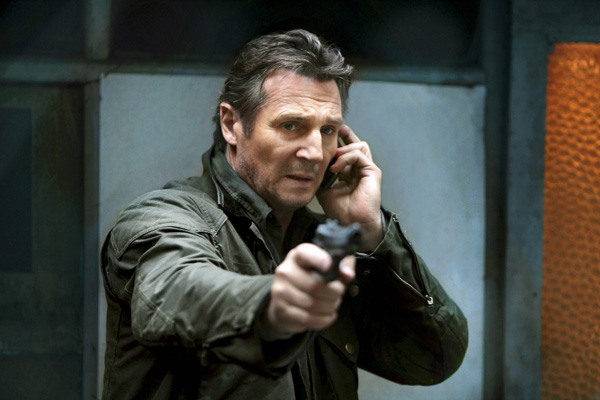
Taken 2 poster

Taken 2 – Bad, and not in a so bad it’s good way

Taken was an unexpected box office smash on its 2008 release and somehow got away with reinventing Liam Neeson (he of Schindler’s List, let’s not forget) as a credible action star.

Although xenophobic in the extreme and ridiculously over-the-top in its execution, Taken had a B-movie charm that was hard to resist. The inevitable sequel picks up shortly after the events of the original, with the relatives of the dastardly sex traffikers who took Bryan Mills’ (Neeson) daughter and paid with their lives vowing to take their revenge.

Murad (Rade Šerbedžija) orders his men to find and capture Bryan, his ex-wife Lenore (Famke Janssen) and their daughter Kim (Maggie Grace). They get their chance when mother and daughter join Bryan in Istanbul, and before long all hell breaks loose as Bryan and Lenore are taken and it’s left to Kim to evade capture and help them escape (in a reversal of the original’s plot).

Taken 2 is bad, and not in a so bad it’s good way. Take away director Olivier Megaton’s glossy handheld camerawork and the multiple explosions and you’re left with the sort of straight-to-DVD cheapie that Steven Seagal peddles out twice a year.

"Have I mentioned that I have a very particular set of skills? I have? Oh."

“Have I mentioned that I have a very particular set of skills? I have? Oh.”

At least Taken had a couple of memorable moments, not least of which was the “I don’t know who you are. I don’t know what you want…” telephone conversation Bryan has with his daughter’s captor, but Taken 2 feels like what it is, a lazy cash-in that throws in more of everything, including the now obligatory Bourne-aping car chase (featuring Grace whining “I can’t!” every time Neeson tells her to drive faster), while chucking narrative logic out the nearest window.

Judging by the huge returns, it’s safe to say Taken 3 will be heading our way in the next couple of years. But what next? Neeson butchering his way through the male population of Albania? Don’t rule it out. Those evil Eastern Europeans just don’t know when to quit.

Review – The Master

There are two kinds of ‘tent pole’ movie; one is the derivative, big-budget blockbuster that bankrolls a studio, while the other is less frequent but far more challenging – succour to the film connoisseur.

Paul Thomas Anderson has established himself as one of only a handful of directors whose films are considered must-see events to any self-respecting lover of cinema.

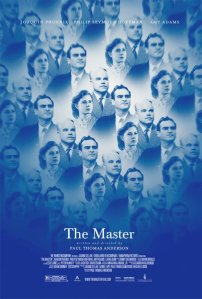
The Master

The Master “will deservedly become regarded as one of this decade’s most enduring classics”

Since his confident debut Hard Eight, Anderson’s career has followed the kind of upward trajectory most film-makers can only dream of, from his brilliant porn industry drama Boogie Nights, through to the epic ensemble piece Magnolia, the marvellously off-kilter romantic comedy-drama Punch Drunk Love and most recently the profound There Will Be Blood.

Anderson treads a similarly bold path with The Master, only his second film in almost a decade. It centres on Freddie Quell (Joaquin Phoenix), a World War Two Navy veteran who gets dumped back into society with little or no prospects, a nervous condition and a serious penchant for his own brand of moonshine, made largely from paint thinner. He seems not to understand social boundaries and is obsessed with sex, an unhealthy mixture shown in an early scene set during the war when he starts dry humping a sand sculpture of a woman his fellow seamen have created on a beach.

Freddie is a powder keg who drawls through a clenched jaw and a sneered lip and resembles a coiled spring in the way he walks, all hunched over like a primate. Constantly escaping his own tortured psyche, he runs away from one unnecessary scrape after another until he takes refuge on a yacht that for all intents and purposes looks like it belongs in another world.

The boat is owned by Lancaster Dodd (Philip Seymour Hoffman), who describes himself to Freddie as “a writer, a doctor, a nuclear physicist, a theoretical philosopher, but, above all, I am a man” and, fascinated with this new arrival, invites him to stay. It emerges that Dodd is the ‘master’ of ‘The Cause’, a Scientology-like movement that believes the Earth is trillions of years old and its inhabitants contain within them countless past lives.

The Master

Lancaster Dodd (Philip Seymour Hoffman) and Freddie Quell (Joaquin Phoenix) in Paul Thomas Anderson’s The Master

Dodd looks upon Freddie as a “silly animal” who has “wandered from the proper path” and decides to help him, akin to a dog and its master. Freddie is at first dubious, but soon embraces Dodd’s unconventional approach to self-improvement and becomes his right-hand man.

Part of this approach is ‘processing’, a psychological question and answer session that Dodd puts Freddie through in the film’s finest moment. Anderson suffocates the viewer, refusing to pull the camera away as we see Freddie’s tortured soul unburden. It’s bravura filmmaking (with mesmerising performance from both actors) and one of the scenes of the year.

A requirement of The Cause is to record everything that is said by Dodd, most revealingly during a scene when a group of young women are writing down a speech in which the Master espouses the pursuit of perfection by rejecting our animal instincts and controlling our emotions. Freddie finds one of the girls attractive and, ignoring Dodd’s words passes her a note saying: “Do you want to fu*k?”

The Master

Freddie Quell (Joaquin Phoenix) joins The Cause in The Master

Dodd comes from the ‘do as I say, not as I do’ school of cult leaders, often allowing his emotions to get the better of him, whether it be envying Freddie’s child-like, unfiltered existence, moments of self-doubt or bouts of rage when his teachings are questioned (most revealingly during a riveting exchange with a skeptic). Although it doesn’t take a genius to see the Master is a fraud, it takes Dodd’s son to scrape off the veneer for Freddie when he tells him: “He’s making all this up as he goes along. You don’t see that?”

Dodd’s wife Peggy (unnervingly played by Amy Adams) reveals herself as the real power behind the throne, tolerating her husband’s love-hate relationship with Freddie, but subtly steering him when the need arrives.

Johnny Greenwood’s mesmeric score amplifies the discordant world these characters exist in, while Anderson also interjects period music to masterful effect (the use of Irving Berlin’s ‘Get Thee Behind Me Satan’ while an attractive, enigmatic woman walks through a shopping mall and eventually encounters Freddie is inspired).

The Master is, in essence, a yin and yang love story between two men from very different backgrounds desperate for what the other has. Whether Anderson intends this meaning or not, one could easily draw parallels to a post-war America at turns equally arrogant and deeply uncertain about its future.

The Master has been pilloried in some quarters for its lack of narrative progression, but these critics are forgetting There Will Be Blood was hardly plot-heavy. Both are studies of entrancing characters whose individual traits are so powerful and entrenched they are bound to them forever. Oil magnate Daniel Plainview is just as alone and consumed by his relentless quest for money and power at the end of There Will Be Blood. Freddie is a broken machine doomed to spend eternity stuck on that beach alongside that pliant, sand sculpture, while Dodd will continue to believe he and The Cause hold all the answers.

Just as There Will Be Blood was one of the great films of this century’s first decade, The Master will deservedly become regarded as one of this decade’s most enduring classics.