Natalie at the fantastic Natalie Stendall blog has very graciously awarded me my very first Very Inspiring Blogger Award. To say I am thrilled is an enormous understatement and I thank Natalie for recognising my blog. Can I also thank everyone who has taken the time to read any one of my reviews and an extra special thanks to those who have chosen to follow my blog, it’s truly appreciated folks.
It’s worth noting there are a set of rules attached to receiving an award of this magnitude:
Link back to the blogger who nominated you – Please see above, I refer back to the splendid Natalie Stendall
Post the award image to your blog – Done
Share seven facts about you – See below!
Nominate other blogs and inform them about it – Also see below!
Here are my seven facts:
The first film I ever watched was Snow White and the Seven Dwarfs – I’ve never seen it since, oddly
I have run two marathons, including last year’s London Marathon. I am pleased to report all my toe nails and nipples survived intact
Scottish hero Rob Roy is a distant ancestor – I was originally disappointed not to be asked to appear in the Liam Neeson-starring film … until I actually watched it
I recently returned from an amazing six month trip to Japan, Australia and New Zealand – my cinematic highlight during this time was watching a film at the Rooftop Cinema in Melbourne (it helped that it was warm)
My favourite toy as a young chap was Jasper, a toy leopard
My first Christmas present for my girlfriend was jewellery – A good idea I think you’d agree, but this was unfortunately before I discovered she is jewellery-phobic. I apologised with a box of Ferrero Rocher … and then found out she has a nut allergy. Who knew?!
I make a mean apple crumble
And here’s who I believe deserves a Very Inspiring Blogger Award. I’m uncertain if there is a limit on the number of blogs you can select, however I’ve gone with the six below. All of these blogs are as informative as they are entertaining and I highly recommend that you pay them a visit:
“Life’s a bitch and then you die,” said Bertolt Brecht (sort of) in his musical The Threepenny Opera and it’s a pithy label often pinned on the work of Austrian filmmaker Michael Haneke.
Amour – “a film for the ages, one that will bring with it fresh meanings and insights into life with each viewing”
Haneke is probably the most effective exponent of slow, claustrophobic, dread-filled cinema at work today and his protaganists invariably have pain and suffering thrust upon them, sometimes self-inflicted (Caché, The Piano Teacher), but more often not (Funny Games, Code Unknown, Time of the Wolf).
His previous film The White Ribbon portrayed a German community collapsing in on itself and earned the director the Palme d’Or at Cannes in 2009, a feat he repeated last year with his latest Amour (Love).
The title raised some eyebrows when it was first announced as cinephiles aware of Haneke’s previous output wondered whether he had gone soft in his old age.
This is a love story, but like none that have gone before it. Compared to the sentimentalised and unrealistic romances of Hollywood, Haneke’s unvarnished honesty may be distressing to watch, but its frank depiction of one elderly couple’s slow, unwinnable battle against the rising tide of chronic ill health and old age sets it out as one of the greatest and most essential films about love and death ever made.
Eva (Isabelle Hupert) and her father Georges (Jean-Louis Trintignant) in Amour
This story of love begins at the end, with the body of Anne (Emmanuelle Riva) discovered on her deathbed by firefighters called because she and her husband Georges (Jean-Louis Trintignant) have not been heard from for several days. It’s an image equal parts beautiful and morbid and remains in the mind as the film travels back to show how she came to rest.
Georges first observes there’s something wrong with his beloved wife Anne when, sat at the kitchen table she suddenly goes into a trance. When she snaps out of it several minutes later she reacts as if nothing’s happened. Soon after she suffers a stroke, an unsuccessful surgery and then another, more devastating stroke that leaves her partially paralysed. As Anne’s physical state degrades she also succombs to the ravages of dementia.
Jean-Louis Trintignant as Georges in Amour
No spring chicken himself, Georges promises Anne “no hospitals” and vows to take care of her himself. In spite of his obvious devotion to his wife, the physical and mental toll it takes on Georges is palpable. He knows he’s fighting a losing battle and Anne’s slow decline from feisty spiritedness to a child-like helplessness is both painful and exhausting, to the extent that in one shocking scene his patience finally evaporates when she refuses to eat and he slaps her across the face.
Michael Haneke, director of Amour
A chamber piece in every sense, Amour features a stunning cast. Trintignant’s refusal to turn on the waterworks or to curry sympathy is exactly what makes him sympathetic in a role he totally inhabits. Riva gives a performance of outstanding physicality and her heart-breaking transformation is a master class in restraint.
The apartment, once filled with joy and music (Georges and Anne are music teachers) gradually takes on the feel of a prison. A pigeon flies in, possibly representing a freedom neither will ever know again, and what follows is a scene both comical and incredibly sad as the decrepit Georges tries to capture it.
Haneke’s black humour is also present near the start of the film when the couple discover burglars have attempted to break in while they were out. Anne’s observation: “Imagine if we were lying in bed and somebody broke in … I think I would die of fright” is starkly ironic bearing in mind we know that firefighters will break into their apartment and discover her body on the bed.
Amour is a tough and often painful watch but there are many, many moments of beauty to be found here too. It’s a film for the ages, one that will bring with it fresh meanings and insights into life with each viewing.
There’s a guilty pleasure in watching Disney’s affectionate homage to the dusty old 8-bit video games that were so adored by kids of all ages when Steven Spielberg’s E.T. was setting the box office alight.
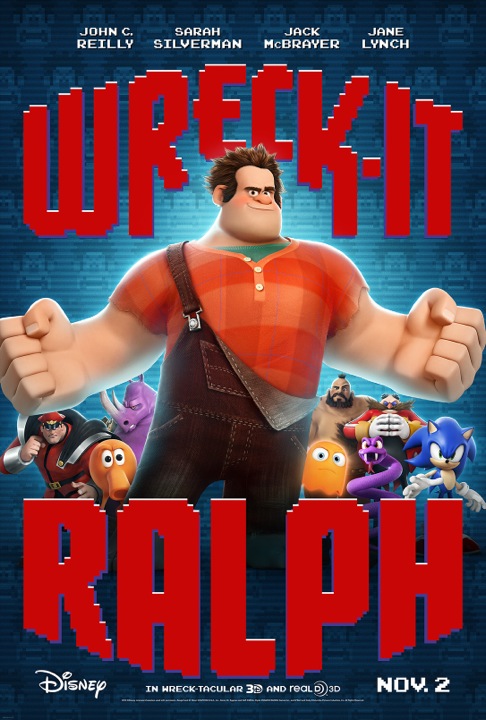
The hugely entertaining and cleverly put-together Wreck-It Ralph
Once as common a sight as Starbucks, arcades have gradually retreated to seaside piers and motorway service stations in the face of the relentless onslaught of ever-more-technologically impressive games consoles.
The hugely entertaining and cleverly put-together Wreck-It Ralph celebrates this dying breed of coin-swallowing entertainment in a lavishly animated movie that also doesn’t forget the higher-definition games that have followed in their wake.
Ralph (John C. Reilly) explains why he doesn’t want to be a bad guy anymore in Wreck-It Ralph
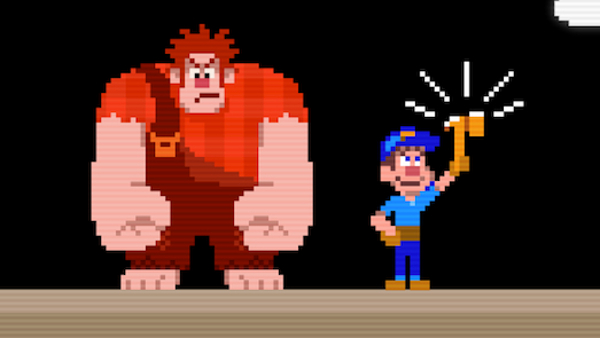
For the past 30 years, Ralph (voiced by John C. Reilly) has played the bad guy in the Donkey Kong-esque arcade game Fix-It Felix, Jnr, smashing up an apartment block only to see it put back together by gee-whizz good guy Felix (Jack McBrayer). It’s a role he’s grown tired of and, during a support group for video game villains reveals he wants to be the good guy for a change.
He gatecrashes a party at Felix’s penthouse home celebrating the game’s 30th anniversary, but is rebuffed by the other characters, who tell him to accept his station in life. Believing the only way he can be seen as ‘good’ is to earn a medal like Felix, Ralph sneaks into ultra-violent first-person shooter Hero’s Duty, but inadvertently launches a catastrophic chain of events that could lead to each of the games in the arcade being unplugged.
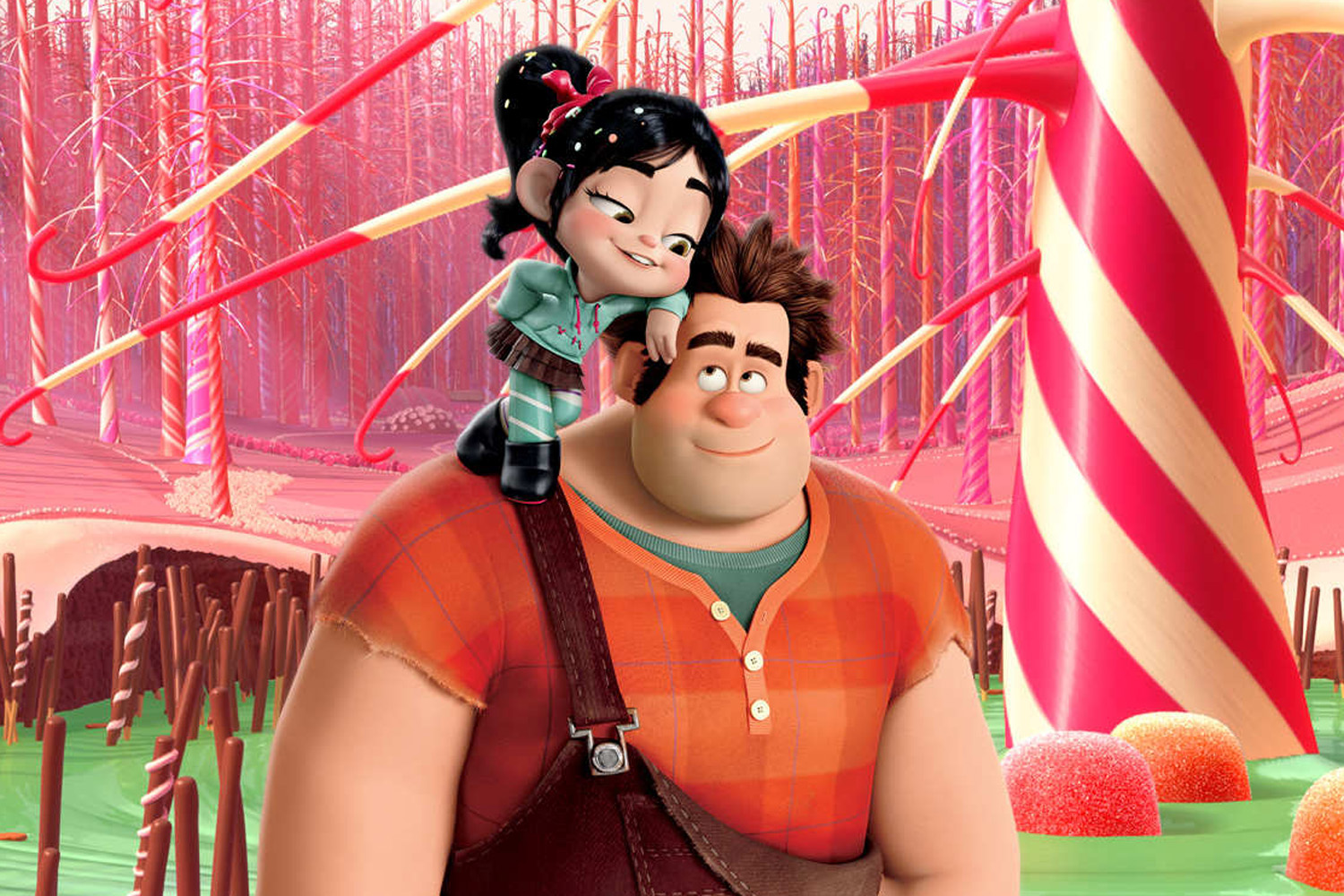
Vanellope von Schweetz (Sarah Silverman) and Ralph (John C. Reilly) travel through the “candy-coated heart of darkness” of Sugar Rush in Wreck-It Ralph
From the moment an 8-bit Walt Disney title card appears at the start of the film, the warm glow of nostalgia takes hold. Much like the Toy Story franchise (which Wreck-It Ralph closely resembles in its premise), there’s a timelessness at work here. I can certainly remember slotting countless coins into games like Pac-Man, Out Run and Dragon’s Lair – it’s how my love affair with video games started – and each generation since will have their own memories of the games they grew up playing.
“I’m gonna wreck it!” – Ralph (John C. Reilly) and the goody-two-shoes Felix (Jack McBrayer) in Wreck-It Ralph
This is nicely captured in a time-lapse sequence at the arcade where the action is set, wherein Fix-It Felix, Jnr sits in the same position over 30 years while the games around it come and go and the fashions and tastes of the youngsters who play them subtly change.
Director Rich Moore and his team introduce a number of nice little touches, including the jerky movements of the less-well developed supporting characters in the game and the blocky low-res furniture in Felix’s apartment, while in Sugar Rush, a garishly coloured kart racing game into which Ralph crash lands and ends up befriending the cute Vanellope von Schweetz (Sarah Silverman), all the characters are made of candy in some nightmarish Disney vision of hell, including policemen made of doughnuts.
Poor old Q*bert hopes for a handout after his game gets unplugged in Wreck-It Ralph
As you might expect, there are nods subtle and unsubtle to a whole host of iconic games and game characters, including Tapper, Q*bert, Street Fighter, Metal Gear Solid, Sonic the Hedgehog and Halo (there are many more I undoubtedly missed), while the loony ruler of Sugar Rush King Candy (Alan Tudyk)is deeply reminiscent of the Mad Hatter from Disney’s 1951 adaptation of Alice in Wonderland.
Henry Jackman’s score, like the film itself, cleverly shifts in tone to reflect the different styles of the games and it wouldn’t be surprising if Wreck-It Ralph‘s ingenious ghost in the machine concept ends up breeding its own franchise.
After a slew of disappointing big-budget animations (even the normally reliable Pixar has been off its game of late), it’s great to see a return to form for the Mouse House and a film you’ll want to replay many times.
Digital effects have come a long way since Yann Martel’s adored novel Life of Pi was first published in 2001, without which director Ang Lee’s efforts to bring this supposedly unfilmable book to the big screen would have been scattered on the rocks.
Ang Lee’s Life of Pi – far from a shipwreck which, for an ‘unfilmable’ tale is no small achievement
It’s an achievement in itself by David Magee to turn Martel’s prose into a screenplay and Lee, in his first film since the passable Taking Woodstock (2009) deserves a lot of credit for realising on screen the many wonders Pi (Suraj Sharma) witnesses during his epic journey.
Certainly in the past, many effects-laden films have sacrificed the things which should come first – a good script and good performances – for the sake of an attention-grabbing shot or action sequence. Lee for his part seems to have learned a thing or two about finding the right balance since falling into that trap with the disengaging Hulk in 2003.
The biggest challenge facing Lee was to give us a convincing Richard Parker, a Bengal tiger that, like the titular Pi, finds itself on a Japanese cargo ship on its way across the Pacific to start a new life in Canada.
Pi (Suraj Sharma) braves the storm in Life of Pi
Except neither the teenage Pi nor Richard Parker have any say in this. Piscine Militor Patel, or Pi as he prefers to be known after being given the unwanted nickname ‘Pissing’ Patel at school is happy living in the zoo his family owns in Pondicherry, India. Seeking a new life for them all, his father closes the zoo and books passage on a ship for both his family and animals, which will be sold abroad.
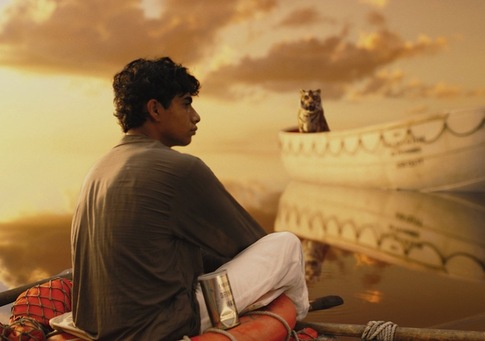
In a scene both vivid and distressing, the ship sinks after getting caught in a terrible storm. Pi is the only human to make it off the vessel alive, but finds he isn’t alone in the small lifeboat; he’s joined on board by a zebra, a hyena, an orangutan – and Richard Parker.
Pi (Suraj Sharma) adrift at sea with tiger Richard Parker in Life of Pi
The storm is a stark reminder for the stricken Pi of nature at its most untamed and recalls an earlier scene when a younger Pi tries to feed Richard Parker and is chided by his father, who shows him that “a tiger is not your friend” by making him watch it kill a goat. Stuck in the lifeboat, he is given a further unpleasant reminder when he witnesses the law of the wild inevitably taking effect. After watching this, the knock-about opening credits which playfully show the zoo animals going about their daily business take on a rather different light.
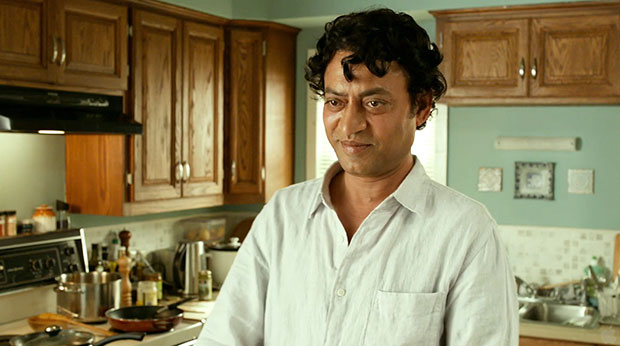
The adult Pi (Irrfan Khan) tells his incredible story in Life of Pi
The teenager names the boat ‘Pi’s Ark’, one of many religious and spiritual references in the film. Pi is shown as a young boy embracing Christianity, Hinduism and Islam, much to the annoyance of his scientifically-minded father, and the extraordinary quest on which he embarks with Richard Parker aboard the boat is as much about spiritual self-discovery as it is about survival.
One of many extraordinary encounters Pi has while lost at sea in Life of Pi
It’s when the boat is adrift at sea that the digital light show really takes over. In spite of falling back on the requisite ‘poke things at the screen’ trick to justify the use of 3D, Lee and his digital effects team conjure up myriad striking images. These range from the beautiful (the boat sat on perfectly still, glassy water) to the wonderfully bizarre (the moment hundreds of flying fish thunder by the boat is one of the film’s most memorable scenes).
The encounters Pi has are both frightening and fantastical – a belly flop from the biggest whale you’ve ever seen and the weirdest island (shaped like a woman) this side of Lost. They also speak to a key theme of Life of Pi, the power of faith. The adult Pi (played by Irrfan Khan) relates his story to a writer (Rafe Spall) devoid of ideas for a new book and bestows it on him to do with it as he pleases (“the story’s yours now”).
Setting aside all the remarkable computer work, Lee’s film works best as a simple buddy story between a teenager and a tiger. Although no masterpiece, Life of Pi is far from being a shipwreck and for an ‘unfilmable’ tale that’s an achievement in itself.
A quick glance at the plot for Silver Linings Playbook and you’d be forgiven for expecting yet another excruciating Hollywood romantic comedy, the kind that Gerard Butler and Jennifer Aniston seem to find themselves in.
David O. Russell’s Silver Linings Playbook – “smart and spiky screwball comedy for the internet age”
What should make this film even worse is that its central figure Pat Jr (Bradley Cooper) has bipolar disorder, which normally results in the sort of turned-up-to-11 manic performance that cries out for an Academy Award.
The fact that Silver Linings Playbook manages to avoid the trap doors and skirts around the clichés is largely down to the mercurial David O. Russell, who adapts and directs this smart and spiky screwball comedy for the internet age from Matthew Quick’s short story.
Pat is diagnosed after attacking his wife’s lover in the shower and, after eight months in a psychiatric institution is released into the care of his OCD-afflicted, Philadelphia Eagles-obsessed father Pat Snr (Robert De Niro) and long-suffering mother Dolores (Australian actress Jacki Weaver). Without a job or a wife, Pat is determined to rebuild his life, believing that if he gets fit and stays positive he can save his marriage.
At a friend’s dinner party he meets the self-destructive Tiffany (Jennifer Lawrence), who has tried to overcome her grief at the death of her husband by sleeping around. Tiffany offers Pat a deal – she’ll help him reconnect with his wife as long as he becomes his dance partner for an upcoming ballroom competition.
Tiffany (Jennifer Lawrence) and Pat (Bradley Cooper) audition for Strictly Come Dancing in Silver Linings Playbook
Russell knows the rom-com tropes – Pat and Tiffany are clearly made for each other – but in the best tradition of those classic screwball comedies, all the fun comes in how these two broken souls finally realise what the audience have known all along.
Crucially, the chemistry between Cooper and Lawrence is fantastic. They fizz off each other like a pair of firecrackers, from the amusing dinner party when they swap anti-depressant stories like Christmas cards to the sultry dance sequences.
The two are equally tactless, whether it be Pat asking Tiffany how many people she slept with in her office before being fired, or Tiffany saving Pat the bother of reading Lord of the Flies by summarising it for him and throwing the book away, annoyed he’s only reading it because it’s on the high school syllabus his estranged wife is teaching (reflecting an earlier scene when Pat throws a copy of A Farewell to Arms through the window because he’s disgusted with the pessimistic ending).
“Go Eagles!” Pat Jnr (Bradley Cooper) and Pat Snr (Robert De Niro) celebrate in Silver Linings Playbook
This is no smooth ride to love of course; Tiffany attacks Pat for being “afraid to be alive” and feels increasingly used by her dance partner as nothing more than a tool in which to win back his spouse. Pat feels guilty for getting closer to Tiffany and suffers a number of violent bipolar episodes, including one in the reception of his therapist Dr Patel (Bollywood favourite Anupam Kher).
Pat Snr, meanwhile, faces his own struggles. In one moving scene, beautifully played by De Niro, he has a moment of guilty realisation that father and son are perhaps more alike than he thought and tries to find some common ground over their shared love of the Eagles.
Cooper has never been better, which admittedly isn’t saying a lot as his output, until now, has hardly been stellar. He isn’t afraid to make Pat unlikeable and restrains himself from falling back on the pretty-boy mugging he’s been guilty of in the past.
Pat Jnr (Bradley Cooper) tries to stay on top of his bipolar disorder in Silver Linings Playbook
After years of picking up the pay cheque, it’s great to see De Niro back on form. For once, he looks fully engaged and appears to enjoy playing opposite Cooper again (following the patchy Limitless).
In lesser hands, the role of Tiffany could have become unbearably kooky or flaky. Apparently Russell originally had Zooey Deschanel in mind for the part, so one can only imagine how painful that would have been to watch.
Instead, Lawrence forgoes the crazy and brings a vulnerability to the role that’s refreshing to see. Instead of relying on a pout or a flailing of the limbs, she does a lot of her work with her eyes, expressing confidence, defensiveness or pain in a single look.
The exaggerated family dynamic and pent up emotions bring to mind Russell’s previous film The Fighter, but while that film somewhat lost its way, here he maintains a sharp focus and sweeps you along so persuasively that come the final dance contest you’ll be willing them on along with the rest.








 three rows back