Great Films You Need To See – 24 Hour Party People (2002)

Never let the truth get in the way of a good story, especially when it’s told with as much, well, ecstasy as Michael Winterbottom’s chaotically crazy paean to the high watermark of the Manchester music scene.

One of the best British movies of this century's first decade, 24 Hour Party People has pills, thrills, bellyaches and plenty more besides

One of the best British movies of this century’s first decade, 24 Hour Party People has pills, thrills, bellyaches and plenty more besides

Paraphrasing John Ford’s The Man Who Shot Liberty Valance, local TV reporter and music impresario (and the ultimate unreliable narrator) Tony Wilson would rather “print the legend” given the choice between that and the truth and Winterbottom and screenwriter Frank Cottrell Boyce are happy to go along.

Wilson is a singular figure and, played by Steve Coogan as Alan Partridge’s cooler, more successful brother, is as clever as he is funny, arrogant, pseudo-intellectual and eccentric. Although claiming at one point that “this is not a film about me; I’m a minor character in my own story” (in one of the film’s many fourth wall-breaking moments), 24 Hour Party People, like Madchester itself, wouldn’t exist without him.

Tony Wilson (Steve Coogan) and wife Lindsay (Shirley Henderson) attend the Sex Pistols' seminal 1976 gig at Manchester Lesser Free Trade Hall in 24 Hour Party People

Tony Wilson (Steve Coogan) and wife Lindsay (Shirley Henderson) attend the Sex Pistols’ seminal 1976 gig at Manchester Lesser Free Trade Hall in 24 Hour Party People

Winterbottom and Coogan gleefully pull the rug from under the audience right from the beginning of the movie, which starts in 1976 with Wilson throwing himself off a hill while attached to a hand-glider. After the elation comes the danger and finally the inevitable crash. Before we can work out the scene’s a metaphor for what’s to come, Wilson gets there ahead of us, saying straight to camera “obviously it’s symbolic, it works on both levels”. He goes on to add: “All I’ll say is … Icarus – If you know what I mean, great. If you don’t, it doesn’t matter; but you probably should read more.”

When not presenting quirky items that generally show up on the “And finally…” section of news programmes, Wilson fronted So It Goes, one of the only avenues in which to discover exciting new music before the days of the world wide web. In June 1976 he and 41 other people (including his first wife Lindsay, played by Shirley Henderson) attended the Sex Pistols’ seminal Manchester Lesser Free Trade Hall gig (which Winterbottom cleverly films by intermingling archive footage for the close-ups of the Pistols) alongside the future movers and shakers of Manchester music (as well as Simply Red’s Mick Hucknall, who doesn’t count).

Ian Curtis (Sean Harris) on stage in 24 Hour Party People

Ian Curtis (Sean Harris) on stage in 24 Hour Party People

Through that gig, Wilson met Ian Curtis (Sean Harris) and the other members of soon-to-become post-punk poster boys Joy Division and created Factory Records. The film follows the crazy highs and the crazier lows of Factory’s turbulent existence, from Joy Division through to New Order (formed by the surviving members of Joy Division after Curtis’ suicide in 1980), the Happy Mondays, the Hacienda nightclub, the birth of rave culture and the inevitable implosion.
The no-nonsense Rob Gretton (Paddy Considine) and unconventional producer Martin Hannett (Andy Serkis) in 24 Hour Party People

The no-nonsense Rob Gretton (Paddy Considine) and unconventional producer Martin Hannett (Andy Serkis) in 24 Hour Party People

Winterbottom purposefully splits 24 Hour Party People into two distinct sections – everything that went on prior to Curtis hanging himself and everything that happened after. Curtis is given the respect he deserves; it’s through his band that Wilson formed Factory in the first place and his suicide is dealt with sensitively and suddenly. Harris’ portrayal of the troubled singer is excellent and particularly captures his intense and contorted on-stage persona (he’s even better than Sam Riley in 2007’s Control, the more autobiographical film about Curtis).

Following Curtis’ death, the film gets increasingly anarchic, reflecting both the times and the head space of Wilson, who doesn’t help himself by making a series of rash financial decisions in the name of art. He doesn’t care, for instance, when told Factory will lose money on every copy of New Order’s elaborately designed gatefold 12″ of Blue Monday as he thinks it won’t sell – only to be proved disastrously wrong when it goes on to become the highest-selling 12″ single in history.

Paul (Paul Popplewell) and Shaun Ryder (Danny Cunningham) up to no good in 24 Hour Party People

Paul (Paul Popplewell) and Shaun Ryder (Danny Cunningham) up to no good in 24 Hour Party People

Likewise, in spite of the fact the Hacienda is haemorrhaging cash he invests in new offices, which include a zinc roof that can only be observed from a helicopter and a £30,000 boardroom table that’s as pointless as it is cheap-looking. That was the dichotomy of Wilson; a can-do entrepreneur Thatcher would undoubtedly have been proud of had he not helped to usher in rave culture.

The film is strengthened by a rogue’s gallery of new and established talent, including Paddy Considine as the no-nonsense Joy Division/New Order manager Rob Gretton, John Simm as New Order singer Bernard Sumner, Andy Serkis as unpredictable genius producer Martin Hannett and Danny Cunningham as Happy Mondays frontman Shaun Ryder.

The seminal Hacienda nightclub brought back to life in 24 Hour Party People

The seminal Hacienda nightclub brought back to life in 24 Hour Party People

It also features a whole host of cameos, many of whom are used imaginatively in the movie, not least of which the real Tony Wilson as a TV producer lambasting the other Wilson’s presentation skills. In another inspired moment, Wilson recalls his wife having sex in a public toilet with Buzzcocks frontman Howard Devoto. As he walks out the camera pans to a cleaner who happens to be the real Howard Devoto, who turns to the camera and says: “I definitely don’t remember this happening.”

Despite the nods to Partridge, Coogan gives the role far more nuance than he’s credited for and clearly relishes the opportunity to flex his acting muscles. He’s arguably never been better.

Needless to say, if you’re a fan of Manchester’s music scene from the late 70s to the early 90s you’ll be in seventh heaven when it comes to the soundtrack (there’s no Stone Roses or Oasis here, however; they’re not part of the Factory story).

One of the best British movies of this century’s first decade, 24 Hour Party People has pills, thrills, bellyaches and plenty more besides.

Review – World War Z

Zombie cinema has come an awful long way from the no-budget claustrophobia of Night Of The Living Dead to this globe-trotting action horror that’s as epic in scale as it is in expense.

World War Z aims to be the last word in zombie-geddon, but in sacrificing character for spectacle World War Z aims to be the last word in zombie-geddon, but in sacrificing character for spectacle it ends up lacking the bite of the genre’s true classics

World War Z aims to be the last word in zombie-geddon, but in sacrificing character for spectacle World War Z aims to be the last word in zombie-geddon, but in sacrificing character for spectacle it ends up lacking the bite of the genre’s true classics

Once regarded as little more than a niche genre presided over by George A Romero, the zombie flick was reanimated for modern audiences by Danny Boyle in his 2002 horror classic 28 Days Later and since then has lurched its way into the mainstream, to the extent that even TV has embraced it in the form of the hugely popular cable show The Walking Dead, based on the comic book of the same name.

While the undead were doing their thing on the big screen, Max Brooks’ 2006 novel World War Z took a wholly new and plausible approach by presenting itself as an oral history of a 10-year global zombie war; a collection of personal accounts compiled by a United Nations agent examining the various geo-political, religious and environmental changes that occurred as a result.

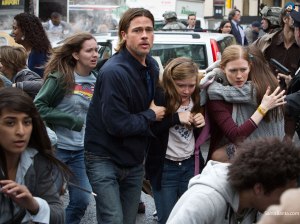
Fleeing the initial zombie outbreak in World War Z

Fleeing the initial zombie outbreak in World War Z

Adapting a book with World War Z‘s particular structure was always going to be tough, but it’s nevertheless surprising just how fast and loose the filmmakers have played with the source material, to the extent that virtually the only thing connecting the two is the title.

The novel’s only common thread is its narrator, so it makes sense the driving force for the movie is former UN investigator Gerry Lane (Brad Pitt), who’s portrayed as a loving father to two girls and husband to Karin (Mireille Enos), presumably to remind both us and him what he’s fighting to save when it all goes down.

Devastation-porn in World War Z

Devastation-porn in World War Z

And boy does it all go down right from the first few minutes when, sitting in heavy traffic in downtown Philadelphia, they are suddenly and violently attacked by a growing horde of rabid zombies. The family barely make it to the roof of an apartment complex, where they are extracted in the nick of time by helicopter (whose complement includes a blink and you’ll miss him Matthew Fox) to a US Navy vessel, where they discover the terrifying scale of the worldwide pandemic. Told that he and his family will be forcibly evacuated off the ship unless he co-operates, Gerry reluctantly agrees to join the needle in a haystack search for Patient Zero, starting at a US military base in South Korea. From there, Gerry travels to Jerusalem and (randomly) Cardiff in a race against time to find anything to give them an advantage against “Zeke”.

Karin (Mireille Enos) and husband Gerry (Brad Pitt) seek escape in World War Z

Karin (Mireille Enos) and husband Gerry (Brad Pitt) seek escape in World War Z

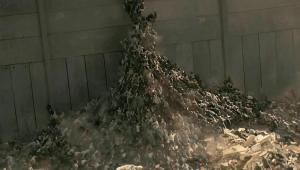
A general rule of previous zombie movies has been to suggest the disturbing degree of the outbreak through emergency radio broadcasts or fuzzy television pictures. Not so World War Z, which tries to live up to its hardcore title by wallowing in the devastation, be it the military bombing the hell out of a city or an anthill of zombies furiously piling on top of each other to traverse a massive wall the Israelis have constructed to supposedly keep the undead out. Before you have chance to catch your breath, though, Gerry’s off again on his whistle stop tour.

Going after "Zeke" in World War Z

Going after “Zeke” in World War Z

As the film progresses, however, the focus gradually narrows from CGI-heavy mass destruction and chaos to a relatively claustrophobic third act set within a laboratory, which was bolted on after the movie’s original ending was jettisoned by the studio and producer Pitt.

Gerry (Brad Pitt) and co in World War Z

Gerry (Brad Pitt) and co in World War Z

Although clearly financially motivated (a static indoor location is far cheaper than horrendously expensive reshoots on the scale of the rest of the film) and somewhat derivative of many a great horror movie that’s come before, director Marc Forster makes the best of what he’s given and does a solid enough job ratcheting up the tension, although this is dampened by one unintentionally humorous zombie’s endless teeth-clicking.

While Brooks’ episodic narrative gave the reader a thorough sense of each individual and their story, World War Z’s script doesn’t have time for such distractions as character. Despite his commendable efforts to get the thing onto the big screen, Pitt feels like the wrong fit for Gerry. An actor with more range would have better suited the material and given the audience a greater sense of the personal impact this unimaginable horror must be having. And with the exception of Daniellla Kertesz’s Israeli soldier, no-one else is given the chance to make any impact.

Probably the most memorable image of World War Z

Probably the most memorable image of World War Z

Watching World War Z, I couldn’t help having the feeling that it would have worked better as a cable TV mini-series. The famous Battle of Yonkers chapters aside, wherein US soldiers make an Alamo-style stand against tens of thousands of ghouls (which is missing from the film anyway), Brooks’ novel largely stayed away from massive spectacle, concentrating instead on ordinary men, women and children fighting for survival.

As fast-moving as the thousands of undead who swarm across the screen, World War Z aims to be the last word in zombie-geddon, but in sacrificing character for spectacle it ends up lacking the bite of the genre’s true classics.

Review – Behind The Candelabra

It’s an unfortunate twist of fate that a film featuring an outrageously flamboyant central figure who was one of the world’s biggest stars ended up being relegated to the small screen in the United States.

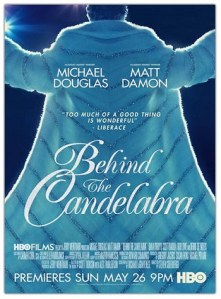
Behind The Candelabra may be a relatively low key film for Soderbergh to bow out on, but it is consumate filmmaking nonetheless and fully advocates Liberace's motto that "too much of a good thing is wonderful".

Behind The Candelabra may be a relatively low key film for Soderbergh to bow out on, but it is consumate filmmaking nonetheless and fully advocates Liberace’s motto that “too much of a good thing is wonderful”.

Despite starring Michael Douglas and Matt Damon and featuring Steven Soderbergh behind he camera for what is supposedly his final film, the Hollywood studio system shamed itself by refusing to back Behind The Candelabra for being ‘too gay’.

In the end, it took HBO to fund the picture and remind those who had forgotten that we’re living in the 21st century. This meant the movie only saw the light of day in America via the cable TV giant, a bittersweet irony considering it played in competition at this year’s Cannes Film Festival and made it into cinemas outside of the States.

'Mr Showmanship' Liberace (Michael Douglas) in action in Behind the Candelabra

‘Mr Showmanship’ Liberace (Michael Douglas) in action in Behind the Candelabra

Best known for overtly masculine roles in the likes of Basic Instinct, Wall Street and Fatal Attraction, Douglas plays seriously against type as Walter ‘Lee’ Liberace, the world-famous pianist extraordinaire who became the highest-paid entertainer on the planet and the epitome of Las Vegas excess.

Behind The Candelabra chronicles the last 10 years of Liberace’s life, focussing in particular on the covert affair he had with the much younger Scott Thorson (Damon), on whose eponymous memoir the film is based. An animal trainer for movies, Scott is introduced to Liberace through Bob Black (Scott Bakula), a Hollywood producer who he meets in a gay bar. Scott is dazzled by Liberace’s piano skills, while Lee is instantly taken with the handsome younger man.

Liberace (Michael Douglas) tells Scott (Matt Damon) how he feels in Behind the Candelabra

Liberace (Michael Douglas) tells Scott (Matt Damon) how he feels in Behind the Candelabra

While’s Liberace’s carefully managed public persona portrays him as being straight, in real life he and Scott become lovers and behind the candelabra embark on a passionate relationship that takes a turn for the surreal before finally ending up in acrimony.

The slightly fuzzy lens reflects the affection Soderbergh clearly has with his subject matter. There are similarities to Paul Thomas Anderson’s Boogie Nights, both in the late 70s and early 80s setting and Damon’s beautifully observed portrayal of Thorson, whose journey from eager-to-please greenhorn to a hurt and embittered shadow of his former self calls to mind Mark Wahlberg’s Dirk Diggler.

Scott Thorson (Matt Damon) all dolled-up in Behind the Candelabra

Scott Thorson (Matt Damon) all dolled-up in Behind the Candelabra

When the story takes a painful turn, Soderbergh is careful not to trade in black and whites and place the blame on any one person’s doorstep. Liberace and Scott are essentially two sides of the same coin, both lonely and desperate to be loved. In Scott’s case this stems from his time as a foster child, in Lee’s it’s from his mother Frances (played by Debbie Reynolds), whom he feels stiffled by. In a telling scene, Frances wins the jackpot on a slot machine she’s playing in Lee’s home, but no money comes out. Lee offers her whatever money he can find, but she refuses and demands a cheque instead.

Being two such lonely souls looking for companionship, it’s of little surprise their relationship is so intense, although things start to get very odd when Lee brings in plastic surgeon Dr Jack Startz (Rob Lowe) to perform some off-kilter work on Scott.

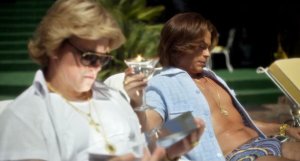
Scott (Matt Damon) and half-baked plastic surgeon Dr Jack Startz (Rob Lowe) in Behind the Candelabra

Scott (Matt Damon) and half-baked plastic surgeon Dr Jack Startz (Rob Lowe) in Behind the Candelabra

Watching Behind The Candelabra, it’s remarkable to think no-one publicly questioned Liberace’s sexuality when he minced about on stage in all manner of camp and ostentatious costumes because it naturally formed part of his self-styled ‘Mr Showmanship’ image. Even Scott looks taken aback when, after watching Liberace on stage for the first time and suggesting to Bob “it’s funny the crowd would like something this gay”, Bob tells him: “They have no idea he’s gay.”

A scene that's probably 'too gay' for the studios in Behind the Candelabra

A scene that’s probably ‘too gay’ for the studios in Behind the Candelabra

Although ironically one of Soderbergh’s least flashy films considerig the subject matter, he still includes a number of clever touches, not least of which when a surly Scott is eating a meal while Lee is flirting with a group of younger men which subtly parallels a scene earlier in the film when Lee’s piano protegé Billy (Cheyenne Jackson) is sat in the same seat dourly eating food while Lee is first chatting to Scott. It’s a nicely observed moment of how disposable things are in Liberace’s world.

While Damon is superb, Douglas is just as good, showing a pain behind the eyes and the showman’s smile that looks decades old. He tells Scott he wants to be his “father, brother, lover and best friend”, but doesn’t know how to be any of them. Lowe, meanwhile, is hilarious as the half-baked nip/tuck doc who’s hardly the greatest advert for plastic surgery.

Behind The Candelabra may be a relatively low key film for Soderbergh to bow out on, but it is consumate filmmaking nonetheless and fully advocates Liberace’s motto that “too much of a good thing is wonderful”.

Review – Man Of Steel

The superhero’s superhero is back, but not as we’ve seen him before, in Zack Snyder’s earnest origin story that strives to put the king-daddy of comic books back on his throne.

There's enough in Man Of Steel to promise much for future adventures, but let's hope there's more fun next time around

There’s enough in Man Of Steel to promise much for future adventures, but let’s hope there’s more fun next time around

While his ability to leap tall buildings in a single bound and run faster than a speeding locomotive naturally lend themselves to incredible set pieces, Superman as a character has always been tricky to build a movie around. His intrinsic capacity for good is far less dramatic than the dark, brooding of Batman, for instance, or the cocksure machismo of Iron Man.

Jor-El (Russell Crowe) prepares to sending his son away from a dying Krypton in Man Of Steel

Jor-El (Russell Crowe) prepares to send his son away from a dying Krypton in Man Of Steel

Uninspiring action sequences, a lacklustre plot and an over-extended running time sank Supes’ last cinematic outing, 2006’s Superman Returns, so the challenge was on to rediscover the magic of 1978’s Superman and make him relevant to a modern day audience.

The news that Man Of Steel would be ‘A Zack Snyder Film’ was hardly a great start. Since his highly watchable 2004 remake of Dawn Of The Dead, the quality of Snyder’s output has diminished further with each new release, to the extent that his most recent film, 2011’s Sucker Punch was virtually unwatchable.

Clark Kent flashbacks to his childhood in Man of Steel's best moments

Clark Kent flashbacks to his childhood in Man of Steel’s best moments

Although the presence of Batman alumnus Christopher Nolan and David S Goyer as, respectively, producer and screenwriter can be felt, there’s no mistaking this is a Snyder movie, which means stylised violence delivered at an ear-bleeding volume.

Taking the character back to his roots, Man Of Steel begins at the moment of his birth on a dying Krypton. His father Jor-El (Russell Crowe) and mother Lara (Ayelet Zurer) manage to launch the spacecraft carrying Kal-El before maniacal rebel General Zod (Michael Shannan) is able to get his hands on the child. Crash-landing on Earth, he’s raised by honest-to-goodness farmers Jonathan and Martha Kent (Kevin Costner and Diane Lane), who name him Clark. When Clark starts to develop super-human powers, his alien lineage is revealed to him by his father, who warns of the need to keep his abilities a secret for fear that a confused, frightened society would reject him. However, when Zod and his followers arrive years later demanding that Earth surrender Kal-El or suffer the consequences, Clark must finally embrace his Kryptonian ancestry and become the superman he was destined to be.

Jonathan Kent (Kevin Costner) consoles a confused Clark in Man Of Steel

Jonathan Kent (Kevin Costner) consoles a confused Clark in Man Of Steel

While the dark and serious approach taken by Nolan for his Dark Knight trilogy works for a superhero who lives in the shadows, the similar direction Man Of Steel takes doesn’t make much sense. Tossing words around like “edgy” and “realistic” is all well and good, but when you’re dealing with god-like alien beings beating the hell out of each other and laying waste to half of Metropolis (and killing thousands of faceless people in the process, although this doesn’t seem important) on a scale not seen since the The Matrix Revolutions, “realistic” is stretching it somewhat.

Taken on their own merits, the childhood flashbacks Clark has during his Christ-like wandering phase in the film’s first act are the film’s finest moments. Handsomely filmed, these scenes are richly evocative and beautifully played by Costner and Lane. Indeed, the brief, wordless moment when a young Clark plays with the family dog and wears a makeshift red cape is Man Of Steel‘s high watermark.

Intrepid Daily Planet reporter Lois Lane (Amy Adams) in Man Of Steel

Intrepid Daily Planet reporter Lois Lane (Amy Adams) in Man Of Steel

A typically restrained Michael Shannan as General Zod in Man Of Steel

A typically restrained Michael Shannon as General Zod in Man Of Steel

However, they look like they belong in another film when Snyder switches into default mode and lets the CGI do the talking. While there was a palpable sense of jeopardy for Iron Man and co during Avengers Assembled‘s extended final battle in New York, here the only thing you feel is a sore backside.

In his big break, Henry Cavill does everything that’s asked of him, from brooding lonerism to conflicted turmoil and finally self-assurance that falls on the right side of smug. He’s no Christopher Reeve, but then who is? Anyone aware of Shannon’s turns in the likes of Take Shelter and HBO’s Boardwalk Empire may wonder like me how much CGI was actually required to show Zod’s heat vision, so intense are Shannon’s eyes anyway. It’s hardly a stretch, but it’s fun nonetheless to watch him deliver Zod’s semi-regular meltdowns.

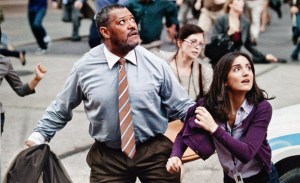
Daily Planet editor Perry White (Laurence Fishburne) and his staff take shelter in Man Of Steel

Daily Planet editor Perry White (Laurence Fishburne) and his staff take shelter in Man Of Steel

Although she starts out well as feisty reporter Lois Lane, Amy Adams struggles with a script that runs out of things for her to do. Laurence Fishburne, meanwhile, dons his Morpheus hat for a spot of sermonising as Daily Planet editor Perry White and Crowe at least gets to run around more than Marlon Brando.

Superman (Henry Cavill) at one with the suit in Man of Steel

Superman (Henry Cavill) at one with the suit in Man of Steel

Hans Zimmer’s score may indulge the Christ motif a little strongly at times (there’s only so many angels you need to hear), but is otherwise stirring and haunting in all the right places and doesn’t make you pine for Jerry Goldsmith’s iconic composition.

Snyder drops in a few nice touches to prepare the ground for the inevitable sequel (a Lexcorp lorry is overturned during the Superman vs Zod melee, suggesting Mr Luthor is being primed) and one can only hope it makes room for a bit more fun next time around.

It’s ironic that a film featuring a character gradually finding himself should lose its way as it goes on. There’s enough here to promise much for future adventures, but this man of steel still has a long way to fly if he hopes to reclaim his crown.

Trailers, Or The Art Of Spoiling A Movie

The hype machine is now as much a part of the fabric of a big budget tent pole movie as the director, cast, special effects and, more often than not, the script.

The relentless drip, drip marketing campaigns for such pictures generally kick off months ahead of release before reaching a crescendo of wall-to-wall promotional blitz targeted at winding audiences up into a collective frenzy of well coordinated anticipation.

The trailered-to-death Man of Steel

The trailered-to-death Man of Steel

One of the oldest, but still most reliably effective weapons in a studio’s armoury is the trailer. Once upon a time, a film got by with just the one trailer to sell itself to the masses. However, as the campaigns for blockbusters have got longer, the number of trailers produced has in turn increased, to the extent that Zack Snyder’s reboot of the Superman franchise Man Of Steel managed a whopping five trailers (not forgetting the numerous teasers and TV spots etc) prior to its release.

When so many trailers are produced for a single film, with each one focussing on a slightly different plot or character aspect, the chances of giving away way too much to the audience are pretty high. Even films that have just one or two trailers are now cut in such a way that you feel like you’re watching the entire movie, or at the very least the best action scenes or the most amusing gags (stand up Fast & Furious 6 and The Hangover Part III).

Just as damaging are the trailers that idiotically give away major plot points, thus spoiling the experience of watching the film. In the right hands, a trailer shows you just enough to whet your appetite for the main feature.

In the wrong hands, trailers such as the ones below can end up ruining a movie before you’ve paid for a ticket.

Warning: The following trailers give away the entire film

The Negotiator (1998)

Probably one of the very worst offenders in Hollywood history, the trailer for this decent action thriller featuring Samuel L Jackson as a hostage negotiator turned hostage taker who only wants to talk to fellow negotiator Kevin Spacey ended up totally ruining the movie when a critical plot point was senselessly revealed at the end. To make matters worse, the offending spoiler-filled line of dialogue spoken by Spacey in the trailer didn’t even make the final cut of the movie!

Carrie (1976)

It seems whoever put together the trailer for Brian De Palma’s horror classic assumed everyone in the world had read the Stephen King book on which the film is based, as absolutely every plot point is crammed in. It may not have revealed the very final shot, but that’s about the only surprise that was spared.

Cast Away (2000)

Robert Zemeckis’ survival drama about an Average Joe stranded on a deserted island remains one of the director’s very best films and sees Tom Hanks at the top of his game, but do we really need the entire plot layed out before us in a single trailer? Anyone in any doubt as to Chuck Noland’s fate need only watch the trailer to realise everything’s been helpfully spelt out for you.

Terminator: Salvation (2009)

The fourth installment in the Terminator franchise managed the double-whammy of being not only uninspiring, but also ruined by its spoiler-tastic trailer. Sam Worthington’s role as Marcus Wright is just as integral to the film as Christian Bale’s resistance leader John Connor, so it was only right to have featured him prominently in the trailer. What wasn’t as smart was the decision to spoon feed us a key character development involving Marcus that pretty much ruined the whole movie.

The Island (2005)

There just had to be a Michael Bay movie somewhere on this list, and while this Philip K Dick-esque dystopian sci-fi is far from his worst, whatever twists the film has are well and truly blown by the trailer. Impressively, it not only gives away the film’s central conceit in one swift line of dialogue by Steve Buscemi, it goes on to ruin another key moment involving Ewan McGregor’s Lincoln Six Echo in between the explosions, chases and leering shots of Scarlett Johansson. Way to go.

Quarantine (2008)

Anyone who watched the far superior Spanish language horror film REC will know exactly how this slavish American remake turns out, but to the uninitiated a semblance of surprise would have been nice. Instead, the trailer serves up all the grisliest details in true bloodthirsty fashion and can’t even resist chucking in the climatic shot, just to make sure there are no surprises.

Those are some of my picks for the worst movie trailers. What are the trailers that most annoy you?