Review – Alan Partridge: Alpha Papa

One of the greatest comedy creations to come out of East Anglia becomes an accidental hero of typically Partridgidian proportions in this long-awaited big screen outing for Norwich’s premier mid-morning ‘D-Jock’.
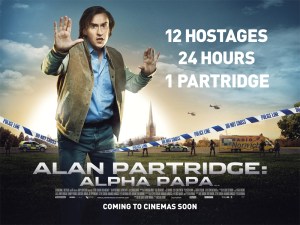
Alan Partridge Alpha Papa Poster

More Dog Day Mid-Morning than Dog Day Afternoon, Alan Partridge: Alpha Papa is effortlessly funny and a genuine triumph. Back of the net!

Like Corn Flakes or bakes beans, Steve Coogan’s most beloved comic persona has remained an enduring constant in a world of change since he first popped up on Radio 4’s On The Hour more than 20 years ago.
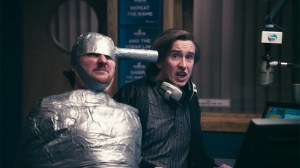
Alan (Steve Coogan) and Sidekick Simon (Tim Key) are forced to stay on air in Alan Partridge: Alpha Papa

Alan (Steve Coogan) and Sidekick Simon (Tim Key) are forced to stay on air (well, not so much ‘forced’ in Alan’s case) in Alan Partridge: Alpha Papa

His egomaniacal ambition may still be intact, but the cold, hard reality for ruddy Alan Partridge is that his fall from grace has been pretty epic since his heyday as a BBC talk show host. And yet, just as Alan seems to be scraping the bottom of the broadcasting barrel as one half of the Mid Morning Matters show on North Norfolk Digital, he’s unwittingly offered a chance of career redemption thanks to disgruntled former colleague Pat Farrell (Colm Meaney).
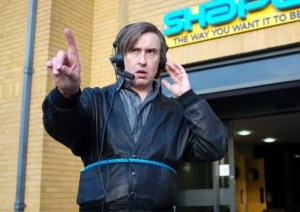
The pathetic, petty and lonely Alan (Steve Coogan) in Alan Partridge: Alpha Papa

The pathetic, petty and lonely Alan (Steve Coogan) in Alan Partridge: Alpha Papa

North Norfolk Digital’s faceless new owners have renamed the station Shape and sacked Pat, who goes off the deep end and holds the station’s staff hostage. The only person he’ll talk to is Alan, whose initial reticence and terror gives way to shameless opportunism when he’s branded the face of the siege by the national media.
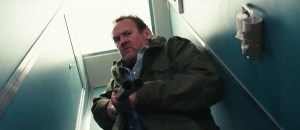
Disgruntled ex-DJ Pat Farrell (Colm Meaney) in Alan Partridge: Alpha Papa

Disgruntled ex-DJ Pat Farrell (Colm Meaney) in Alan Partridge: Alpha Papa

Wisely deciding against the lazy old chestnut of relocating a TV show abroad in an attempt to generate some fish-out-of-water chortles, Coogan and co instead remove Alan from his comfort zone while still basing the action in his native Norwich.

Having played him on and off for more than two decades, Coogan slips comfortably into the leather jacket of Alan, a petty, pathetic, lonely and selfish excuse for a human being who you can’t help warming to in spite of yourself.
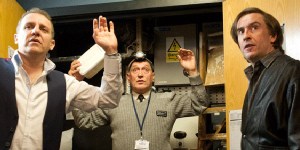
Alan Partridge Alpha Papa

New station boss Jason Cresswell (Nigel Lindsay), Geordie security guard Michael (Simon Greenall) and ruddy Alan (Steve Coogan) in Alan Partridge: Alpha Papa

The opening credits sequence in which Alan fervently mimes along to Roachford’s Cuddly Toy while sat behind the wheel (and not forgetting to point out to another driver that her fog lamps are mistakenly on) is an inspired moment of physical comedy that perfectly encapsulates Partridge. Likewise, a later scene sees him furiously flicking through dozens of TV channels to find any mention of himself in a pitiable attempt to impress station employee Angela (Monica Dolan). Director Declan Lowney’s camera lingers on Alan’s face as the desperation creeps into his eyes when he starts to think his little stunt may have backfired.

Alan's long-suffering assistant Lynn (Felicity Montagu) in Alan Partridge: Alpha Papa

Alan’s long-suffering assistant Lynn (Felicity Montagu) in Alan Partridge: Alpha Papa

Since the character’s earliest  radioappearance, the writing by Coogan, Armando Iannucci and numerous others has been as critical to the lasting success of Partridge as Coogan’s inimitable portrayal. There have been a multitude of memorable one-liners and vignettes over the years and Alpha Papa maintains the hit rate. The moment when Alan justifies a panic attack he suffered in a car wash, blaming “a perfect storm of no sleep, no wife and angry brushes whirring towards me” is just one of many quotable lines that will have you chuckling along.
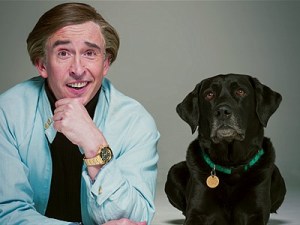
Alan (Steve Coogan) and best friend in Alan Partridge: Alpha Papa

Alan (Steve Coogan) and best friend in Alan Partridge: Alpha Papa

One of the film’s strengths is the time it spends fleshing out the sizeable supporting cast. Tragic DJ Dave Clifton’s (Phil Cornwell) stereotypically upbeat radio voice can’t disguise his near-suicidal ramblings, while Simon Greenall makes a welcome return as simple-minded Geordie Michael, whose lunchbox instigates the film’s crassest joke. Felicity Montagu delivers a lovely performance as Alan’s long-suffering assistant Lynn and comedian Tim Key also impresses, finding a depth to his role as Alan’s bemused sidekick Simon.

With so many comedies having failed this year to raise a titter, the ease with which Alpha Papa has you laughing out loud is testament to the fantastic writing and deft performances.

More Dog Day Mid-Morning than Dog Day Afternoon, Alan Partridge: Alpha Papa is effortlessly funny and a genuine triumph. Back of the net!

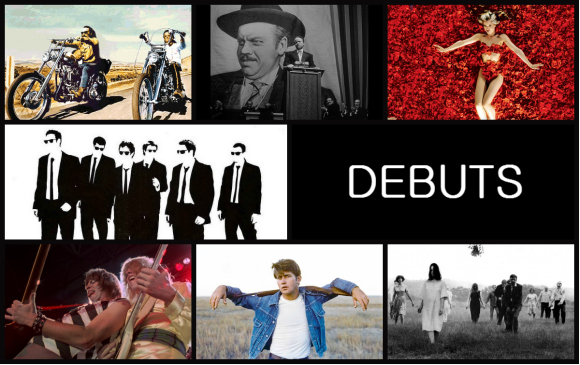
Blogathon Announcement – ‘Debuts’

Debuts Banner

Calling all bloggers! Myself and the stupendous Terry Malloy’s Pigeon Coop are jointly hosting our first blogathon … and we want you to join us!

Speaking for myself, a blogathon is something I’ve wanted to get off the ground for a long time and I’m delighted to be working with the critical heavyweight Chris Thomson – aka Terry Malloy’s Pigeon Coop – to finally host one.

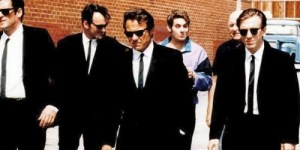
Quentin Tarantino's Reservoir Dogs

Quentin Tarantino’s Reservoir Dogs

The ‘Debuts’ blogathon will, as the name implies, focus on directors’ first features (shorts not included), whether that be some little known work no-one’s heard of or a breakthrough piece that catapulted them to stardom. All directors, be they legends of the silver screen or plain old also-rans start somewhere and it’s fascinating looking back at a director’s first film to see how their work has matured, improved or steadily declined over subsequent features.

Orson Welles' Citizen Kane

Orson Welles’ Citizen Kane

And this is, of course, where you come in. Do you have a director whose debut you think deserves to be put in the spotlight? Maybe you’d like to look at Tarantino’s Reservoir Dogs? Or Jean-Luc Godard’s A Bout de Souffle? How about Sam Raimi’s The Evil Dead or Orson Welles’ Citizen Kane?

Chris and I are getting our choices in early – perks of hosting a blogathon. I’m going to be examining Steven Soderbergh’s Sex, Lies, and Videotape, while Chris is focusing on Stanley Kubrick’s Fear & Desire. Aside from those two, the world of directorial debuts is your oyster.

Charles Laughton's The Night of the Hunter

Charles Laughton’s The Night of the Hunter

Is there a movie director whose debut feature you’d like to re-examine? If so, then make sure to contribute! We’re looking to run the blogathon from Monday, September 2, probably for about a week or so. Before you get cracking, however, please drop me an email at threerowsback@gmail.com or email Chris at chris1039@hotmail.com by Sunday, August 25 letting us know who you’d like to write about (just so we don’t get duplicate posts) or for more info.

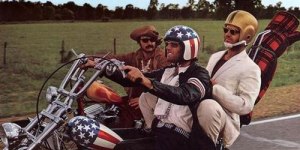
Dennis Hopper's Easy Rider

Dennis Hopper’s Easy Rider

We’ll stick out a few reminders over the coming weeks, but as we may well put a cap on the number of entries, we advise that you get in early to avoid disappointment (ours as much as yours).

We’re looking forward to receiving your posts for what we’re hoping will be a diverse and fascinating blogathon. Thanks for reading and we hope to hear from you soon! Most importantly, though, GET INVOLVED!

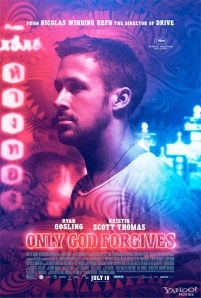
Review – Only God Forgives

Rarely has a film divided critical opinion in recent years as much as Nicolas Winding Refn’s ultra-violent, religiously symbolic and uncompromising journey into hell.

A bleak nightmare, Nicolas Winding Refn's Only God Forgives doesn't so much enter the void as dives headlong into it

A bleak nightmare, Nicolas Winding Refn’s Only God Forgives doesn’t so much enter the void as dive headlong into it

Following the surprising success of Refn’s man-with-no-name neo-noir Drive, he’s reteamed with star Ryan Gosling, relocated to Thailand and revved up the experimentalism in Only God Forgives.

Although Refn has connected his latest to Drive,  alluding to the fact they both exist in a heightened reality, it actually bears a closer kinship to his lesser-seen 2009 work Valhalla Rising. With its brutal acts of violence, minimalist style, and preponderance for mood over dialogue, the two films share a lot in common.

The ghost-like Angel of Vengeance Chang (Vithaya Pansringarm) in Only God Forgives

The ghost-like Angel of Vengeance Chang (Vithaya Pansringarm) in Only God Forgives

Critics rounded on the film at its Cannes premiere earlier this year, possibly out of confusion that Refn and Gosling hadn’t given them Drive 2,  but those who balk at the director’s use of violence and stripped-back approach (most notably his fascination with silence) forget these are the qualities that he’s built his career on. His Pusher trilogy, Bronson and Valhalla Rising are all stylistic works punctuated by moments of shocking ferocity.

Julian (Gosling) is an expat living in Bangkok whose boxing club is a front for an industrial-scale drug operation. When his brother murders a prostitute and is himself killed out of vengeance, the monosyllabic Julian must not only contend with his domineering and contemptuous mother Crystal (Kristin Scott Thomas), but also samurai sword-wielding cop Chang (Vithaya Pansringarm).

Julian (Ryan Gosling) on hisslow descent in Only God Forgives

Julian (Ryan Gosling) on his slow descent in Only God Forgives

If Drive was a pared-down story of heroism akin to a dream, Only God Forgives is its mirror image, a bleak nightmare whose self-loathing lead character is waiting to embrace his own damnation with open arms.

Crystal (Kristin Scott Thomas), a modern-day Lady Macbeth in Only God Forgives

Crystal (Kristin Scott Thomas), a modern-day Lady Macbeth in Only God Forgives

Indeed, arms feature regularly in the film, be they stretched out with hands open to represent helplessness and a plea for forgiveness, or with clenched fists to show rage and repression. Refn also attaches an Old Testament religious symbolism to these shots wherein Julian is welcoming punishment for his past misdeeds.

This theological inflection is as present as the hellish crimson lighting Refn drenches over many of the scenes. Corridors are given an extra menace, while the empty nightclub in which Julian meets Chang is a barely concealed metaphor for hell’s anteroom.

Crystal (Kristin Scott Thomas) gets gangster Bryon (Byron Gibson) on side in Only God Forgives

Crystal (Kristin Scott Thomas) gets gangster Bryon (Byron Gibson) on side in Only God Forgives

As well as being a cop, Chang exudes a supernatural force. Somehow able to produce his samurai sword as if it’s attached to his spine, Chang is referred to as the Angel of Vengeance. During filming, Refn apparently whispered into Pansringarm’s ear that “you’re God”. If he is God, he’s more of the Old Testament kind, the sort who has the power of forgiveness but doesn’t intend on showing any.

Mai (Rhatha Phongam) and Julian (Ryan Gosling) in Only God Forgives

Mai (Rhatha Phongam) and Julian (Ryan Gosling) in Only God Forgives

Thomas is deliciously repellant as Crystal, a modern day Lady Macbeth consumed by a thirst for revenge at the death of her son and a weirdly incestuous love/hate relationship with Julian. When Julian points out that his brother raped and killed a 16-year-old girl, she replies: “I’m sure he had his reasons.”

Pansringarm is eerily non-expressive as the ghost-like Chang, who seems conjured up from Julian’s tortured subconscious. With only 17 lines of dialogue in the while film, Gosling delivers a tightly coiled performance that deviates between submissive catatonia to moments of explosive rage. He has some of the most expressive eyes in modern cinema which can emote pained puppy dog one second and barely restrained psychosis the next.

Accompanied by Cliff Martinez’s typically excellent score (one that weaves in Eastern influences without ever coming across as rote or lazy), Only God Forgives doesn’t so much enter the void as dive headlong into it.

Once Is Enough

Sometimes once is enough. However great or ‘important’ certain films are, once you’ve watched them you know that you’ll likely never choose to view them again.

There are some films, like DW Griffith’s pioneering 1915 classic The Birth Of A Nation, that any aspiring cinefile needs to have on their ‘to watch’ list, but after viewing all three racist hours of it you’ll probably not want to give it a repeat viewing.

These are just some of the films I’ve really appreciated over the years but have no particular desire to watch again.

Let me know some of your one-timers:

The War Game (1965)

The War Game

Peter Watkins’ trailblazing docu-drama made for the BBC about the devastating effects of a nuclear war on Britain won Best Documentary at the 1966 Academy Awards, but was shelved by a spineless Beeb in light of serious misgivings by Harold Wilson’s Labour government for more than 20 years. An important social document of what would actually happen should a nuclear missile strike that put the ‘duck and cover’ nonsense the people were being told into stark perspective, it’s a terrifying and harrowing experience that I wouldn’t wish to repeat any time soon.

Irréversible (2002)

Irreversible

Just as Christopher Nolan’s Memento had done two years earlier, Gaspar Noé’s notorious Irréversible employs a non-linear structure by starting at the end and working backwards in time to finish at the start. Infamous for its deeply distressing and prolonged rape scene, Noé’s second film also features bursts of stomach-churning violence that led to it becoming a poster boy of the New French Extremity movement alongside the likes of Inside and Martyrs. Noé has always enjoyed pushing buttons (his most recent film Enter The Void is just plain bonkers) and he pushed plenty with this one-timer.

Requiem For A Dream (2000)

Requiem for a Dream

Based on Hubert Selby Jr’s novel of the same name, Darren Aronofsky followed up his acclaimed debut Pi with this numbing account of several characters’ spiralling descent into a vortex of delusional drug addiction. Although Jared Leto’s Harry and Jennifer Connelly’s Marion are put through hell, it’s Ellen Burstyn’s devastating journey into the abyss of amphetamine dependence that proves the film’s real sucker punch. Burstyn’s performance as the pitiful Sara is as traumatic as it is brilliant (Julia Roberts beat her to the Best Actress Oscar for Erin Brockovich; a good performance but not on the same planet as Burstyn), and the final 15 minutes of the film is some of the most gut-wrenching cinema you’ll ever watch.

Salò, or the 120 Days of Sodom (1975)

Salo

Of all the films on this list, Pier Paolo Passolini’s Salò is the one that I know for absolutely certain I won’t be watching again. Based on the Marquis de Sade’s book The 120 Days Of Sodom, Salò follows four corrupt Italian fascists who, following the fall of Mussolini’s tyrannical regime in World War II, kidnap a group of young men and women and subject them to four months of mental, sexual and physical torture, degradation and sadism. Passolini is making political points about how absolute power corrupts absolutely (tellingly the four men represent the church, the political establishment, the aristocracy and the legal system), but the sheer relentless suffering meted out to the men and women is almost beyond belief (the film was banned in several countries). Most certainly not for the squeamish.

Antichrist (2009)

Antichrist

Lars von Trier has long enjoyed a controversial reputation for his films and Antichrist remains possibly his most notorious work to date. Ostensibly about a married couple (Willem Defoe and Charlotte Gainsbourg) retreating to a cabin in the woods to grieve following the sudden death of their child, von Trier shows in extremely graphic detail Gainsbourg’s ‘She’ going completely off the rails and Defoe’s ‘He’ experiencing increasingly bizarre visions. Throw in a talking fox spouting how “chaos reigns” and you have the sort of lunacy which one viewing will suffice. The film’s final 20 minutes involving an act of self-mutilation and a further act of extreme violence is pretty hard to watch once let alone several times.

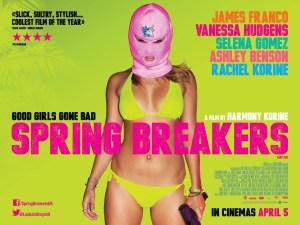
Review – Spring Breakers

The enfant terrible of American arthouse cinema is at it again in this shamelessly controversial witches’ brew of sexploitative teen drama, dreamscape and MTV’s Cribs.

A weird, hallucinatory trip down the trashy corridors of its director's headspace, Spring Breakers is a one-of-a-kind and for that alone it deserves to be seen

A weird, hallucinatory trip down the trashy corridors of its director’s headspace, Spring Breakers is a one-of-a-kind and for that alone it deserves to be seen

Since making his name as the writer of Larry Clark’s headline-grabbing Kids back in 1995, Harmony Korine’s directorial career has crashed, banged and walloped through one two-fingered salute after another, most recently in 2009’s self-explanatory Trash Humpers.

Whilst unmistakably a Korine film, Spring Breakers is his most mainstream and accessible work to date and the first movie of his career to turn a profit.

Candy (Vanessa Hudgens), Brittany (Ashley Benson), Cotty (Rachel Korine) and Faith (Selena Gomez) let their hair down in Spring Breakers

Candy (Vanessa Hudgens), Brittany (Ashley Benson), Cotty (Rachel Korine) and Faith (Selena Gomez) let their hair down in Spring Breakers

Obsessed with ditching college for an epic spring break blowout – but short of cash to do so – Candy (Vanessa Hudgens), Brittany (Ashley Benson) and Cotty (Rachel Korine, wife of Harmony) put on pink balaclavas (bringing to mind the Putin-bashing Russian punk rock band Pussy Riot) and rob a fast food restaurant.

The trio, joined by the God-fearing Faith (Selena Gomez), head down to Florida for drink, drugs and wild beach parties and fall in with the charismatic Alien (James Franco), a self-proclaimed “hustler … a gangster with a heart of gold” who’s engaged in a turf war with Big Arch (rapper Gucci Mane). The craziness become too much for Faith, but for the others this is the chance to enjoy “spring break forever”.

"Spring break foreverrrr" - Alien (James Franco) in Spring Breakers

“Spring break foreverrrr” – Alien (James Franco) in Spring Breakers

Spring Breakers shares a similar sensibility to Sofia Coppola’s The Bling Ring in its unvarnished portrayal of a group of young American teenagers consumed by self-entitlement and dazzled by all things materialistic. Candy and co see it as their right to go on spring break and feel no guilt at robbing the store, indeed they “pretend it’s a video game”.

There’s a certain gratuitousness to Korine’s camerawork, exacerbated by the fact the girls are dressed in flourescent bikinis throughout, but he also often uses harsh lighting to both desexualise them and highlight the ugliness of their characters. The film is shot through with blue and red filters (at one point a friend of Faith’s suggests Candy, Brittany and Cotty have “got demon blood in them” before we see them bathed in red, hellish light), while UV lighting is also used to add an otherworldly nature to the film.

Brittany (Ashley Benson) pretends it's just a video game in Spring Breakers

Brittany (Ashley Benson) pretends it’s just a video game in Spring Breakers

Korine also uses repetition of dialogue to lend Spring Breakers a hallucinatory quality, while the increasingly fantastical narrative supports this notion.

While Candy, Brittany and Cotty are happy living in their own little fantasy worlds, their minds are blown when their encounter Alien, a gold-toothed drug dealer and self-styled personification of the American Dream who at one point tells the girls: “Everyone’s always tellin’ me you gotta change. I’m about stacking change. I’m about making money.”

Candy (Vanessa Hudgens), Brittany (Ashley Benson), Cotty (Rachel Korine) and Faith (Selena Gomez) in trouble in Spring Breakers

Candy (Vanessa Hudgens), Brittany (Ashley Benson), Cotty (Rachel Korine) and Faith (Selena Gomez) in trouble in Spring Breakers

Alien is consumerism personified – his flashy car has hub caps with dollar signs on them, while his mantra “look at my shit!” is repeated ad infinitum while proudly pointing out all the stuff he owns. He also shows off his guns and love of Scarface (“I got Scarface on re-peat; I got it on constantly!”) as if he’s trying to convince not just the girls of his gangster credentials but himself too.

James Franco plays larger-than-life gangsta Alien in Spring Breakers

James Franco plays larger-than-life gangsta Alien in Spring Breakers

Franco brings just the right balance of humour, pathos, arrogance and fear to the larger-than-life Alien and he’s without doubt Spring Breakers‘ star turn. Hudgens and  Benson are also impressive as the vacuous college girls blinded by self-delusional platitudes about the spiritual benefits their violent crime spree is providing.

There are moments when the film really hits the mark, not least of which in the oddly sweet (and tongue-in-cheek) moment when Korine intercuts a heartfelt Alien playing Britney Spears’ Everytime on his piano to the balaclava-clad girls with footage of them breaking peoples’ faces and robbing them of their stuff. The scene plays as a clever mirror image to a scene earlier in the film when the girls happily sing Spears’ Baby One More Time.

A weird, hallucinatory trip down the trashy corridors of its director’s headspace, Spring Breakers is a one-of-a-kind and for that alone it deserves to be seen.