Debuts Blogathon: Steven Soderbergh – Sex, Lies And Videotape (1989)
Debuts Blogathon

It’s the final day of the Debuts Blogathon; and what a great Blogathon it’s been. When we first proposed the idea; Chris and I never guessed we’d get such a brilliant response. The diversity and quality of the entries we’ve received has been what’s made this such a fun feature to put together. I’ve learned a lot and look forward to revisiting some old classics and adding others to my watch list. I hope you have to. Thanks so much to Chris at Terry Malloy’s Pigeon Coop for being my partner on this venture; I couldn’t have put this together without him. Thanks also to all the brilliant contributors whose insightful and passionate entries have made this Blogathon so great. Finally, thanks to everyone who’s taken the time to follow the Blogathon; I hope you’ve enjoyed it as much as I have. Here we go, the last entry and it’s my take on Steven Soderbergh’s debut Sex, Lies And Videotape.

Steven Soderbergh

Sex, Lies And Videotape (1989)

Stepping up to accept the Palme d’Or at the 1989 Cannes Film Festival for his debut feature Sex, Lies And Videotape – at 26, the youngest director ever to do so – a bewildered Steven Soderbergh was heard to say: “Well, I guess it’s all downhill from here.”
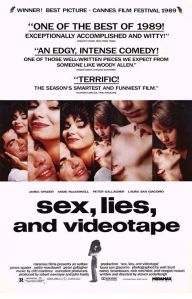
Sex, Lies and Videotape PosterThe weight of such an achievement could easily ruin a career, but not Soderbergh. Since that heady day on the French Riviera, he’s made some clangers, but some inspired, important works of cinema too and, as he (supposedly) folds up his director’s chair for good he can reflect on a filmography many others would give their right arm for.

Written in eight days and filmed for a budget of $1.2m, Sex, Lies And Videotape has been credited with helping to usher in the explosion of the new American independent film movement of the 1990s. The film was distributed by Miramax and made almost $25m at the box office. Suddenly, indies were no longer the preserve of the arthouse crowd; they were for everyone.

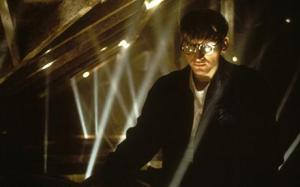
Sex, Lies and VideotapeThe title of the film helped to turn heads, of course. One might almost think it was a working title as it’s so self-explanatory. The plot is equally straightforward – unhappy, sexually uptight housewife Ann (Andie MacDowell) is married to conceited lawyer John (Peter Gallagher), who’s having an affair with Ann’s extroverted sister Cynthia (Laura San Giacomo). The cat is thrown among the pigeons with the arrival of John’s old school friend, the shy, eccentric Graham (James Spader), whose only cure for impotence is to watch back videotaped interviews he’s carried out with women talking about their sexual experiences.
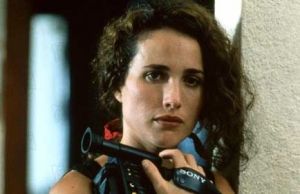
Sex, Lies and VideotapeIn lesser hands such a premise could be a recipe for exploitative disaster, but what lifts Sex, Lies And Videotape into the realms of great cinema are two things – the script and performances.

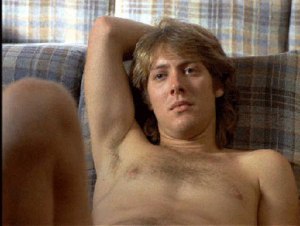
Soderbergh lives up to the frankness of the title with raw, unflinching dialogue that fizzes and crackles when spoken by the superb cast. MacDowell was never better as the prissy Ann, who talks about First World problems to her shrink and is seemingly destined to allow John to walk over her until she’s woken out of her stupor by Graham. Gallagher and Giancomo (an actress who’s deserved a brighter career) are both great, but it’s Spader who really stands out. His big breakthrough, Spader took Best Actor at Cannes alongside Soderbergh’s triumph and it’s easy to see why; the emotional honesty and depth he brings to the repressed Graham is startling.
Sex, Lies and VideotapeAs the title implies, at its dark, chastened heart this is a film about deception. In one nicely observed moment, as John is rearranging a business meeting to be with Cynthia, the camera slowly moves pulls a 180° until it comes to rest on a picture sitting on his desk of a smiling Ann. Soderbergh makes the point more cleverly by running one scene into the next while still having the end of a conversation play out over the new scene. These conversations invariably undercut what we’re watching and underline the lies these characters trade in without fear of being exposed.

Sex, Lies and VideotapeDeception (and self-deception) is a theme Soderbergh has returned to time and again throughout his oeuvre. His Ocean’s trilogy features characters who deceive for a living; the eponymous Erin Brockovich tries to expose corporate secrets that have led to the residents of a small town suffering chronic medical problems; the lies spoken by those in and around the drug trade are explored in Traffic; George Clooney’s psychologist/astronaut chooses to believe in a lie in Solaris; Matt Damon’s whistleblower employee gets a taste of his own medicine in The Informant! and Liberace (Michael Douglas) keeps his homosexuality under wraps in Behind The Candelabra.

Sex, Lies and VideotapeIn an interview, Soderbergh spoke of his fascination with deception: “I’m fascinated by lying, If you walk around all day every day, telling the truth about every situation you encountered, to everyone you encountered, someone will eventually kill you. It’s just a matter of where the line is for you in lying.”

If Soderbergh is anything he’s reliably unreliable when it comes to his output. After Sex, Lies And Videotape, he suffered a fallow period commercially, making curios like the noirish The Underneath (1995) and Schizopolis (1996), which made peanuts. It wasn’t until 1998’s Out Of Sight that he got noticed by the wider world again, a film that paved the way for his style-over-substance Ocean’s trilogy. In between he veered between the brilliant (Traffic (2000), which deservedly bagged him a Best Director Oscar; the hugely underrated Solaris (2002); his two-part 2008 biopic of Che) and the not-so-good (2006’s The Good German; The Girlfriend Experience (2009), which starred porn actress Sasha Grey). For every glossy studio picture there’s been a low-budget project, broadly described as a ‘one for them, one for me’ approach.

Sex, Lies and VideotapeMuch like Tarantino, music is extremely important in Soderbergh’s films. While QT prefers the jukebox approach of adopting pre-recorded music, Soderbergh uses musical score, supplied in many of his films by composer par excellence Cliff Martinez. Martinez’s score for Sex, Lies And Videotape (his debut score) is one of the film’s great strengths; it’s experimental, ‘indie’ aesthetic fits the film like a glove and created a trend that many scores aped over the following decade.

In a lot of ways, Graham is Soderbergh, a man with a movie camera looking for some kind of truth. Graham eventually destroys his camera, which Soderbergh has done (metaphorically speaking at least) by turning his back on filmmaking out of disillusionment with a Hollywood system that could fire him from the Brad Pitt-starring Moneyball a week before the cameras started to roll.

Any time away from the camera for this most gifted and adventurous of filmmakers is our loss. The promise he showed with Sex, Lies And Videotape almost 25 years ago has been realised enough times to make us wish for it once more.

Over at Terry Malloy’s Pigeon Coop, Chris delivers his brilliant assessment of Stanley Kubrick’s 1953 debut Fear And Desire. To read the other entries in the Blogathon, click here.

Debuts Blogathon: Danny Boyle – Shallow Grave (1994)

Debuts Blogathon

It’s the penultimate day of the Debuts Blogathon, hosted by myself and Chris at Terry Malloy’s Pigeon Coop, and today Chris and I will be featuring the same review of Danny Boyle’s first feature Shallow Grave by Shah from Blank Page Beatdown. Shah’s great looking site examines trailers and features interesting reviews of new and recent releases from around the world, including some great Bollywood stuff. He also runs a section called Random Rants that, as the title suggests, sees Shah riffing about what’s currently setting the internet alight. Do make a point to check out his great site.

Danny Boyle

Shallow Grave (1994)

Danny Boyle’s body of work is pretty varied and diverse; he is one of the few directors whom I cannot label a hack. Quentin Tarantino is a hack; Guy Ritchie is a hack; J. J. Abrams is a hack.

Shallow Grave PosterI don’t mean this as an insult; those guys are some of my favorite directors, I just mean that most directors’ films will have some clear indications of the fact that it is their brand of cinema. This could be through style of cinematography (Tim Burton), similar subject matter and content (Tarantino), or unique technical execution, such as a plethora of lens flares (Abrams) that will clearly identify the director of the movie. The complete opposite is true of Danny Boyle.

Boyle is probably the only director whose movies reveal nothing of the man behind the camera, as no two movie are alike in theme, tone, style or even genre. From zombie apocalypses, to Bollywood extravaganzas, to drug induced piles of awesome, there is nothing that Danny Boyle cannot direct, apparently.

Shallow GraveThe Debuts Blogathon, started by Chris over at Terry’s Malloy’s Pigeon Coop and Mark from Three Rows Back, has allowed me a chance to visit Boyle’s debut as a feature film director in Shallow Grave and compare it against his now famous repertoire of film. Even though Trainspotting launched Boyle (and others) into cult fanatic status, Shallow Grave is where he started his path of originality and has stayed true to it ever since.

Shallow GraveShallow Grave is an easy story that goes places and requires little explanation. Three friends have to come to grips with the death of a new roommate, while being transformed due to the discovery of a suitcase full of money with the body. It’s never explained who the man was, or why he had the money; it doesn’t matter.

Shallow Grave stars Ewan McGregor in his first leading role as the jester with a heart of stone. Along with him is Christopher Eccleston, better known as (one of many) Dr Who, who is amazing as a soft-spoken bookish man, who’s traumatised by his experiences during the story. Eccleston steals the show, in my opinion, in  a performance with great range and depth.

Shallow GraveI say it’s an easy movie because the usual sequence of events don’t take place. There aren’t long drawn out moral conundrums about what to do with the money, or how to dispose of the dead body; they just do it and move on. What’s more interesting is the slow and steady transformation of mild-mannered David played by Eccleston. The brutal actions he takes part in, almost compelled to do so by his so-called friends, changes him dramatically. The movie focuses on the bonds of friendship when tested under unusual circumstances and challenged by greed and selfishness.

Shallow GraveWhile being his most mediocre film, it’s not difficult to see how this is Boyle’s first film. The ‘wow factor’ isn’t really present until the third act in terms of the story. Boyle’s usual aesthetics seem amateurish, with topsy-turvy camera work, even though it works for the story being told in this particular movie and is similar to how the rawness of the camerawork worked for a story like 28 Days Later. The Brit chemistry is on full display between the three main characters; just like Trainspotting, but to a lesser extent.

Shallow GraveLike most Boyle films, Shallow Grave does go deeper than what it gives you at face value. It goes to darker places while invoking emotion that bring you to the edge of the seat, at least in the final 10 minutes. The journey of the characters within the story follows the darkness exhibited by the lead in Boyle’s The Beach; however, nowhere near as extreme. The one thing consistent with Boyle’s other movies is the downward spiral the characters take throughout the film, and especially near the end, with intense consequences.

Boyle has become one of my favorite directors despite, or in spite of, his completely out-of-the-box style of filmmaking and interests. Every Boyle movie looks nothing like the last Boyle movie, which I think is more challenging than creating a trademark style evident in all of one’s films. Shallow Grave marked the beginning of an acclaimed career and it’s not difficult to see in this film how the talent behind the camera got more creative and stylistic over the years.

Tomorrow, the Debuts Blogathon reaches its conclusion with my thoughts of Steven Soderbergh’s Palme d’Or-winning Sex, Lies And Videotape, while Chris over at Terry Malloy’s Pigeon Coop will be examining Stanley Kubrick’s 1953 debut Fear And Desire. It’s been a fun ride, so please don’t miss the end!

Debuts Blogathon: Andrew Dominik – Chopper (2000)

Terry Malloy's Pigeon Coop's avatarTerry Malloy's Pigeon Coop

debuts collage 2

We’re nearing the end of the Debuts Blogathon, but both Mark and I still have a few pieces left for you and today’s comes from Dave over at ccpopculture with his look at Andrew Dominik’s Chopper. Dave’s blog is a reasonably new one to me but I’ve really enjoyed what I’ve read; definitely worth checking out. Take it away Dave…

ANDREW DOMINIK

Chopper (2000)

Chopper, the directorial debut of New Zealand-born Australian director Andrew Dominik, is a study in contrasts and contradictions. Mark “Chopper” Read, the real Australian crim from whom the film takes its name, is a complex character, simultaneously fascinating and horrifying. The film’s script is penned by Dominik but based heavily on Read’s own best-selling memoirs, which were omnipresent in Australia bookstores throughout the ‘90s, and it refuses to celebrate or denigrate the man’s violent history. It opens with the disclaimer, “This film is a dramatization…

View original post 1,148 more words

Debuts Blogathon: Quentin Tarantino – Reservoir Dogs (1992)

Debuts Blogathon

As the Debuts Blogathon, hosted by myself and Chris at Terry Malloy’s Pigeon Coop, nears its end, we’ve saved one of the very best till last. Tyson from Head in a Vice is covering the one and only Reservoir Dogs, Quentin Tarantino’s hugely influential 1992 debut. Tyson was the first movie blogger to follow me and I’ve followed his posts ever since. His site is a real one-of-a-kind, providing entertaining reviews of genre fare, as well as his long-term Project: De Niro to watch and review all of Bobby’s films and his popular Desert Island Films feature (I promise to sort mine out soon!). Simply put, this is a fantastic site you really need to be following.

Quentin Tarantino

Reservoir Dogs (1992)

When Chris and Mark posted about this project, I immediately knew I could only do it if I could grab Quentin Tarantino’s debut Reservoir Dogs.

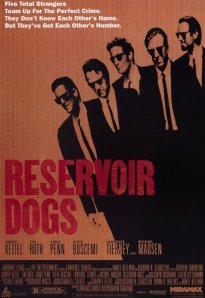
Reservoir Dogs PosterFor my money, it’s the greatest directorial debut and the man has continued to inspire and make incredible movies in his uncompromising style. Luckily, I was quick off the mark and the boys gave me this movie to talk about. Now I have it, I’m here to offer my thoughts on the film, Tarantino himself and the lasting effects Reservoir Dogs has had on cinema.

Reservoir DogsWhat can I say about Reservoir Dogs that hasn’t already been said a million times, by people much more respectable than me? Not a lot, but I’ll throw some stuff out here anyway. For those that don’t know, the plot goes a little something like this: a diamond heist goes bad and the thieves are left to pick up the pieces back at their warehouse headquarters, all the while suspecting that a traitor in their midst sabotaged the operation.

Tarantino’s style can be seen immediately in the opening scene, and it showcases what most people associate Tarantino with – dialogue. The conversations his characters have in all his movies, I mean, you can tell a Tarantino film just by tuning in to a conversation. The smallest, most subtle things take on so much meaning and for me no one writes like this man. I didn’t see the film on its release (as I was 10-years-old), but I can imagine people watching it and wondering who the hell this Quentin Tarantino guy was; writing, directing and acting in his debut movie.

Reservoir DogsThen the opening scene kicks in and we are listening to some guys talking about random things like tipping and the subtext of Madonna’s Like a Virgin song. It just holds your attention, then the guys leave; the suave crew walking out of the diner in slow motion, set to the George Baker Selection’s super cool Little Green Bag. Wow. You’re just hooked, and here we are over 20 years later, the effect has not diminished at all.

Reservoir DogsI love how within this opening scene, where the issue of tipping the waitress comes up and Mr Pink’s refusal to tip, sets into action a discussion that not only tells us all we need to know about these characters, but even foreshadows the events of the film. Mr Pink won’t tip, showing he mostly cares only about himself (I’ll be honest, his argument is solid and I hate tipping). Mr White believes the waitress works hard and deserves a tip, which shows despite being a criminal he cares for people, which is what leads him to be so blindly trusting with regards to Mr Orange. Mr Blonde offers to shoot Mr Pink for a joke, foreshadowing his sociopathic tendencies. Mr Orange tells Joe that Mr Pink refused to tip, playing the part of a rat, which he is. Joe pressures Mr Pink to tip and he does, showing Mr Pink is ultimately a coward. All that is gleaned from an argument about a tip. That is great writing, and a standard which he has continued throughout his career.

Reservoir DogsIt’s a heist movie where we never actually see the heist. People always assume it’s a horrendously violent film, yet apart from the police torture scene – the camera even cuts away from the ear slicing – it really isn’t that violent. Most of it is set in a warehouse, with a small cast. Yet I can’t find a bad thing about it. Everything from the dialogue, to the cast and the music is not only perfect, but something which is synonymous with all of Tarantino’s films. He finds random music in Japanese clothing stores. He takes washed up actors and gives them the part of a lifetime. But mostly he just does what the hell he wants, when he wants.

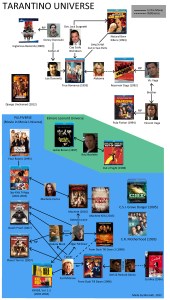
Reservoir DogsAs a fan, the one thing I think I love more than anything else Tarantino-wise is that all the characters from his films are alive and real to him. They all play out in his head, and by doing so he has created an intricate, instantly recognisable movie universe – one which boasts a family tree of miscreants that overlap between movies in weird and wonderful ways. This chart shows the links, and it just emphasises the detail and thought that goes into everything he writes.

Reservoir DogsThese connections – however subtle they may be – bear little effect, if any, on the plots of Tarantino’s movies. Instead, they’re like Easter Eggs that reward observant onlookers: in-jokes that might mean nothing to us, but mean the world to their creator. Even in his early work, Tarantino was building his own giant playground, in which not only his individual movies co-exist, but their characters’ paths cross and intersect behind the scenes.

I could go on and on about it, but I’m merely scratching the surface. Ultimately Reservoir Dogs is a work of genius by a debut director and a film that, while he may have bettered in my opinion with Pulp Fiction, will easily stand the test of time. I’m hungry, let’s get a taco.

Over at Terry Malloy’s Pigeon Coop, Dave from ccpopculture provides a piece on New Zealand-born director Andrew Dominik’s 2000 debut Chopper. Head over to Chris’s site now by clicking here.

Tomorrow is the penultimate post in the Blogathon and comes courtesy of Shah from Blank Page Beatdown with his piece on Danny Boyle’s Shallow Grave. Don’t miss it!

Debuts Blogathon: Sam Mendes – American Beauty (1999)

Terry Malloy's Pigeon Coop's avatarTerry Malloy's Pigeon Coop

Today’s post on the Debuts Blogathon, hosted by myself and Three Rows Back, comes from Nika at The Running Reel with a superb look At Sam Mendes’s excellent American Beauty. I urge everyone to head over and give Nika’s blog a read; there’s some great reviews and features well worth checking out. Take it away Nika…

SAM MENDES

American Beauty (1999)

I cannot imagine any talk about directing debuts without even mentioning Sam Mendes’s 5 Oscar winner picture American Beauty. Considering everything I am going to discuss in my post, none of the directors have ever had such a high standard debut as Mendes had.

American Beauty looks at average life of average American family, their aspiration to happiness, their failure to actually be happy and the way how it ends.

Lester Burnham (Kevin Spacey) is a father to a troubled teenage daughter Jane (Thora Birch) and a…

View original post 721 more words