Review – The Grand Budapest Hotel

The idiosyncratic Wes Anderson conjures up his latest magical microcosm in this sumptuously designed feast for the senses.

When Wes Anderson is good he's very, very good and with The Grand Budapest Hotel he's at the top of his game. It's is an absolute delight

When Wes Anderson is good he’s very, very good and with The Grand Budapest Hotel he’s at the top of his game. It’s an absolute delight

One could compare Anderson’s career to that of a sculptor meticulously chiseling away at a piece of rock and removing all of the rough edges until what’s left is a thing of beauty.

His 1996 debut Bottle Rocket was an uneven work with enough flashes of Anderson’s unique visual style to mark him out as one to watch. His following two films, the resplendent Rushmore (1998) and superior The Royal Tenenbaums (2001) marked the end of a highly impressive first phase.
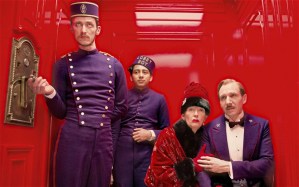
M. Gustave H. (Raplph Fiennes) comforts the elderly Madame D. (Tilda Swinton) in The Grand Budapest Hotel

M. Gustave H. (Ralph Fiennes) comforts the elderly Madame D. (Tilda Swinton) in The Grand Budapest Hotel

Phase two was more difficult, with The Life Aquatic With Steve Zissou (2004) and The Darjeeling Limited (2006) failing to strike the same chord. However, since 2009’s Fantastic Mr. Fox, the balance of whimsy, eccentricity and maturity he failed to achieve in his previous two films was finally stuck, with this third phase in Anderson’s oeuvre also producing the lovely Moonrise Kingdom (2012) and now this charming confection (actually his second ‘hotel’ picture following the 2007 short Hotel Chevalier).

The film begins with an unnamed author (Tom Wilkinson) recollecting the time he spent as a younger man (played by Jude Law) at the Grand Budapest Hotel, where he encountered its reclusive owner Zero Moustafa (F. Murray Abraham). Over dinner, Zero tells the extraordinary story of how, as a young man in the 1930s, he came to inherit one of Europe’s most lavish hotels from M. Gustave (Ralph Fiennes), who at the time was its suave and sophisticated concierge. They strike up a warm friendship after Gustave is framed for the murder of his octogenarian lover Madame D. (Tilda Swinton) and must prove not only his innocence but also uncover the real culprits.
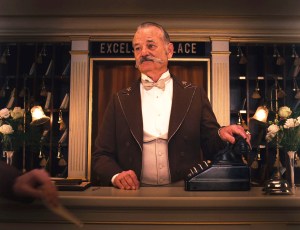
The one and only Bill Murray plays hotel concierge M. Ivan in The Grand Budapest Hotel

The one and only Bill Murray plays hotel concierge M. Ivan in The Grand Budapest Hotel

Anderson’s love of early cinema, present in Bottle Rocket with its nod to Edwin S Porter’s landmark 1903 picture The Great Train Robbery, can be found here in the wonderful old school effects shots that bring to mind pioneering genius Georges Méliès. Likewise, the film’s deadpan physical comedy inevitably brings to mind such early masters of the form as Chaplin and Keaton.

M. Gustave H. (Raplh Fiennes) confronts the dastardly Dmitri Desgoffe-und-Taxis (Adrieb Brody) and his henchman J.G. Jopling (Willem Dafoe) in The Grand Budapest Hotel

M. Gustave H. (Ralph Fiennes) confronts the dastardly Dmitri Desgoffe-und-Taxis (Adrien Brody) and his henchman J.G. Jopling (Willem Dafoe) in The Grand Budapest Hotel

His trademark mise en scène is also taken to the nth degree in The Grand Budapest Hotel, with its beautifully crafted and crisp tracking shots, zooms and back and forth camera shots so meticulously constructed as to make Stanley Kubrick proud.

In spite of being a marvel of precise technical mastery, the film is rich with memorable characters, each brought vividly to life by a splendid cast. Fiennes, in his first collaboration with Anderson, is a marvel and gives a beautifully measured turn that’s equal parts farcical, steely eyed and kind. He’s matched by Tony Revolori, whose portrayal of the loyal and determined young Zero sits perfectly next to his partner-in-crime Gustave.

Zero Moustafa (Tony Revolori) and his beau Agatha (Saoirse Ronan) in The Grand Budapest Hotel

Zero Moustafa (Tony Revolori) and his beau Agatha (Saoirse Ronan) in The Grand Budapest Hotel

The supporting cast, many giving extended cameos, all stand out due to the care and attention given to each of their characters. Willem Dafoe’s henchman J.G. Jopling looks like a cross between Nosferatu and Frankenstein’s monster, while Jeff Goldblum gives a typically terrific turn as the unfortunate Deputy Kovacs and Saoirse Ronan is sweet as Zero’s love interest Agatha. Let’s not forget Bill Murray, of course, who makes a quick impression as fellow hotel concierge M. Ivan.

These warm performances are matched by Anderson’s dialogue that, while maintaining the zippiness of his previous films, is also imbued with a generosity and affection that radiates when uttered by such a gifted cast.

When Wes Anderson is good he’s very, very good and with The Grand Budapest Hotel he’s at the top of his game. It’s an absolute delight.

Review – 300: Rise Of An Empire

Beware Greeks bearing swords, especially when they’re as testosterone-fuelled as the cast of this gleefully gory festival of brutal CGI-baked bloodletting.

300: Rise Of An Empire makes no apologies for itself and asks little of its audience other than to wallow in its tidal wave of blood and entrails. If you're after anything else you'd best look elsewhere

300: Rise Of An Empire makes no apologies for itself and asks little of its audience other than to wallow in its tidal wave of blood and entrails. If you’re after anything else you’d best look elsewhere

Comic books have provided a rich vein of material for filmmakers over the years, although the explosion of big budget movies involving Batman, Superman, Iron Man and Thor et al in recent times has reached near epidemic levels.

Alongside the big names of the Marvel and DC universes that have gone before the cameras are equally beloved titles, most notably from the pen and pencil of the revered Frank Miller. In 2005, a collection of Miller’s hugely acclaimed Sin City stories was directed by Robert Rodriguez and Miller himself (with a helping hand from Quentin Tarantino) and was noteworthy for being one of the first fully digital live action films.

The starting point - sort of - of 300: Rise Of An Empire

The starting point – sort of – of 300: Rise Of An Empire

It made the film look, for all intents and purposes, like a live action graphic novel and a similar visual approach was adopted by Zack Snyder for his 2006 adaptation of Miller’s 300, in which King Leonidas (Gerard Butler) leads his 300 Spartans into battle against the vastly superior forces of the invading Persian armies, led by the ‘God King’ Xerxes.

That film’s enormous success has inevitably led to 300: Rise Of An Empire that, while not directed by Snyder, might as well have been judging by its identical style. If anything, director Noam Murro has gone even further, throwing in curious tricks like the incessant and distracting floating dust that permeates nearly every frame.

War!! 'God-King' Xerxes (Rodrigo Santoro) rallies the Persians in 300: Rise Of An Empire

War!! ‘God-King’ Xerxes (Rodrigo Santoro) rallies the Persians in 300: Rise Of An Empire

This follow-up is a sequel of sorts, taking place before, during and after the fateful Battle of Thermopylae that was the centrepiece of 300. Sizeable chunks of the film are given over to exposition-heavy narration which establishes how the events of 300 came to pass. At the Battle of Marathon, Xerxes (Rodrigo Santoro) witnesses his father Darius’ death at the hands of Greek General Themistocles (Sullivan Stapleton) and is goaded into annihilating the Greeks by Darius’ bloodthirsty naval commander Artemisia (Eva Green).

Artemisia has her own reasons for wanting the Greeks to be wiped out and leads the entire Persian navy into war against the Greek fleet, led by Themistocles. Although vastly outnumbered the Greeks fight on, not only for their families, but also for their way of life.

Heroic Greek leader Themistocles (Sullivan Stapleton) in 300: Rise Of An Empire

Heroic Greek leader Themistocles (Sullivan Stapleton) in 300: Rise Of An Empire

By sticking so slavishly to 300‘s super-stylised visual palette, Rise Of An Empire loses a lot of its forebear’s impact, but that’s not to say the film doesn’t water the eyes with a series of shamelessly over-the-top battle scenes.

Set on  water for large chunks, the film does an effective job of showing large-scale naval warfare, while the swordplay is even more brutal than its predecessor, with limbs being lopped off and CGI blood spraying around so readily it beats you into submission.

The vengeful Artemesia (Eva Green) in 300: Rise Of An Empire

The vengeful Artemesia (Eva Green) in 300: Rise Of An Empire

Anyone looking for depth will find none here (Snyder co-wrote the script, which should tell you all you need to know), but then this is 300: Rise Of An Empire we’re talking about here and anyone who watched 300 will know what to expect.

The acting is of secondary importance; Stapleton is no Butler (not a phrase I thought I’d ever use), but Green deserves credit for giving a performance of such scenery chewing madness you’d be forgiven for thinking she’d been let out on day release. This isn’t a film that does anything by half and that also goes for the comically absurd sex scene involving Artemisia and Themistocles – illustrated by the glance exchanged by two guards stood outside.

300: Rise Of An Empire makes no apologies for itself and asks little of its audience other than to wallow in its tidal wave of blood and entrails. If you’re after anything else you’d best look elsewhere.

Review – Nebraska

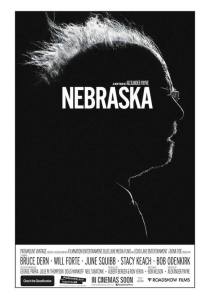
The desperate search for fulfillment that so preoccupies the leading men of Alexander Payne’s films finds its zenith in this beautifully crafted elegy to small town America.

Tragic and melancholy; funny and touching, Nebraska is another triumph from one of cinema's most richly distinctive voices

Tragic and melancholy; funny and touching, Nebraska is another triumph from one of cinema’s most richly distinctive voices

A corrosive thread of sadness and frustration connects Matthew Broderick’s high school teacher in Election (1999), Jack Nicholson’s retired widower in About Schmidt (2002), Paul Giamatti’s wannabe novelist and wine obsessive in Sideways (2004) and George Clooney’s Hawaii-based attorney in The Descendants (2011).

Life has worn each of them down, but not as much as Woody Grant (Bruce Dern), the grizzled geriatric at the centre of Payne’s bittersweet and understated sixth feature Nebraska.

Father and son, Woody (Bruce Dern) and David (Will Forte) hit the road in Nebraska

Father and son, Woody (Bruce Dern) and David (Will Forte) hit the road in Nebraska

We’re first introduced to Woody as he’s shuffling along the highway – as lost and enigmatic a figure as Paris, Texas‘ Travis Henderson. The reason for his wanderings reveals itself when he explains to his son David (Will Forte) that he was on his way to Lincoln, Nebraska, to collect a $1m sweepstake prize he has supposedly won.

Against his better judgement, David agrees to drive his father to Lincoln despite knowing the letter he received is almost certainly a scam. Their trip takes them through Hawthorne, Woody’s dead-end home town, where they visit relatives and bump into his old business partner Ed (Stacey Keach), before being joined by Woody’s outspoken wife Kate (June Squibb) and David’s brother Ross (Bob Odenkirk).

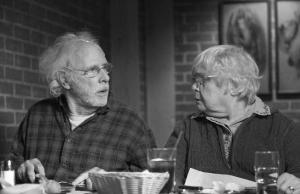
Woody (Bruce Dern) and Kate (June Squibb) squabble in Nebraska

Woody (Bruce Dern) and Kate (June Squibb) squabble in Nebraska

Following the fine tradition of the road movie, an emotional journey is taken alongside the physical one as the wall of ice that has built up around Woody and David begins to thaw and the son begins to understand and come to terms with the father.

The film may be gloriously shot by Payne’s longtime DP Phedon Papamichael in magnificent monochrome, but that’s the only thing black and white about Nebraska.

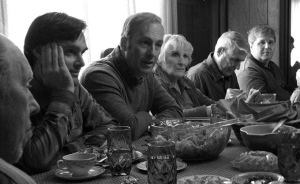
Family time for David (Will Forte) and brother Ross (Bill Odenkirk) in Nebraska

Family time for David (Will Forte) and brother Ross (Bill Odenkirk) in Nebraska

Payne’s blacky comic script doesn’t pull any punches and makes subtle observations about self-entitlement and the quiet desperation many of us feel for something to go our way.

Asked what he would do with the $1m, Woody shrugs his shoulders and can only think of buying a new truck and an air compressor. In spite of having a limited shopping list, what really motivates Woody is the thought of finally having something substantial that’s his and no-one else’s.

The quietly desperate Woody (Bruce Dern) in Nebraska

The quietly desperate Woody (Bruce Dern) in Nebraska

When Woody lets slip his impending payday while in Hawthorne, he becomes an overnight local celebrity; a development he appears both confused and quietly pleased about. While many are genuinely pleased for Woody, others, Ed in particular, try to pressure him into making good on old debts he’s supposedly accrued.

It’s a rich and nuanced performance from Dern, easily the best he has given for many, many years. Woody isn’t a terribly likeable character, but he’s all-too-human. We, along with David, discover what a flawed man he is through the many mistakes he’s made over the course of a long life; but equally we get a sense of the terrible childhood he must have endured and the scars left by war that carved him into the man he has become.

Like father, like son... David (Will Forte) in Nebraska

Like father, like son… David (Will Forte) in Nebraska

David sees the road trip as a chance to finally get to know his father. Certain home truths are tough to hear; most notably Woody’s matter-of-fact explanation that love “never came up” when it came to marriage to Kate and that they had kids because he “liked to screw”. David is also more alike to his father than he would care to admit; both are stubborn and lead unfulfilled lives.

A veteran of Saturday Night Live, Forte navigates the demands of a dramatic role with ease and plays wonderfully off Dern. The looks of mild confusion and annoyance he shoots at Woody are nicely counterbalanced later in the film by the pride and childlike love he displays.

Payne has a natural skill in handling actors and also helps to bring out great performances from Keach, Odenkirk and Squibb, who gets to let her hair down (and lift her skirt up, but we won’t go into that) with a wonderfully written role.

Tragic and melancholy; funny and touching, Nebraska is another triumph from one of cinema’s most richly distinctive voices.

Review – Killer Joe

Some directors mellow in their old age; not so William Friedkin, as his grisly and grimy take on Tracy Letts’ grand slice of southern gothic Guignol shows.

Killer Joe certainly isn't to everyone's tastes, but for those who enjoy their movies trashy it's finger lickin' good

Killer Joe certainly isn’t to everyone’s tastes, but for those who enjoy their movies trashy it’s finger lickin’ good

Friedkin’s controversy-baiting style has won him an army of devotees and led to a back catalogue that many filmmakers would sell their soul for. The French Connection (1971) and The Exorcist (1973) have rightly earned their place in cinema’s Valhalla, while pictures like Sorcerer (1977), Cruising (1980) and To Live And Die In LA (1985) may be lesser known, but are equally absorbing.

He made a welcome return to horror in his disturbing 2007 adaptation of Letts’ suffocating play Bug and collaborated again with the celebrated playwright four years later for what, according to the poster, is “a totally twisted deep fried Texas redneck trailer park murder story”.

Dumb Chris (Emile Hirsch) makes a play too far in Killer Joe

Dumb Chris (Emile Hirsch) makes a play too far in Killer Joe

The film centres around the Smith clan, a less-than-functional trailer trash brood who make the family from The Texas Chainsaw Massacre look sweet in comparison. Chris (Emile Hirsch) is a drug dealer who’s got himself into debt with the wrong people and, with the help of his simple-minded dad Ansel (Thomas Haden Church), makes a pact with the devil in the shape of Mephistophelean hitman-cop Joe Cooper (Matthew McConaughey) to murder his mother and collect on the life insurance.

Dottie (Juno Temple) takes her retribution in Killer Joe

Dottie (Juno Temple) takes her retribution in Killer Joe

Chris is unable to provide a down-payment to the dark and mysterious Joe, who decides instead to take a retainer in the form of Chris’ childlike sister Dottie (Juno Temple) until the cash is forthcoming.

Friedkin has never been one to shy away from down and dirty filmmaking and is at his most gleefully scuzzy here in what’s effectively a good old-fashioned exploitation B-movie. There’s something of the 1980s here, especially in the montage of close-ups as we’re introduced to Joe, who’s such a badass even the chained-up psycho dog sat outside the family trailer goes quiet when he strolls past.

'Angel of death' Joe Cooper (Matthew McConaughey) in Killer Joe

‘Angel of death’ Joe Cooper (Matthew McConaughey) in Killer Joe

Furthermore, a pretty good clue of what to expect comes early on when the first sign we get of Chris’ loathsome stepmother Sharla (Gina Gershon) is of her naked from the waist down. Subtle it ain’t.

The film’s blackly comic tone adds fuel to the argument that Friedkin is mocking the characters; the only one who seems remotely redeemable is Dottie, although you’re left with the sneaking suspicion she knows more than she’s letting on.

Redneck Ansel (Thomas Haden Church) and trailer trash wife Sharla (Gina Gershon) in Killer Joe

Redneck Ansel (Thomas Haden Church) and trailer trash wife Sharla (Gina Gershon) in Killer Joe

Killer Joe has been likened to a fairytale, with Dottie as the princess looking for her Prince Charming and Joe the wolf at the door, yet no-one emerges from this particular tale with a happy ending. The Smiths’ murderous greed and back-stabbing comes back to bite them hard as the evil they’ve invited into their home arrives for its pound of flesh in the film’s closing scenes, most notoriously involving a fried chicken drumstick.

The film is held together by McConaughey’s shark-eyed turn as Joe, who glides around like some Stetson-wearing angel of death and remains unnervingly calm until his thirst for violence takes over.

Killer Joe certainly isn’t to everyone’s tastes, but for those who enjoy their movies trashy it’s finger lickin’ good.

Great Films You Need To See – Red Rock West (1993)

This is my latest contribution to The Big Picture, the internationally-recognised magazine and website that offers an intelligent take on cinema, focussing on how film affects our lives. This piece about John Dahl’s 1993 western neo noir thriller Red Rock West was written as part of The Big Picture’s Lost Classics strand, although I am including it within my list of Great Films You Need To See.

Cinema’s dustbin is littered with movies that disappeared between the cracks or didn’t fit neatly into any easy-to-sell marketing category.

Watched now, more than 20 years on, Red Rock West has barely aged a day and deserves its place alongside the likes of the Coens’ Blood Simple as one of cinema’s most ingenious neo-noirs

Watched now, more than 20 years on, Red Rock West has barely aged a day and deserves its place alongside the likes of the Coens’ Blood Simple as one of cinema’s most ingenious neo-noirs

It’s a fate that befell the criminally underseen Red Rock West, John Dahl’s sophomore feature that, according to the late Roger Ebert, “exists sneakily between a western and a thriller, between a film noir and a black comedy”.

The film is worth seeing for the cast alone. Nicolas Cage gives one of his most hangdog turns as Michael Williams, an ordinary Joe on the road to nowhere who rolls into dead-end Red Rock and is immediately mistaken for “Lyle from Dallas” by bar owner Wayne Brown (J.T. Walsh).

Michael Williams (Nicolas Cage) fools bar owner Wayne Brown (J.T. Walsh) he's "Lyle from Dallas" in Red Rock West

Michael Williams (Nicolas Cage) fools bar owner Wayne Brown (J.T. Walsh) he’s “Lyle from Dallas” in Red Rock West

Down on his luck, Michael keeps his mouth shut when he accepts $5,000 by Wayne to kill his wife Suzanne (Lara Flynn Boyle). He’s then offered double by Suzanne to kill Wayne after telling her about the contract. The plot takes a turn for the perilous with the arrival of the real Lyle (Dennis Hopper), a psychopathic hitman who dresses like he stepped out of a Garth Brooks concert.

Dahl, who co-wrote the script with brother Rick, throws in more twists than a pretzel factory and has a ball in the process. There’s an amusing running joke that sees the exasperated Michael continually trying to leave Red Rock but, like Jim Carrey’s Truman Burbank, is seemingly never able to escape.

Michael (Nicolas Cage) gets himself into hot water with Wayne's wife Suzanne (Lara Flynn Boyle) in Red Rock West

Michael (Nicolas Cage) gets himself into hot water with Wayne’s wife Suzanne (Lara Flynn Boyle) in Red Rock West

There’s more than a little of David Lynch in the film, and not just because three-quarters of the main cast have worked with him. Hopper is in full-on Frank Booth mode, while Boyle exudes the sort of old school matinee seduction she displayed in Twin Peaks.

In a film of meaty performances, the tastiest is given by Walsh (who should have appeared in a Lynch film, but never did). In lesser hands Wayne could have been a stock villain, but Walsh imbues him with a banality that is all the more chilling for being so underplayed.

Dennis Hopper is in full-on Frank Booth mode as Lyle in Red Rock West

Dennis Hopper is in full-on Frank Booth mode as Lyle in Red Rock West

Dahl is one of life’s nearly men. Now predominately a director of high-end cable and network TV shows, his film career never garnered the commercial success it was due in spite of such entertaining fare as The Last Seduction and Rounders, the Matt Damon and Edward Norton joint that helped launch the current poker craze.

Released in the wake of Reservoir Dogs (1992), Red Rock West became a casualty of the rapidly changing landscape of American independent cinema post-Tarantino. Watched now, more than 20 years on, the film has barely aged a day and deserves its place alongside the likes of the Coens’ Blood Simple (1984) as one of cinema’s most ingenious neo-noirs.