Review – Short Term 12

It’s to the immense credit of all concerned that this tale following the lives of the caring staff and troubled teens of a foster care facility manages to bypass the stereotypes and melodrama to deliver a truly affecting piece of cinema.
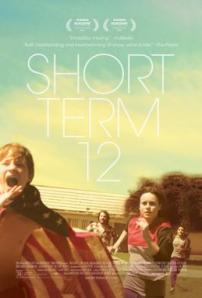
Short Term 12 is a genuine pleasure and should be regarded as a calling card for both its director and exciting young ensemble

Short Term 12 is a genuine pleasure and should be regarded as a calling card for both its director and exciting young ensemble

A hit at last year’s SXSW, the emotional honesty and intelligence of Short Term 12 is as refreshing as it is rare; as is its ability to break free of the style-over-substance shackles that so often tie down indie movies.

A big reason for this is the cast, led by Brie Larson in a breakout performance as Grace, a supervisor at the titular halfway house whose concern for its neglected kids is so strong that it can prove overpowering, especially when it comes to the facility’s newest addition Jayden (Kaitlyn Dever).
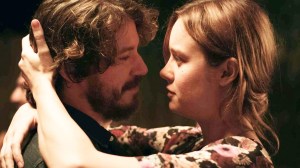
Garce (Brie Larson) and Mason (John Gallagher Jr) in Short Term 12

Garce (Brie Larson) and Mason (John Gallagher Jr) in Short Term 12

Grace sees a lot of herself in Jayden, an angry and confused teenager struggling to deal with circumstances forced upon her. The film draws parallels between the two (they look so alike they could be sisters) and just as Grace finds that she’s getting through to the trouble youth, the demons of her past creep to the surface and threaten her relationship with boyfriend and co-worker Mason (John Gallagher Jr).

Short Term 12 is ultimately about our inherent desire and fear of bonding and trusting each other. Marcus (Keith Stanfield, giving an excellent performance) is about to turn 18 and, as a result, must leave the facility. The fear of facing the outside world and giving up the connections he has made in order to form new ones is written on his face and explicit in his self-destructive actions. When he performs a rap he’s created to Mason, the pain Marcus feels is etched into each word, but so is the strength that opening up gives him.

Grace (Brie Larson) tries to connect with Marcus (Keith Stanfield) in Short Term 12

Grace (Brie Larson) tries to connect with Marcus (Keith Stanfield) in Short Term 12

These are kids who have been deprived of care and attention and struggle to adapt when it is offered. Sometimes small tokens, such as a cupcake, are enough. More often than not, these kids just need someone they can relate to.

In much the same way as Jaws‘  Brody, Hooper and Quint, a shared moment comparing scars (in this case caused by self-harm) generates a connection between Grace and Jayden and offers a moment of realisation that neither need be alone to face the pain they hold within.

Mason (John Gallagher Jr) and Nate (Rami Malek) try to calm down tearaway teen Jayden (Kaitlyn Dever) in Short Term 12

Mason (John Gallagher Jr) and Nate (Rami Malek) try to calm down tear away teen Jayden (Kaitlyn Dever) in Short Term 12

The bond between Grace and Mason is affectionately handled and given an honest edge by the two performers. Mason clearly loves Grace, but is frustrated she won’t fully open up to him, while a shock development in Grace’s life threatens to tip their relationship over the edge.

Writer-director Destin Daniel Cretton never ventures into Dangerous Minds cod-inspirationalism or been-there-seen-it grittiness (handheld camerawork aside); rather he earns the affection we feel for each fully rounded major and minor character and lets the story play out.

Short Term 12 is a genuine pleasure and should be regarded as a calling card for both its director and exciting young ensemble.

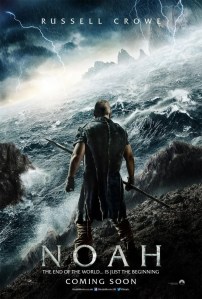
Review – Noah

Bonkers, bizarre and brilliant in equal measure, it’s fair to say there won’t be another film quite like Darren Aronofsky’s Noah this – or perhaps any – year.

In an age of identikit blockbusters, Noah should be applauded for having the courage of its convictions to offer an experience you won't soon forget

In an age of identikit blockbusters, Noah should be applauded for having the courage of its convictions to offer an experience you won’t soon forget

The Bible’s many film adaptations have invariably been of the epic variety; overblown ‘event’ movies that are as extravagant as they are huge.

While Noah doesn’t skimp on the computer-generated bombast, it’s also the product of a singular vision – one that both captivates and infuriates.

Throughout his career, Aronofsky’s films have centred on obsessively driven characters; whether they be the cast of Requiem For A Dream (2000) seeking the next fix, Natalie’s Portman’s ballet dancer going to any lengths to reach the top of the pile in Black Swan (2010), or Hugh Jackman’s various incarnations of the same character searching for the tree of life in The Fountain (2006).

The 'Creator' gets angry in Noah

The ‘Creator’ gets angry in Noah

Noah represents his most fanatical character yet – a husband and father whose response to an apocalyptic vision received from ‘the Creator’ is to spend years building a giant ark to save the animal kingdom from the impending flood.

The world Noah (Russell Crowe) and his family inhabit has been ravaged by mankind’s greed and corruption. They eke out a nomadic life away from the rest of humanity in a shattered, lunar landscape (Iceland in reality) ruled by Tubal-Cain (Ray Winstone), descendant of Adam and Eve’s murderous son Cain.

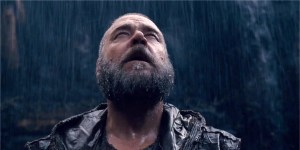
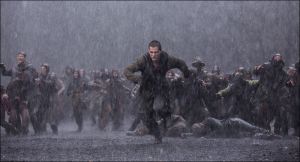
Noah (Russell Crowe) finally feels the rain in Noah

Noah (Russell Crowe) finally feels the rain in Noah

A fearful Tubal-Cain is determined to seize the ark, but must first build an army to overcome the Watchers; crazy-looking fallen angels encrusted in rock who aid Noah in his mammoth task and come across as the craggy cousins of the talking trees from The Lord Of The Rings.

When it finally does come, the flood is impressively staged. The sense of chaotic desperation among Tubal-Cain and his followers to fight their way onto the ark as Noah and the Watchers try to keep them back is both unnerving and edge-of-the-seat stuff. However, the most chilling and indelible image comes later as the last vestiges of mankind cling hopelessly to a rapidly submerging rock, wailing in vain at the nearby ark as Noah blanks out their screams.

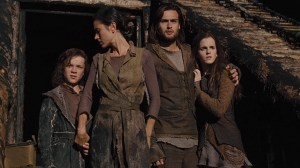
Noah's family, son Japheth (Leo McHugh Carroll), wife Naameh (Jennifer Connelly), son Shem (Douglas Booth) and adopted daughter Ila (Emma Watson) in Noah

Noah’s family, son Japheth (Leo McHugh Carroll), wife Naameh (Jennifer Connelly), son Shem (Douglas Booth) and adopted daughter Ila (Emma Watson) in Noah

It’s a truly nightmarish moment that sets up the film’s final act as an increasingly dogmatic Noah turns his wife Naameh (Jennifer Connelly), sons Shem (Douglas Booth) and Ham (Logan Lerman) and adopted daughter Ila (Emma Watson) against him when he declares his work won’t be finished until the ultimate sacrifice is made.

Just as with The Fountain, Noah is predominately a spiritualist film rather than an overtly religious one (reflective of Aronofsky’s personal beliefs). It also carries an urgent environmental message – as global warming brings with it rising sea levels, scorched earth and dwindling resources, may we too be forced to start again when the proverbial crap hits the fan?

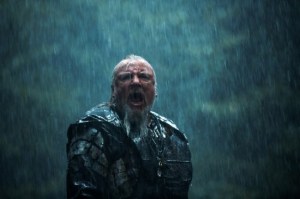
"Take the ark!!" - Tubal-cain (Ray Winstone) gets mad in Noah

“Take the ark!!” – Tubal-cain (Ray Winstone) gets mad in Noah

The film has a curious mix of the fantastical (a strange, dog-like beast being hunted by Tubal-Cain’s men; the Watchers; huge stars shining brightly in the daytime) and the grittily authentic. In spite of the larger-than-life connotations of the source material, Aronofsky never lets us forget these are human beings making stomach-churning decisions.

The anger and bewilderment expressed by Shem and Ham towards their merciless father when the screams of those left outside the ark are heard is entirely believable. At one point, a sickened Shem pleads to Noah to let them in, pointing out that not everyone can be ‘guilty’. Noah’s response is to state that every human has a darkness inside of them, a point given form earlier in the film when Noah sneaks into Tubal-Cain’s sin-laden camp and sees a vision of himself giving into his base instincts in order to survive.

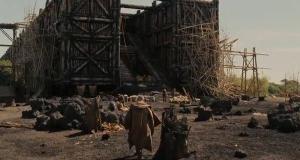
Have ark, will travel - Noah and co prepare for the storm in Noah

Have ark, will travel – Noah and co prepare for the storm in Noah

By staging the flood halfway through the movie, one imagines Aronofsky aimed for the real drama to take place within the confines of the ark. However, rather than being the dramatic cannonball he was hoping for, this final act curiously fails to engage and ends up going off the deep end. Perhaps it’s Noah’s incessant reiteration that everyone must accept their punishment that ultimately proves the biggest turn off.

Whatever misgivings one may have here are counterbalanced by the much talked about ‘creation sequence’, reinterpreted by Aronofsky’s time-lapsed visuals as the journey of evolution from the big bang (“Let there be light”) to man’s inhumanity to man. It’s a bravura scene that’s worth the price of admission alone.

Noah's son Ham (Logan Lerman) runs for his life in Noah

Noah’s son Ham (Logan Lerman) runs for his life in Noah

In his best performance for years, Crowe gives a truly affecting performance of a man being pushed beyond his limits while carrying the weight of the world on his shoulders. While a very physical performer, Crowe does his best work with his eyes by showing the terrible emotional pain he endures in order to carry out the Creator’s work.

Connelly’s Naameh is the crux both we and her family lean on to navigate our way through these turbulent waters and her performance is excellent. Winstone does what he does best as the unhinged Tubal-Cain, who appears to be history’s first Cockney, while an ancient-looking Anthony Hopkins has a twinkle in his eye as Noah’s grandfather Methuselah.

In an age of identikit blockbusters, Noah should be applauded for having the courage of its convictions to offer an experience you won’t soon forget.

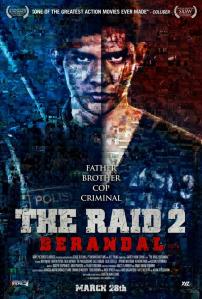
Review – The Raid 2: Berandal

Topping one of the most jaw-dropping action films in years is an unenviable challenge, but Gareth Evans has done just that with this savage and scintillating follow-up.

Evans has indicated a third and final chapter is on the way and for that we should count ourselves lucky - action movies simply do not come any better than this

Evans has indicated a third and final chapter is on the way and for that we should count ourselves lucky – action movies simply do not come any better than this

Evans announced himself in 2012 with The Raid: Redemption, a down-and-dirty Indonesian action flick that breathed new life not only into martial arts movies but action cinema as a whole.

Action is one of cinema’s most universal genres – its language is that of physicality rather than dialogue, which means foreign language pictures such as The Raid franchise often travel more easily and can find a bigger audience.

SWAT member turned undercover officer Rama (Iko Uwais) in The Raid 2

SWAT member turned undercover officer Rama (Iko Uwais) in The Raid 2

At their best, action movies transcend their genre trappings and become ballets of ballistic extreme. The Raid was one such picture, which not only made a name for Evans, but also for its hugely talented star Iko Uwais, who was working as a delivery man when Evans cast him in his cult debut feature Merantau (2009).

The two reunite for The Raid 2: Berandal (“thug” in Indonesian), which expands greatly on the scope of its predecessor and defines itself as an epic in every sense.

The film picks up where The Raid left off, with rookie special forces officer Rama (Uwais) having survived a near-suicidal ambush on a 15-storey tower block in order to take a brutal crime lord into custody. With his family’s lives in danger, he must infiltrate a deadly Jakarta crime syndicate and take down its leaders, as well as the police and politicians in its pocket.

The angry, embittered Uco (Arifin Putra) in The Raid 2

The angry, embittered Uco (Arifin Putra) in The Raid 2

A big reason why The Raid: Redemption worked so well was its confined setting – a single tower block full of bad guys up against Rama and a rag-tag bunch of fellow SWAT officers. From Berendal‘s first crane shot of nasty goings on in a nondescript field out of the city, Evans signals his intentions; the canvas is going to be much bigger this time, although the predominant colour is still going to be red.

The first reel disorientates the viewer by cutting between groups of characters and different time frames, but as the pieces fall into place what emerges is a clever introduction to the world we’re going to inhabit for the next 150 minutes.

Baseball Bat Man (Very Tri Yulisman) and Hammer Girl (Julie Estelle) get ready for some ultraviolence in The Raid 2

Baseball Bat Man (Very Tri Yulisman) and Hammer Girl (Julie Estelle) get ready for some ultraviolence in The Raid 2

Western cinema has long borrowed from the East and vice versa and Evans, a Welsh national living in Indonesia, brings a liberal dose of both styles to The Raid 2.

Uwais channels Bruce Lee’s kick-ass rage and Jackie Chan’s dogged tenacity into his leading man and the imprint of both of these screen legends can be found all over the film. Likewise, the gangland narrative, as unoriginal as it is, brings to mind The Godfather and Beat Takashi; the stylised violence inevitably invites comparisons to John Woo and Sam Peckinpah; while Rama’s infiltration of Bangun’s (Tio Pakusadewo) criminal enterprise nods to Infernal Affairs and its Western remake The Departed.

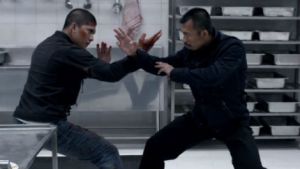
Just one of the jaw-dropping fight scenes in The Raid 2

Just one of the jaw-dropping fight scenes in The Raid 2

The Raid stood out from the competition thanks to its eye-popping fight scenes and Berandal ups the ante even further. A massive scrap early on in a muddy prison yard is an early standout and acts as a bone-snapping promise of what’s to come. An epic car chase/fight is masterfully handled, while the final act as Rama battles his way through increasingly bloodthirsty enemies – including the psychopathic ‘Hammer Girl’ (Julie Estelle, whose appearance is straight out of Kill Bill) and ‘Baseball Bat Man’ (Very Tri Yulisman playing the ultimate killer hoodie) – is as good as it gets. Indeed, the climatic duel between Rama and ‘The Assassin’ (Cecep Arif Rahman) is one of the most exhausting and engrossing fight scenes you’ll ever see.

With such a sizeable cast, it would be easy to lose track of certain characters, but Evans keeps the plates spinning and is rewarded with some effective performances from the likes of Yayan Ruhian as a vagabond assassin (which brings to mind Amores Perros‘ vagrant hitman) and Arifin Putra as Bangun’s impetuous son Uco.

Evans has indicated a third and final chapter is on the way and for that we should count ourselves lucky – action movies simply do not come any better than this.

Review – Captain America: The Winter Soldier

After seriously dropping the hammer with the disappointing Thor: The Dark World, Marvel has got its mojo back with this superheroic espionage thriller that packs a real biff, pow and bang.

Although on paper a two-dimensional relic of 1940s flag-waving propaganda comics, Captain America's onscreen adventures are fast becoming the Marvel movies to look out for

Although on paper a two-dimensional relic of 1940s flag-waving propaganda comics, Captain America’s onscreen adventures are fast becoming the Marvel movies to look out for

On its 2011 release, Captain America: The First Avenger was an unexpected pleasure, skillfully mixing pulpy action and period nostalgia with a World War Two setting that perfectly suited the old school heroics of Captain Steve Rogers (Chris Evans, a great fit for the role).

His appearance alongside Iron Man, Thor et al in Avengers Assemble (as it was called over here) was largely about him trying to come to terms with the modern world and it’s an issue that inevitably permeates through The Winter Soldier.

Steve 'Cap' Rogers (Chris Evans) forms a valuable friendship with fellow veteran Sam Wilson (Anthony Mackie) in Captain America: The Winter Soldier

Steve ‘Cap’ Rogers (Chris Evans) forms a valuable friendship with fellow veteran Sam Wilson (Anthony Mackie) in Captain America: The Winter Soldier

However, screenwriters Christopher Markus and Stephen McFeeley (who also wrote the first movie) deserve a lot of credit for crafting a story that transcends fish-out-of-water narrative tropes and instead gives the character something he can really get his shield stuck into.

While the bad guys he’s fighting this time around aren’t as clear-cut as the uber-Nazis he was battling in The First Avenger, Cap’s inherent goodness and staunch belief in the enduring power of freedom are traits that prove just as necessary in The Winter Soldier.

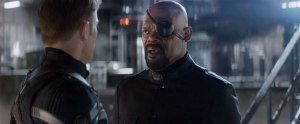
Cap (Chris Evans) expresses his concerns as to the direction S.H.I.E.L.D is taking to Nick Fury (Samuel L Jackson) in Captain America: The Winter Soldier

Cap (Chris Evans) expresses his concerns as to the direction S.H.I.E.L.D is taking to Nick Fury (Samuel L Jackson) in Captain America: The Winter Soldier

Since being thawed out from cryogenic stasis at the end of The First Avenger, Rogers has allied himself with S.H.I.E.L.D, the labyrinthine spy and law-enforcement network led by Nick Fury (Samuel L Jackson, given more to do this time) – but is growing ever-more sceptical about its true motives. Rogers is forced to go on the run from S.H.I.E.L.D after finding himself in the middle of a massive conspiracy and, with the help of deadly assassin Natalia Romanoff, aka Black Widow (Scarlett Johannson, also with more to do this time), and fellow war veteran Sam Wilson (Anthony Mackie, underused) sets about uncovering the truth.

While Thor’s second solo outing got lost in an Asgardian vortex of Dark Elves and cod-Lord Of The Rings nonsense, Cap’s big return has a far more engaging narrative.

Cap (Chris Evans) must work with deadly assassin Natasha Romanoff, aka Black Widow (Scarlett Johannson) in Captain America: The Winter Soldier

Cap (Chris Evans) must work with deadly assassin Natasha Romanoff, aka Black Widow (Scarlett Johannson) in Captain America: The Winter Soldier

The central plot makes no bones about its nods to 1970s conspiracy cinema classics like The Parallax View (1974) and Three Days Of The Condor (1975), right down to the casting of Condor‘s Robert Redford, who effortlessly raises the level of the film every time he’s on screen as senior S.H.I.E.L.D figure Alexander Pierce.

The juxtaposition of Cap’s clearly defined outlook of right and wrong with the murky, compromised ideology of S.H.I.E.L.D is a nice idea and a very contemporary concept, but the film doesn’t trust the audience to work it out for themselves. When he witnesses just how far S.H.I.E.L.D is willing to go to “neutralise threats”, a rattled Rogers tells Fury “This isn’t freedom, this is fear”; to which Fury replies the agency “takes the world as it is, not as we’d like it to be”. The point is made several more times in case we haven’t picked it up.

Nick Fury (Samuel L Jackson) with old buddy and fellow S.H.I.E.L.D colleague Alexander Pierce (Robert Redford) in Captain America: The Winter Soldier

Nick Fury (Samuel L Jackson) with old buddy and fellow S.H.I.E.L.D colleague Alexander Pierce (Robert Redford) in Captain America: The Winter Soldier

In spite of the lack of subtlety, it’s undoubtedly the most interesting element of both this and any other Marvel picture to date, and one you feel directors Anthony and Joe Russo would rather have concentrated on more. This being a superhero movie, however, it’s a prerequisite that things go boom sooner or later.

That being said, an early set piece involving an ambush on Fury’s S.H.I.E.L.D mobile is exhilarating stuff, while a fight involving Rogers and a dozen or so S.H.I.E.L.D goons in a lift gets the pulse racing. It’s when the scale of the action is amped up that the film – especially in the final act – loses its way and turns into just another Marvel movie involving a stack of CGI explosions in the sky.

The mysterious Winter Soldier in Captain America: The Winter Soldier

The mysterious Winter Soldier in Captain America: The Winter Soldier

In spite of being part of the title, we’re given only a brief taste of who and what the Winter Soldier is. It’s a plot thread you suspect had more meat on it during early drafts and is left dangling for Cap’s third solo movie. At 136 minutes, the film is too long anyway, so it’s not surprising this wasn’t developed more.

Although on paper a two-dimensional relic of 1940s flag-waving propaganda comics, Captain America’s onscreen adventures are fast becoming the Marvel movies to look out for.

Four Frames – The Natural (1984)

This is my latest contribution to The Big Picture, the internationally-recognised magazine and website that offers an intelligent take on cinema, focussing on how film affects our lives. This piece is part of the Four Frames section, wherein the importance of four significant shots are discussed, in this case from Barry Levinson’s hagiographic baseball epic The Natural.

Of all the films made about the sport of baseball, plenty have struck out, while only a handful have truly knocked it out of the park. None, however, can compare to The Natural.

It’s unsurprising that a sport so revered by its innumerous followers should provide the backdrop to a picture whose central character is seemingly touched by the divine.

The Natural

Determined to become “the best there ever was” in baseball, the rise to greatness of gifted 19-year-old farm boy Roy Hobbs (Robert Redford, aged 47 at the time of release) is brutally cut short by a maniacal femme fatale dressed head-to-toe in black (Barbara Hershey), who lures him to her hotel room before shooting him.

Sixteen years later, Roy joins the dead-end New York Knights as a “middle-aged rookie” and becomes an overnight sensation when he literally knocks the cover off the ball, a feat lent extra drama when a thunderstorm breaks out as the ball is struck.

The Natural

His belated ascent to baseball deity is threatened when he again allows himself to succumb to the wrong woman, this time in the form of the duplicitous and manipulative Memo (Kim Basinger). However, redemption presents itself when his childhood sweetheart Iris (Glenn Close) re-enters his life.

Director Barry Levinson’s sophomore picture incurred the wrath of many by jettisoning the downbeat ending of Bernard Malamud’s source novel in favour of a wholly triumphant final reel.

The Natural

It’s the crucial play-off game and a debilitated Roy steps up to the plate knowing the Knights’ whole season rests on his shoulders. Cometh the hour, cometh the man; he sends one final, glorious home run crashing into the stadium lights, exploding them in a shower of sparks that light up his lap of honour in front of an enraptured crowd – all played out in slow-motion as if time itself is in awe.

Shameless and implausible it may be, but for a genre that so repeatedly wallows in melodrama, it remains an iconic moment in sports cinema. All the ingredients are there; from Randy Newman’s superheroic score, to Caleb Deschanel’s breathtaking cinematography, which imbues each frame with a warm and nostalgic beauty.

The Natural

The film takes Arthurian legend (Roy’s Excalibur-esque bat Wonderboy, fashioned from a tree split in two by lightning) and Homer’s The Odyssey and fashions its own mythos out of the mix. It also lathers on the religious sub-text, most strikingly during a key moment when Iris, dressed all in white and stood in the stands watching Roy play, is bathed in an angelic glow courtesy of Deschanel’s astonishing use of lighting.

As hagiographic as it is towards Hobbs – and, in turn, Redford – The Natural perfectly captures the joy of witnessing the sort of greatness that comes along only once-in-a-lifetime.