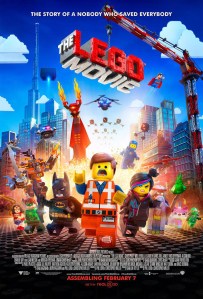
Review – The Lego Movie

As chaotic as it is clever and comedic, this gloriously absurd tale about the “highly sophisticated interlocking brick system” should be required watching for Michael Bay to see how movies about toys should be made.
As cunningly catchy as the signature awesome tune that plays throughout, The Lego Movie is that rarest of Hollywood gifts - a genuine and delightful surprise

As cunningly catchy as the signature awesome tune that plays throughout, The Lego Movie is that rarest of Hollywood gifts – a genuine and delightful surprise

It doesn’t happen very often, but every once in a while a film comes along that goes some way to make amends for the many wasted hours long-suffering cinemagoers spend sat in popcorn-encrusted multiplexes being force-fed creatively bankrupt Tinseltown trash.

For all intents and purposes The Lego Movie shouldn’t be that film. What should (read: normally) have happened is that it burst into cinemas and made a pot of cash before anyone realised it was rubbish. However, Phil Lord and Christopher Miller chose instead to take the road travelled most recently by Disney’s Frozen of making a well-written, funny and charming movie that appeals to young and old alike and attracts repeat viewings.

Simple, ordinary Emmet (Chris Pratt) is about to have his world rocked in The Lego Movie

Simple, ordinary Emmet (Chris Pratt) is about to have his world rocked in The Lego Movie

Lord and Miller’s previous animated flick, 2009’s Cloudy With A Chance Of Meatballs, was weirdly anarchic in itself, but the crazy juice is in full flow here.

We all have something that makes us something, but construction worker Emmet Brickowski (voiced by Chris Pratt) is the definition of ordinary. That is until he inadvertently stumbles across The Piece of Resistance which, according to the prophecy set down by wonky wizard Vitruvius (Morgan Freeman), makes him The Special; the person capable of stopping the evil Lord Business (Will Ferrell) from using a superweapon called the Kragle to freeze the world and preserve perfect order.

Wonky wizard Vitruvius  (Morgan Freeman) faces evil Lord Business (Will Ferrell) in The Lego Movie

Wonky wizard Vitruvius (Morgan Freeman) faces evil Lord Business (Will Ferrell) in The Lego Movie

Emmet suddenly finds himself in a strange new world and is helped on his quest by the feisty Wyldstyle (Elizabeth Banks), her boyfriend Batman (Will Arnett) and an army of Master Builders, recognisable from the world of comic books, movies and real life. However, they must all contend with Business and his relentless right clawed man Bad Cop (Liam Neeson).

The chaos of The Lego Movie is, aptly enough, exactly why the film works. As the makers of Minecraft would no doubt agree, the beauty of Lego is that it can be anything its builder wants it to be; whether that be an elaborately designed world (Bricksburg), a free-for-all (as depicted in the movie by the visually bonkers Cloud Cuckoo Land), a pirate ship, or simply two blocks randomly stuck together (the height of my Lego creativity as a youngster).
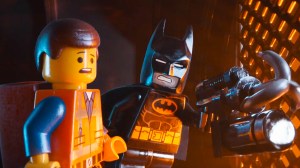
Batman (Will Arnett) prepares to "wing it" with Emmet (Chris Pratt) in The Lego Movie

Batman (Will Arnett) prepares to “wing it” with Emmet (Chris Pratt) in The Lego Movie

Taking Toy Story and The Matrix as building blocks, Lord and Miller’s knowing and subversive script weaves in everything from the unhealthy ties between politics and big business to cultural dumbing down (the TV show Where’s My Pants?), overpriced coffee, good old-fashioned satire and plenty of jokes.

By way of example, there’s the throwaway parody of Batman via the lyrics of a self-penned song he plays through the Batmobile’s new subwoofers: “Darkness… No parents… More darkness… Get it?… The opposite of light… Super rich… Kinda makes it better.”

The Lego Movie gang

The Lego Movie gang

To achieve this level of chaos without the film imploding in on itself takes some doing, while the animation itself is ingeniously rendered. Even water is fashioned from Lego blocks and somehow fits in with everything else that’s happening on screen.

The film also deftly underscores the cross-generational appeal of Lego and the different outlook that kids have (build whatever, deconstruct and start again) and adults (build something elaborate, stick it together with glue, remove the fun out of it) have when it comes to the little blocks.

As cunningly catchy as the signature awesome tune that plays throughout, The Lego Movie is that rarest of Hollywood gifts – a genuine and delightful surprise.

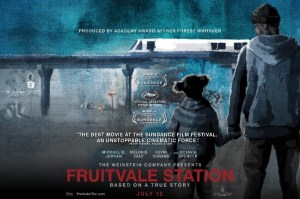
Review – Fruitvale Station

There’s something remarkably matter-of-fact about Ryan Coogler’s portrait of the hours leading up to the tragic and needless shooting of Oscar Grant III.

An undeniably powerful and harrowing lament of a life taken far too early it may be, but Fruitvale Station fails to break free of its heavy-handed shackles

An undeniably powerful and harrowing lament of a life taken far too early it may be, but Fruitvale Station fails to break free of its heavy-handed shackles

The drama that unfolds over the course of Fruitvale Station‘s 85 minutes could so easily have been amplified for propagandistic effect, so it’s to the credit of both the writer-director and a mature and measured Michael B. Jordan in the lead role that this is avoided.

However, a heavy-handed script, manipulative visual touches and a televisual style cut the film short of being a truly outstanding debut feature from Coogler.

Oscar (Michael B. Jordan) hangs out with his daughter Tatiana (Ariana Neal) in Fruitvale Station

Oscar (Michael B. Jordan) hangs out with his daughter Tatiana (Ariana Neal) in Fruitvale Station

Fruitvale Station follows the final day of Grant, a young guy from California who spends New Year’s Eve in 2008 trying to make a fresh start.

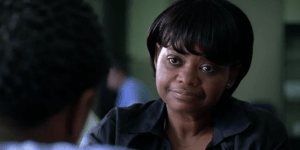
As well as attempting to work things through with his girlfriend Sophina (Melonie Diaz) for the sake of their daughter Tatiana (Ariana Neal), Oscar is treading a more straight and narrow path with the law and hoping to get his job back while preparing for his mother Wanda’s (Octavia Spencer) birthday.

Oscar's loving mother Wanda  (Octavia Spencer) in Fruitvale Station

Oscar’s loving mother Wanda (Octavia Spencer) in Fruitvale Station

However, in a cruel irony, an act of kindness earlier in the film inadvertently creates a chain of events that lead to Oscar’s death at the eponymous Fruitvale Station when he’s shot in the back by a BART police officer; an act filmed by several passengers on their mobile phones.

The film’s elliptical structure opens with chilling footage taken by one of the passengers before rewinding back to the start of the day and following Oscar until his tragic shooting. The harrowing events at the station are undeniably shocking and are powerfully reenacted by Coogler with the help of Kevin Durand and Chad Michael Murray as the police officers whose actions led to his death (the officer who shot Oscar argued in court that he mistakenly used his firearm, believing it to be his Taser weapon).

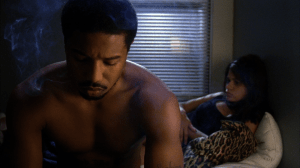
Sophina (Melonie Diaz) faces an awkward moment with boyfriend Oscar (Michael B. Jordan) in Fruitvale Station

Sophina (Melonie Diaz) faces an awkward moment with boyfriend Oscar (Michael B. Jordan) in Fruitvale Station

There’s a sadness to the scenes leading up to this moment as we know Oscar is going to be denied the fruits of his labours. However, Coogler lets himself down by forcing the issue too much.

The death of a dog right in front of Oscar is a little too on the money and isn’t helped by the director pulling the shot back to show a train leaving a station as a prophetic sign of what’s to come.

Officer Caruso (Kevin Durand) imposes himself on Oscar (Michael B. Jordan) and his friends in Fruitvale Station

Officer Caruso (Kevin Durand) imposes himself on Oscar (Michael B. Jordan) and his friends in Fruitvale Station

Later in the film, Oscar suggests to Sophina that they should stay in, but she insists on going out to enjoy New Year’s Eve. Likewise, his daughter implores Oscar not to go out because she can hear “gunshots” (actually firecrackers), but he promises her there’s nothing to worry about.

This lack of subtly extends to some of the visual choices made by the director. A slo-mo scene of Oscar running after Tatiana feels manipulative and the cheesy score laid on top merely reinforces this. A further life decision that sees Oscar driving to the coast and staring out to sea is beautifully filmed, but serves no other purpose than to hammer home a point we’ve already ascertained.

Michael B. Jordan plays Oscar Grant III in Fruitvale Station

Michael B. Jordan plays Oscar Grant III in Fruitvale Station

In spite of this, the performances are universally compelling, with Spencer on devastating form as Oscar’s mother, whose hopes of a better life for her son following a stint in jail are cruelly snatched away. Diaz is also excellent as the headstrong Sophina, while Neal is a natural who’s required to do as much heavy lifting as many of her older co-stars.

However, this is Jordan’s film and he gives a magnetic turn as Oscar. Jordan is careful not to paint his character as a saint, rather’s he’s a good man who’s smart enough to understand the path he needs to take is different to the one he’s found himself down.

An undeniably powerful and harrowing lament of a life taken far too early it may be, but Fruitvale Station fails to break free of its heavy-handed shackles.

Review – Edge Of Tomorrow

Movies and video games have never made the easiest of bedfellows, so it’s ironic a film based on a book should inadvertently capture what makes great games tick.

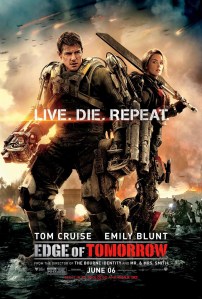
As fun a ride as you're likely to have all summer, Edge Of Tomorrow is a film you'll want to watch it all over again

As fun a ride as you’re likely to have all summer, Edge Of Tomorrow is a film you’ll want to watch it all over again

Although Edge Of Tomorrow inevitably attracts comparisons to Groundhog Day in its time loop structure, Major William Cage’s (Tom Cruise) seemingly endless replays and slow, obsessive battle to defeat the bad guys brings to mind the likes of Halo and other highly intensive action games.

In fact it wouldn’t have looked out of place for the words ‘Game Over’ to appear each time Cage dies before respawning at the same point, while its tagline ‘Live. Die. Repeat.’ will be familiar to millions of gamers trying to progress through their latest game.

Major William Cage's (Tom Cruise) day is about to turn very bad in Edge Of Tomorrow

Major William Cage’s (Tom Cruise) day is about to turn very bad in Edge Of Tomorrow

Setting aside his odd personal beliefs, you have to hand it to Cruise for having managed to remain at the top of the tree for more than 30 years. He’s also done it on his own terms and has often been prepared to use that winning smile he became famous for early in his career to subversive effect.

Here, the smile is used to sell the allied war effort against an invading alien race known as Mimics who have conquered most of  Europe. In spite of his senior rank, PR guru Cage has seen no combat, choosing instead to fight the war in front of the TV cameras as the face of the United Defence Forces (UDF).

Major William Cage (Tom Cruise) and Special Forces soldier Rita Vrataski (Emily Blunt) consider their next move in Edge Of Tomorrow

Major William Cage (Tom Cruise) and Special Forces soldier Rita Vrataski (Emily Blunt) consider their next move in Edge Of Tomorrow

So when UDF commander General Brigham (Brendan Gleeson) informs the cowardly Cage that he’s being embedded on the frontlines for Operation Downfall, the UDF’s all-or-nothing invasion of France (it can’t be a coincidence the film has been released in the US on the 70th anniversary of D-Day), Cage unsuccessfully attempts to worm his way out of it.

Deployed in the first wave, Cage is killed within a few minutes, only to suddenly awaken back at the barracks, where the invasion begins all over again. With the help of super soldier and UDF poster girl Rita Vrataski (Emily Blunt), who appears to be the only one who understands what is happening to Cage, they set about trying to defeat the enemy, one death and one time loop at a time.

Super soldier Rita Vrataski (Emily Blunt) does the business in Edge Of Tomorrow

Super soldier Rita Vrataski (Emily Blunt) does the business in Edge Of Tomorrow

Director Doug Liman is now best regarded as an action director, although he made a name for himself with the indie classic Swingers (1996). His form in the genre has been patchy; on the plus side he gave us The Bourne Identity (2002), but this was followed by the smug Mr And Mrs Smith (2005) and the tedious Jumper (2008).

The scales have been balanced with this rousing romp (based on the novel All You Need Is Kill by Hiroshi Sakurazaka) that zips along at a dizzying pace and doesn’t get lost in its time-space continuum. Cruise plays a genuinely slimy and unlikable character who is forced to become a better man by the fortitude and bravery shown by Vrataski.

Major William Cage (Tom Cruise) finds himself on the frontline in Edge Of Tomorrow

Major William Cage (Tom Cruise) finds himself on the frontline in Edge Of Tomorrow

Blunt, who must have a thing for time travel movies after staring in Rian Johnson’s Looper (2012), is a breath of fresh air. It’s a role that demands a strong performance and Blunt delivers it with consummate ease; she’s more than Cruise’s equal on screen and flexes both her acting and physical chops.

The film’s kinetic editing style effectively emphasises the sheer number of times Cage must undergo the same events in order to progress that little bit further each time and the psychological impact it must have is etched on Cruise’s increasingly tortured face.

Sci-fi movies steal from each other all the time and Liman is happy to maintain this tradition. The exoskeleton used in the film is lifted from Aliens and last year’s Elysium, while the influence of militaristic sci-fi flicks such as Starship Troopers is palpable.

As fun a ride as you’re likely to have all summer, Edge Of Tomorrow is a film you’ll want to watch it all over again.

Great Films You Need To See – Sorcerer (1977)

This is my latest contribution to The Big Picture, the internationally recognised magazine and website that offers an intelligent take on cinema, focussing on how film affects our lives. This piece about William Friedkin’s criminally underseen 1977 existentialist thriller Sorcerer was written as part of The Big Picture’s Lost Classics strand, although I am including it within my list of Great Films You Need To See.

Unwittingly foreshadowing the fate of its four displaced protagonists, William Friedkin’s existential follow-up to The Exorcist was doomed the moment a certain lightsaber-rattling space opera arrived in cinemas from a galaxy far, far away.

Still Friedkin's most enigmatic and idiosyncratic film, Sorcerer's bewitching spell deserves to be cast far more widely

Still Friedkin’s most enigmatic and idiosyncratic film, Sorcerer’s bewitching spell deserves to be cast far more widely

Sorcerer (1977) has been cited by some as the beginning of the end for the New Hollywood movement. However, a giant nail had been hammered into its coffin several weeks earlier with the release of George Lucas’ Star Wars.

In light of this new paradigm of droids, Death Stars and Darth Vader, it’s no great surprise the film bombed on its release and disappeared without trace. That said, Sorcerer was (and still is) one of the most unashamedly offbeat big budget films ever released and was always going to be a tough sell.

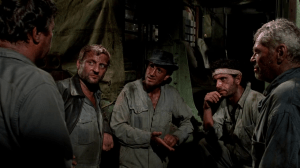
Mexican assassin Nilo (Francisco Rabal), Palestinian terrorist Kassem (Amidou), fraudulent French businessman Victor Manzon (Bruno Cremer) and New Jersey gangster Jackie Scanlon (Roy Schneider) weigh up their options in Sorcerer

Mexican assassin Nilo (Francisco Rabal), Palestinian terrorist Kassem (Amidou), fraudulent French businessman Victor Manzon (Bruno Cremer) and New Jersey gangster Jackie Scanlon (Roy Schneider) weigh up their options in Sorcerer

Although Friedkin insisted it wasn’t a remake of Henri-Georges Clouzot’s classic The Wages Of Fear, financiers Universal Studios and Paramount Pictures didn’t share the same opinion, changing its name to Wages Of Fear and re-editing the picture for international release.

The plot is certainly familiar. Four criminals – a Mexican assassin (Francisco Rabal), a Palestinian terrorist (Amidou), a fraudulent French businessman (Bruno Cremer) and a New Jersey gangster (Roy Schneider) – flee the scenes of their respective crimes and end up in a squalid Dominican Republic backwater working for a dodgy oil conglomerate. When one of the firm’s wells is blown up by ‘terrorists’, the desperate quartet sign-up to drive two truckloads of nitroglycerin across more than 200 miles of unforgiving jungle to put out the resulting blaze and pocket a big payday. The only problem is the dynamite is highly unstable and one false move could lead to an abruptly explosive end.

Getting ready for a dangerous trip in Sorcerer

Getting ready for a dangerous trip in Sorcerer

Friedkin has never been one to do things by half and employed the same guerilla style of filmmaking that won him an Oscar for The French Connection (1971) to down and dirty effect for what the director declares is the most important film of his career.

In his autobiography, The Friedkin Connection, he regales how scenes filmed in Jerusalem for the film’s globe-trotting first reel were given added authenticity by a real-life terrorist bombing that took place near to the shoot. In true Friedkin fashion, he made sure to train the cameras on the chaos that was ensuing rather than getting the hell out of there.

Crossing the most dilapidated bridge in the world in Sorcerer

Crossing the most dilapidated bridge in the world in Sorcerer

This is nothing, however, compared to what comes later in the film. Five years before Werner Herzog dragged a steam ship over a hillside in Fitzcarraldo (1982) in the name of art, Friedkin risked life and limb by having the trucks cross possibly the most dilapidated bridge in the world. The panic-inducing drama as the trucks swing violently back and forth over a raging torrent through almost Biblical levels of rain is almost unbearable to watch and is given extra power by Tangerine Dream’s nightmarish score.

Death and violence seep out of every frame and Friedkin takes an unholy pleasure in stripping hope away from his damned characters at every turn. The look of madness that creeps into Schneider’s eyes as their journey descends further into hell is startling and the hallucinogenic final reel is genuinely unsettling.

Still Friedkin’s most enigmatic and idiosyncratic film, Sorcerer‘s bewitching spell deserves to be cast far more widely.

Review – X-Men: Days Of Future Past

Marvel’s most well-worn franchise is back to the future and back to its best in this exhilarating time travelling romp that resolutely refuses to take itself too seriously.

Setting aside the slightly needless set piece involving Magneto raising the Robert F Kennedy Memorial Stadium and chucking it over the White House like a giant donut, X-Men: Days Of Future Past is a genuine contender for blockbuster of the year

Setting aside the slightly needless set piece involving Magneto raising the Robert F Kennedy Memorial Stadium and chucking it over the White House like a giant donut, X-Men: Days Of Future Past is a genuine contender for blockbuster of the year

It’s been 14 years since X-Men arrived like a juggernaut into cinemas and ushered in a new paradigm in Hollywood that shows no signs of abating.

The franchise’s high water mark X2 (2003) still remains one of the most fully realised comic book movies. The same, however, could not be said of its sequel The Last Stand (2006) and the two standalone films featuring the evergreen Wolverine – all of which validated the law of diminishing returns.

1970s era Professor Xavier (James McAvoy) re-enters cerebro with Beast (Nicholas Hoult) and Wolverine (Hugh Jackman) in X-Men: Days of Future Past

1970s era Professor Xavier (James McAvoy) re-enters cerebro with Beast (Nicholas Hoult) and Wolverine (Hugh Jackman) in X-Men: Days of Future Past

As seems to happen with most money-spinning comic book series these days, the clocks were turned back and the reboot switch was flipped with X-Men: First Class (2011), an effective superhero flick that used recent history (the 1962 Cuban Missile Crisis) to posit an alternative reality in which mutants played a significant part.

The golden thread that linked First Class and X-Men 1.0 was Hugh Jackman’s pithy cameo as Wolverine and the character inevitably plays a crucial role in bridging the two time periods for Days Of Future Past.

Military scientist and businessman Bolivar Trask (Peter Dinklage) in X-Men: Days of Future Past

Military scientist and businessman Bolivar Trask (Peter Dinklage) in X-Men: Days of Future Past

The other golden thread is director Bryan Singer, who has come home after a patchy recent run that included Superman Returns (2006), Valkyrie (2008) and Jack The Giant Slayer (2013) and in the process delivered the best film in the franchise since his last turn in the big chair with X2.

Wolverine is zapped back in time to 1973 by Kitty Pryde (Ellen Page) to avert a future wherein seemingly invincible man-made robots called Sentinels are within a hair’s breadth of wiping out mutant kind. The situation is so grim that friends-turned-enemies Professor Xavier (Patrick Stewart) and Magneto (Ian McKellen) have joined forces to make a last stand (not that one) against the metallic beasts.

Mystique (Jennifer Lawrence) sets her sights in X-Men: Days of Future Past

Mystique (Jennifer Lawrence) sets her sights in X-Men: Days of Future Past

Meanwhile, back in ’73, Wolverine must convince a younger, more disillusioned Xavier (James McAvoy) to break Magneto (Michael Fassbender) out of the Pentagon in order for him to help them stop the shape-shifting Mystique (Jennifer Lawrence) from killing military scientist Bolivar Trask (Peter Dinklage), whose murder convinces President Nixon’s government to implement Trask’s Sentinel programme.

Using time travel to change an event in the past in order to alter the future invariably brings to mind the likes of The Terminator and Days Of Future Past doesn’t try particularly hard in hiding its obvious debt to that film as the Sentinels turn the planet into a mass graveyard in its dystopian opening reel.

1970s era Magneto (Michael Fassbender) tries to stop traffic in X-Men: Days of Future Past

1970s era Magneto (Michael Fassbender) tries to stop traffic in X-Men: Days of Future Past

The film also owes a debt to Star Trek, specifically First Contact and The Voyage Home in its ambition to strike a tone between serious and light-hearted. It’s a tough balance to strike, but one the film carries off with aplomb.

The scenes involving a young Peter Maximoff, aka Quicksilver, are great fun and Evan Peters has a blast in the part of the mutant who’s faster than a speeding bullet. The slo-mo Pentagon kitchen sequence involving a gleeful Quicksilver concocting an elaborate way of getting past the gun-toting guards is an ingenious fusion of special effects, balletic choreography and music (Jim Croce’s Time In A Bottle) that pays off to highly satisfying effect.

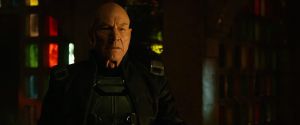
A future Professor Charles Xavier (Patrick Stewart) in X-Men: Days of Future Past

A future Professor Charles Xavier (Patrick Stewart) in X-Men: Days of Future Past

Singer just about manages to avoid things slipping into Village People ridiculousness, although Simon Kinberg’s script slips into over-exposition and needless anachronisms, to the extent you half expect Jackman to break the fourth wall and ask ‘are you keeping up?’.

A strength of the film, aside from John Ottman’s nicely judged score, is its ability to juggle a sizeable cast. With the exception of Halle Berry’s increasingly redundant Storm and Anna Paquin’s much-discussed reduction in screen time, pretty much everyone gets their moment to shine, in particular Nicholas Hoult, who continues the good work he put in during First Class as Hank McCoy, aka Beast.

Future Magneto (Ian McKellen) and Iceman (Shawn Ashmore) in X-Men: Days of Future Past

Future Magneto (Ian McKellen) and Iceman (Shawn Ashmore) in X-Men: Days of Future Past

Jackman, Stewart and McKellen slip into their respective roles as they would an old pair of shoes, while Lawrence gives Mystique a very human dimension and McAvoy expands greatly on what he did in First Class.

The biggest plaudits must go to the excellent Dinklage, who offers up a different sort of villain from the ones we’re used to seeing. Even the very worst of humanity think they’re doing the right thing and Trask is no different. Singer wisely cast Dinklage, whose diminutive size suggests a harmless industrialist, but whose character exbibits ambitions that are world-changing indeed.

Setting aside the slightly needless set piece involving Magneto raising the Robert F Kennedy Memorial Stadium and chucking it over the White House like a giant donut, X-Men: Days Of Future Past is a genuine contender for blockbuster of the year.