Review – Guardians Of The Galaxy

The Marvel Cinematic Universe lives up to its name in this star-spanning space opera that puts the fun back into a genre that had disappeared up its black hole.

A genuine pleasure, Guardians Of The Galaxy should give JJ Abrams something to think about for the next installment of  that other well known space opera

A genuine pleasure, Guardians Of The Galaxy should give JJ Abrams something to think about for the next installment of that other well-known space opera

The fact that Guardians Of The Galaxy is drawing so many comparisons to Star Wars is not only a testament to the high esteem it’s being held in by so many critics, but also to the fact that it’s so refreshing to watch a film of this ilk that resolutely refuses to take itself too seriously.

Too often, sci-fi filmmakers get bogged down in blindsiding their audience with Midi-chlorians, flibbertigibbets and unnecessary solemnity at the expense of an intriguing narrative and engaging characters. Although Guardians… isn’t averse to a spot of Basil Exposition (understandable considering it’s the first in what will undoubtedly become another Marvel franchise), it does so with a light and breezy air that avoids spoon-feeding the audience.
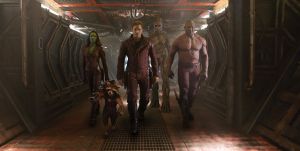
The A Team - Gamora (Zoe Saldana), Rocket (Bradley Cooper), Peter Quill (Chris Pratt), Groot (Vin Diesel) and Drax the Destroyer (Dave Bautista) in Guardians Of The Galaxy

The A Team – Gamora (Zoe Saldana), Rocket (Bradley Cooper), Peter Quill (Chris Pratt), Groot (Vin Diesel) and Drax the Destroyer (Dave Bautista) in Guardians Of The Galaxy

Abducted from Earth as a young boy following the death of his mother, intergalactic thief Peter Quill, aka Star-Lord, (Chris Pratt) incurs the wrath of the super-evil Ronan (Lee Pace) when he steals a mysterious orb. With Ronan’s henchmen, and women, hot on the trail of the orb, including his lieutenant Nebula (Karen Gillan), Peter forms an uneasy accord with assassin Gamora (Zoe Saldana), genetically engineered racoon Rocket (voiced by Bradley Cooper), the tree-like Groot (Vin Diesel) and warrior Drax the Destroyer (WWE star Dave Bautista).

When the extent of the orb’s power becomes clear, and Ronan’s diabolical plan reveals itself, Peter must turn his ragtag associates into a full-on fighting force to save the galaxy from destruction.
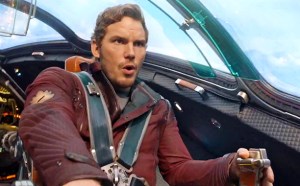
The heroic Peter Quill/Star Lord (Chris Pratt) in Guardians Of The Galaxy

The heroic Peter Quill/Star Lord (Chris Pratt) in Guardians Of The Galaxy

Marvel’s policy of trusting its multi-million dollar products to leftfield directors (Edgar Wright’s departure from 2015’s Ant Man notwithstanding) once again pays off. The edgy comic touch of James Gunn’s previous flicks Slither (2006) and Super (2010) is a perfect fit for Guardians‘ tongue-in-cheek sensibility.

The film takes great pleasure in sending up the clichés of the genre, such as the team’s slow motion walk towards the camera in which Gamora can be seen yawning. Gunn and Nicole Perlman’s meta script goes off on tangents, some funny, others less so, and concentrates on the relationships between the lead characters. This is a bunch of misfits we can believe in and the bond they gradually form is convincingly handled by the cast.
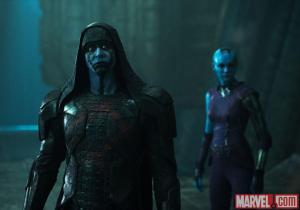
The evil Ronan the Accuser (Lee Pace) and his loyal lieutenant Nebula (Karen Gillan) in Guardians Of The Galaxy

The evil Ronan the Accuser (Lee Pace) and his loyal lieutenant Nebula (Karen Gillan) in Guardians Of The Galaxy

One of the more successful elements of Guardians… is its soundtrack of 70s and 80s classics, ingeniously crowbarred into the film as they form part of Peter’s beloved mix tape from his mother. Setting aside the fact that his Walkman wouldn’t probably survive 26 years and that AA batteries would likely be a little hard to come by in outer space, the music serves as a reminder that Peter, like Buck Rogers and John Carter, is a human in an alien environment and our way into this universe.

Gamora (Zoe Saldana) learns more about the mysterious orb in Guardians Of The Galaxy

Gamora (Zoe Saldana) learns more about the mysterious orb in Guardians Of The Galaxy

Despite trying a bit too hard at times to be Han Solo’s slightly less cool brother, Pratt is a good fit for Peter and proves a likeable lead. Saldana may look like a character from Star Trek, but she kicks ass and is proving a formidable presence in the world of big budget sci-fi, what with the Trek and Avatar franchises already in place. Cooper’s energetic, fast-talking voice work for Rocket is nicely played, while Diesel manages to give a new meaning to each new utterance of his singular phrase “I am Groot” and even non-actor Bautista does some solid work as meathead Drax.

Elsewhere, Gillan is impressively alien as Nebula, while Gunn makes sure to give his other supporting cast members something to do, especially Michael Rooker’s blue-skinned alien Yondu and John C Reilly’s corpsman Rhomann Dey.

A genuine pleasure, Guardians Of The Galaxy should give JJ Abrams something to think about for the next installment of  that other well-known space opera.

Review – Dawn Of The Planet Of The Apes

You absolutely know you’ve bought into this hugely ambitious blockbuster sequel when the sight of an ape riding a horse while firing machine guns with each hand makes perfect sense rather than looking ridiculous.

In a year of mostly superior blockbuster fare, Dawn Of The Planet Of The Apes could just be the most genetically superior of the lot

In a year of mostly superior blockbuster fare, Dawn Of The Planet Of The Apes could just be the most genetically superior of the lot

The world built by Rupert Wyatt’s Rise Of The Planet Of The Apes (2011)  is impressively expanded upon here, while the astonishing visual effects service, rather than drive an engaging story of Shakespearean proportions.

The fact that the lead ape is called Caesar is entirely fitting to a tale of brotherhood, betrayal and tragedy that beats its chest in appreciation of the Bard’s Julius Caesar, just as Rise… took elements of Henry V in its depiction of Caesar’s ascent to leadership. Although Dawn‘s lofty aspirations don’t always hit the mark, the zeal in which it goes about it is something to applaud.

Caesar (Andy Serkis) in battle mode in Dawn Of The Planet Of The Apes

Caesar (Andy Serkis) in battle mode in Dawn Of The Planet Of The Apes

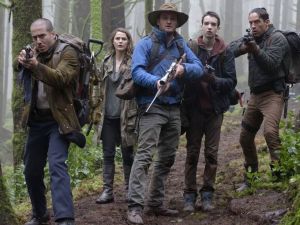
It’s been 10 years since the so-called Simian Flu has reduced the human race to the point of extinction and, inversely, led to a growing utopian society of genetically evolved apes, led by Caesar (Andy Serkis). This idyll is turned upside down by the sudden and unexpected arrival of a group of humans, including Malcolm (Jason Clarke), his son Alexander (Kodi Smit-McPhee, who’s making a habit of appearing in apocalyptic dramas following The Road) and Ellie (Keri Russell).

The encounter reignites old enmities in Caesar’s second-in-command Koba (Toby Kebbell), who believes the humans pose a direct threat, while in the human colony this mutual suspicion is shared by uneasy leader Dreyfus (Gary Oldman). Caesar and Malcolm, meanwhile, try to build a shaky détente in the hope that war can be averted.

The human survivors, including Malcolm (Jason Clarke), Ellie (Keri Russell) and Alexander (Kodi Smit-McPhee) are told to "Goooooooo!!!" in Dawn Of The Planet Of The Apes

The human survivors, including Malcolm (Jason Clarke), Ellie (Keri Russell) and Alexander (Kodi Smit-McPhee) are told to “Goooooooo!!!” in Dawn Of The Planet Of The Apes

The devastating effect of the Simian Flu, introduced during Rise‘s post-credits sequence is dealt with in the film’s efficient opening credits, which skilfully weave in real life news footage to establish how Charlton Heston’s astronaut could come to his horrific realisation at the end of Planet Of The Apes (1968).

The 10 years separating the two films are written on the faces of the protagonists. Caesar has grown into a responsible, benevolent leader; a husband and father who espouses the central rule of an orderly society: ‘ape do not harm ape’. On the other side of the divide, desperation is etched on the human survivors, who unwittingly traverse into ape territory in the search of a much-needed power source.

The human survivors seriously underestimate Koba (Toby Kebbell) in Dawn Of The Planet Of The Apes

The human survivors seriously underestimate Koba (Toby Kebbell) in Dawn Of The Planet Of The Apes

As soon as humans and apes come into contact, we know that war is inevitable, but the journey to get there is effectively handled by director Matt Reeves and scriptwriters Rick Jaffa, Amanda Silver and Mark Bomback, who get us to empathise with each character’s motives.

Dawn… has been criticised for too neatly presenting the different factions as mirror images of each other – Koba and Dreyfus represent the hawkish shoot-first-ask-questions-later approach bred by a combination of antipathy and fear; while Caesar and Malcolm are the peacemakers who see diplomacy as the way forward rather than conflict.

The benevolent Maurice (Karin Konoval) in Dawn Of The Planet Of The Apes

The benevolent Maurice (Karin Konoval) in Dawn Of The Planet Of The Apes

Watch the film, however, and this approach makes perfect sense; the apes and humans are far more alike than either might wish to admit, something acknowledged in a wry observation by Caesar late in the film to his conflicted son Blue Eyes (Nick Thurston). This is a direct nod to the original Apes series and underlines how this most unique of franchises is forever adaptable to the times in which we live.

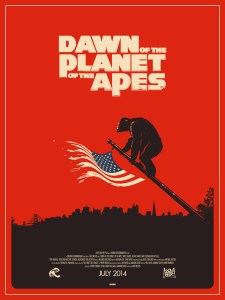
With so many apes on screen, the action scenes could easily have descended into disengaged confusion; however, we’re never left high and dry and there is even room for a number of bravura shots, including one in which the camera positioned on a slowly revolving tank turret shows us the full-scale of the battle and a startling shot (achieved on the spur of the moment, apparently) of Koba perched atop a battered American flagpole staring at his enemy.

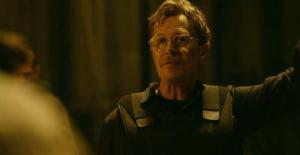
Human leader Dreyfus (Gary Oldman) in Dawn Of The Planet Of The Apes

Human leader Dreyfus (Gary Oldman) in Dawn Of The Planet Of The Apes

Serkis further rubber stamps his standing as cinema’s motion capture godfather with a sublime turn as Caesar, while Kebbell is equally expressive as the tortured Koba. On the other side, Oldman invests Dreyfus with an all-too-human frailty and Clarke is efficient without setting off too many fireworks. Meanwhile, Russell’s thankless turn only serves to underline the dearth of decent female parts.

In a year of mostly superior blockbuster fare, Dawn Of The Planet Of The Apes could just be the most genetically superior of the lot.

In Retrospect – Beverly Hills Cop (1984)

The following is a Bite Sized Review I’ve written for Tom at Digital Shortbread. There can’t be many of you who hasn’t checked out what is one of the very best sites out there for movie reviews of all shapes and sizes. Tom’s site has come on leaps and bounds and I’m honoured to have been asked to contribute. Hope you enjoy this appreciation of the 80’s action comedy classic Beverly Hills Cop, which this year celebrates its 30th anniversary.

It may seem difficult to believe to anyone under the age of 30, but once upon a time Eddie Murphy was the biggest movie star on the planet. Murphy may have torched his reputation with the likes of Norbit and Meet Dave, but during the 1980s he was seriously hot shit and none more so than in Beverly Hills Cop.

Beverly Hills Cop - the 80s at its near-best

Beverly Hills Cop – the 80s at its near-best

In one of those ‘what if?’ parallel universes that Hollywood seems to excel at (think Frank Sinatra being first choice for Dirty Harry), the project was originally due to star Mickey Rourke (that would have been… interesting) and then Sylvester Stallone, who pulled out two weeks before shooting was due to start. Murphy was drafted in at the 11th hour by legendary producing duo Don Simpson and Jerry Bruckheimer for his first leading role and the rest, as they say, is history.

It’s impossible to imagine anyone else playing the part of wise cracking maverick Detroit detective Axel Foley, who heads west to the freak show that is Beverly Hills against the instructions of his hard-ass boss (played by Gil Hill) to investigate the death of his friend. His snooping not only rubs up against oily art dealer Victor Maitland (Steven Berkoff) but also the Beverly Hills Police Department, specifically grizzled cop Taggart (John Ashton), his wide-eyed partner Rosewood (Judge Reinhold) and Lieutenant Bogomil (Ronny Cox).

Eddie Murphy at the top of his game in Beverly Hills Cop

Eddie Murphy at the top of his game in Beverly Hills Cop

The alchemy that Murphy and director Martin Brest conjure up out of a well-worn fish-out-of-water premise is just as irresistible 30 years on. Murphy simply owns the film and it’s testament to his chops as a performer that the movie can get away with switching from broad comedy to drama in the blink of an eye. Murphy’s trademark laugh is in full effect, as is his ability to maintain a straight face while spinning a line to whatever lackey stands in his way.

Beverly Hills Cop was among the first movies in which the soundtrack was as popular as the film itself and anyone who appreciates uplifting 80s music (and who doesn’t?) will be hard pressed not to smile when The Heat Is On kicks in. Let’s also not forget the talismanic Harold Faltermeyer’s synth-tastic score that helps glue the movie together.

Axel Foley (Eddie Murphy) gets under the skin of Rosewood (Judge Reinhold) and Taggart (John Ashton) in Beverly Hills Cop

Axel Foley (Eddie Murphy) gets under the skin of Rosewood (Judge Reinhold) and Taggart (John Ashton) in Beverly Hills Cop

This isn’t just Murphy’s film, of course. Reinhold gives a warm performance as the naive Rosewood that perfectly complements Ashton’s grumbling turn as Taggart, while Bronson Pinchot is great as extravagant art gallery employee Serge. Also, keep an eye out for Damon Wayans in his debut role as a camp hotel employee.

On the negative side, the film has one of the worst stunt doubles ever. Check out 1h 4m in when Foley throws Maitland’s stony-faced goon (played by Breaking Bad‘s Jonathan Banks) over a buffet table; it’s almost laughable.

Finally folks, I’ve always been left wondering whether a banana in the tailpipe would actually stop a car from driving properly. If anybody can put me out of my misery on that one I’d be grateful.

Great Films You Need To See – Man Push Cart (2005)

This is my latest contribution to The Big Picture, the internationally recognised magazine and website that offers an intelligent take on cinema, focussing on how film affects our lives. This piece about Rahim Bahrani’s masterful 2005 debut Man Push Cart was written as part of The Big Picture’s Lost Classics strand, although I am including it within my list of Great Films You Need To See.

Few images more powerfully evoke the stark reality of 21st century city survival than the Sisyphean struggle of Pakistani immigrant Ahmad dragging his cart along the indifferent Manhattan streets in Rahim Bahrani’s mournfully poetic debut feature.

Man Push Cart remains an important milestone from a turbulent decade and marked itself out as the first words from a unique and exciting new voice in American cinema

Man Push Cart remains an important milestone from a turbulent decade and marked itself out as the first words from a unique and exciting new voice in American cinema

It’s an image Bahrani revisits throughout the extraordinary Man Push Cart (2005) as Ahmad (Ahmad Razvi) toils away day in and day out selling coffee and bagels from his push cart in the hope of affording a place in which he can live with his estranged son.

Bahrani isn’t interested in lecturing us about the plight of Asian immigrants in post 9/11 America or wailing against the world’s injustices; instead he casts a soft light on the invisible people who eke out a living on the fringes of first world society with a quiet dignity befitting of his protagonist.

Ahmad's (Ahmad Razvi) day begins - again - in Man Push Cart

Ahmad’s (Ahmad Razvi) day begins – again – in Man Push Cart

The Iranian-American director spent a year getting to know Razvi, who had been working as a push cart vendor for some time, before approaching him to star in their respective first features. The mutual trust that clearly developed over time reaps its reward as both director and actor mirror each other in their approach and let the natural drama of each scene play out.

Ahmad, we come to learn, is a former rock star in his native Pakistan living in the shadow of a recent tragedy that has left him grief-stricken and struggling to hold onto even the smallest dream. His life seemingly takes an upward turn when he forms a connection with young Spanish immigrant Noemi (Leticia Dolera) and befriends wealthy Pakistani businessman Mohammad (Charles Daniel Sandoval), who recognises Ahmad from his days as a minor celebrity and makes promises about getting him back in show business. However, in spite of the better life each option potentially presents, his past won’t let go that easily.

Ahmad (Ahmad Razvi) strikes up a connection with Noemi (Leticia Dolera) in Man Push Cart

Ahmad (Ahmad Razvi) strikes up a connection with Noemi (Leticia Dolera) in Man Push Cart

Bahrani uses a tight focus to reflect the lack of options Ahmad faces and adopts an unshowy, documentary-style approach that befits the performances.

The shadows of Ken Loach and Robert Bresson fall over the film (Bresson’s Pickpocket (1959) has been cited as an influence), while Ahmad’s quiet desperation reflects that of Antonio Ricci’s tragic protagonist in Vittorio De Sica‘s neo-realist classic Bicycle Thieves (1948).

Ahmad (Ahmad Razvi)'s Sisyphusian existence in Man Push Cart

Ahmad (Ahmad Razvi)’s Sisyphusian existence in Man Push Cart

Ahmad sees the cart as a means of escape from the desperate situation he finds himself in, although it’s difficult to get away from the impression that it more closely resembles a millstone that’s slowly dragging him further down.

Man Push Cart remains an important milestone from a turbulent decade and marked Bahrani out as a unique and exciting new voice in American cinema whom the late Roger Ebert hailed as “the new great American director”.

In the end, it’s that evocative image of Ahmad pulling his cart that lingers longest in the mind. Ahmad is our everyman and his struggle is universal.

Blogathon Relay: The 10 Most Influential Directors Of All Time

The 10 Most Influential Directors Of All Time

One of the more pleasant surprises I’ve had recently was to have received the baton from the lovely Ruth at FlixChatter for the 10 Most Influential Directors of All Time Blogathon relay.

The Blogathon was the brainchild of John at Hichcock’s World. It’s a brilliant idea and John sums it up nicely: “I have compiled a list of 10 directors I consider to be extremely influential. I will name another blogger to take over. That blogger, in their own article, will go through my list and choose one they feel doesn’t belong, make a case for why that director doesn’t fit, and then bring out a replacement. After making a case for why that director is a better choice, they will pass the baton onto another blogger. That third blogger will repeat the process before choosing another one to take over, and so on.”

The baton has so far been passed to the following:

Girl Meets Cinema
And So It Begins…
Dell On Movies
Two Dollar Cinema
A Fistful Of Films
The Cinematic Spectacle
FlixChatter (Thanks for the banner logo Ruth!)

The original list had plenty of incredible directors on it, but as the baton has been handed down the list has become pretty damned impressive:

The 10 Most Influential Directors Of All Time

Billy Wilder, Alfred Hitchcock, Quentin Tarantino, Georges Méliès, Martin Scorsese, Orson Welles, Steven Spielberg, Ingmar Bergman and Stanley Kubrick

Ruth’s addition to the list was Billy Wilder and her justification was thus: “I’ve recently seen one of Wilder’s best, The Apartment, and I could see why his films are so beloved. He imbued such wit in his films, a dose of cynical humor. He also has a way with actors, having directed no less than 14 actors to Oscar-nominated performances. He’s also a versatile writer/director, as he excelled in numerous genres: drama, noir, comedy as well as war films. He’s one of those directors whose work I still need to see more of, but even from the few that I’ve seen, it’s easy to see how Mr Wilder belongs in this list.”

So, Who’s Out?

Jean Luc Goddard

Jean-Luc Godard

Man, this was an almost impossible decision. Godard’s still making movies aged 83 and there’s no denying the influence of his work. Breathless remains a defining work of the French New Wave and his 1964 film Bande à part was stolen by Tarantino for the name of his production company. The more I think about it, the less I’m sure, but compared to the others on this list I feel Godard’s influence has slipped and, as such, he doesn’t quite make it. Sorry Jean-Luc, but I suspect you’d feel that lists like this are way too bourgeois anyway.

Now, Who’s In?

John Ford

John Ford

Reflecting on his masterpiece Citizen Kane, Orson Welles was asked who influenced what is still regarded as one of the greatest films ever made. Welles’ reply was simple: “The old masters, by which I mean John Ford, John Ford and John Ford.” He had reputedly watched Ford’s 1939 classic Stagecoach more than 40 times in preparation for his debut feature and he wasn’t the only one to have been drawn to the work of one of the most influential directors of all time.

An encounter with Ford proved to have a massive impact on a 15-year-old Steven Spielberg, who subsequently said of the great man: “Ford’s in my mind when I make a lot of my pictures.” Watch Saving Private Ryan‘s devastating D-Day landings sequence and War Horse and you’ll see Ford’s stamp front and centre.

Likewise, Martin Scorsese has cited The Searchers as one of his favourite films. Speaking about the film in the Hollywood Reporter, Scorsese said: “In truly great films – the ones that people need to make, the ones that start speaking through them, the ones that keep moving into territory that is more and more unfathomable and uncomfortable – nothing’s ever simple or neatly resolved. You’re left with a mystery. In this case, the mystery of a man who spends 10 years of his life searching for someone, realises his goal, brings her back and then walks away. Only an artist as great as John Ford would dare to end a film on such a note.”

The list goes on. Ingmar Bergman cited Ford as “the best director in the world”, while Alfred Hitchcock declared that a “John Ford film was a visual gratification”.

From the earliest days of film, through to the invention of sound and the introduction of colour, Ford remained a cinematic pioneer. Although best regarded for his westerns, he also made another masterpiece that defined a nation – The Grapes Of Wrath; while his incredible World War Two documentaries The Battle Of Midway and December 7th remain quintessential examples of the craft. For all this alone, John Ford should be regarded as The Great American Director.


Well, that’s me done, so now the torch passes to… Fernando at Committed to Celluloid. Good luck Fernando; you’re gonna need it!