Review – Enemy

There’s double trouble to be had in Denis Villeneuve’s compulsive and uncompromising psychological descent into a world of neurosis, nightmares and arachnids.
Enemy is bold and beguiling filmmaking and a puzzle that will linger in the memory long after the closing credits

Enemy is bold and beguiling filmmaking and a puzzle that will linger in the memory long after the closing credits

Loosely based on José Saramago’s 2002 novel The Double as opposed to Dostoyevsky’s novel of the same name (which Richard Ayoade adapted to moderate acclaim in 2014), Enemy is one of those puzzle box films that reward repeat viewings.

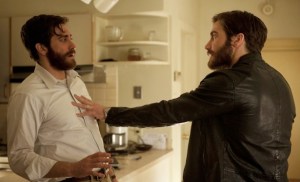
Ostensibly, the movie follows unfulfilled history lecturer Adam Bell (Jake Gyllenhaal) down the rabbit hole following the shock discovery that a bit player in a movie he’s watching is his apparent doppelgänger. Adam seeks out actor Anthony Claire (also Gyllenhaal), who may be his physical duplicate but appears more narcissistic and charismatic than the nervous and emotionally repressed Adam. Their encounter has unforeseen repercussions for both men, as well as for Adam’s girlfriend Mary (Mélanie Laurent) and Anthony’s pregnant wife Helen (Sarah Gadon).

The left hand doesn't know what thr right hand's doing for Adam/Anthony (Jake Gyllenhaal) in Enemy

The left hand doesn’t know what the right hand’s doing for Adam/Anthony (Jake Gyllenhaal) in Enemy

Scratch beneath the surface, however, and Villeneuve’s absorbing picture is a spider’s nest of different interpretations and perspectives in which individuality has become as precarious as one man’s collapsing mind.

The film’s opening intertitle “Chaos is order yet undeciphered” – a line taken from Saramago‘s novel – is given form by the numerous long shots of a city (in this case Toronto); that most chaotic yet fully formed of human creations that here is infected with a yellow, hazy sickliness, beautifully realised by cinematographer Nicolas Bodluc.
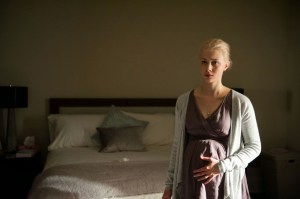
Anthony's pregnant wife Helen (Sarah Gadon) in Enemy

Anthony’s pregnant wife Helen (Sarah Gadon) in Enemy

It has been argued (convincingly in my mind) the spiders seen throughout the film are both a visual and subtextual metaphor for a loss of freedom.

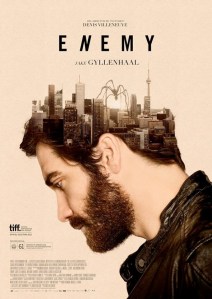
Adam teaches his class about the larger impact of this loss of freedom through his lectures on dictatorships, specifically their obsession with control and “censoring any means of individual expression”. On a more personal scale, Villeneuve shows us Adam/Anthony’s fractured psychological state and as the film continues it becomes apparent (at least to this reviewer) that Adam and Anthony are one in the same person, battling it out to see which side of his personality wins out. As a poster for the film implies: “You can’t escape yourself.”

Anthony (or is it Adam?) (Jake Gyllenhaal)  spies on Mary (Mélanie Laurent) in Enemy

Anthony (or is it Adam?) (Jake Gyllenhaal) spies on Mary (Mélanie Laurent) in Enemy

Shots of overhead electrical cables and a cracked window signify a spider’s web and lend extra weight to the suggestion that Adam/Anthony is trapped and must confront his own identity.

In many ways, Prisoners, the title of Villeneuve’s and Gyllenhaal’s other collaboration would be a more fitting title for this film, although the name Enemy, like the rest of the movie, works on more than one level.

Since breaking out with 2001’s Donnie Darko, Gyllenhaal has freed himself from the spider’s web of big budget nonsense like The Day After Tomorrow (2004) and Prince Of Persia: The Sands Of Time (2010) to set himself apart as an actor who commands serious respect. Gyllenhaal has had his fair amount of detractors in the past, but the choices he’s making with the likes of this and Nightcrawler are genuinely exciting.
Double trouble in Enemy

Double trouble in Enemy

Gyllenhaal is tremendous in the dual role of two men both separate and conjoined and, crucially, makes you forget about the novelty factor almost immediately. Laurent and Gadon don’t have an awful lot to do, but lend themselves to the overall sense of disquiet. The influence of Vertigo has been acknowledged by Villeneuve and the fact that both Laurent and Gadon are striking blonds in the picture is presumably a nod to Hitchcock’s preference for women in his movies with that hair colour.

Furthermore, the film’s ominous visual palette is lent extra impact by the disquieting score by Daniel Bensi and Saunder Jurriaans which pulls you around as much as Bodluc’s camera.

Enemy is bold and beguiling filmmaking and a puzzle that will linger in the memory long after the closing credits.

Dr NOOOO!! – The Worst Of Bond

‘Tis the season for end-of-year lists. ‘Tis also the season for James Bond’s filmography to clog up our TV listings.

While this means 007th heaven when it comes to out-and-out Bond classics like From Russia With Love (1963), Goldfinger (1964) and Casino Royale (2006) – as opposed to the 1967 effort starring David Niven and Woody Allen – it usually also means a repeat showing of some of the super spy’s not-so-super offerings.

Following the excellent Skyfall (2012), there is genuine anticipation for Spectre, Craig’s fourth outing in the role. But for now, let’s moonrake over the Bond movies that are a load of thunderballs.

Which are the worst Bond films in your opinion?

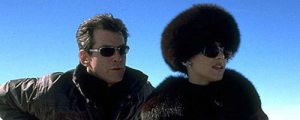
1. Die Another Day (2002)

Die Another Day

You have to feel sorry for Pierce Brosnan; a genuinely good actor when given material he can get his teeth into (The Matador (2005) being just one example). But when it came to his tenure as 007 – a role he was born to play – he was ill-served and none more so than in this nadir for the franchise. A strong opening reel wherein Bond gets captured by the evil North Korean army and is tortured and eventually released by a reluctant British government promises much, but the default switch soon gets flipped and before we know it we’re being asked to swallow gubbins involving an ice palace, a space laser and a car with a cloaking device. To make matters worse, Madonna puts in a performance that would insult a piece of wood and a smarmy Toby Stephens is so over-the-top it’s laughable. To top it off we have Bond Kite. Surfing. On. A. Tsunami. A film so bad everyone went away and took a very long and hard look at themselves and came back with Casino Royale.

2. A View To A Kill (1985)

A View To A Kill

After six movies and 12 years in the role, the 57-year-old Roger Moore was looking a little long in the tooth to be playing the walking killing and sex machine that is James Bond. However, in classic ‘one last job’ style, they renewed his license to kill one more time for a film that proved to mark the end of an era. Moore has been quoted as saying that A View To A Kill was his least enjoyable 007 experience and it shows in the uncomfortable expression glued on his face, not least of which during his seducing of Tanya Roberts’ Bond girl, a woman whose mother was younger than Moore. However, it’s the genuinely squirmy bedroom scene between Moore and Grace Jones’ May Day that will have you sitting uncomfortably in your seat. Whoever thought that was a good idea is anyone’s guess. A tired and flabby movie (featuring a half decent villain in Christopher Walken’s Zorin to be fair) that marked a sad end to Moore’s reign.

3.  The World Is Not Enough (1999)

The World Is Not Enough

Only in the world of 007 would Denise Richards be cast as a nuclear physicist – and one called Christmas Jones at that. The rot had been setting into Brosnan’s tenure since Tomorrow Never Dies (1997), but the nudge wink approach adopted throughout Moore’s residence was well and truly back following the Dalton years (the most underrated Bond in my book) and Brosnan’s solid debut GoldenEye (1995). While Robert Carlyle is better than the material he’s given playing international terrorist Francis Begbie… sorry, Renard, the narrative is all over the place, while the stunts merely reheat what we’ve seen before (ski chase? Yep. Helicopter action? You betcha). And let’s not forget that immortal line given by a post-coital Bond to Jones: “I thought Christmas came only once a year.” Wahey!

4. Octopussy (1983)

Octopussy

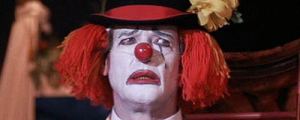
While Moore’s sixth outing in the tuxedo has its merits – an inclination towards a more serious plot being the most welcome – there’s a point in Octopussy when the cast and crew probably looked at each other and collectively realised that, by being a Roger Moore Bond movie, it therefore should contractually get very silly indeed. Moore must have raised an eyebrow in the way only Moore can when he read in the script that he’d have to get dressed up in a clown outfit to save the day. Maud Adams is at least Moore’s age and is the best thing about the film (the movie is named after her character after all), but Louis Jourdan doesn’t cut the mustard as the villain and tennis pro Vijay Amritraj should probably have stayed on the courts rather than turn up as Bond’s Indian ally Vijay.

5. Quantum Of Solace (2008)

Quantum Of Solace

The fates were against Quantum Of Solace. The back-to-basics Casino Royale had given the franchise the shot in the arm it so desperately needed and the pressure was on from the studio to keep the cash tills ringing. The decision to directly follow the events of Casino Royale certainly made sense as it provided the opportunity to explore the themes thrown up by Bond’s traumatic previous outing. However, the Writers Guild of America strike proved a crippling blow to the script’s development and things got so bad that Craig himself ended up trying to rewrite certain scenes. The script’s lack of cohesiveness shows in the undercooked dialogue, while director Marc Forster’s lack of action credentials revealed itself in the uneven set pieces; many of which tried to emulate the jittery Bourne-style shaky cam, but came off as confused and second-rate. A film that leaves you shaky, but not stirred.

Review – ’71

The Troubles serve as a suitably murky backdrop to this taut and absorbing thriller that a young John Carpenter would be proud of.

One of the year's most suspensful thrillers, '71 is edge-of-the-seat stuff and another feather in the cap for its leading man

One of the year’s most suspenseful thrillers, ’71 is edge-of-the-seat stuff and another feather in the cap for its leading man

It’s been quite a year for Jack O’Connell, the rising star of the superb prison drama Starred Up and Angelina Jolie’s latest Unbroken.

What makes O’Connell stand out is the honesty of his performances and the physical and emotional spectrum he’s able to tap into. He brings that range to bear in his portrayal of Gary Hook, a recent army recruit whose regiment is shipped off to Belfast during the height of the Troubles – the political and sectarian conflict between Irish nationalists and unionists loyal to the Queen.

You're in the army now: Soldier Gary Hook (Jack 'O'Connell) in '71

You’re in the army now: Soldier Gary Hook (Jack ‘O’Connell) in ’71

The regiment (and the viewer, of course) are reminded that, by being deployed to Northern Ireland, they “are not leaving this country”, but when they arrive and are sent to support the Royal Ulster Constabulary’s search for guns along the Falls Road – the fault line that largely separated unionists and nationalists – director Yann Demange potently illustrates just how far away from ‘home’ these young men suddenly feel.

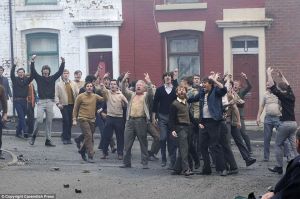
Essentially thrown in at the deep end, their disorientation and fear spirals as they are confronted first by women banging dustbin lids on the ground (to warn fellow Republicans that British soldiers are approaching) and then by an increasingly angry mob. Hook gets cut off from his fellow soldiers when he’s sent after a boy who has snatched a rifle and, following the regiment’s hasty retreat, must fight for survival behind enemy lines.

I predict a riot: things turn ugly in '71

I predict a riot: things turn ugly in ’71

And while the solider tries to evade capture by hiding out (and gets a lesson in soldiering from Richard Dormer’s kindly Eamon, who describes it as “posh c***s telling thick c***s to kill poor c***s”), he becomes a pawn in a larger game being played between senior IRA members and shadowy British operatives led by Sean Harris’ Captain Browning.

Escape from Belfast: Hook (Jack O'Connell) tries to think of a way out in '71

Escape from Belfast: Hook (Jack O’Connell) tries to think of a way out in ’71

The Troubles have inspired some absorbing cinema and ’71 can sit proudly alongside the likes of Alan Clarke’s Elephant (1989), Ken Loach’s Hidden Agenda (1990) and Paul Greengrass’ Bloody Sunday (2002).While not as overtly political as those films, Gregory Burke’s economical script doesn’t ignore it either, although the briefing to senior officers prior to all hell breaking loose does come across as a little too ‘are you paying attention?’.

The film is at its strongest when following the hapless Hook as he stumbles from one terrifying episode to the next. A heart-pounding cat and mouse chase between the fleeing soldier and two gun-toting young IRA members is brilliantly done, while an explosive scene in a pub and its nightmarish aftermath as Hook staggers through what resemble the streets of hell makes you question whether he’ll make it out of there.

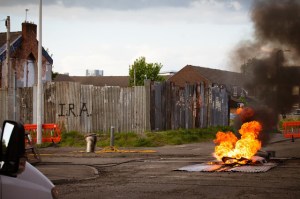
Troubles, troubles: Life in Belfast circa '71

Troubles, troubles: Life in Belfast circa ’71

Anthony Radcliffe’s immersive and atmospheric cinematography, the murky nighttime setting, David Holmes’ retro-inflected score and the questionable loyalties of its characters bring to mind Carpenter’s Assault On Precinct 13 (1976), while the against-the-odds battle to survive tips a wink to Escape From New York (1981); comparisons not made lightly, but ones that speak very highly of just how impressive ’71 is.

One of the year’s most suspenseful thrillers, ’71 is edge-of-the-seat stuff and another feather in the cap for its leading man.

Four Frames – The Godfather: Part II (1974)

This is my latest contribution to The Big Picture, the internationally recognised magazine and website that shows film in a wider context. It’s the festive season and The Big Picture is running a series of features and reviews with the theme of ‘family’. This piece is part of the Four Frames section, wherein the importance of four significant shots are discussed, in this case from Francis Ford Coppola’s ‘family’ classic The Godfather: Part II.

Keep your friends close, but keep your enemies closer. As for family, well…

Towards the end of Francis Ford Coppola’s tenebrous portrait of a family eating itself from the inside, an aghast Tom Hagen (Robert Duvall) asks his adopted brother Michael Corleone (Al Pacino) why he wants to wipe everyone out when he’s already won, to which he’s cooly informed: “I don’t feel I have to wipe everybody out, Tom, just my enemies.”

The Godfather: Part II

Just who isn’t an enemy in Don Corleone’s paranoid mind by this time is open to debate, but any hope of saving his corrupted soul from damnation evaporates when he has his own brother Fredo (Jon Cazale) killed. Fredo is a dead man walking from the moment Michael discovers his weak-willed brother has ties to Florida crime lord Herman Roth (Lee Strasberg), a former associate of their father whom Michael is convinced wants him dead.

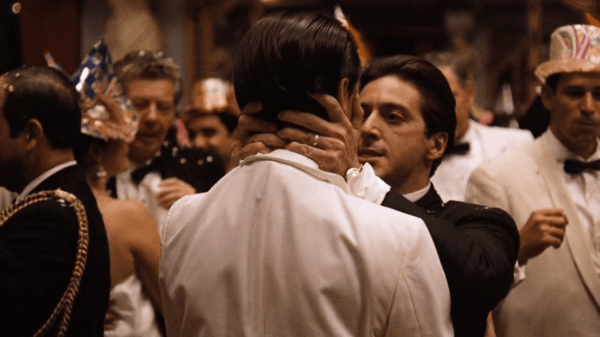
The die is cast when, during a New Year’s Eve party in Havana, Michael dramatically embraces his brother and says “I know it was you… you broke my heart”. Despite seemingly acquiescing to his sister Connie’s (Talia Shire) pleas for Fredo to be brought back into the family fold following their mother’s death, it’s mere window dressing; Fredo is nothing more than an enemy in Michael’s eyes that needs to be “wiped out”.

The Godfather: Part II

The Shakespearian tragedy of this moment is lent even greater weight when Coppola flashes back to a Corleone family dinner party almost 20 years earlier in which a wide-eyed Michael defiantly resists taking after his brothers into the ‘family business’ by announcing that he’s signed up for the Marines following the Japanese attack on Pearl Harbor. Ironically, Fredo is the only one to support his decision.

This scene evokes the Michael we meet at the start of The Godfather (1972); a man determined to live a life governed by his American future rather than his Sicilian past, which is exemplified by his relationship with Kay Adams (Diane Keaton). However, just when he thought he was out, the family business pulls him back in.

The Godfather: Part II

When Kay reminds him of his promise to make the family’s affairs legitimate within five years of becoming Don (“that was seven years ago”), Michael swears he’s doing all he can. However, cinematographer Gordon Willis’ low-lighting tells another story. Indeed, darkness gradually envelops the film as the light of hope and redemption is extinguished.

Michael comes to see Kay as little more than a vessel to produce a son in order to continue the Corleone line and a revealing moment comes when, instead of enquiring about his wife’s health after receiving news of her miscarriage, he demands to know whether it was a boy.

The Godfather: Part II

A later confrontation accentuates the irrecoverable chasm that has opened up between them. So blinded by what he has become, he is indifferent to Kay’s heartbreaking admission that “at this moment I feel no love for you at all”, but reacts with volcanic rage when she drops a bombshell about their lost child. When Michael closes the door on Kay, he is also closing the door on any future happiness.

While the family business thrives, Michael’s other family lays in ruins, a victim of ruthless ambition and rampant neurosis. Sat alone at the end of the film, dead-eyed and paralysed by vengeful enmity, we see what it has cost him.

Review – The Hobbit: The Battle Of The Five Armies

As good a writer as JRR Tolkien was, he wouldn’t have got very far in Hollywood if his description of the epic battle of orcs, elves, dwarfs, men and anyone else lying around was anything to go by.

And so we come to the end of Jackson's Middle Earth fellowship. LOTR-lite it may be, but fantasy cinema is all the richer for The Hobbit having been in it

And so we come to the end of Jackson’s Middle Earth fellowship. LOTR-lite it may be, but fantasy cinema is all the richer for The Hobbit having been in it

Passed off by Tolkien in just a few words, Peter Jackson obviously had other ideas when imagining how he’d like to conclude his stint as Middle Earth’s resident director.

It’s a decision in keeping with the whole exercise of making three movies out of a 300-page book, which is ironic when you consider he originally envisaged making two films out of The Lord Of The Rings; a three-book saga spanning more than 1,000 pages.

The loyal band of dwarfs prepare for war in The Hobbit: The Battle Of The Five Armies

The loyal band of dwarfs prepare for war in The Hobbit: The Battle Of The Five Armies

That said, Jackson has thrown everything and the kitchen sink into this final chapter of his prequel trilogy and, while there is much to enjoy, it won’t change anyone’s opinion that The Hobbit ultimately remains the poor cousin of LOTR.

We pick up where we left off last time, with the dragon Smaug (voiced by Benedict Cumberbatch) on his way from the Lonely Mountain to smite Laketown and its terrified folk. It’s a breathless opening salvo, arguably the best sequence in the entire trilogy as Bard (Luke Evans) desperately tries to bring the beast down as the town is incinerated around him.

Watching on helplessly are hobbit Bilbo Baggins (Martin Freeman) and his dwarf companions, led by Thorin Oakenshield (Richard Armitage), who disturbed Smaug’s slumber in search of untold wealth and the coveted Arkenstone, a precious gem Thorin is desperate to reclaim.

Gandalf (Ian McKellen) looks on worried in The Hobbit: The Battle Of The Five Armies

Gandalf (Ian McKellen) looks on worried in The Hobbit: The Battle Of The Five Armies

When word spreads of Smaug’s death, an elf army under Thranduil (Lee Pace) marches to the Lonely Mountain to reclaim lost treasure, while a separate force of orcs led by Azog the Defiler (Manu Bennett) also approaches. While all hell breaks loose outside the mountain, as men, dwarfs and elves go to war against the vast numbers of orcs, inside the mountain an increasingly unstable Thorin exasperates his fellow dwarfs and Bilbo by refusing to see sense.

Just as Jackson coiled the spring in the first half of The Return Of The King before unleashing CGI-infused mayhem, he employs a similar approach in The Battle Of The Five Armies. Characters look either pensive or defiant as they talk of impending war, while Jackson cranks up the expectation by regularly cutting to the orc hordes drawing ever nearer to the Lonely Mountain.

Azog the Defiler (Manu Bennett) looks his usual grumpy self in The Hobbit: The Battle Of The Five Armies

Azog the Defiler (Manu Bennett) looks his usual grumpy self in The Hobbit: The Battle Of The Five Armies

When it finally does come, the battle is everything you expect; brutal and frenzied, with seemingly endless waves of orcs pitted against the dwindling alliance. However, as visually impressive as it is, it doesn’t involve you as much as the epic battle of Helm’s Deep in The Two Towers.

The stakes may be just as high, but the clammy terror of a band of brothers fighting for their lives against an implacable army of Urak Hai is what sets Helm’s Deep apart. Too often, Jackson is content to pit CGI army against CGI army; an impressive enough site to be sure but one that will never grab you as much as seeing real people at each other’s throats.

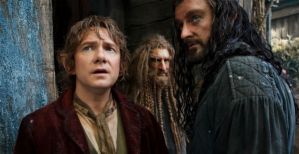
Bilbo Baggins (Martin Freeman) and Thorin Oakenshield (Richard Armitage) look worried in The Hobbit: The Battle Of The Five Armies

Bilbo Baggins (Martin Freeman) and Thorin Oakenshield (Richard Armitage) look worried in The Hobbit: The Battle Of The Five Armies

While the skirmish is the film’s key selling point, it works best when boiling things down to the struggle going on inside Thorin’s mind. Overcome by ‘dragon sickness’, his slide into mental illness is convincingly played by Armitage, who shows enough of the old Thorin to convince Bilbo (a conversation between the two that starts with an acorn is a standout) and co that he’s not gone completely off the deep end. Jackson has brilliantly played up the possessive effects ‘precious’ treasure can have on otherwise strong-willed characters throughout his Middle Earth saga and the lightning bolt moment Thorin experiences during a surreal hallucination is particularly effective.

Freeman does his best with the limited screen time Bilbo is given and lights up every scene he’s in, but once the battle kicks in he’s pretty much sidelined in favour of head-butting dwarves and snarling orcs.

Legolas (Orlando Bloom) and fellow elf Tauriel (Evangeline Lilly) go in search of orcs in The Hobbit: The Battle Of The Five Armies

Legolas (Orlando Bloom) and fellow elf Tauriel (Evangeline Lilly) go in search of orcs in The Hobbit: The Battle Of The Five Armies

Also left on the sidelines is Ian McKellen’s Gandalf, whose rescue from the clutches of Sauron by his fellow White Council members (most notably Cate Blanchett’s luminous Galadriel) is an early highlight, but feels rushed (ironic, I know). Once Gandalf joins the party at the Lonely Mountain he soon gets swallowed up in the rest of the action.

And so we come to the end of Jackson’s Middle Earth fellowship. LOTR-lite it may be, but fantasy cinema is all the richer for The Hobbit having been in it.