Review – It Follows

With a premise that’s as ingeniously simple as it is terrifying, David Robert Mitchell’s masterful low-budget chiller stalks our primal fears with a potency that’s all-too-rare in today’s horror cinema.

A bona fide modern horror classic, the cold, clammy sense of dread of It Follows will mean you're looking over your shoulder long after the credits roll

A bona fide modern horror classic, the cold, clammy sense of dread of It Follows will mean you’re looking over your shoulder long after the credits roll

The brilliance of It Follows is in the way it borrows from the likes of John Carpenter’s Halloween (1998), Ringu (1998) and Whistle And I’ll Come To You (1968), the little-seen screen adaptation of M.R. James’ classic short story, and comes up with something that’s both refreshing and bloodcurdling.

Based on a recurring nightmare Mitchell experienced as a child, the horror of It Follows stems from the spine-tingling concept of being pursued by an unrelenting figure that only the victim can see.

Jay (Maika Monroe) gets way more than she bargained for thanks to Hugh (Jake Weary) in It Follows

Jay (Maika Monroe) gets way more than she bargained for thanks to Hugh (Jake Weary) in It Follows

Mitchell’s script injects sex into the equation, both as a nod to the horror trope of punishing those who engage in intercourse, but also as a sideways observation on the consequences of sexually transmitted disease; in this case one spread as a deadly curse that can only be lifted by having sex with another person.

The film’s disturbing prologue tracks a terrified teenage girl who perplexes her father by running out of her house and speeding off in the family car; all the while looking behind her at what appears to be nothing.

Another victim of 'it' in It Follows

Another victim of ‘it’ in It Follows

The grisly aftermath points to something very real, however, and the next teenager on the chopping block is Jay (Maika Monroe), whose sexual encounter with Hugh (Jake Weary) takes a disturbing turn when she’s informed she’s now the target of a malevolent figure that will stalk and kill her unless she passes the curse onto someone else.

Despite not being able to see the supernatural figure, which constantly changes its appearance, Jay’s sister Kelly (Lili Sepe) and friends Paul (Keir Gilchrist), Yara (Olivia Luccardi) and Greg (Daniel Zovatto) come to her aid and try to find a way to stop Jay’s relentless pursuer.

Scared

Scared

In the wrong hands, this could so easily have been just another limp-wristed horror flick, but Mitchell gives us a genuinely taut and unnerving experience. The use of the camera is inspired; from the artful 360-degree pans which are as slow and methodical as the assailant, to the way he cuts between tight close-ups and empty corridors or doorways that invite us to imagine the worst is just out of shot. Furthermore, Mike Gioulakis’ oppressive cinematography uses light and dark to terrific effect.

A superbly edited sequence on a beach leads to a – literally – hair-raising moment, while a key sequence in a swimming pool is a masterclass in grinding tension.

Scared #2

Scared #2

It Follows distinguishes itself from the crop of lazily edited cash-grabbing products loosely defined as ‘horror’ by giving us characters we actually care about. Jay is sympathetically played by Monroe and the friendship she shares with the others is believable and engaging.

One of the film’s strongest threads is its jagged and percussive synth score by Disasterpeace that evokes the very best of Carpenter and serves to amp up the terror rather than smother it, while geek fans will note the use of the Serif Gothic font in the title is a further nod to Carpenter’s Halloween.

A bona fide modern horror classic, the cold, clammy sense of dread of It Follows will mean you’re looking over your shoulder long after the credits roll.

Four Frames – Ace In The Hole (1951)

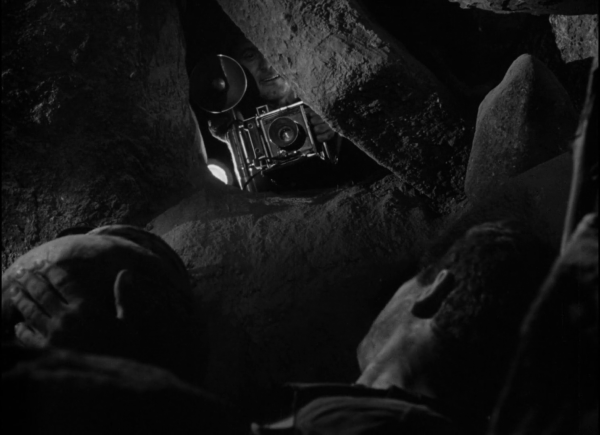
This is my latest contribution to The Big Picture, the internationally recognised website that shows film in a wider context. It’s awards season and The Big Picture is running a series of features and reviews with the theme of ‘fame’. This piece is part of the Four Frames section, wherein the importance of four significant shots are discussed, in this case from Billy Wilder’s underseen classic Ace In The Hole.

Anyone who thought Billy Wilder’s savagely cynical noir about a disgraced journalist’s search for a career-rejuvenating scoop was too sensational need only recall 2010’s media circus that surrounded the plight of the 33 trapped Chilean miners.

The sight of hundreds of rubberneckers flanked by publicity-hungry officials and hordes of reporters dowsing the crisis at ‘Camp Hope’ with high drama and low rhetoric is sadly reflective of the tasteless carnival that plays out in Ace In The Hole (1951).

Ace In The Hole

Its orchestrator is Kirk Douglas’ fanatically single-minded Chuck Tatum, a down-at-heel ex-New York hack whom we meet being towed into little ‘ole Albuquerque in New Mexico, sitting in the hitched-up car defiantly reading a copy of the local Albuquerque Sun-Bulletin and carrying himself with an arrogance that’s as audacious as it misplaced.

Tatum is taken on by the paper’s principled editor (Porter Hall) despite ridiculing it (“even for Albuquerque, this is pretty Albuquerque”), mocking the secretary’s hand-stitched motto “tell the truth” and making it clear he’ll only be around as long as it takes him to sell a big story and win a place back in the big leagues.

Ace In The Hole

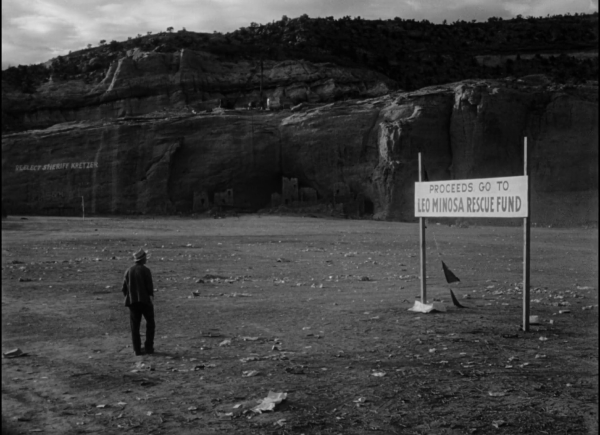
After a year of scraping around, Tatum stumbles across his scoop when he learns of a man, Leo Minosa (Richard Benedict), who has become trapped inside a mountain tunnel whilst searching for Native American relics. We straight away see the wheels turning in Tatum’s eyes as he sensationalises the story (“Ancient curse entombs man”) and sells promises of celebrity to the corruptible local sheriff (Ray Teal) in order to lean on a contractor to spin out the rescue effort for dramatic effect.

The Big Carnival (as the film was initially renamed just prior to its release) quickly descends, with people herding to the ‘cursed’ mountain to gawp at the ensuing drama, while good old fashioned American capitalism cranks into gear, with car parking charges, a fairground and stalls selling distasteful Native American headdress and copies of the lyrics of a swiftly penned song about Leo’s rescue.

Ace In The Hole

Also benefiting is Leo’s callous wife Lorraine (the fantastic Jan Sterling), who couldn’t care less about her stricken husband and wants to run away to the big city, but is convinced to hang around by the ringing tills of her diner and Tatum’s forceful persuasion. Lorraine realises she’s met her match in the tabloid hack (“I’ve met a lot of hard boiled eggs in my time, but you’re 20 minutes”) and a volatile game of mutually assured destruction plays out between the two of them.

Douglas was once quoted as saying that he’d “made a career out of playing sons of bitches” and none are more repellent than the force-of-nature that is Chuck Tatum, a natural born deceiver who lives by the adage that “bad news sells best, because good news is no news”.

Ace In The Hole

Realising the story may not pan out exactly how he’d first intended, Tatum suddenly seems to want to do the right thing by Leo, but you suspect it’s more out of a sense of self-preservation than guilt. Besides, it’s way too late to put the genie back in the bottle and once the circus leaves town, no-one cares anymore.

A work of all-too-sad relevance that hasn’t aged a day, the brilliance of Ace In The Hole is in the way it reflects the very worst of the Fourth Estate right back on us and our own morbid curiosity.

Review – Ex Machina

The irony cannot be lost on Alex Garland that the release of his efficiently tense sci-fi parable about the dangers of playing god should follow Stephen Hawking’s apocalyptic warnings that mankind is ushering in its own doom with its unquenchable drive towards creating thinking machines.

Although hardly original, Ex Machina asks enough of the right questions to make it an enticing and worthy addition to the sci-fi canon

Although hardly original, Ex Machina asks enough of the right questions to make it an enticing and worthy addition to the sci-fi canon

While Hawking is more inclined to go down the road of judgement day when the moment of so-called ‘singularity’ arrives and machines finally gain conscious thought and the ability to reproduce, Garland has been quoted as saying that his sympathies ultimately lie with the robots rather than their creators.

It’s a philosophy that courses through the circuits of his low-key directorial debut Ex Machina, wherein computer coder Caleb (Domhnall Gleeson) wins a week with his boss Nathan (Oscar Isaac), the reclusive billionaire owner of Bluebook, the world’s most popular search engine.

Guns out: Nathan (Oscar Isaac) shows seven-stone weakling Caleb (Domhnall Gleeson) how to do it in Ex Machina

Guns out: Nathan (Oscar Isaac) shows seven-stone weakling Caleb (Domhnall Gleeson) how to do it in Ex Machina

Nathan has brought Caleb out to his wayward mountain estate in order to perform the Turing Test on his experimental humanoid cyborg Ava (Alicia Vikander) to determine whether she/it can exhibit intelligent behaviour and pass herself/itself off as human.

In spite of the glass wall between them, Caleb and Ava form a bond that both troubles and allures the young programmer and this soon evolves into something far more complicated as questions over Nathan’s real motives start to emerge.

I Robot: Ava (Alicia Vikander) learns more about herself in Ex Machina

I Robot: Ava (Alicia Vikander) learns more about herself in Ex Machina

Ever since Dr Frankenstein brought life to his creation in Mary Shelley’s 1818 novel, writers and filmmakers have been fascinated by the dangers and enticements of playing god. This took the form of robots in Fritz Lang’s masterful Metropolis (1927) and has been spelling our doom ever since, most notably in The Terminator (1984); the film Hawking possibly most thinks reflects where we’re headed.

While acknowledging the tech fear of The Terminator et al, Garland’s chamber piece is more concerned with exploring the impact Ava’s behaviour has on the two men. When Ava subtly flirts with Caleb, he cannot help responding in kind in spite of himself. Likewise, when Caleb asks his boss why he’s sexualised his robot, Nathan the computer scientist gives a suitably technical response, while Nathan the red-blooded male follows it up with a playful shrug and an explanation that sex serves a primary purpose.

Caleb (Domhnall Gleeson) - not replacing a contact lens - in Ex Machina

Caleb (Domhnall Gleeson) – not replacing a contact lens – in Ex Machina

Cooped up for all intents and purposes in a glass prison, we inevitably start to feel sympathy for Ava and it’s to the film’s credit that as it morphs into a tech-thriller and tries to throw us off the scent, that emotional engagement is maintained.

Vikander gives a wholly convincing performance as Ava and invests the cyborg with a complexity befitting such a well-rounded character. Her movement is both graceful and artificial and brings to mind Haley Joel Osment’s underrated turn as David, the robot who just wants to be a boy in A.I: Artificial Intelligence (2001).

Ava (Alicia Vikander) and Caleb (Domhnall Gleeson) bond in Ex Machina

Ava (Alicia Vikander) and Caleb (Domhnall Gleeson) bond in Ex Machina

The chameleonic Isaac is typically excellent as Nathan, whose arrogance and petulance are matched by his pathetic weirdness, not least during a drunken disco dance with his mute servant Kyoko (Sonoya Mizuno) which is as odd as it is amusing. Meanwhile, Gleeson (who will be teaming up again with Isaac in that other sci-fi movie later this year) builds upon his recent good work in Frank and Unbroken with another solid turn as the somewhat overwhelmed programmer who starts to question his own humanity as the truth of what is happening takes hold.

Although hardly original, Ex Machina asks enough of the right questions to make it an enticing and worthy addition to the sci-fi canon.

Review – Kingsman: The Secret Service

After giving superheroes a boot in the Thunderballs with Kick Ass, Matthew Vaughn turns his Goldeneye onto the spy flick with typically brash and boisterous results.

It may not reach the heights of Kick Ass, but Kingman: The Secret Service is so unashamedly over-the-top it's hard not to sign up to its licence to thrill

It may not reach the heights of Kick Ass, but Kingman: The Secret Service is so unashamedly over-the-top it’s hard not to sign up to its licence to thrill

Vaughn’s unique style has won him a legion of admirers since his much-loved 2004 debut Layer Cake; the film that went a long way to bagging its star Daniel Craig the iconic role of James Bond, who in a neatly circular turn of events is the primary influence for Kingsman: The Secret Service.

Hoping to capture lightning in a bottle for a second time following the success of Kick Ass (2010), Vaughn and co-screenwriter Jane Goldman have once again teamed up with Mark Millar to loosely adapt another of his comic book series.

Spy Harry Hart (Colin Firth) creates holy hell in Kingsman: The Secret Service

Spy Harry Hart (Colin Firth) creates holy hell in Kingsman: The Secret Service

While Millar’s comic was set within the world of MI6, the movie decides to go even more super-secretive by focusing on the Kingsman, a spy agency so covert that 007 himself probably doesn’t know about them.

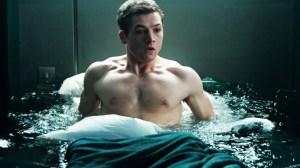
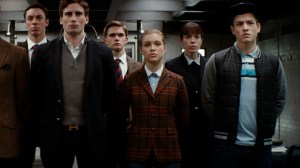
Influenced by Arthurian legend, the Kingsman are led by a round table of gentlemen spies, including Arther (Michael Caine) and Galahad, aka Harry Hart (Colin Firth). When one of their own is killed in action, Hart takes mouthy street kid Eggsy (Taron Egerton) under his wing and convinces him to go up against other young hopefuls to replace the fallen spy.

Eggsy (Taron Egerton) in deep water in Kingsman: The Secret Service

Eggsy (Taron Egerton) in deep water in Kingsman: The Secret Service

Tech tycoon Richmond Valentine (Samuel L Jackson), meanwhile, is busy trying to take over the world and it falls on what’s left of the Kingsman to put a stop to his ultra-sinister plan.

The spy movie has hardly been short of a spoof or two; hell, the godfather James Bond was sending it up most of the time during the Roger Moore years. Kingsman takes its cue from that era; from the poster which is a direct pastiche of For Your Eyes Only to the high concept plotline that really took hold during Moore’s era.

Dot com douchebag Richmond Valentine (Samuel L Jackson) in Kingsman: The Secret Service

Dot com douchebag Richmond Valentine (Samuel L Jackson) in Kingsman: The Secret Service

Alongside the numerous nods to Bond, there are other homages to a well-trodden genre, including The Avengers‘ (no, not that one) John Steed with the Saville Row-besuited league of gentlemen spies and liberal use of umbrellas.

While the tips of the bowler hat to 007 and co are plentiful, Vaughn and Goldman’s self-referential script is also at pains to have its cake and eat it by having its characters remind each other that “this isn’t that kind of movie” shortly before endeavouring to pull the rug out from under our feet.

The recruits striving to become a Kingsman in Kingsman: The Secret Service

The recruits striving to become a Kingsman in Kingsman: The Secret Service

The most glaring way Kingsman “isn’t that kind of movie” is through the colourful use of Anglo saxon (much like Kick Ass). As occasionally amusing as it is (pretty much every sentence uttered by Jackson drops an f-bomb; and we all know how gleefully Sammy invokes the use of that word), you suspect the thinking behind it is to see how far it can be pushed and to give us a spy drama with the shackles removed. This admittedly works quite nicely when Arthur’s well-spoken demeanour disappears at one point and the foul-mouthed cockney lurking under the surface is exposed.

The offhand ultra violence that marked Kick Ass out as a bold piece of filmmaking is also in plentiful supply here. An early bust-up in a pub is the aperitif to an unholy bloodbath in a right-wing Christian church to the tune of Lynyrd Skynyrd’s Freebird that reaches Old Testament levels of brutality and sees the camera get stuck in to the ensuing carnage.

'King' Arther (Michael Caine) in Kingsman: The Secret Service

‘King’ Arther (Michael Caine) in Kingsman: The Secret Service

This, and later fight scenes have a balletic quality John Woo would be proud of, although the final assault on Valentine’s secret lair by Mark Strong’s Q-esque Merlin and Eggsy leaves you wondering at what point the former tearaway learned such gracefully merciless close quarters fighting techniques (we’re left to assume he’s picked this up as the film never bothers to show us).

While it has plenty of nice touches, in particular the casting of Mark Hamill as a very convincing English professor (in the comic, the terrorists abduct an environmental scientist called Mark Hamill), it ends on a bum note with a moment of pantomime absurdity that makes Q’s infamous line from Moonraker – “I think he’s attempting re-entry sir” – seem like a moment of restraint worthy of Bergman.

It may not reach the heights of Kick Ass, but Kingman: The Secret Service is so unashamedly over-the-top it’s hard not to sign up to its licence to thrill.

Review – Birdman

At one point in Alejandro González Iñárritu’s fluidic and freewheeling latest a character points out to Michael Keaton’s actor-on-the-edge-of-a-nervous-breakdown that he “confuses love for admiration”.

Birdman is a very good piece of work, at times brilliant; I just wish I could have soared with it as much as I'd hoped

Birdman is a very good piece of work, at times brilliant; I just wish I could have soared with it as much as I’d hoped

It’s a charge that can be levelled at Birdman; a whirlwind of industrial wizardry and an actor’s dream that’s very easy to admire, but more difficult to love.

It will be fascinating to see how Birdman is regarded in five or 10 years time. Iñárritu has a habit of making films that profess to profundity at the time of release, but come to be dismissed as the river of time flows; his English-language debut 21 Grams (2003) and its emperor’s new clothes follow-up Babel (2006) in particular.

Riggan Thomson (Michael Keaton) and his nemesis/alter ego in Birdman

Riggan Thomson (Michael Keaton) and his nemesis/alter ego in Birdman

One suspects his latest will weather more favourably, if for no other reason than the career-defining central performance by Keaton, an actor whose scarcity in front of the camera is all-the-more tragic in light of his turn as the calamitous and anxiety-ridden Riggan Thomson.

Thomson has ploughed his finances and fragile soul into staging a Broadway adaptation of a Raymond Carver short story in the hope of injecting new life into a flagging career defined by playing the superhero Birdman in a series of big budget movies.

Riggan Thomson (Michael Keaton) prepares for opening night with fellow actor Lesley (Naomi Watts) and lawyer Jake (Zach Galifianakis) in Birdman

Riggan Thomson (Michael Keaton) prepares for opening night with fellow actor Lesley (Naomi Watts) and lawyer Jake (Zach Galifianakis) in Birdman

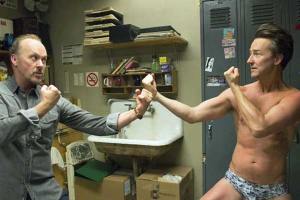
His troupe of actors includes the deeply insecure Lesley (Naomi Watts) and the revered, but unpredictable Mike Shiner (Edward Norton), while backstage his best friend and lawyer Jake (Zach Galifianakis) tries to keep the production afloat and he struggles to connect with his daughter Sam (Emma Stone). With opening night fast approaching, the cracks in Riggan’s splintered psyche start to widen and the voice of Birdman in his head manifests itself in his everyday life.

Keaton has spoken in interviews of the huge technical demands placed on the cast to ensure they hit their marks so as not to spoil one of cinematographer Emmanuel Lubezki’s lengthy shots, which have been masterfully stitched together to give the impression of a single, unbroken take.

Riggan Thomson (Michael Keaton) goes toe-to-toe with method actor Mike Shiner (Edward Norton) in Birdman

Riggan Thomson (Michael Keaton) goes toe-to-toe with method actor Mike Shiner (Edward Norton) in Birdman

As a technical feat, it’s second-to-none and Lubezki deserves his plaudits for a job very well done. However, the many tricks Birdman has up its sleeves end up getting in the way of the film itself and become a distraction from the character-led comedy drama going on in spite of everything else. Similar accusations have been levelled on Wes Anderson’s work, which has often divided critics and filmgoers alike.

The film has some interesting things to say about what constitutes art in the social media age and cheekily gives Thomson the final word when confronted by an embittered theatre critic (played by Lindsay Duncan) who promises to wield the Sword of Damocles on the play because she hates what he stands for.

Riggan Thomson's long-suffering daughter Sam (Emma Stone) in Birdman

Riggan Thomson’s long-suffering daughter Sam (Emma Stone) in Birdman

By focusing so tightly on the emotionally fractured Thomson, Iñárritu asks us to question what is and isn’t real, right until the film’s final shot. Meanwhile, the presence of Birdman is akin to a winged devil on his shoulder whom Thomson must confront if he is to salvage his imploding soul.

Bottled up within the claustrophobic confines of the theatre for the most part, the wild ride the camera takes is matched by Antonio Sánchez’s jittery jazz drum score, which rattles around in the head, but doesn’t distract as much as some critics have suggested.

Birdman is a very good piece of work, at times brilliant; I just wish I could have soared with it as much as I’d hoped.