Review – Inherent Vice

There’s a moment in Paul Thomas Anderson’s chaotically brilliant latest when Joaquin Phoenix’s perennially baked private detective asks someone what inherent vice is, only to be told “I don’t know”.

Like much of Anderson's work, Inherent Vice will undoubtedly reward repeated viewings and, though not his finest picture, it remains an experience to inhale and imbibe

Like much of Anderson’s work, Inherent Vice will undoubtedly reward repeated viewings and, though not his finest picture, it remains an experience to inhale and imbibe

It’s a telling exchange in a film that’s stuffed with plot threads, but is enjoying itself way too much to want to stitch them together into a traditional narrative. As whacked out as Inherent Vice is, though, it is filmmaking on a higher plane of existence that reinforces PTA’s credentials as one of cinema’s most distinctive and timeless auteurs.

The 70s are generally regarded as a paranoid come down from the flower-powered counterculturalism of the previous decade, but it’s also the same decade that produced the New American Cinema and Inherent Vice is a wistful and melancholic throwback to such classic ’70s revisionist detective films as The Long Goodbye and Chinatown.

Ouija believe it: 'Doc' Sportello (Joaquin Phoenix) with Sortilège (Joanna Newsom) and Shasta (Katherine Waterston) in Inherent Vice

Ouija believe it: ‘Doc’ Sportello (Joaquin Phoenix) with Sortilège (Joanna Newsom) and Shasta (Katherine Waterston) in Inherent Vice

This mood is mirrored by the film’s evocative soundtrack, that includes Harvest and (appropriately enough) Journey Through The Past by Neil Young, whose mutton chops and wide-brimmed hat provided the visual way into the California dreamin’ character of Larry ‘Doc’ Sportello for Phoenix.

Doc is hired by ex-girlfriend Shasta (Katherine Waterston) to look into the disappearance of her wealthy real estate lover Mickey Wolfmann (Eric Roberts). As Doc disappears down the rabbit hole, his increasingly mind-altering investigation takes in black activists, nazi bikers, double agents, dodgy dentists, a weird cult (shades of his 2012 film The Master) and something called the Golden Fang. Meanwhile, hippie-hating LAPD Detective Christian F. ‘Bigfoot’ Bjornsen (Josh Brolin) makes his presence known from time-to-time and proves to be a curious love/hate companion to the shambling Doc.

What's up Doc: Private detective 'Doc' Sportello (Joaquin Phoenix) in Inherent Vice

What’s up Doc: Private detective ‘Doc’ Sportello (Joaquin Phoenix) in Inherent Vice

Anderson’s free-spirited adaptation of Thomas Pynchon’s novel fits perfectly with the tone and mood of a film that, whilst not as goofy as the misleading trailer would have you believe, nevertheless has plenty of laughs courtesy of Phoenix’s irresistible central performance. His hilariously over-the-top reaction to a picture of a baby is priceless, while his irreverent scribbles during interviews and exchanges with Brolin’s square-jawed square are among the film’s many highlights.

Me and my shadow: 'Doc' Sportello (Joaquin Phoenix) and Detective 'Bigfoot' Bjornsen (Josh Brolin) in Inherent Vice

Me and my shadow: ‘Doc’ Sportello (Joaquin Phoenix) and Detective ‘Bigfoot’ Bjornsen (Josh Brolin) in Inherent Vice

Anderson and Phoenix counteract this with moments of introspection, not least of which when he periodically looks out the window of his ramshackle beach house with a nostalgic yearning for a time that is already fading into memory; or chats with the wise Sortilège (Joanna Newsom); a character whom you suspect is possibly a figment of Doc’s febrile imagination bearing in mind her sudden appearances and disappearances and the fact nobody else interacts with her.

Phoenix is given plenty to work opposite a stellar cast, all of whom are able to put flesh on the bones of their characters thanks to PTA’s Oscar-nominated screenplay. Martin Short leaves you wanting more from his all-too-brief cameo as deranged tooth doctor Rudy Blatnoyd, while the excellent Waterston floats along as flower child femme fatale Shasta; the love of Doc’s life who may or may not be the best thing for him.

Inherent Vice does da Vinci's The Last Supper

Inherent Vice does da Vinci’s The Last Supper

Individual frames also lodge themselves in the mind; not least of which a throwaway moment around a busy dining table involving Owen Wilson’s missing-believed-dead Coy that looks like it’s lifted straight from da Vinci’s The Last Supper.

Like much of Anderson’s work, Inherent Vice will undoubtedly reward repeated viewings and, though not his finest picture, it remains an experience to inhale and imbibe.

Great Films You Need To See – Secretary (2002)

This is my latest contribution to The Big Picture, the visually focused film magazine that proves there’s more to film than meets the eye. The Big Picture is running a series of features and reviews throughout March with the theme of ‘sexuality’. This piece is part of the site’s Lost Classics section (featuring in my list of Great Films You Need To See), in this case Steven Shainberg’s S&M-flavoured romance Secretary.

Long before the box office submitted to the inevitable adaptation of E.L James’ mummy porn juggernaut, another, altogether more fascinating Mr Grey indulged in a spot of big screen sadomasochism.

A film that doesn't allow itself to be dominated by its subject matter, Secretary is a sweet and gentle romance between kindred spirits, albeit one with an off-kilter and subversive outlook

A film that doesn’t allow itself to be dominated by its subject matter, Secretary is a sweet and gentle romance between kindred spirits, albeit one with an off-kilter and subversive outlook

It helps that the Mr Grey of Steven Shainberg’s Secretary (2002) is played by jittery genius that is James Spader, whose career has been mottled with sexually dysfunctional types, from his impotent voyeur in Sex, Lies And Videotape (1989), to his character’s penchant for amputees in Crash (1996).

A nother day at the office for Lee Holloway (Maggie Gyllenhaal) in Scretary

A nother day at the office for Lee Holloway (Maggie Gyllenhaal) in Scretary

His is the perfect casting for the eccentric attorney; an obsessive-compulsive misfit who finds his soul mate in Maggie Gyllenhaal’s equally damaged Lee. Fresh out of a psychiatric hospital following a long period of self-harm, Lee soon returns to her masochistic ways in the miserable company of her hard-drinking father and meek, downtrodden mother. She responds to a job advert for a secretary at Grey’s low-rent office (an oft-sought vacancy, presumably, due to the illuminated sign out front) and the pair slowly attune to each other’s wavelength; which just happens to involve acts of BDSM.

The film’s prologue features Lee in bondage performing menial office tasks, before flashing back six months to her leaving hospital. The sight of Lee stapling paper using her chin and fixing up a cup of coffee with her arms bound to a pole is treated matter-of-factly but nevertheless threatens the prospect of a nudge-nudge sex comedy (the misjudged poster also doesn’t help).

Eccentric attorney E. Edward Grey (James Spader) in skulking mode in Secretary

Eccentric attorney E. Edward Grey (James Spader) in skulking mode in Secretary

But Shainberg wisely avoids the trap of winking at the audience or going over-the-top thanks to a script that treats its characters with a tenderness and understanding they have been longing for all their lives and finally find with each other.

The Red (actually purple) Riding Hood cloak the wide-eyed Lee wears when she first enters what we assume is the wolf’s lair of Grey’s office is nicely subverted when we see him frantically checking his hair, asking awkward, inappropriate questions of his would-be employee and revealing his carefully manicured orchids; a none-too-subtle symbol of his own fragility.

Interesting...

Interesting…

The film is careful not to rush what is a complex relationship, with their guarded fascination with each other signalled by lascivious glances that suddenly explode into something more extreme as Grey’s dominant demands for perfection from the willfully submissive Lee play out in increasingly intense ways. This extends beyond the office, to the extent whereby he instructs her on how many peas to put on her plate, to the bafflement of her family.

There are other nice touches, particularly between Lee and timid childhood friend Peter (Jeremy Davies) whom she falls into a relationship with to the delight of their parents. Lee’s frustration with the unassuming Peter is palpable, while the look on her face when she spies his picture during a masturbatory fantasy about her boss is priceless.

Office work takes a turn for boss E. Edward Grey (James Spader) and his Secretary Lee Holloway (Maggie Gyllenhaal)

Office work takes a turn for boss E. Edward Grey (James Spader) and his Secretary Lee Holloway (Maggie Gyllenhaal)

In a breakout performance, Gyllenhaal takes Lee on an involving journey from a child-like waif controlled by her illness, to someone who knows what – and who – she wants and is more than prepared to do what is necessary to get it.

Spader, who reportedly adopted the same hot/cold demeanour with Gyllenhaal off set as Grey has with Lee, is typically hypnotic; all slow, hushed tones and coiled mannerisms that erupt into moments of sexual expression that appear to surprise and thrill him in equal measure.

A film that doesn’t allow itself to be dominated by its subject matter, Secretary is a sweet and gentle romance between kindred spirits, albeit one with an off-kilter and subversive outlook.

Review – Chappie

Humanity’s last hope may not be human as the poster to Neill Blomkamp’s latest dramatically implies, but it also isn’t any good.

A mess from start to finish, Chappie adds to the growing body of evidence that suggests Blomkamp is nothing more than a one-trick pony

A mess from start to finish, Chappie adds to the growing body of evidence that suggests Blomkamp is nothing more than a one-trick pony

Instead, Chappie is a mess; a further misguided step backwards in what was once a career full of real promise for its writer-director.

In promoting the film, Blomkamp has taken the admirably honest approach of conceding that he “f**ked up” his previous picture Elysium (2013) by not having developed a strong enough narrative and script out of what was a promising concept.

Chappie's creator Deon (Dev Patel)

Chappie’s creator Deon (Dev Patel)

The same charge can also be levelled at Chappie; an intriguing idea crippled by a shoddy script and a tone that drunkenly veers between family friendly cutesiness and over-the-top sweary violence; usually involving a pair of ridiculous cartoon gangstas played by South African rappers Die Antwoord.

Blomkamp returns to his native Johannesburg for this near-future parable in which robots have been purchased from multi-national weapons manufacturer Tetravaal by the police to help restore order to the streets. Their creator Deon (Dev Patel) goes one better and develops the world’s first artificial intelligence, which he installs into a terminally damaged droid he’s stolen from his employers. However, the ‘bot is droid-napped by street thugs who want to use it to help them pull a heist, but don’t count on forming an emotional attachment to the sentient cyborg, which they name Chappie.

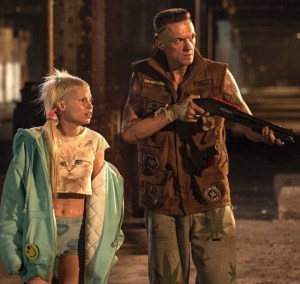
Street thugs Ninja (Ninja) and Yolandi (Yolandi Visser) in Chappie

Street thugs Ninja (Ninja) and Yolandi (Yolandi Visser) in Chappie

The social awareness that gave Blomkamp’s 2009 debut District 9 and the first half of Elysium its edge is nowhere to be seen here; rather the film paints with broad strokes (weapons manufacturers are bad and only care about money, in case you may have suspected otherwise) and lacks the satirical edge of his previous work.

Sections of the film simply make no sense, such as how on earth Deon is able to smuggle both a droid and the all-important ‘guard key’ out of a (supposedly) highly secure weapons firm without being spotted, and for it to take several days before someone finally realises it’s gone.

Vincent Moore (Hugh Jackman), a surefire Best Hair 2016 Oscar winner, in Chappie

Vincent Moore (Hugh Jackman), a surefire Best Hair 2016 Oscar winner, in Chappie

Likewise, it’s not clear exactly what Tetravaal employee Vincent Moore (Hugh Jackman, great hair) is doing at the company bearing in mind his attack robot ‘the MOOSE’ (a shameless homage to ED-209 from RoboCop, to which Chappie owes a huge debt) has been sidelined by the firm’s CEO (Sigourney Weaver, looking lost). He also strolls around the office with a gun, which one imagines would contravene health and safety guidelines.

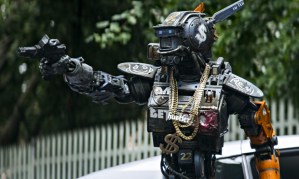
The character of Chappie itself is vividly realised by Weta Digital and the motion capture blends seamlessly into the environment. Unfortunately, Blomkamp regular Sharlto Copley delivers an exaggerated performance in the mo-cap suit that soon becomes annoying.

Chappie (Sharlto Copley) goes all street

Chappie (Sharlto Copley) goes all street

However, it’s not nearly as aggravating as the turns put in by Ninja and Yolandi Visser as Chappie’s street outlaw ‘mummy’ and ‘daddy’. Resembling rejects from Mad Max, both (Ninja especially) are desperately out of their depth and struggle to register a single convincing emotion between them. A moment towards the end with Ninja on his knees, arms outstretched and screaming in anger (in slow motion no less), is already a low point in 2015 cinema.

The wooden spoon is reserved, though, for Brandon Auret, whose ludicrous performance as crimelord Hippo is so bad it’s almost passable. Served with awful dialogue (which is subtitled even though it’s perfectly understandable), Auret’s wild-eyed gurning provides the biggest laughs as he roars, on more than one occasion, “I want EVERYTHING!”.

A mess from start to finish, Chappie adds to the growing body of evidence that suggests Blomkamp is nothing more than a one-trick pony.

Great Films You Need To See – Dark Star (1974)

Before he became a master of horror, John Carpenter went where no hippie had gone before with his gloriously goofy sci-fi debut that put the space into spaced out.

A cult classic in the truest sense, Dark Star's slacker sci-fi is smarter than its cheap and cheerful veneer lets on and deserves its place on the shelf alongside the greats of the genre

A cult classic in the truest sense, Dark Star’s slacker sci-fi is smarter than its cheap and cheerful veneer lets on and deserves its place on the shelf alongside the greats of the genre

In the wake of 2001: A Space Odyssey (1968) and Solaris (1972), science fiction had entered a new, grown up phase, one where contemplation and big ideas had replaced explosions and cheap entertainment.

For Carpenter and fellow University of Southern California student Dan O’Bannon, Kubrick’s masterpiece represented a summit they could never hope to reach. In response, they cobbled together $60,000 and made Dark Star, a film that may represent the mirror image of 2001, but has proved just as influential.

Pinback (Dan O'Bannon), Doolittle (Brian Narelle) and Boiler (Cal Kuniholm) - the crew of Dark Star

Pinback (Dan O’Bannon), Doolittle (Brian Narelle) and Boiler (Cal Kuniholm) – the crew of Dark Star

Without the budget to lavish on grand sets or grander special effects, Carpenter and fellow screenwriter O’Bannon came up with the inspired notion of injecting a dose of blue-collar mundanity to their vision of space travel.

Think about it for a moment; who would you expect to see being sent on a 20-year mission to blow up unstable planets in systems marked out for future human colonisation? Dark Star’s crew – Doolittle (Brian Narelle), Pinback (O’Bannon), Boiler (Cal Kuniholm) and Talby (Dre Pahich) – are the other guys; the ones who do the donkey work so that others more glamorous and well-paid than themselves can take all the credit.

State of the art special effects, ahem, in Dark Star

State of the art special effects, ahem, in Dark Star

This ‘truckers in space’ approach has been used in numerous sci-fi movies since, most notably in the O’Bannon-scripted Alien (1979), while Carpenter himself has elaborated on the blue-collar Joe Schmoe concept in The Thing (1982). Anyone who’s watched Ghostbusters will also spot where that film got its idea for Murray and co’s jumpsuits.

The shorthand dialogue and bored, petty resentments between the crew, especially from the highly strung Pinback, are completely plausible, as is their unkempt appearance. After all, with only each other for company, why bother cutting your hair or trimming your beard?

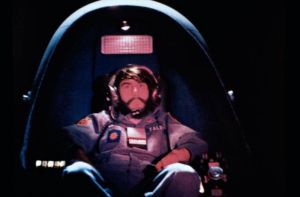
The solitary Talby (Dre Pahich) in Dark Star

The solitary Talby (Dre Pahich) in Dark Star

Shoulder-shrugging observations about the deteriorating state of the ship are another nice touch, such as Doolittle’s ship’s log report about the Dark Star’s stock of toilet rolls blowing up thanks to a computer malfunction; a previous explosion which has destroyed their sleeping quarters; and the ship’s complement of talking bombs, which have become increasingly unpredictable and are responsible for the film’s darkly humourous final act.

The mind-numbing length of their mission also suggests itself in nicely observed exchanges and asides (“chicken again!”), with Doolittle’s admission that he can no longer remember his own first name being an amusing case in point.

The cheeky alien beachball in Dark Star

The cheeky alien beachball in Dark Star

With only a shoestring budget to play around with, the decision to use a beachball to represent a squeaky-voiced alien the crew have adopted as a mascot is brilliantly inspired. Pinback’s increasingly desperate efforts to first feed and then track down the mischievous creature is its own mini-movie; half-slapstick and half-dramatic that drives much of the film’s middle section.

Surfing on a space wave in Dark Star

Surfing on a space wave in Dark Star

The limited finances are also evident in Dark Star‘s wonky special effects, which have an old-school DIY aesthetic that gives the film an anti-establishment feel in keeping with its theme of sticking two fingers up to the Man. Meanwhile, Carpenter’s otherworldly score (a long-running constant throughout most of his oeuvre) harkens back to the sci-fi movies of his youth.

A cult classic in the truest sense, Dark Star‘s slacker sci-fi is smarter than its cheap and cheerful veneer lets on and deserves its place on the shelf alongside the greats of the genre.

Review – Blackhat

The heat is strangely missing from Michael Mann’s fumbled first foray into the mysterious playground of computer hackers.

There is much to like about Blackhat, but too many mishandled moments means you'll be reaching for the proverbial control-alt-delete buttons come the end

There is much to like about Blackhat, but too many mishandled moments means you’ll be reaching for the proverbial control-alt-delete buttons come the end

On first glance, it’s obvious what drew Mann to such material; hacking demands a methodology and an obsessiveness as life-consuming as the cops and criminals who do battle on the mean streets of the writer-director’s numerous crime movies.

The film’s release just weeks after the hack on Sony Pictures and on the back of a growing list of other big name incidents also lends the film an up-to-the-minute relevance.

It’s odd, therefore, that Blackhat never quite catches fire in the same way as his other crime thrillers, in particular Manhunter (1986), Heat (1995) and Collateral (2004).

Hathaway (Chris Hemsworth) goes on the run with Lien (Tang Wei) in Blackhat

Hathaway (Chris Hemsworth) goes on the run with Lien (Tang Wei) in Blackhat

It doesn’t help that the film starts badly with an extended visually clichéd sequence of data infecting a Chinese nuclear power plant’s systems. The intention is clear – something so small can cause something so big – but it feels old hat and the film is further blighted by indulging in other computer movies chestnuts, most notably by having screens bleep when information is typed in (what computers actually make those sounds outside of the movies?!).

Baffled by who is responsible for the power plant incident and a subsequent hack on a US trade exchange, Chinese official Captain Chen Dawai (Leehom Wang) convinces FBI Agent Carol Barrett (a typically solid Viola Davis) to temporarily release convicted coder Nick Hathaway (Chris Hemsworth, doing his best) from prison to help with the investigation. As they edge ever nearer to the truth of what is actually going on, the threat grows, as does the attraction between Hathaway and Dawai’s sister Lien (Tang Wei).

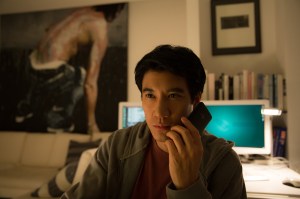
Captain Chen Dawai (Leehom Wang) is tasked with finding the hacker in Blackhat

Captain Chen Dawai (Leehom Wang) is tasked with finding the hacker in Blackhat

Blackhat grinds to a halt for the techie bits, which usually involve one or more of the cast watching the beautifully coiffured Hemsworth bash away at the keys of a computer keyboard with a stern look on his face (the fact he’s a butch alpha male is explained in a throwaway moment early on when he starts doing press-ups against the wall of his cell).

Likewise, the chemistry between Hemsworth and Tang is pretty weak and the romance between the characters is as unnecessary as that between Colin Farrell and Gong Li in the otherwise underrated Miami Vice (2006).

Viola Davis plays FBI Agent Carol Barrett in Blackhat

Viola Davis plays FBI Agent Carol Barrett in Blackhat

However, the film comes alive when it takes to the streets, dispenses with much of the dialogue and has its camera tracking the characters like a bird of prey as they go to work. An early fight in a restaurant bodes well and the promise is delivered during two fantastic gun battles; one set in a shipping yard, with the noise of bullets thudding into the containers a particular highlight, and another, bloodier exchange on the streets of Jakarta.

This latter gunfight especially reminds you of just how much of a natural Mann is when it comes to knowing where to place the (now de rigueur DV) camera while letting the raw punch of gunfire do much of the work.

Hathaway (Chris Hemsworth) has a view to a kill in Blackhat

Hathaway (Chris Hemsworth) has a view to a kill in Blackhat

The director’s neo noir style comes to the fore during the numerous night scenes in Hong Kong, which allow the director to cross between beautifully lit narrow lanes and expansive streets bathed in colour and often flanked by banner advertisements of faces or eyes that underscore the film’s tone of being watched by forces of which we have little understanding.

In addition, the momentary flash of a binocular lens on a coffee pot in one scene also underscores the difference between the ultra-professionalism of Mann’s main characters and everyone else (while also bringing to mind the moment in Heat when a cop accidentally bumps against the side of a van during a surveillance operation).

There is much to like about Blackhat, but too many mishandled moments means you’ll be reaching for the proverbial control-alt-delete buttons come the end.