Review – Bridge Of Spies
Tom Hanks plays the (sort of) spy who came in with a cold in Steven Spielberg’s effortlessly polished and absorbing character drama whose themes, sadly, still resonate as strongly today as they did more than half a century ago.
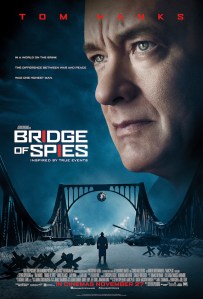
Bridge Of Spies certainly won’t leave you cold and finds Spielberg, unlike his protagonist, in rude health
While the canvas may not be as broad as some of his blockbuster fare, the dramatic stakes at the heart of Spielberg’s latest are high indeed.
Bridge Of Spies shares more than a passing similarity to the bearded one’s previous feature, Lincoln (2012) – both involve backroom negotiations driven by an idealist where potentially world-changing consequences pivot on their success or failure.
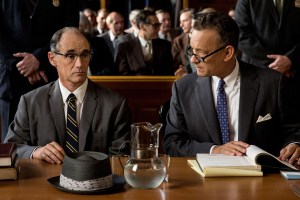
“Would it help?”: James B. Donovan (Tom Hanks) and suspected Soviet spy Rudolf Abel (Mark Rylance) in Bridge Of Spies
In this case, that responsibility falls to insurance lawyer James B. Donovan (Hanks), who takes on the defence of suspected Soviet spy Rudolf Abel (Mark Rylance) against the wishes of his wife Mary (Amy Ryan). Instead of simply going through the motions to facilitate Abel’s guilt, Donovan vigorously defends his client and marks himself out as a troublemaker by the CIA and a Soviet sympathiser by the media and wider public.
His foresight in keeping Abel away from Death Row sees him drafted in to travel to the newly walled off East Berlin in 1961 to negotiate under the radar for the exchange of Francis Gary Powers (Austin Stowell), a U.S pilot whose U-2 reconnaissance mission was dramatically curtailed.
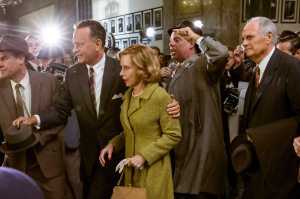
The public take against lawyer James B. Donovan (Tom Hanks) and his wife Mary (Amy Ryan) in Bridge Of Spies
For someone who has revisited World War Two so often throughout his career, it’s perhaps surprising Bridge Of Spies is Spielberg’s first Cold War movie. A desolated post-war Berlin is evocatively captured by the director and cinematographer Janusz Kamiński and the chaos surrounding the erection of a wall that would remain in place for almost 30 years is both unsettling to watch and masterfully handled.
Spielberg employs subtle touches to imply a deeper meaning, such as the use of mirrors to symbolise what is both real and illusion alongside Abel’s skill as a portrait artist to present both himself – and others – in a certain light. Abel’s sniffle at the start of the film is also nicely reflected later on when Donovan develops a cold whilst in sub-zero Berlin.
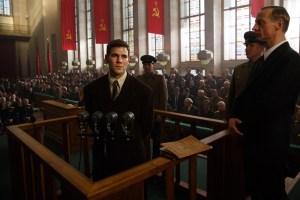
U-2 spy plane pilot Francis Gary Powers (Austin Stowell) has his day in court in Bridge Of Spies
The film’s themes of tolerance, fairness and what makes Americans American (an adherence to the U.S Constitution as Donovan not unreasonably sees it) draws inevitable parallels to events that continue to unfold in this turbulent century.
Donovan puts his head on the block in seeking to give Abel a fair trial arguing that, whilst his ideology may be anathema to that of most Americans, he remains “a good soldier” who is only doing what he believes to be right. Whether that sort of defence would be accepted by many in today’s society is among the many things that can be taken away from this spirited production.
Hanks, as always, delivers a highly watchable performance in a central role that could so easily have been played by Burt Lancaster or James Stewart had Bridge Of Spies been filmed some decades earlier. Aided by Joel and Ethan Coen’s polish of Matt Charman’s original script, Hanks has a blast in a part that allows him to deliver all-American dialogue with a twinkle in the eye.
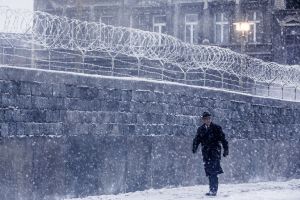
Lawyer James B. Donovan (Tom Hanks) alongside the newly constructed Berlin Wall in Bridge Of Spies
As good as Hanks is, however, he’s acted off the screen by Rylance, who has been a king of the stage for many years but now appears to be increasingly transitioning to TV and film work (let’s forget his recent cheque-chasing turn in Sean Penn’s geri-action flick The Gunman though). Employing a less-is-so-much-more technique, Rylance’s quietly inquisitively body language and measured demeanour keep you transfixed as you try to work out what’s going on behind those eyes, while his scenes with Hanks are some of the best interplay you’ll see this year.
Special mention must also go to Thomas Newman’s pleasingly restrained score. So often, Spielberg’s films are ill-served by abundant soundtracks, but Newman keeps things relatively low-key and scenes are often allowed to play out without the use of a score.
Bridge Of Spies certainly won’t leave you cold and finds Spielberg, unlike his protagonist, in rude health.











 three rows back