Review – The Big Short

The laughs may be plentiful in Adam McKay’s vigorous and impassioned dissection of the catastrophic financial crash, but the joke – as so many discovered – is ultimately on us.
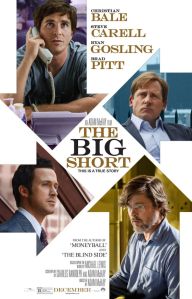
Filmmakers have largely distinguished themselves when it comes to exploring the global financial meltdown and The Big Short, although over-the-top at times, is an illustrious addition to this growing sub-genre

Filmmakers have largely distinguished themselves when it comes to exploring the global financial meltdown and The Big Short, although over-the-top at times, is an illustrious addition to this growing sub-genre

Whilst the ‘collateral damage’ caused by the fraudulent greed of so many within a morally bankrupt and deregulated industry is touched upon in McKay’s adaptation of Michael Lewis’ book, the director’s gaze is more squarely focussed on the small group of individuals who foresaw – and came to profit from – what so many others either couldn’t or didn’t want to see back in 2007.

This approach has drawn criticism in some quarters for largely ignoring the consequences meted out on ordinary folk but, much like the subprime mortgage crisis that helped fuel the collapse, the central players in The Big Short operate within their own bubble.

CRASH! Hedge funder Dr Michael Burry (Christian Bale) in The Big Short

CRASH! Hedge funder Dr Michael Burry (Christian Bale) in The Big Short

These are the other guys – to employ the title of McKay’s 2010 comedy – hedge fund manager Dr Michael Burry (Christian Bale), who is the first to realise the U.S. housing market is built on sand and uses his investors’ money to bet against it; arrogant, but smart trader Jared Vennett (Ryan Gosling), who stumbles across Burry’s predictions and smells an opportunity; Mark Baum (Steve Carell), a hedge fund manager who is repulsed by the excesses the industry has spawned but nevertheless swims with the sharks; and young investors Charlie Gellor (John Magaro) and Jamie Shipley (Finn Wittrock), who also chance upon Burry’s work and, with the help of retired banker Ben Rickert (Brad Pitt), try to make a killing on the collapse.

The film follows each group (they never come into direct contact with each other) as they defy their colleagues by betting against a AAA-rated system they are convinced is on the brink of oblivion.

Former trader Ben Rickert (Brad Pitt) finds himself back in the game in The Big Short

Former trader Ben Rickert (Brad Pitt) finds himself back in the game in The Big Short

Whilst we know the disastrous events that followed the crash when it eventually arrived in mid-2008, The Big Short takes a procedural approach by having its core cast kick over the rotting carcass that was/is the banking and housing markets and navigate their way through the chaos and bullshit that seemingly permeated every nook and cranny.

McKay paints his supporting characters in broad strokes, whether it be a pair of wildly reprehensible real estate douchebags who boast to Baum’s team about how much money they make selling snake oil to people who want their big house(s) at any cost; or Melissa Leo’s Standard and Poor’s ratings agency rep whose sight problem is a none-too-subtle metaphor for the wanton blindness of the system at large.

The irony is also palpable when several characters attend the American Securitization Forum in, of all places, Las Vegas and see for themselves just how far some will go to bleed the system dry for the sake of a buck.

Outspoken Wall Street hedge fund manager Mark Baum (Steve Carell) tries to keep himself in check in front of suave hot shot Jared Vennett (Ryan Gosling) in The Big Short

Outspoken Wall Street hedge fund manager Mark Baum (Steve Carell) tries to keep himself in check in front of suave hot-shot Jared Vennett (Ryan Gosling) in The Big Short

It’s sometimes easy to forget that the main protagonists here are guys who placed their chips on the entire U.S. economy failing, but in case we get carried away in the moment, Pitt’s wary ex-banker castigates Gellor and Shipley for celebrating, reminding them – and us, of course – exactly what it is they are betting against and the human cost it will incur should they be right.

McKay’s frantic direction, employing crash zooms, freeze frames and plenty of hand-held camerawork fits the farcical comedy of much of the film, although it’s notable that things calm down as the laughs dry up in the final act and are replaced by a bubbling anger.

The film’s tone and regular breaking of the fourth wall is reminiscent of Michael Winterbottom’s 24 Hour Party People (a major influence according to McKay), in particular Margot Robbie (in a bubble bath for some reason), chef Anthony Bourdain and Selena Gomez who provide ‘for dummies’ explanations to camera for the financial sector’s more batshit creations.

Filmmakers have largely distinguished themselves when it comes to exploring the global financial meltdown and The Big Short, although over-the-top at times, is an illustrious addition to this growing sub-genre.

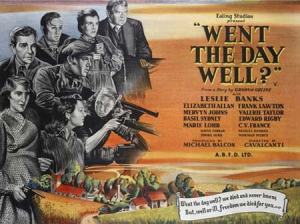
Great Films You Need To See – Went The Day Well? (1942)

This is my latest contribution to The Big Picture, the visually focused film magazine that proves there’s more to film than meets the eye. The Big Picture is kicking off 2016 with a series of features and reviews with the theme of ‘war’ (fun, I know). This piece is part of the site’s Lost Classics section (featuring in my list of Great Films You Need To See), and covers Alberto Cavalcanti’s superb 1942 wartime drama Went The Day Well?

Went The Day Well? remains a brilliantly imaginative and disturbing wartime 'what if'

Went The Day Well? remains a brilliantly imaginative and disturbing wartime ‘what if’

Propaganda films exist to sell a varnished version of real events, which makes it even more remarkable a movie made at a time when the outcome of World Ward Two was far from certain would so boldly write the epitaph for Hitler’s Third Reich.

Adapted from Graham Greene’s magazine story, Alberto Cavalcanti’s 1942 classic Went The Day Well? regales supposedly contemporaneous events from a point in the future (not too distant audiences presumably hoped) when the war was over and the Allies stood victorious.

Cherry villager (Mervyn Johns) shows us "the only bit of England the Germans got" in Went The Day Well?

Cherry villager (Mervyn Johns) shows us “the only bit of England the Germans got” in Went The Day Well?

In spite of the happy ending, it must have nevertheless been discomforting for audiences to be told by a cheery pipe-smoking villager (played by Mervyn Johns) that the so-called Battle of Bramley End had been kept a state secret until after the war was over – a battle for the very heart of England where the front line is a sleepy country village; not too dissimilar to the sort of quaint idyll many people would have returned home to after stepping out of the cinema.

Went The Day Well? enacts the nightmare scenario Brits would have feared at the time; namely a German invasion of Britain under the noses of honest, hard-working folk. What makes the film even more unnerving is that the fifth column of Nazi soldiers who arrive en masse in Bramley End largely speak with cut-glass English accents and ingratiate themselves into this small community with considerable ease.

The dastadly Garmans hatch their plot in Went The Day Well?

The dastardly Germans hatch their plot in Went The Day Well?

It transpires they’ve had help from at least one Nazi sympathiser on the inside, revealing an ugly truth that has hidden in plain sight, and the deviousness of their plan – Bramley End is the beachhead where the English way of life can be destroyed from within – is staged in brutal, thuggish fashion when they reveal their true intentions during a church service (a none-too-subtle implication that the Nazis are a godless lot).

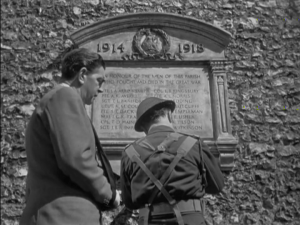
Cavalcanti does away with dramatic flourish and instead films events with a documentarian’s gaze. That said, there are several pointed moments, not least of which a brief shot of Basil Sydney’s Kommandant Orlter consulting his mission plans next to a plaque honouring the fallen dead of World War One.

Postmistress Mrs Collins (Muriel George) turns ax murderer in Went The Day Well?

Postmistress Mrs Collins (Muriel George) turns ax murderer in Went The Day Well?

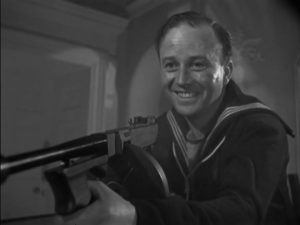
The villagers’ eventual fight back is still startling and must have stirred in audiences of the time an odd mix of revenge fantasy and queasiness at the bloodthirsty nature of what they were watching. Postmistress Mrs Collins’ (Muriel George) use of an axe to kill a gruff-sounding Nazi is tempered by the tear-stained shock etched on her face when the gravity of the deed starts to set in, while the look of joyous satisfaction a villager gives to shooting a German invader augurs the action man movies of the 1980s and beyond.

Even Thora Hird gets in on the act in her first starring role as a gun-toting Bramley Ender who makes the Nazis wish they’d picked another quiet strip of England to invade.

That got 'em! Shooting Germans in Went The Day Well?

That got ’em! Shooting Germans in Went The Day Well?

One can perhaps forgive some of the more circumspect dialogue bearing in mind the time in which it was released, although the response a young Harry Fowler gives when asked “do you know what morale is?” – “yeah, it’s what the wops ain’t got!”- is difficult to defend.

Went The Day Well? remains a brilliantly imaginative and disturbing wartime ‘what if’ that no doubt sent a stark warning to ol’ Adolf – you mess with Little Britain at your peril.

The Land Of Ice

Hi everyone! I’ve had a few requests to upload some pictures from my recent trip to Iceland and, never one to let down my fans (ahem), I am happy to oblige.

I wasn’t there for as long as I would have liked (when isn’t that the case?), but in my time I came to fall in love with this beautifully rugged and magical country; full of kind and generous people and sights that nowhere else on Earth can offer.

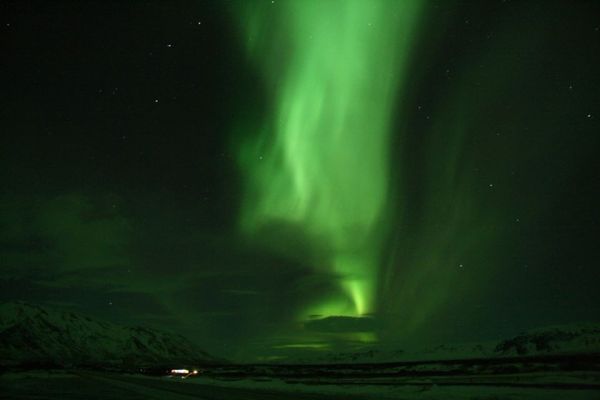
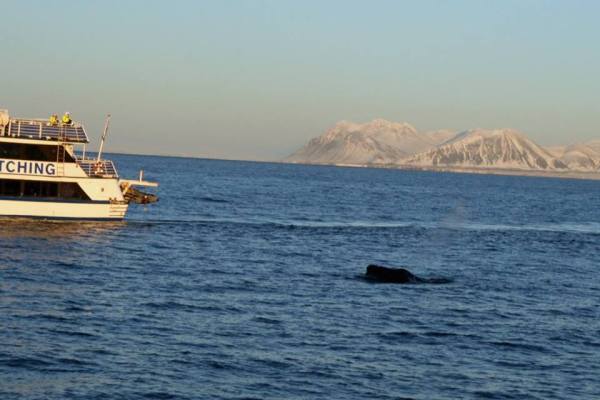
My trip was made even more special by having witnessed the Northern Lights in their full resplendent glory – a stroke of luck bearing in mind how fickle they can be, but the show I witnessed will stay with me for the rest of my life. I also got to see a humpback whale barely 10 metres from the edge of the boat I was on; again a rare sight and one that I will remember with a smile for years to come.

Here are a few pictures of my trip. I’ll be back with the usual film review stuff imminently. Thanks as always for your support of my blog; it means a lot.

The Northern Lights in all their splendour

The Northern Lights in all their splendour

Pingvellir National Park

Pingvellir National Park

Prettttty cold

Prettttty cold

Gullfoss waterfall

Gullfoss waterfall


As geysers go, Strokkur isn't half bad

As geysers go, Strokkur isn’t half bad

Me!

Me!

It's a humpback. Promise...

It’s a humpback. Promise…

The Lebowski Bar! The dude abides in Reykjavik!

The Lebowski Bar! The dude abides in Reykjavik!

We also found the Chuck Norris Grill with these wise words

We also found the Chuck Norris Grill with these wise words

Temporary (Unavoidable) Blogging Hiatus

You may have noticed I have been somewhat quiet of late when it comes to blogging, whether that be posting reviews or commenting on the splendid work of my fellow bloggers.

I’ve not disappeared rest assured, but have spent the past week or so moving house and will be travelling to chilly Iceland next week for a few days of sub-zero sight-seeing.

I’ve also been unable to get access to Wi-Fi whilst the house move has been ongoing, which has meant I’ve not been able to get online very much.

Excuses aside, I aim to be back online in a week or so, but in the meantime I wanted to wish everyone a belated Happy New Year. See you soon blogging community!

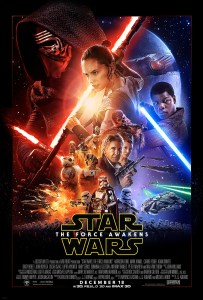
Review – Star Wars Episode VII – The Force Awakens

Following the tantrum-inducing menace of George Lucas’ Darth Vader: The Younger Years trilogy of car wrecks, the most beloved film saga of them all strikes back in glorious fashion.

With The Force Awakens, we're indeed home. Thank you J.J. Abrams; thank you

With The Force Awakens, we’re indeed home. Thank you J.J. Abrams; thank you

Anyone nervous that Episode VII might fail to live up to the enormous weight of expectation unfairly heaped upon its shoulders can rest easy; The Force Awakens is about as far removed from The Phantom Menace in terms of sheer, unadulterated grin-inducing entertainment as Jar Jar Binks is from, well, pretty much any other character committed to film.

Watching The Force Awakens, it becomes clear very quickly exactly why J.J. Abrams was brought on board to direct (and co-write). His Star Trek (2009) skilfully managed to walk the tightrope of reminding us of why we cared about the franchise in the first place, while at the same time flipping the switch to offer us something completely new.

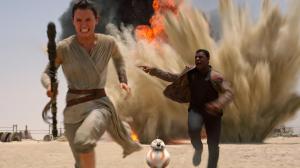
Rey (Daisy Ridley), Finn (John Boyega) and BB-8 in Star Wars Episode VII - The Force Awakens

Rey (Daisy Ridley), Finn (John Boyega) and BB-8 in Star Wars Episode VII – The Force Awakens

In the case of Star Wars, Abrams and co-writer Lawrence Kasdan consign midichlorians and trade blockades into the sarlacc pitt and instead return to what made film fans fall in love with the saga in the first place; namely a simple story about disparate characters coming together to stop a seemingly insurmountable enemy.

Criticisms that The Force Awakens too readily retreads old ground, particularly A New Hope, are missing the point. Abrams, just like in Star Trek, gives us something old, something new, something borrowed and something blue (does the lightsaber count?).

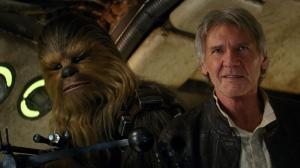
Han Solo (Harrison Ford) and Chewbacca (Peter Mayhem) back on the Falcon in Star Wars Episode VII - The Force Awakens

Han Solo (Harrison Ford) and Chewbacca (Peter Mayhem) back on the Falcon in Star Wars Episode VII – The Force Awakens

The story picks up 30 years after the events of Return Of The Jedi, with both the Resistance and the evil First Order in search of Luke Skywalker (Mark Hamill), the last known Jedi Knight. Droid BB-8 seemingly holds the key to Skywalker’s whereabouts and into the fray steps scavenger Ren (Daisy Ridley) and Finn (John Boyega), a  stormtrooper who has deserted the First Order.

Having emerged from the ashes of the Empire, the First Order employ similarly fascistic tendencies (not least of which a penchant for Nuremberg-esque rallies) and are led by the Kool Aid-guzzling General Hux (Domhnall Gleeson), unpredictable Kylo Ren (Adam Driver) and a mysterious dark lord (I won’t spoil it).

Kylo Ren (Adam Driver) has anger issues in Star Wars Episode VII - The Force Awakens

Kylo Ren (Adam Driver) has anger issues in Star Wars Episode VII – The Force Awakens

It’s often said that bad guys are the most interesting characters in cinema and that’s certainly the case with Ren, a figure beset by bouts of petulant rage who is both terrifying and childishly vulnerable at the same time. Performing behind a mask for much of the running time, the fantastic Driver gives Ren a unnervingly measured tone that threatens to crack at any moment.

Boyega too is excellent; at first tortured by the horrors he is expected to participate in before growing into the hero we rejoice in cheering on. Ridley also impresses in what is perhaps the most underdeveloped character, but the journey she goes on will no doubt pay off in spades beyond The Force Awakens.

The Resistance reists in Star Wars Episode VII - The Force Awakens

The Resistance resists in Star Wars Episode VII – The Force Awakens

It says an awful lot about the strength of the new cast that we don’t rely too heavily on the very welcome reintroduction of Harrison Ford as everyone’s favourite scruffy-looking nerf herder Han Solo, Carrie Fisher as the sadder, more world-weary General Organa, Chewbacca (Peter Mayhew), C-3PO (Anthony Daniels) and R2-D2 among other old guard.

That said, it’s a joy to see them back on the big screen and Abrams and Kasdan give each character plenty of choice dialogue as well as well-woven story arcs.

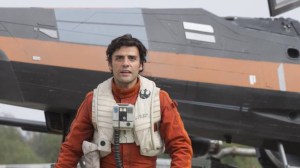
Ace pilot Poe Dameron (Oscar Isaac) in Star Wars Episode VII - The Force Awakens

Ace pilot Poe Dameron (Oscar Isaac) in Star Wars Episode VII – The Force Awakens

While it’s hard to say whether the original band got back together, it’s nevertheless wonderful to see and hear John Williams is back. Williams’ score promised much in the trailers and truly delivers with a soundtrack that splices well-loved refrains with new material that perfectly complements the action on screen.

Speaking of action, Abrams’ resistance to the CGI-heavy set pieces so beloved on Lucas circa Episodes I-III really delivers, with dogfights that you can follow and care about the outcome of, while a shoot out on a forest planet (the look Han gives Rey when she says “I never knew there could be so much green” is wonderful) is effortlessly staged.

With The Force Awakens, we’re indeed home. Thank you J.J. Abrams; thank you.