Review – Zero Dark Thirty

As politicians lapped up the credit and thousands of people across America took to the streets to revel in the perceived victory, the ones who were truly responsible for the capture and killing of Osama Bin Laden remained behind the scenes.

Kathyryn Bigelow's Zero Dark Thirty

Kathyryn Bigelow’s “complex, challenging and totally gripping” Zero Dark Thirty

Their moment has come in director Kathryn Bigelow and screenwriter Mark Boal’s complex, challenging and totally gripping Zero Dark Thirty, the follow up to their Oscar-winning Iraq war drama The Hurt Locker.

Those expecting or hoping for a flag-waving, ultra-patriotic exercise in easy-to-swallow triumphalism will need to look elsewhere. What we get is a sobering, cerebral and, most importantly, apolitical account of the tireless work that went into tracking down America’s public enemy number one by a small band of Central Intelligence Agency and military personnel.

Zero Dark Thirty is a classic procedural in the mould of All The President’s Men and TV’s The Wire, with the crime here being the 9/11 attacks. Bigelow’s first masterstroke is not to show us those infamous images (they’ve been scorched into our psyches already); instead the film opens with a chilling montage of overlapping telephone calls made by people trapped in the Twin Towers played over a black screen.
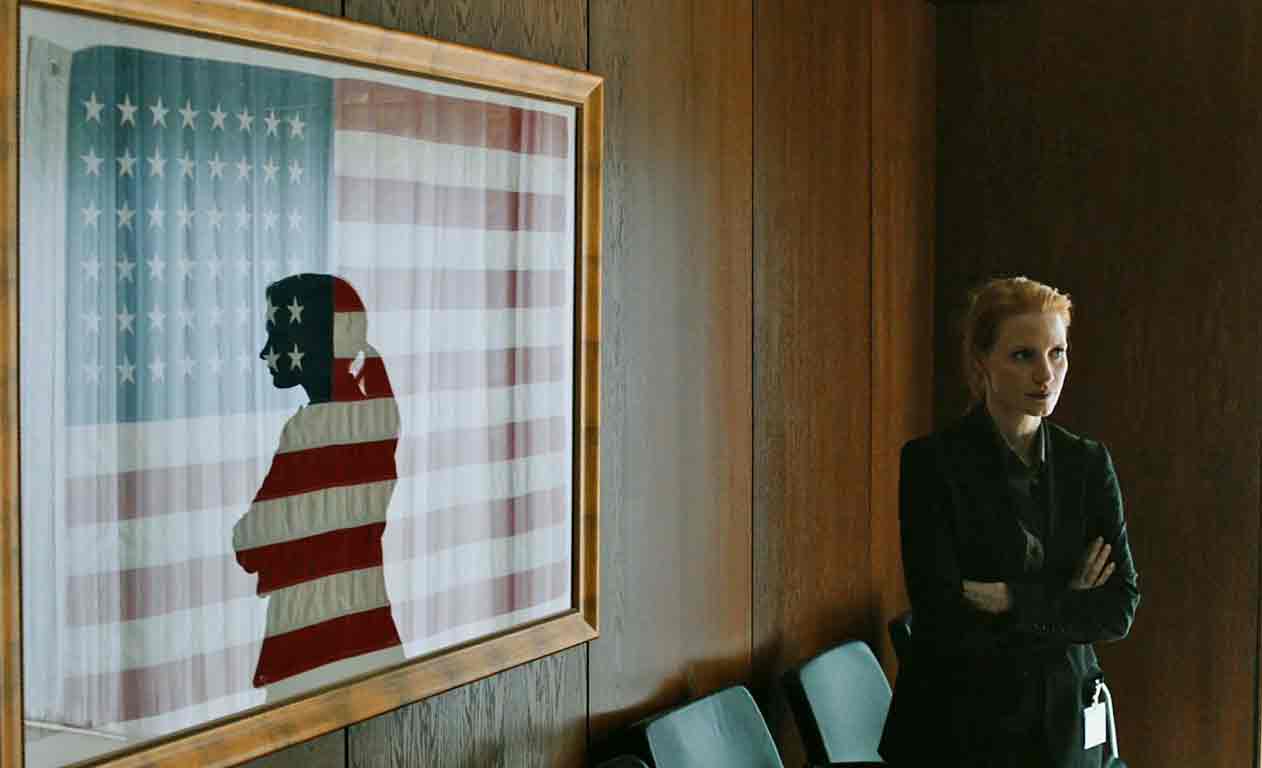
CIA officer Maya (Jessica Chastain) leads the decade-long hunt for Osama Bin Laden in Zero Dark Thirty

CIA officer Maya (Jessica Chastain) leads the decade-long hunt for Osama Bin Laden in Zero Dark Thirty

The film then jarringly throws us into an undisclosed CIA site in Pakistan where new girl Maya (Jessica Chastain) witnesses ‘enhanced interrogation techniques’ (read: torture)  up-close for the first time courtesy of fellow operative Dan (Jason Clarke), a chameleon who looks as comforable in a shirt and tie as he does with his hands around someone’s neck.

Dan wants actionable intelligence and makes good on a repeated threat to his prisoner that “when you lie to me, I hurt you” by subjecting him to waterboarding and other forms of torture. Initially distressed, Maya is soon employing similiar tactics in her own interrogations.

CIA operative Dan (Jason Clarke) in Zero Dark Thirty

CIA operative Dan (Jason Clarke) in Zero Dark Thirty

Maya is a blank canvas, with no back story, personal life or friends, merely an all-consuming, evangelical zeal to find Bin Laden by any means necessary. She represents a post-9/11 America whose moral compass has been eroded by a willingness to justify increasingly unethical behaviour.

The only connections she has are with fellow CIA officers, in particular Jessica (the excellent Jennifer Ehle), an older, more wily operative who talks of baking a cake for a potential informant and having him killed if he doesn’t prove useful in the same conversation.

As coldly analytical as Maya and her colleagues are towards contacts or detainees, seeing them as nothing more than assets to drive forward the investigation, its constant dead-ends, labyrinthine complexity and mounting casualties breeds a frustrated thirst for vengeance. At her lowest ebb, a grieving Maya coldly informs a colleague: “I’m going to smoke everybody involved in this op, and then I’m going to kill Bin Laden.”

The Seal Team Six raid Bin Laden's compound in Zero Dark Thirty

The Seal Team Six raid Bin Laden’s compound in Zero Dark Thirty

In the hands of a lesser director, Zero Dark Thirty could have been reduced to a tub-thumping embarrasment, but Bigelow is too smart to poison Boal’s painstakingly researched script like that and instead maintains a measured detachment to the material.

The Navy Seal raid on the compound believed to house Bin Laden (only Maya is prepared to stick her neck out to categorically state he is in there) is a case in point. It could so easily have turned into a hyper-stylised action set piece akin to a video game, but in Bigelow’s hands Zero Dark Thirty‘s final act has a documentary feel, all be it a superbly filmed one (much of it shot using night vision lenses) that has a taut, nerve-jangling authenticity to it.

CIA senior officer George (Mark Strong) looks on nervously in Zero Dark Thirty

CIA senior officer George (Mark Strong) looks on nervously in Zero Dark Thirty

Bigelow is clearly fascinated with the dehumanising effect the so-called ‘War on Terror’ has on those fighting on the frontlines. In The Hurt Locker it was a bomb disposal expert; here it’s Maya whose soul is gradually eaten away by the things she sees and does.

During one scene Maya, angry at a colleague’s decision not to deploy a team to track down a key target, realises her bad cop approach isn’t working and gives him a beer to sweeten him up. It’s reminiscent of an earlier moment when she observes Dan using the same tactic to get a tortured detainee onside and serves as a subtle allusion to the lengths she’s prepared to go.

The fact that politicians and pundits on all sides have come out against the film means Bigelow and Boal have done their job. In one scene, Maya and Jessica watch impassively as President Obama states on TV that “America doesn’t torture” before carrying on their conversation. Just as with the rest of the film, Bigelow leaves it to us to read into it what we will.

The most explosive charge levelled at the filmmakers has come from those attacking Zero Dark Thirty for supposedly condoning torture (in many cases before they’ve even watched the film). Hard to watch they may be, but to omit these scenes from a film as important as this because they make politicians uncomfortable would have been to disregard a key chapter and inexorably damage the story Bigelow and Boal are trying to tell.

A fantastic cast is led by the compulsive Chastain, who knows exactly what to give in every scene. It’s a haunting performance, one appropriate to a film that, like Robert Redford at the end of The Candidate asks “what do we do now?”.

Review – Safety Not Guaranteed

Looking to fill a blank space in the September 1997 edition of Backwoods Home Magazine, employee John Silveira wrote a pithy classified ad as a joke.

Safety Not Guaranteed

Safety Not Guaranteed – “there’s enough heart here to earn a smile come the closing credits”

The ad stated: “Wanted: Somebody to go back in time with me. This is not a joke. P.O. Box 91 Ocean View, WA 99393. You’ll get paid after we get back. Must bring your own weapons. Safety not guaranteed. I have only done this once before”.

Little did Silveira know that his throwaway paragraph would prove the inspiration for the low-budget Safety Not Guaranteed, a comedy-drama equal parts whimsical and melancholic from the mumblecore stable of American independents.

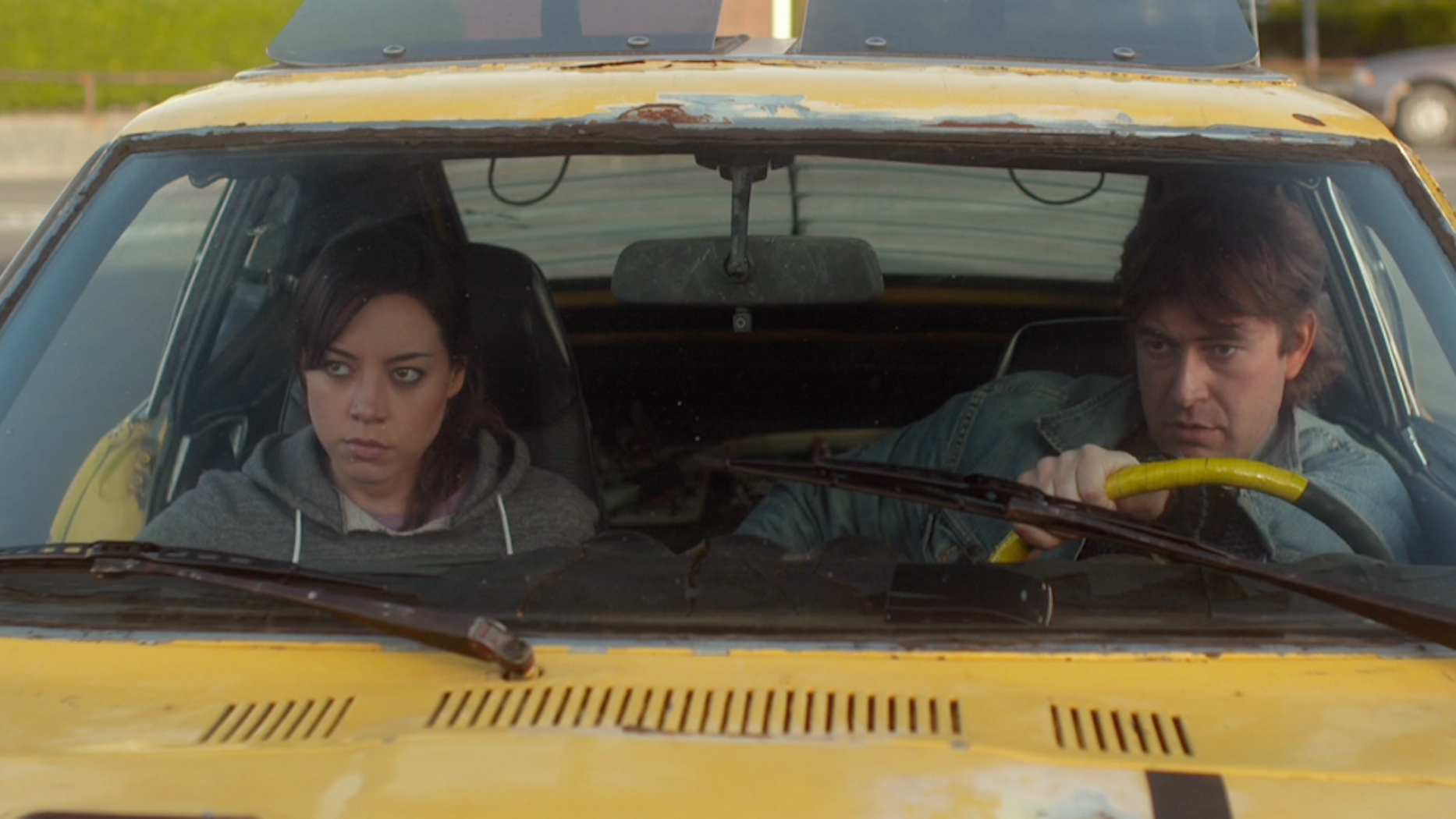
Disconnected and disillusioned Darius (Aubrey Plaza) interns at a Seattle magazine and volunteers with fellow staffer Arnau (Karan Soni) to assist writer Jeff (Jake Johnson) in tracking down the ad’s author in a sleepy seaside town. This turns out to be Kenneth (mumblecore alumnus Mark Duplass), an eccentric and paranoid supermarket employee who deals in conspiracy theories and is convinced secret agents are out to get him.

She poses as an applicant with her own reasons to want to travel back in time and wins the trust of the slightly obsessed, but kind-hearted loner, who sees in Darius a kindred spirit and someone who’s not afraid “to stare fear and danger in the eye and say ‘yes'”.

Darius at first indulges the child-like Kenneth’s plan to build a time machine, believing it to be nothing more than a fantasy, but as they spend more time together she finds herself increasingly attracted to the fellow misfit and starts to wonder if what he’s claiming is actually the real deal.

Darius (Aubrey Plaza) and Kenneth (Mark Duplass) in Safety Not Guaranteed

Darius (Aubrey Plaza) and Kenneth (Mark Duplass) in Safety Not Guaranteed

Safety Not Guaranteed brings to mind the offbeat 1980 film Somewhere In Time, in which Christopher Reeve’s writer becomes so obsessed with a picture of an actress (played by Jane Seymour) that he travels back in time to 1912 to be with her.

Memory, in particular the desire to recapture and revisit a specific moment in time, is a prominent motif throughout the film. Darius, who has resigned herself to simply “expect the worst and try not to get my hopes up”, would rather return to when life was easier and made more sense.

According to Kenneth, the whole point of building his time machine is to prevent a tragic event from occurring, although as he lets slip to Darius, it’s actually more “about a time and a place” when he believes he was happiest.

Darius (Aubrey Plaza), Arnau (Karan Soni) and Jeff (Jake Johnson) try to track down the mysterious author of an unconventional ad in Safety Not Guaranteed

Darius (Aubrey Plaza), Arnau (Karan Soni) and Jeff (Jake Johnson) try to track down the mysterious author of an unconventional ad in Safety Not Guaranteed

The melancholic yearning for younger, less complicated days is also present in the character of Jeff, who uses the assignment to look up his first love, whom he has reminisced about and wondered ‘what if?’ for years. He also urges Arnau not to waste his youth and, in scenes reminiscent of Roger Dodger prises the young intern away from his laptop to introduce him to the world of girls.

Director Colin Trevorrow gives the film a lightness of touch that dilutes the sadness of Derek Connolly’s script. Duplass, who has made a career out of directing inward-looking adults with arrested development excels as Kenneth, bringing the right mix of oddball innocence to the role.

Plaza (from TV’s Parks and Recreation) has the face-slapped-with-a-wet-fish look down to a tee, but finds an endearing sweetness in her scenes with Duplass. Indeed, the moments when the two are training for their ‘mission’ are the highlights of the film.

Whether you buy the ending largely depends on how invested you are in the characters. Trevorrow for one tries his best to sell it, as do the cast, and while it doesn’t entirely convince there’s enough heart here to earn a smile come the closing credits.

Review – Taken 2

The man with “a very particular set of skills” returns to remind another cabal of evil-looking Eastern Europeans why messing with Americans is never a good idea.

Taken 2 poster

Taken 2 – Bad, and not in a so bad it’s good way

Taken was an unexpected box office smash on its 2008 release and somehow got away with reinventing Liam Neeson (he of Schindler’s List, let’s not forget) as a credible action star.

Although xenophobic in the extreme and ridiculously over-the-top in its execution, Taken had a B-movie charm that was hard to resist. The inevitable sequel picks up shortly after the events of the original, with the relatives of the dastardly sex traffikers who took Bryan Mills’ (Neeson) daughter and paid with their lives vowing to take their revenge.

Murad (Rade Šerbedžija) orders his men to find and capture Bryan, his ex-wife Lenore (Famke Janssen) and their daughter Kim (Maggie Grace). They get their chance when mother and daughter join Bryan in Istanbul, and before long all hell breaks loose as Bryan and Lenore are taken and it’s left to Kim to evade capture and help them escape (in a reversal of the original’s plot).

Taken 2 is bad, and not in a so bad it’s good way. Take away director Olivier Megaton’s glossy handheld camerawork and the multiple explosions and you’re left with the sort of straight-to-DVD cheapie that Steven Seagal peddles out twice a year.

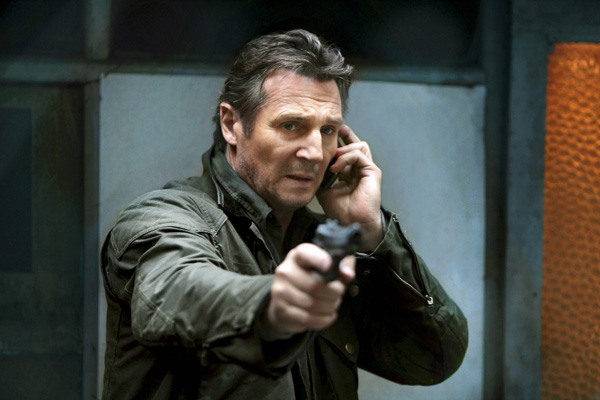
"Have I mentioned that I have a very particular set of skills? I have? Oh."

“Have I mentioned that I have a very particular set of skills? I have? Oh.”

At least Taken had a couple of memorable moments, not least of which was the “I don’t know who you are. I don’t know what you want…” telephone conversation Bryan has with his daughter’s captor, but Taken 2 feels like what it is, a lazy cash-in that throws in more of everything, including the now obligatory Bourne-aping car chase (featuring Grace whining “I can’t!” every time Neeson tells her to drive faster), while chucking narrative logic out the nearest window.

Judging by the huge returns, it’s safe to say Taken 3 will be heading our way in the next couple of years. But what next? Neeson butchering his way through the male population of Albania? Don’t rule it out. Those evil Eastern Europeans just don’t know when to quit.

Review – The Sessions

The human spirit is a quite remarkable thing; our innate ability to overcome great obstacles and keep smiling in the face of tragedy sets us apart.

Our greatest inspiration is often found from those with disabilities who overcome significant obstacles to achieve things they and we never thought possible.

The Sessions – “uplifting cinema without the schmaltz”

Acclaimed poet and journalist Mark O’Brien was paralyzed from the neck down as a child after contracting polio and as a result was forced to spend the vast majority of each day confined to an iron lung to help with his breathing. Whilst interviewing other disabled people about how they found having and enjoying sex, Mark came to fervently envy them and became determined to lose his virginity.

This is the set-up for Ben Lewin’s warmly touching true-life drama based on Mark’s physical and spiritual adventure and the impact it and he had on those around him. A committed Catholic, Mark (played by John Hawkes) first consults Father Brendan (William H. Macy) about the theological quandary this poses. Taking into account Mark’s circumstances, he concludes the Almighty would in all likelihood give him “a free pass on this one”.

The stage is set for Mark to hire professional sex surrogate Cheryl Cohen-Greene (Helen Hunt). At first his fear and awkwardness is palpable, but as their sessions continue a tender bond develops between the two.

It’s a stone-cold fact that disability sells when it comes to awards season and it’s likely The Sessions will be recognised in the same way as The Diving Bell and the Butterfly, A Beautiful Mind and Forrest Gump before it.

Mark O’Brien (John Hawkes) employs the services of sex surrogate Cheryl Cohen-Greene (Helen Hunt) in Ben Lewin’s The Sessions

That being said, not a cynical bone exists in the picture’s body. The largely excellent cast see to that, pulling back when histrionics could be reached for or emotional heartstrings pulled.

Given her strongest role in years, Hunt excels. It’s a brave, utterly believable performance of a person who comes to re-evaluate herself the closer she gets to Mark, whose article On Seeing a Sex Surrogate the film is based on.

After scaring the bejesus out of us with quietly menacing portraits of a drug-addicted killer and cult leader in Winter’s Bone and Martha Marcy May Marlene respectively, Hawkes pulls a complete about-turn here as a man who gradually realises there’s nothing to be gained from punishing yourself for reasons beyond your control. His bright optimism hides a what-would-Jesus-say guilt and fear that erodes over time as he becomes more comfortable in his own skin.

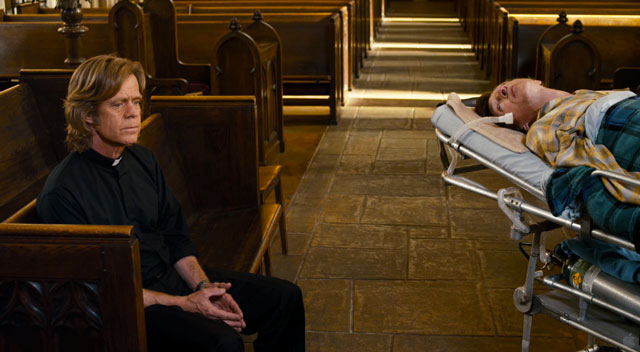
Father (William H Macy) conducts an unusual confessional with Mark O'Brien (John Hawkes) in The Sessions

Father Brendan (William H. Macy) conducts an unusual confessional with Mark O’Brien (John Hawkes) in The Sessions

In addition, Macy is on fine form as the sincere priest who forms a genuine friendship with Mark, while Moon Bloodgood’s poker face portrayal of Mark’s carer Vera nicely contrasts his heart-on-sleeve demeanour.

The warm hues used by Lewin (a polio survivor himself) reflect the cosy nature of the film, while Marco Beltrami’s soundtrack stays the right side of manipulative.

In many ways Mark’s preoccupations with sex, fear and religion are no different to many sections of American society, and while Lewin ultimately sides with the sexually liberated Cheryl’s mantra that we should “stop thinking about it so much” he never once pokes fun at Mark’s hang-ups.

The kind of film where a smile and a tear are never too far away from each other, The Sessions is uplifting cinema without the schmaltz and for that it should be congratulated.