Review – T2 Trainspotting
So, how do you follow an era-defining testament of 90s youth?
Well, you can’t, and Danny Boyle is smart enough to know that, much like his leading men, trying to match your previous escapades is likely to end in disaster.
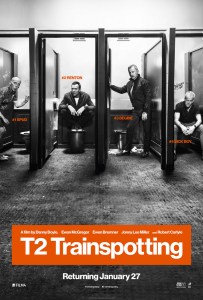 What we get instead from this sequel to 1996’s kinetic Trainspotting is a contemplative look through the rear view mirror of lives beset by regret, anger, inertia and a deep frustration at what could have been.
While the world has changed irrevocably, Rent Boy/Mark (Ewan McGregor), Sick Boy/Simon (Jonny Lee Miller), Spud/Daniel (Ewen Bremner) and Begbie/Franco (Robert Carlyle) have largely stagnated since that fateful drug deal in London more than two decades ago in which, to quote Spud, “first there was an opportunity… then there was a betrayal”.
That opportunity and betrayal proves the focal point for T2‘s narrative, based loosely on Irvine Welsh’s literary follow-up Porno, which picks up with Mark returning from Amsterdam to an Edinburgh that is both barely recognisable and utterly familiar.
 In one of the film’s numerous sly nods to Trainspotting, it picks up just as the original did with Mark running, except this time it’s not from security guards, but rather on a treadmill. Boyle flashes between this and the end of the first film with Mark’s defiant walk across Waterloo bridge, not only to act as a literal bridge between the two films but also to underscore the passing of time.
Mark fled to Amsterdam in part to get away from his “so-called friends” and fully realises there’s a price to be paid by returning home. While Spud is still a heroin addict and all the more tragic for it, Sick Boy has been reduced to blackmailing businessmen in order to make ends meet, while Begbie remains in prison. Both Sick Boy and Begbie continue to be consumed with vengeance, believing Mark not only stole their share of the drug deal but also their hopes and dreams for a life less ordinary.
 It’s to John Hodge’s credit as writer and Miller’s performance that we are kept guessing as to Sick Boy’s true intentions towards his old friend. Whilst there is undoubted anger and jealousy, the brotherhood and joy the character also exhibits following Mark’s return feels just as genuine.
McGregor slips back into his most iconic role and injects a fearful guilt into his portrayal. In a beautifully touching moment, Mark sits next to his father at the dinner table, with the light casting a human shadow onto the empty chair his late mother would have sat on – another pointed reminder of the cruel march of time.
Carlyle is properly unhinged as Begbie, a powder keg of self-loathing and hatred who can’t escape the narrow path his upbringing at the hands of a wastrel father set him on.
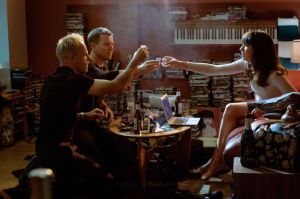 A terrific cast, which sees the return of several familiar faces from the original, is topped by a moving turn by Bremner as Spud. Blessed with a face that exudes so much with a single look, Bremner injects a growing defiance into the most fragile of the central leads. Mark’s return acts as a reawakening for Spud, who’s told by his friend to channel his addictive energy away drugs into something more creative and fulfilling – the results of which become the film’s beating heart and key source of nostalgia.
Rather than be used as a direct homage to Scorsese as was the case in the original, the heavy use of freeze frame has been attributed by Boyle to his characters capturing a moment in time, much like a Polaroid. It’s a nice touch, although used too liberally by the director so that it ends up becoming something of an affectation.
 That said, the film (and Edinburgh especially) looks stunning and while the needle-drop soundtrack (a big part of the original film’s cultural impact) may not be quite as memorable this time around, it’s in keeping with the tone (Underworld’s Slow Slippy in particular).
In Trainspotting, Mark asks: “So we all get old and then we can’t hack it anymore. Is that it?” The march of time notwithstanding, T2: Trainspotting can hack it with the best of them.

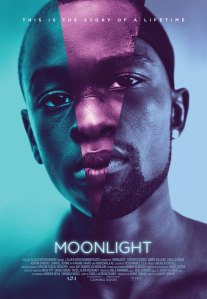 Films about the grim reality of existing within some of America’s most damaged neighbourhoods are hardly uncommon and more often than not check off a list that includes drugs and violence.
 It chronicles three key stages in the painful path to adulthood for the introverted Chiron, a poor kid living in a run-down district of Miami who must contend with a drug-addled mother (played by Naomi Harris), bullying at school and the feelings he develops for best friend Kevin.
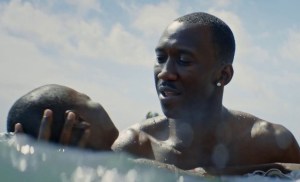 A beautifully played scene in which Blue teaches Chiron to swim is poetic in its grace and suggests a baptism of some sort is taking place for both characters. It is here where the reason for Blue’s fascination with Chiron becomes clear – for it is in this moment when he can be the man you suspect he wants so desperately to be.
 While the physical similarity of the three actors who play Chiron as a boy (Hibbert), a scrawny teenager (Ashton Sanders) and a bulked up adult (Trevante Rhodes) is not immediately apparent, the character’s awkwardness in his own skin, expressed through hunched shoulders and a downcast, forlorn expression is a baton seamlessly passed on from one to the next.
 Jenkins has spoken of how much Tarrell Alvin McCraney’s source novel In Moonlight Black Boys Look Blue spoke to him (they grew up in the same Miami neighbourhood, although were never acquainted) and this manifests itself in his screenplay which imbues each character with a depth and history that actors of the calibre of Ali and Harris plunder to rousing effect.
 Laxton’s camerawork is lent greater poetry by Nicholas Brittell’s glorious score, which is centred on a recurring six-note refrain and applies the ‘chopped and screwed’ technique to hip hop and orchestral music to create a slowed down and wholly original sound that submerges the viewer and exacerbates the holding pattern Chiron finds himself in.
 Back in 2013, I wrote a
  The renewed promise of that movie is largely realised in this, their latest colaboration, which gifts James McAvoy the role of his career as Kevin, a man who exhibits 23 different personalities due to his being diagnosed with dissociative identity disorder (DID).
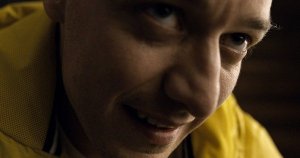 This self-entitled ‘horde’ are compelled to abduct teens Casey (Anna Taylor-Joy), Claire (Haley Lu Richardson) and Marcia (Jessica Sula) for a purpose that becomes disturbingly clear as ‘Kevin”s visits to specialist psychologist Dr Fletcher (Betty Buckley) reveal a 24th personality known only as ‘the Beast’ is waiting in the wings to show himself.
 Tight close-ups are used throughout, focusing on McAvoy’s saucer-like eyes and trapping us in Kevin’s fractured psyche along with his trio of victims.
 While Taylor-Joy’s blood raw performance is excellent, it’s overshadowed by McAvoy giving it his all and then some in a dizzying turn. It’s the role of a lifetime for anyone brave enough to seize it with both hands and McAvoy unpacks what he brought to the table as a corrupt, mentally evaporating cop in 2013’s Filth and lets rip with a mesmeric barrage of verbal dexterity, contorted body language and unnerving unpredictability that somehow avoids falling into the pit of comical caricature.











 three rows back