Review – Wreck-It Ralph

There’s a guilty pleasure in watching Disney’s affectionate homage to the dusty old 8-bit video games that were so adored by kids of all ages when Steven Spielberg’s E.T. was setting the box office alight.
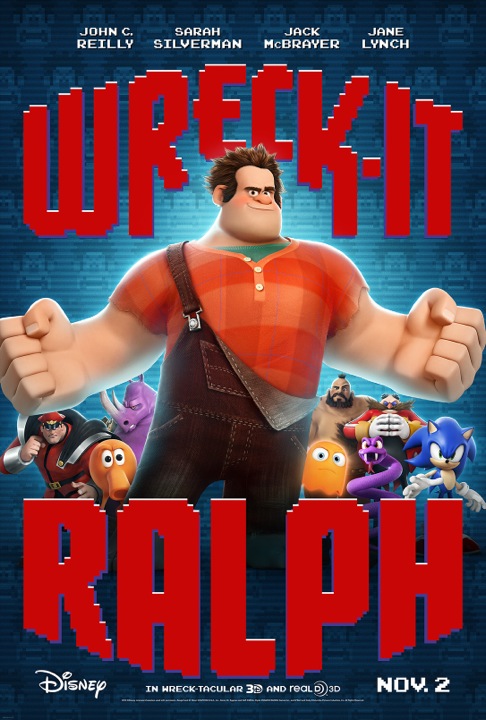
Wreck-It Ralph

The hugely entertaining and cleverly put-together Wreck-It Ralph

Once as common a sight as Starbucks, arcades have gradually retreated to seaside piers and motorway service stations in the face of the relentless onslaught of ever-more-technologically impressive games consoles.

The hugely entertaining and cleverly put-together Wreck-It Ralph celebrates this dying breed of coin-swallowing entertainment in a lavishly animated movie that also doesn’t forget the higher-definition games that have followed in their wake.

Wreck-It Ralph

Ralph (John C. Reilly) explains why he doesn’t want to be a bad guy anymore in Wreck-It Ralph

For the past 30 years, Ralph (voiced by John C. Reilly) has played the bad guy in the Donkey Kong-esque arcade game Fix-It Felix, Jnr, smashing up an apartment block only to see it put back together by gee-whizz good guy Felix (Jack McBrayer). It’s a role he’s grown tired of and, during a support group for video game villains reveals he wants to be the good guy for a change.

He gatecrashes a party at Felix’s penthouse home celebrating the game’s 30th anniversary, but is rebuffed by the other characters, who tell him to accept his station in life. Believing the only way he can be seen as ‘good’ is to earn a medal like Felix, Ralph sneaks into ultra-violent first-person shooter Hero’s Duty, but inadvertently launches a catastrophic chain of events that could lead to each of the games in the arcade being unplugged.
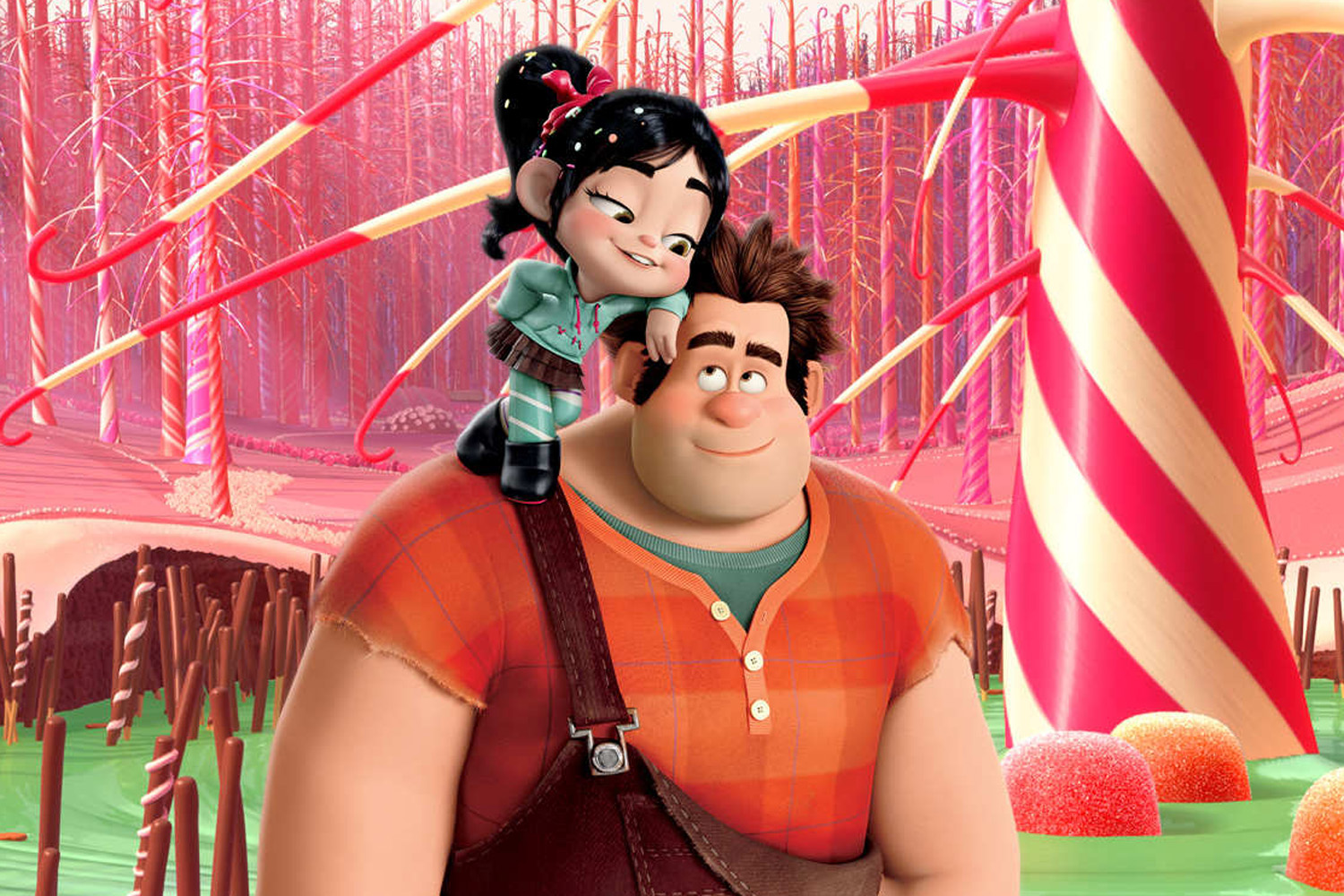
Wreck-It Ralph

Vanellope von Schweetz (Sarah Silverman) and Ralph (John C. Reilly) travel through the “candy-coated heart of darkness” of Sugar Rush in Wreck-It Ralph

From the moment an 8-bit Walt Disney title card appears at the start of the film, the warm glow of nostalgia takes hold. Much like the Toy Story franchise (which Wreck-It Ralph closely resembles in its premise), there’s a timelessness at work here. I can certainly remember slotting countless coins into games like Pac-Man, Out Run and Dragon’s Lair – it’s how my love affair with video games started – and each generation since will have their own memories of the games they grew up playing.

Wreck-It Ralph

“I’m gonna wreck it!” – Ralph (John C. Reilly) and the goody-two-shoes Felix (Jack McBrayer) in Wreck-It Ralph

This is nicely captured in a time-lapse sequence at the arcade where the action is set, wherein Fix-It Felix, Jnr sits in the same position over 30 years while the games around it come and go and the fashions and tastes of the youngsters who play them subtly change.

Director Rich Moore and his team introduce a number of nice little touches, including the jerky movements of the less-well developed supporting characters in the game and the blocky low-res furniture in Felix’s apartment, while in Sugar Rush, a garishly coloured kart racing game into which Ralph crash lands and ends up befriending the cute Vanellope von Schweetz (Sarah Silverman), all the characters are made of candy in some nightmarish Disney vision of hell, including policemen made of doughnuts.

Wreck-It Ralph

Poor old Q*bert hopes for a handout after his game gets unplugged in Wreck-It Ralph

As you might expect, there are nods subtle and unsubtle to a whole host of iconic games and game characters, including Tapper, Q*bert, Street Fighter, Metal Gear Solid, Sonic the Hedgehog and Halo (there are many more I undoubtedly missed), while the loony ruler of Sugar Rush King Candy (Alan Tudyk) is deeply reminiscent of the Mad Hatter from Disney’s 1951 adaptation of Alice in Wonderland.

Henry Jackman’s score, like the film itself, cleverly shifts in tone to reflect the different styles of the games and it wouldn’t be surprising if Wreck-It Ralph‘s ingenious ghost in the machine concept ends up breeding its own franchise.

After a slew of disappointing big-budget animations (even the normally reliable Pixar has been off its game of late), it’s great to see a return to form for the Mouse House and a film you’ll want to replay many times.

Review – Life Of Pi

Digital effects have come a long way since Yann Martel’s adored novel Life of Pi was first published in 2001, without which director Ang Lee’s efforts to bring this supposedly unfilmable book to the big screen would have been scattered on the rocks.

Ang Lee's Life of Pi

Ang Lee’s Life of Pi – far from a shipwreck which, for an ‘unfilmable’ tale is no small achievement

It’s an achievement in itself by David Magee to turn Martel’s prose into a screenplay and Lee, in his first film since the passable Taking Woodstock (2009) deserves a lot of credit for realising on screen the many wonders Pi (Suraj Sharma) witnesses during his epic journey.

Certainly in the past, many effects-laden films have sacrificed the things which should come first – a good script and good performances – for the sake of an attention-grabbing shot or action sequence. Lee for his part seems to have learned a thing or two about finding the right balance since falling into that trap with the disengaging Hulk in 2003.

The biggest challenge facing Lee was to give us a convincing Richard Parker, a Bengal tiger that, like the titular Pi, finds itself on a Japanese cargo ship on its way across the Pacific to start a new life in Canada.

Pi (Suraj Sharma) braves the storm in Life of Pi

Pi (Suraj Sharma) braves the storm in Life of Pi

Except neither the teenage Pi nor Richard Parker have any say in this. Piscine Militor Patel, or Pi as he prefers to be known after being given the unwanted nickname ‘Pissing’ Patel at school is happy living in the zoo his family owns in Pondicherry, India. Seeking a new life for them all, his father closes the zoo and books passage on a ship for both his family and animals, which will be sold abroad.

In a scene both vivid and distressing, the ship sinks after getting caught in a terrible storm. Pi is the only human to make it off the vessel alive, but finds he isn’t alone in the small lifeboat; he’s joined on board by a zebra, a hyena, an orangutan – and Richard Parker.

Pi (Suraj Sharma) adrift at sea with tiger Richard Parker in Life of Pi

Pi (Suraj Sharma) adrift at sea with tiger Richard Parker in Life of Pi

The storm is a stark reminder for the stricken Pi of nature at its most untamed and recalls an earlier scene when a younger Pi tries to feed Richard Parker and is chided by his father, who shows him that “a tiger is not your friend” by making him watch it kill a goat. Stuck in the lifeboat, he is given a further unpleasant reminder when he witnesses the law of the wild inevitably taking effect. After watching this, the knock-about opening credits which playfully show the zoo animals going about their daily business take on a rather different light.

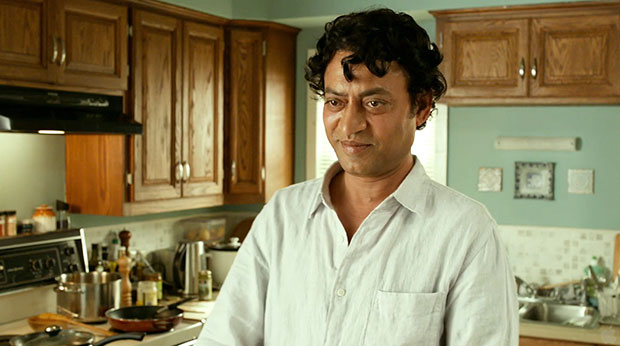
The adult Pi (Irrfan Khan) tells his incredible story in Life of Pi

The adult Pi (Irrfan Khan) tells his incredible story in Life of Pi

The teenager names the boat ‘Pi’s Ark’, one of many religious and spiritual references in the film. Pi is shown as a young boy embracing Christianity, Hinduism and Islam, much to the annoyance of his scientifically-minded father, and the extraordinary quest on which he embarks with Richard Parker aboard the boat is as much about spiritual self-discovery as it is about survival.

One of many extraordinary encounters Pi has while lost at sea in Life of Pi

One of many extraordinary encounters Pi has while lost at sea in Life of Pi

It’s when the boat is adrift at sea that the digital light show really takes over. In spite of falling back on the requisite ‘poke things at the screen’ trick to justify the use of 3D, Lee and his digital effects team conjure up myriad striking images. These range from the beautiful (the boat sat on perfectly still, glassy water) to the wonderfully bizarre (the moment hundreds of flying fish thunder by the boat is one of the film’s most memorable scenes).

The encounters Pi has are both frightening and fantastical – a belly flop from the biggest whale you’ve ever seen and the weirdest island (shaped like a woman) this side of Lost. They also speak to a key theme of Life of Pi, the power of faith. The adult Pi (played by Irrfan Khan) relates his story to a writer (Rafe Spall) devoid of ideas for a new book and bestows it on him to do with it as he pleases (“the story’s yours now”).

Setting aside all the remarkable computer work, Lee’s film works best as a simple buddy story between a teenager and a tiger. Although no masterpiece, Life of Pi is far from being a shipwreck and for an ‘unfilmable’ tale that’s an achievement in itself.

Review – Silver Linings Playbook

A quick glance at the plot for Silver Linings Playbook and you’d be forgiven for expecting yet another excruciating Hollywood romantic comedy, the kind that Gerard Butler and Jennifer Aniston seem to find themselves in.

Silver Linings Playbook

David O. Russell’s Silver Linings Playbook – “smart and spiky screwball comedy for the internet age”

What should make this film even worse is that its central figure Pat Jr (Bradley Cooper) has bipolar disorder, which normally results in the sort of turned-up-to-11  manic performance that cries out for an Academy Award.

The fact that Silver Linings Playbook manages to avoid the trap doors and skirts around the clichés is largely down to the mercurial David O. Russell, who adapts and directs this smart and spiky screwball comedy for the internet age from Matthew Quick’s short story.

Pat is diagnosed after attacking his wife’s lover in the shower and, after eight months in a psychiatric institution is released into the care of his OCD-afflicted, Philadelphia Eagles-obsessed father Pat Snr (Robert De Niro) and long-suffering mother Dolores (Australian actress Jacki Weaver). Without a job or a wife, Pat is determined to rebuild his life, believing that if he gets fit and stays positive he can save his marriage.

At a friend’s dinner party he meets the self-destructive Tiffany (Jennifer Lawrence), who has tried to overcome her grief at the death of her husband by sleeping around. Tiffany offers Pat a deal – she’ll help him reconnect with his wife as long as he becomes his dance partner for an upcoming ballroom competition.

Tiffany (Jennifer Lawrence) and Pat (Bradley Cooper) audition for Strictly Come Dancing in Silver Linings Playbook

Tiffany (Jennifer Lawrence) and Pat (Bradley Cooper) audition for Strictly Come Dancing in Silver Linings Playbook

Russell knows the rom-com tropes – Pat and Tiffany are clearly made for each other – but in the best tradition of those classic screwball comedies, all the fun comes in how these two broken souls finally realise what the audience have known all along.

Crucially, the chemistry between Cooper and Lawrence is fantastic. They fizz off each other like a pair of firecrackers, from the amusing dinner party when they swap anti-depressant stories like Christmas cards to the sultry dance sequences.

The two are equally tactless, whether it be Pat asking Tiffany how many people she slept with in her office before being fired, or Tiffany saving Pat the bother of reading Lord of the Flies by summarising it for him and throwing the book away, annoyed he’s only reading it because it’s on the high school syllabus his estranged wife is teaching (reflecting an earlier scene when Pat throws a copy of A Farewell to Arms through the window because he’s disgusted with the pessimistic ending).

"Go Eagles!" Pat Jnr (Bradley Cooper) and Pat Snr (Robert De Niro) celebrate in Silver Linings Playbook

“Go Eagles!” Pat Jnr (Bradley Cooper) and Pat Snr (Robert De Niro) celebrate in Silver Linings Playbook

This is no smooth ride to love of course; Tiffany attacks Pat for being “afraid to be alive” and feels increasingly used by her dance partner as nothing more than a tool in which to win back his spouse. Pat feels guilty for getting closer to Tiffany and suffers a number of violent bipolar episodes, including one in the reception of his therapist Dr Patel (Bollywood favourite Anupam Kher).

Pat Snr, meanwhile, faces his own struggles. In one moving scene, beautifully played by De Niro, he has a moment of guilty realisation that father and son are perhaps more alike than he thought and tries to find some common ground over their shared love of the Eagles.

Cooper has never been better, which admittedly isn’t saying a lot as his output, until now, has hardly been stellar. He isn’t afraid to make Pat unlikeable and restrains himself from falling back on the pretty-boy mugging he’s been guilty of in the past.

Pat Jnr (Bradley Cooper) tries to stay on top of his bipolar disorder in Silver Linings Playbook

Pat Jnr (Bradley Cooper) tries to stay on top of his bipolar disorder in Silver Linings Playbook

After years of picking up the pay cheque, it’s great to see De Niro back on form. For once, he looks fully engaged and appears to enjoy playing opposite Cooper again (following the patchy Limitless).

In lesser hands, the role of Tiffany could have become unbearably kooky or flaky. Apparently Russell originally had Zooey Deschanel in mind for the part, so one can only imagine how painful that would have been to watch.

Instead, Lawrence forgoes the crazy and brings a vulnerability to the role that’s refreshing to see. Instead of relying on a pout or a flailing of the limbs, she does a lot of her work with her eyes, expressing confidence, defensiveness or pain in a single look.

The exaggerated family dynamic and pent up emotions bring to mind Russell’s previous film The Fighter, but while that film somewhat lost its way, here he maintains a sharp focus and sweeps you along so persuasively that come the final dance contest you’ll be willing them on along with the rest.

Review – Lincoln

There’s a moment at the start of Lincoln when you fear Steven Spielberg isn’t going to be able to resist going all Amistad on us and clubbing you over the head with the film’s message.

Steven Spielberg's Lincoln

Steven Spielberg’s Lincoln

The scene is thus: following a brief prologue of Civil War carnage involving black and white soldiers (proving that everyone is equal on the battlefield), a black union soldier respectfully gibes the President about inequality. Two white unionists approach separately and in worshipful tones quote Lincoln’s Gettysburg Address (“Four score and seven years ago…”) back to him, but stumble over the final words, leaving it to the African-American trooper to complete the recital before rejoining his company.

On the face of it, this opening four minutes or so brings to mind the sort of heavy-handed approach Spielberg has so often been guilty of in his historical epics. Yet, delve a little deeper and it becomes apparent Tony Kushner’s script and Spielberg’s direction are very cleverly revealing two contrasting perceptions of Lincoln; on one side is the saintly Honest Abe figure common to school textbooks, on the other the crafty politician with a gift for oratory who nevertheless knows that deeds, not words are what’s needed.

Lincoln focuses tightly on the final four months of the Republican president’s life, centring on the politicking and increasingly frantic horse-trading that took place in the darkened corridors of power in early 1865 to secure passage through the House of Representatives of the crucial 13th Amendment to the US Constitution to formally abolish slavery.

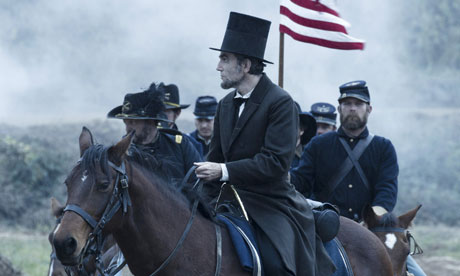
Lincoln

Honest Abe (Daniel Day-Lewis) mournfully surveys the battlefield in Lincoln

With the Civil War in its final death throes, time is of the essence for Lincoln, who is worried his 1863 Emancipation Proclamation decreeing that all slaves be freed will be thrown out by the courts once the war is over and the 13th Amendment defeated by the returning slave states of the south. Warned not to do it by those closest to him for fear of tarnishing his revered reputation, the President realises the opportunity could be lost and leans heavily on his colleagues to help him get the vote through.

Needing a two-thirds majority in the House, Lincoln and Secretary of State William Seward (David Straithairn) send lobbyists William Bilbo (James Spader), Robert Latham (John Hawkes) and Richard Schell (Tim Blake Nelson) out to procure the crucial votes of on-the-fence Democrats by any means necessary.

Tommy Lee Jones as fiery Republican Congessional leader Thaddeus Stevens in Lincoln

Tommy Lee Jones as fiery Republican Congressional leader Thaddeus Stevens in Lincoln

Three distinct threads run through the film – the war of words in the House between Democrats and Republican congressmen enjoying the sound of their own voice, the behind-the-scenes machinations, and the strain on Lincoln’s marriage to First Lady Mary Lincoln (Sally Field) – and it’s to Spielberg’s great credit that we never lose focus of any of them.

Kushner’s witty script is necessarily talky, and it pays not to lose attention, but the enormity of the stakes is always clear and the dialogue positively crackles in the hands of probably the greatest cast assembled for any Spielberg film to date.

Tommy Lee Jones, in his best role for years, has a ball as Republican Congressional leader Thaddeus Stevens, a radical anti-slavery advocate who can’t stop himself insulting Democratic leaders for sport, but knows when to keep his cards close to his chest when the need arises.

There’s a levity to the efforts of the lobbyists to curry the Democrats’ favour, although the grave seriousness of their task is not lost, and the vote itself is expertly handled by Spielberg, who ratchets up the tension like the old pro he is.

Daniel Day Lewis as Honest Abe in Lincoln

Daniel Day Lewis as Honest Abe in Lincoln

The ideologically led politics of Lincoln serves as a timely parallel to the entrenched state of today’s American party political system where petty in-fighting and belligerence can often push progress to the sidelines.

It seems appropriate that America’s most beloved President is played by arguably today’s greatest living actor and Daniel Day-Lewis is stupendous in the title role. He plays Lincoln as a kindly uncle who chooses to win people over with an amusing anecdote or a subtle observation and, ever the politician, engages in a lot of hand holding.

First Lady Mary Lincoln (Sally Field) in Lincoln

First Lady Mary Lincoln (Sally Field) in Lincoln

Day-Lewis makes it look effortless, finding a pause here or a change of tone there to give what will probably become the definitive take on this most adored of presidents. It’s a masterclass in the power of knowing when to underplay a role, to the extent that when some of the cast look in awe of the President you wonder whether it’s actually Day-Lewis they are marvelling at.

We see a more vulnerable Lincoln when he shares private moments with Mary, who has fallen apart following the death of their son and begs her husband to stop their other sibling Robert (Joseph Gordon-Levitt) from joining the war effort. Their pained arguments are powerfully wrought, and Field is excellent as a figure who, like Abe, must compartmentalise personal grief for the good of the country.

Despite this being Spielberg’s most mature and discliplined work to date, he still can’t help himself on occasion, whether it be the rather obvious symbolism of a ticking clock and Lincoln glancing at his watch to show how time is running out, or the saccharine moment when the President walks to a window bathed in light upon hearing the vote has been passed.

Bringing to life a significant moment in the turbulent history of the world’s only superpower, who’d have thought a film where little happens for long periods could be this engrossing?

Review – Django Unchained

For a writer and director who’s the unashamed king of the movie homage there really isn’t anyone else out there making films quite like Quentin Tarantino.

Quentin Tarantino's Django Unchained

Quentin Tarantino’s Django Unchained – arguably his most outrageous film yet

Django Unchained, Tarantino’s eighth feature is arguably his most outrageous yet and serves up a similar stylistic mash-up as his previous film Inglourious Basterds.

In that movie, he somehow got away with making a World War Two spaghetti western (complete with Ennio Morricone music) where a squadron of Jewish-American soldiers give the Nazis a taste of their own medicine.

Here, Tarantino uses a similar mould for his most fully realised and satisfying film since Jackie Brown, jettisoning the episodic structure that has been so familiar throughout his filmography.

Django Unchained is a western with extra spaghetti sauce and features a blaxploitation hero even cooler than Shaft. From the title, which directly references the 1966 spaghetti western Django starring Franco Nero (who makes a cameo here), to the red-painted opening credits, music, ultra violence and theme of revenge (common to virtually all of Tarantino’s work), the film sends the homage-o-meter up to 11.

Dr King Schultz (Christoph Waltz) shows Django (Jamie Foxx) the way of the gun in Django Unchained

Dr King Schultz (Christoph Waltz) shows Django (Jamie Foxx) the way of the gun in Django Unchained

It’s also the writer-director’s most overtly political work to date, addressing the still thorny subject of slavery in a frank and often brutal way. Our hero is Django (Jamie Foxx), a slave in 1858 Texas who wins his freedom thanks to the intervention of Christoph Waltz’s German dentist-turned bounty hunter Dr King Schultz (it can’t be a coincidence that a character who abhors slavery shares his name with Dr Martin Luther King).

The sadistic Calvin Candie (Leonardo DiCaprio) in Django Unchained

The sadistic Calvin Candie (Leonardo DiCaprio) in Django Unchained

Schultz takes Django under his wing and trains him in the art of bounty hunting (“like slavery, it’s a flesh for cash business”) and, in return for assisting him, Schultz agrees to help Django win the freedom of his wife, Broomhilda (Kerry Washington), a slave forced to work at the perversely named Candyland, owned by the despicable sadist and racial supremacist Calvin Candie (Leonardo DiCaprio, sporting horribly blackened teeth).

Tarantino has never been one to shy away from throwing in the kitchen sink when it comes to on-screen violence. It’s a facet of his work that has attracted considerable consternation from critics and commentators throughout his career, but while he no doubt takes great pleasure in seeing how far he can go he also never lets you forget that violence and bullets hurt – a lot. When we see slaves being killed in the most vicious of ways at the hands of Candie, we’re left in no uncertain terms that this is no laughing matter.

The deplorable house slave Stephen (Samuel L Jackson) in Django Unchained

The deplorable house slave Stephen (Samuel L Jackson) in Django Unchained

That being said, just as the Nazis have it coming in Inglourious Basterds, there’s a certain gleeful satisfaction in seeing a black man administer justice of the most merciless kind to the racist white trash who have profited from and exploited the slave trade.

In the film’s most amusing scene , a group of proto-Ku Klux Klansmen led by Big Daddy (Don Johnson) go in search of Schultz and Django, only to bicker among themselves because they can’t see properly out of their white hoods. It’s a nicely observed comment on the absurdity and cowardice of racism.

Tarantino also nods to classic John Ford westerns, framing his heroes against a series of expansive vistas, beautifully filmed by cinematographer Robert Richardson, and conjures up a number of arresting images, most strikingly when blood splattters over pure white cotton on a plantation.

Quentin Tarantino directs and unfortunately stars in Django Unchained

Quentin Tarantino directs and unfortunately stars in Django Unchained

As verbose as Tarantino’s scripts are, his rich dialogue is a gift for the superlative cast he’s assembled here. Waltz almost steals the show as the kind-but-deadly Schultz, as memorable a screen presence as his diabolical Hans Landa from Inglourious Basterds.

Foxx does a nice line in man-with-no-name quiet intensity (can you imagine what Will Smith, Tarantino’s original choice, would have done with the role?), while DiCaprio has a whale of a time tearing it up as the dapper southern aristocrat out of control in his own private fiefdom.

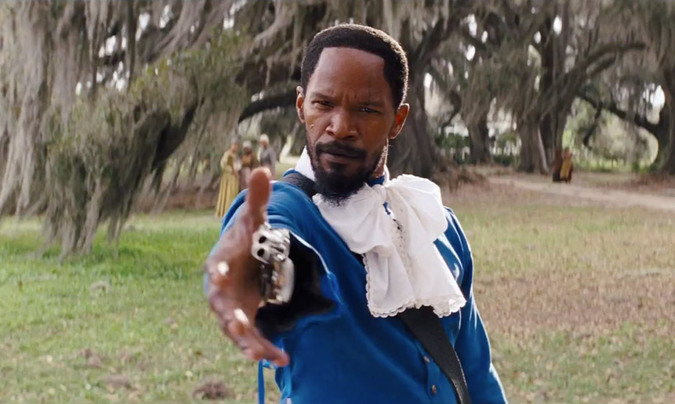
The colourfully dressed Django (Jamie Foxx) kicks ass and takes names in Django Unchained

The colourfully dressed Django (Jamie Foxx) kicks ass and takes names in Django Unchained

However, all pale in comparison to the quite brilliant Samuel L Jackson as Stephen, Candie’s house slave who’s so servile he makes Uncle Tom look like a Black Panther. Hidden behind that frail, shuffling walk lies a truly abominable human being who, when he isn’t perched on Candie’s shoulder like a parrot repeating his every line, is punishing his fellow slaves and conspiring against them to get in his white master’s good books. It’s a very disturbing performance that only Tarantino and Jackson could have dreamt up.

What Tarantino still has some trouble with, however, is acting and he’s truly terrible as an Australian (!) slave driver. He can’t even resist affording himself the film’s most colourful death. This entire section is the only weak spot in the whole movie. There’s a natural end point before this, but Tarantino (who has previously admitted to not showing enough discipline when it comes to a script) gives himself another half an hour before he finally wraps things up, all be it in a pleasingly brutal way.

The thing you have to admire about Tarantino is that he’s a rock’n’roll director in the truest sense, a film geek who wants to share his love of cinema’s outer margins and with Django Unchained he hits it out of the park.