Review – Star Trek Into Darkness

After achieving the sort of franchise rejuvenation in which Christopher Nolan would be proud, J.J Abrams has boldly gone bigger, badder and bolder for his breathlessly enterprising Star Trek sequel.

Star Trek Into Darkness - As smart and engaging as it is outrageously entertaining, blockbusters don't come much better than this

Star Trek Into Darkness – As smart and engaging as it is outrageously entertaining, blockbusters don’t come much better than this

It looked like the final frontier was upon one of cinema’s longest-running film series when 2002’s Star Trek: Nemesis tanked at the box office. But as the Batman franchise had so effectively demonstrated, when stuck in a creative cul-de-sac the best way out is to wipe the slate clean and start again (this summer’s Man of Steel being a case in point).

Kirk (Chris Pine) and Spock (Zachary Quinto) come face-to-face with John Harrison (Benedict Cumberbatch) in Star Trek Into Darkness

Kirk (Chris Pine) and Spock (Zachary Quinto) come face-to-face with John Harrison (Benedict Cumberbatch) in Star Trek Into Darkness

The task of delivering ‘Star Trek Begins’ fell to Abrams, a major player in television with such cult shows as Alias and Lost, but whose only previous big screen experience in the director’s chair had been with the underrated Mission: Impossible III. A self-confessed Trek neophyte, Abrams’ lack of fan-baggage essentially made him the perfect man for the job.

With the help of a finely tuned script by Roberto Orci and Alex Kurtzman that wasn’t afraid to take risks, 2009’s Star Trek managed to please both hardened Trekkies and newbies alike with its impressive mix of epic action set-pieces and emotionally engaging characters.

Abrams wisely retains the core of what worked last time around, while upping the ante considerably with Star Trek Into Darkness, which sees Starfleet under attack from Shakesperean-esque villain John Harrison (Benedict Cumberbatch). Seeking vengeance, Kirk (Chris Pine) leads Spock (Zachary Quinto), Bones (Karl Urban) and the Enterprise crew into a deadly conflict against the cold, calculating terrorist.

Deadly terrorist John Harrison (Benedict Cumberbatch) in Star Trek Into Darkness

Deadly terrorist John Harrison (Benedict Cumberbatch) in Star Trek Into Darkness

Trek is often at its best when subtly preaching tolerance on issues reflecting the times we live in. In the 1960s it was civil rights and feminism, here it’s terrorism, specifically the desire for revenge when cooler heads are needed. It’s an issue that gives the writers plenty of scope to play with the dynamics of the cast, in particular the relationship between the hot-headed, unvarnished Kirk and logical Spock. Kirk’s impulsiveness is what gets results, but it’s also what gets them into trouble in the first place.

New crew member Carol Marcus (Alice Eve) hasn't yet fallen for Kirk's (Chris Pine) charms in Star Trek Into Darkness

New crew member Carol Marcus (Alice Eve) hasn’t yet fallen for Kirk’s (Chris Pine) charms in Star Trek Into Darkness

One of the things that really worked in the rebooted Star Trek was the generous screen time given to the supporting cast. It’s good to see the same approach being taken for the sequel, with Scotty (Simon Pegg), Uhura (Zoe Saldana), Sulu (John Cho) and Chekhov (Anton Yelchin) all integral to the story and given their moments to shine.

Spock (Zachary Quinto) ready for action in Star Trek Into Darkness

Spock (Zachary Quinto) ready for action in Star Trek Into Darkness

Pine finds the chinks in Kirk’s armour and makes him more likeable this time around, while Quinto’s become so comfortable as Spock it’s as if he’s never taken off his Vulcan ears and makes you believe the tumult of emotions under the surface could erupt at any time. Cumberbatch relishes his role and gives the impression he knows he’s always two steps ahead of everyone else. When he tells Kirk that “I’m better … at everything”, you believe him.

Needless to say the film looks stunning, with Abrams’ signature lens flare present and correct in virtually every frame. His long-time production designer Scott Chambliss manages to make the Enterprise beautifully functional (lots of white) without it becoming sterile, while the digital effects team outdo themselves with their realisation of a 23rd century London and San Francisco that feels entirely authentic.

"Damn it Jim!" Bones (Karl Urban) Star Trek Into Darkness

“Damn it Jim!” Bones (Karl Urban) Star Trek Into Darkness

No Abrams film would be complete without a nod to his hero Steven Spielberg and here it’s in an opening scene lifted straight from Raiders Of The Lost Ark in which Kirk and Bones run for their lives from the inhabitants of a primitive planet. Abrams also seems to have a thing for filming long takes of his actors running (remember the extended scene of Tom Cruise legging it in Mission: Impossible III?) and visits that upon poor old Pegg here. There’s even a wink at The Godfather Part III.

On the negative side, Michael Giancchino’s score is way over-the-top. I’m normally a fan of his work, but there were times when the soundtrack was too big even for a film of this scale. Likewise, the finale gets a little too ridiculous for its own good and could have done with being trimmed.

Abrams leaves enough breadcrumbs to whet your appetite for the next installment, even if he’s likely to pass in favour of that other franchise starting with ‘Star’. As smart and engaging as it is outrageously entertaining, blockbusters don’t come much better than this.

Review – The Place Beyond The Pines

The gospel according to Philip Larkin espouses that, whether they mean to or not, your parents will always f**k you up and “add some extra, just for you”.

The Place Beyond The Pines marks Derek Cianfrance out as one of the most exciting and accomplished young directors out there

The Place Beyond The Pines marks Derek Cianfrance out as one of the most exciting and accomplished young directors out there

Larkin’s most famous and acerbic poem, This Be The Verse, could well have been the operating manual for director Derek Cianfrance’s absorbing and operatic second feature, The Place Beyond The Pines.

The sins of the father weigh heavily on the young sons of lawless, directionless Luke (Ryan Gosling) and rookie cop Avery (Bradley Cooper), whose lives intersect in harrowing fashion and send out shock waves that reverberate years later.

Intense motorcycle stuntman Luke Glanton (Ryan Gosling) in The Place Beyond The Pines

Intense motorcycle stuntman Luke Glanton (Ryan Gosling) in The Place Beyond The Pines

Cianfrance chronicled a relationship’s happy beginnings and painful collapse in his previous feature, the acclaimed Blue Valentine, and that film’s exploration of how bad choices made with ‘good’ intentions can come back to haunt you finds a parallel in this more ambitious and superior follow-up.

The Place Beyond The Pines also sees a reunion between Cianfrance and Gosling, whose star wattage has brightened significantly since Blue Valentine, most notably as a result of 2011’s fantastic Drive. In that film Gosling played an intense stunt performer moonlighting as a getaway driver; here he plays an intense motorcycle stuntman who discovers he has a son with ex-lover Romina (Eva Mendes).

Rookie cop Avery Cross (Bradley Cooper) must learn to live with a split-second decision in The Place Beyond The Pines

Rookie cop Avery Cross (Bradley Cooper) must learn to live with a split-second decision in The Place Beyond The Pines

Determined not to follow his father’s example Luke vows to provide for young Jason and does so by robbing a bank, but as he gets carried away he’s warned by his friend Robin (Ben Mendelsohn): “If you’re going to ride like lightning, you’re going to crash like thunder.”

Avery, meanwhile, struggles to come to terms with the aftermath of a split-second decision made in the line of duty that gradually eats away at him. Wracked with guilt, he becomes distant from his infant son AJ and wife Jennifer (Rose Byrne) and starts listening to his district attorney father, who believes Avery should utilise the hero status he gained after that fateful decision by turning his back on the police force and entering politics.

AJ (Emory Cohen) and Jason (Dane DeHaan) in The Place Beyond The Pines

AJ (Emory Cohen) and Jason (Dane DeHaan) in The Place Beyond The Pines

The film’s title derives from the loose English translation of the Mohawk word Schenectady, a city in upstate New York where the picture events are set. The city itself plays as big a part as its characters, who are all anchored to their surroundings and the pits they have dug for themselves.

Gosling is electrifying as the charismatic, but foolish Luke, equal parts Marlon Brando and Paul Newman. His method has been criticised in the past for being overly showy and inauthentic, but many of his critics were won over by his magnetic performance in Drive and here proves it wasn’t a one-off. Gosling does much of his acting with his piercing blue eyes, which can convey shame, self-hatred and sociopathy in the space of a single blink.

Romina (Eva Mendes) and Luke (Ryan Gosling) in a rare happy moment in The Place Beyond The Pines

Romina (Eva Mendes) and Luke (Ryan Gosling) in a rare happy moment in The Place Beyond The Pines

Cooper gives a career-best turn as the conflicted and guilt-ridden Avery. It’s good to see Cooper stretching himself well beyond the smug and arrogant efforts he put into The Hangover franchise and The A-Team. He proved he had chops in Silver Linings Playbook, but here gives a more rounded and reined in performance.

The superb supporting cast include Mendes, who is beautifully naturalistic as the stability-seeking Romina, the terrific Mendelsohn as deadbeat Robin and a snake-like Ray Liotta doing what he does best as corrupt cop Deluca.

A moment nicely echoed later in The Place Beyond The Pines

A moment nicely echoed later in The Place Beyond The Pines

Much of the criticism of The Place Beyond The Pines has centred on Cianfrance’s decision to include what amounts to an extended coda set 15 years after the film’s earlier events in which the now teenage sons of Luke and Avery cross paths to devastating effect. Some have found fault with the neat way in which Cianfrance ties a bow on what until then had been a freeform narrative, while others have questioned why it’s there in the first place.

I for one feel the film is enriched by the scenes involving AJ (Emory Cohen) and Jason (Dane DeHaan) as they provide a deeper context and nicely echo moments that have gone before. When Jason rides his bike down a country road, for instance, it brings to mind the momentary freedom Luke feels on his motorcycle. We don’t need to know what happened in those intervening 15 years, Cianfrance gives us enough to work it out for ourselves.

If Blue Valentine was an impressive calling card, The Place Beyond the Pines marks Cianfrance out as one of the most exciting and accomplished young directors out there.

Review – Oblivion

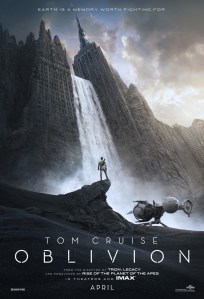
The argument that original ideas in Hollywood are a rare beast is pretty difficult to refute if Tom Cruise’s slick, but highly derivative new slice of dystopian sci-fi is anything to go by.

However visually dazzling and ambitious Joseph Kosinski's Oblivion is, it ultimately gets lost in a void of its own making

However visually dazzling and ambitious Joseph Kosinski’s Oblivion is, it ultimately gets lost in a void of its own making

Director Joseph Kosinski has followed up the visually resplendent Tron: Legacy with another sumptuous spectacle that uses smoke and mirrors to deft effect to disguise its shortcomings.

Kosinski has openly admitted the stream of serious, pre-Star Wars sci-fi films made in the first half of the 1970s – in particular Silent Running, The Omega Man and Soylent Green – were a major influence on the look and feel he wanted for Oblivion.

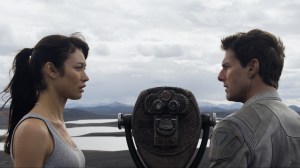
"I know you don't I?" Julia (Olga Kurylenko) is questioned by Jack (Tom Cruise) in Oblivion

“I know you don’t I?” Julia (Olga Kurylenko) is questioned by Jack (Tom Cruise) in Oblivion

However, there are also glaring nods to Planet Of The Apes, 2001: A Space Odyssey, Total Recall and, more recently Duncan Jones’ excellent Moon and the Pixar classic Wall-E.

Set in 2077, Cruise plays Jack Harper, who we learn in a long opening voiceover is part of “the mop-up crew” alongside partner/lover Victoria (Andrea Riseborough) for an Earth half-destroyed by an invading alien force 60 years previously. The war against the aliens, we are told, was won, but the planet was ravaged beyond saving and Jack and Victoria are preparing to rejoin what remains of humanity on Saturn’s largest moon Titan.

Their only contact with home is through a glitchy feed to Mission Control (Melissa Leo), who seeks regular assurances they remain “an effective team”. Jack is tasked with maintaining gun-wielding drones (a cross between Robocop‘s ED-209 and the robots from the classic Commodore 64 computer game Paradroid) which hunt down alien “scavengers”, but is haunted by a nagging memory that threatens to undermine everything he believes.

One of the many stunning shots in Joseph Kosinski's Oblivion

One of the many stunning shots in Joseph Kosinski’s Oblivion

There’s no doubt Kosinski (previously attached to a remake of another 1970s sci-fi classic Logan’s Run) has an eye for a memorable shot. Indeed, there are times when what you’re looking at takes your breath away, most indelibly when Jack is sat atop a mountain looking out onto a beautifully ravaged landscape (in reality Iceland). His ambitions have been given life thanks to the remarkable work of cinematographer Claudio Miranda, who won an Oscar for Life of Pi, and Darren Gilford’s incredible production design.

Victoria (Andrea Risedborough), one half of an effective team in Oblivion

Victoria (Andrea Risedborough), one half of an effective team in Oblivion

Kosinski also has a cool ear, having secured French dance pioneers Daft Punk to score Tron: Legacy and fellow electro-inclined Frenchies M83 to provide a Vangelis/Hans Zimmer-esque epic sci-fi soundtrack here.

A charge levelled at science fiction of this ilk is that it can come across as cold and aloof to the viewer and, unfortunately, Oblivion fails to avoid that trap. Stunning visuals do not a great film make and somewhere along the line an engaging and logical narrative got lost amid the search for the next jaw-dropping shot.

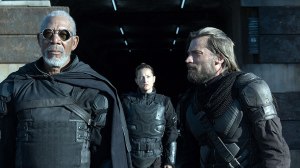
Malcolm Beech (Morgan Freeman), Kara (Zoë Bell) and Sykes (Nikolaj Coster-Waldau) in Oblivion

Malcolm Beech (Morgan Freeman), Kara (Zoë Bell) and Sykes (Nikolaj Coster-Waldau) in Oblivion

No stranger to dystopian sci-fi following Steven Spielberg’s Minority Report and criminally underrated War of the Worlds, Cruise does his best to find a fully rounded human being in Jack Harper but is let down by a disappointing script co-written by Kosinski.

Olga Kurylenko is given little to do as the enigmatic Julia, while Morgan Freeman and Game of Thrones‘ Nikolaj Coster-Waldau are entirely wasted as leading figures in the film’s dubious and confused second half. The real standout is Riseborough, who injects empathy and humanity into what could easily have been a cardboard cut-out role in lesser hands.

Serious, cerebral moviemaking on a sizeable budget is something of a rarity these days, but however visually dazzling and ambitious Oblivion is, it ultimately gets lost in a void of its own making.

Review – Iron Man 3

The law of diminishing returns has long been an affliction of the modern movie franchise, wherein bigger is believed to be better and the script often resembles a paint-by-numbers exercise in calculated cynicism.

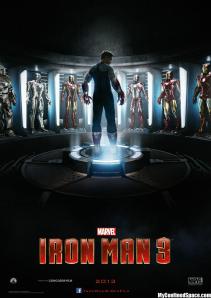
Iron Man 3 - "Black has forged a Marvel-ous summer blockbuster that’s as cool, collected and cocksure as its hero"

Iron Man 3 – “Black has forged a Marvel-ous summer blockbuster that’s as cool, collected and cocksure as its hero”

The rust appeared to have set in for Ol’ Shellhead with the turgid Iron Man 2, a vacant mess as bloated as its director John Favreau that undid all of the good work of the entertaining first instalment.

However, the mojo is back thanks to another bold decision by the powers that be at Marvel (following the call to appoint Kenneth Branagh to direct Thor) to take a punt on meta-man Shane Black to co-write and helm the studio’s first salvo since Joss Whedon’s Avengers Assemble struck box office platinum.

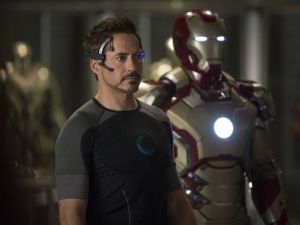
Tony Stark (Robert Downey Jr) with his latest toy in Iron Man 3

Tony Stark (Robert Downey Jr) with his latest toy in Iron Man 3

Anyone familiar with Black’s only previous stint in the director’s chair, 2005’s Kiss Kiss Bang Bang will know getting him on board for Iron Man 3 makes total sense. For one thing, Kiss Kiss Bang Bang starred Robert Downey Jr (in something of a career comeback performance), whose rapid-fire delivery fitted Black’s snappy, wise-cracking dialogue to perfection.

It therefore shouldn’t come as a major surprise to learn that Black has a blast with Tony Stark (Downey Jr), the ingenious, fast-talking billionaire egotist and self-appointed superhero who must go back-to-basics and overcome his post-Avengers Assembled panic attacks when his cosy world is turned upside down at the hands of the Mandarin (Ben Kingsley), a megalomaniacal terrorist seemingly hell-bent on bringing America to its knees.

Although there are obligatory boxes that need ticking when dealing with a franchise picture, there are more than enough Blackisms peppered throughout the film’s 130-minute running time. While Whedon got away with one truly inspired moment in Avengers Assembled when a crew member on S.H.I.E.L.D’s flying aircraft carrier is caught playing classic video game Galaga, Iron Man 3 is all Black.

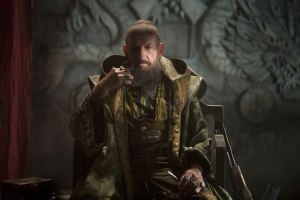
The mysterious Mandarin (Ben Kingsley) in Iron Man 3

The mysterious Mandarin (Ben Kingsley) in Iron Man 3

He has a field day pulling the rug from under the viewer by undermining familiar screenwriting tropes, such as in the amusing relationship between Stark and troubled kid Harley (Ty Simpkins), who helps him get to the bottom of the Mandarin’s dastardly plan. Black knows we’re expecting a father/son bond to form, but buries the notion in a blizzard of cute one-liners.

Likewise, he saves some of the best lines for the smart-suited henchmen, who in any other blockbuster outside of an Austin Powers flick would be nothing more than target practice for our hero.

Pepper Potts (Gwyneth Paltrow) picks up the pieces in Iron Man 3

Pepper Potts (Gwyneth Paltrow) picks up the pieces in Iron Man 3

To Black’s credit, he and co-screenwriter Drew Pearce keep Tony out of the heavy metal suit for long periods (even during the inevitable robots-hitting-each-other final reel), no doubt understanding the franchise’s greatest strength isn’t the wham-bam special effects (although there’s still plenty of them), but rather Downey Jr’s scenery-chewing performance.

That being said, Downey Jr’s turn is so big many of the supporting cast barely have a chance to make an impact, especially Gwyneth Paltrow as Tony’s soul mate Pepper Potts, who looks confused or shocked most of the time, and Rebecca Hall as Stark’s former conquest Dr Maya Hansen, who has so little to do it’s almost tragic.

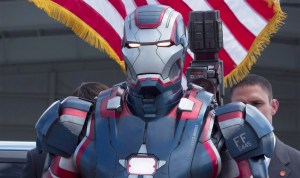
War Machine, make that Iron Patriot, in Iron Man 3

War Machine, make that Iron Patriot, in Iron Man 3

Don Cheadle gets a lot more to do this time around as Rhodes, whose Iron Man suit has been sprayed red, white and blue and renamed Iron Patriot (as opposed to its previous moniker, the more honest War Machine) and who gets to enjoy some Lethal Weapon-style buddy action with Tony, which is only appropriate bearing in mind Black wrote that 80s blockbuster.

The only one who truly stands out alongside Downey Jr, however, is Kingsley, who steals every scene he’s in as the mysterious Mandarin. It’s a superb, multi-layered performance that’s as out-there as it is memorable.

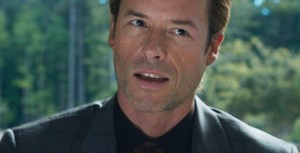
Tony Stark's former number one fan Aldrich Killian (Guy Pearce) in Iron Man 3

Tony Stark’s former number one fan Aldrich Killian (Guy Pearce) in Iron Man 3

One of the problems with creating a post-Avengers universe containing a big green guy and a hammer-wielding god is that they’re notable by their absence in Marvel’s stand-alone movies. The film tries to get around this big, gaping logic hole when Stark explains: “This isn’t superhero business. It’s American business.” But if that’s the case, then where’s Captain America?

As with Kiss Kiss Bang Bang and Black’s numerous other scripts (in particular The Last Boy Scout), Iron Man 3 gets a little too-cute for its own good, to the extent whereby some scenes get so caught up in the next one-liner the narrative grinds to a halt.

That being said, the direction Black and Pearce take the main character is a real winner. This Tony Stark must swallow his pride, understand the consequences of his actions and rely on the skills that created Iron Man in the first place if he is going to prevail.

Whether this is Downey Jr’s final solo stint as Ol’ Shellhead remains to be seen; either way Black has forged a Marvel-ous summer blockbuster that’s as cool, collected and cocksure as its hero.

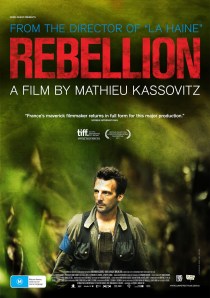
Review – Rebellion

This review originally formed part of my blog covering the 2011 London Film Festival. Only now has the film finally gained a wide international release.

Mathieu Kassovitz's Rebellion - "brave, prescient film-making of the highest order"

Mathieu Kassovitz’s Rebellion – “brave, prescient film-making of the highest order”

Mathieu Kassovitz has never quite managed to reach the same heights as his hard-hitting debut feature La Haine (1995). In fact he was fast turning into a hack for hire with such lightweight US genre fare as the terrible Halle Berry ‘shocker’ Gothika (2003) and Vin Diesel-starring sci-fi dud Babylon AD (2008).

Well, Kassovitz is back in France and back to his best with the searing, heavyweight political thriller Rebellion, which chronicles an incident in 1988 in the French colony of New Caledonia when 27 hostages were taken by a group of indigenous guerilla fighters seeking independence, and the bloody military rescue operation that subsequently took place.

The French forces round up the 'insurgents' in Rebellion

The French forces round up the ‘insurgents’ in Rebellion

Kassovitz films the drama through the eyes and experiences of Philippe Legorjus (played by the director himself), a Captain with the French GIGN counter-terrorist special forces, which were called on to assist the army with tracking down the ‘insurgents’ and freeing the hostages.

Legorjus and his men are primarily trained to deal with hostage-takers through negotiation, but the Captain quickly gets the impression that talking isn’t the number one goal of the military brass and French minister Bernard Pons (Daniel Martin), especially when there’s a presidential election taking place in France and incumbent President François Mitterrand and his opponent Jacques Chirac are trying to out-do each other over their tough stances on the unfolding crisis.

The bloody fallout of the 1988 New Caledonia hostage crisis begins in Rebellion

The bloody fallout of the 1988 New Caledonia hostage crisis begins in Rebellion

Legorjus nevertheless tries to make contact with the group holding the hostages and succeeds after he is himself taken hostage. He wins the hard-earned trust of leader Alphonse Dianou (Iabe Lapacas) and is set free, promising to do what he can to give the group a platform in which to put their case for independence forward.

With the situation still tense, Legorjus works around the clock trying to convince the powers that be that the hostage-takers are willing to negotiate, but keeps running into brick walls until time runs out and a full military assault is ordered. With no time left, Legorjus realises he must betray Dianou’s trust in an effort to save as many of the hostages as he can.

The military brass in full effect in Rebellion

The military brass in full effect in Rebellion

Counting down over the course of 10 days until the dramatic, bloody assault on the cave where the hostages are being held, there’s a growing sense of inevitability that Legorjus is fighting a losing battle.

There are pointed remarks sprinkled throughout the film as to where this path is headed; when Legorjus tells a lawyer living on the island that the order to attack has been given, he asks the captain incredulously “the government wouldn’t do that would they?”. Another moment comes earlier in the film when Legorjus reminds his men that the population of New Caledonia are officially French citizens and therefore not ‘the enemy’. Needless to say these words ring hollow later in the film.

Thought-provoking and provocative, the anger of the film seeps out of every frame. This is brave, prescient film-making of the highest order.