Review – Mud

A serious contender for this year’s Great American Film, Jeff Nicholls’ lyrical, poetic third feature evokes a timeless quality all-too-rare in today’s cinematic landscape.
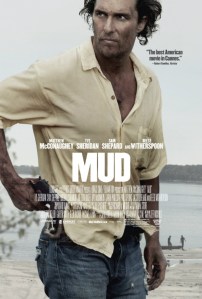
A serious contender for this year's Great American Film, Jeff Nicholls' lyrical, poetic Mud evokes a timeless quality all-too-rare in today's cinematic landscape

A serious contender for this year’s Great American Film, Jeff Nicholls’ lyrical, poetic Mud evokes a timeless quality all-too-rare in today’s cinematic landscape

Nicholls has quietly positioned himself among the most visionary and essential directors at work today with his striking 2007 debut Shotgun Stories and his belated follow-up, the disturbing and astonishing Take Shelter (2011).

The incredible boat in a tree in Mud

The incredible boat in a tree in Mud

In both Shotgun Stories and Take Shelter, their leading characters (played each time by the mesmeric Michael Shannon) are driven by an almost insane conviction. That same dogmatic approach is adopted by Mud (Matthew McConaughey), the charismatic fugitive living out on a small island in the Mississippi River who befriends inquisitive teenagers Ellis (Tye Sheridan) and Neckbone (Jacob Lofland). Mud has risked his freedom by returning to the area in which he grew up to be reunited with his true love Juniper (Reese Witherspoon), but a group of killers arrive in town looking to avenge a past crime by Mud.

Nicholls has been quick to acknowledge the debt the film owes to Mark Twain’s Adventures of Huckleberry Finn in the overtly Finn/Tom Sawyer relationship between Ellis, who lives on a river boat with his squabbling parents (played by the excellent Ray McKinnon and Sarah Paulson) and Neckbone.

Ellis (Tye Sheridan) and Neckbone (Jacob Lofland) first meet Mud (Matthew McConaughey) in Mud

Ellis (Tye Sheridan) and Neckbone (Jacob Lofland) first meet Mud (Matthew McConaughey) in Mud

The 14-year-old Ellis is an idealist who’s obsessed with reuniting Mud and Juniper because he believes in the power of love. As young teenagers, the concept of true love can be all-encompassing and Ellis acts with such doggedness in order to counterbalance the failing relationship of his parents. Likewise, he gets a tough lesson in the ways of love courtesy of an older girl he falls for.

The love of Mud's life, Junniper (Reese Witherspoon) in Mud

The love of Mud’s life, Juniper (Reese Witherspoon) in Mud

Mud brings to mind Terence Malick in its penchant for the Magic Hour (and its fascination with nature) and Nicholls with long-time director of photography Adam Stone captures a string of breathtaking shots. The relationship with Malick doesn’t end there; Mud’s producer Sarah Green worked on The Tree of Life, while Sheridan was given his debut in that film.

Jeff Nicholls' long-time partner Michael Shannon plays Galen in Mud

Jeff Nicholls’ long-time partner Michael Shannon plays Galen in Mud

He only has a limited filmography, but Sheridan is already showing himself as a young actor with a lot of promise. It’s a demanding role and he brings a lot of maturity to it. All he wants is for people to be happy and for things to be in order, so you can feel his pain when he realises life is much harder to get a handle on.

Maintaining his remarkable career renaissance (aka, his McConaisance), McConaughey is a revelation in the title role. Once the butt of many a joke for his languid, cheque-grabbing performances in duds like Failure to Launch, McConaughey of late has returned to the high watermark he achieved in the likes of Dazed and Confused and Lone Star. Lovelorn, scared, but determined also, his Mud is not so very different from Ellis.

Mud (Matthew McConaughey) tries to save his skin in Mud

Mud (Matthew McConaughey) tries to save his skin in Mud

The excellent supporting cast includes Shannon as Neckbone’s placid Uncle Galen (as far removed from Take Shelter‘s Curtis LaForche as you can get) and the impeccable Sam Shepard as Tom, who may or may not be a former CIA agent living off the grid in the Mississippi swamps.

Just as Malick managed to capture the coming of age adventure of adolescence in The Tree of Life, so too does Nicholls here. When we see a boat stuck up a tree (Mud’s temporary home), we marvel instead of questioning the unlikelihood of what we’re watching; such is the power of Nicholls’ persuasive vision.

The slightly fumbled ending doesn’t detract from what is a work of true poetry from Nicholls. Much like last year’s Beasts of the Southern Wild, Mud is a real one-off that will stay with you for a long time after.

Review – Hummingbird

Britain’s last action hero Jason ‘The Stath’ Statham flexes his acting muscles as much as his real ones in this low-key curiosity.

Whether Hummingbird turns out to be a one-off diversion on Statham's action-packed career path we'll wait and see, but I for one would welcome more roles like this from Mr Chrome Dome

Whether Hummingbird turns out to be a one-off diversion on Statham’s action-packed career path we’ll wait and see, but I for one would welcome more roles like this from Mr Chrome Dome

Whether you like Statham or not (and there are plenty who don’t), there’s no denying the former diver and black market trader has done the business on his own terms.

I for one have a huge amount of respect for Statham. While many of his action man peers rely on straight-to-DVD trash to make a living, Mr Chrome Dome has become a genuine movie star in his own right. A big reason for this is because he (mostly) tends to choose his films wisely and isn’t afraid to send his hard man persona up.

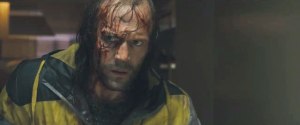
Down and out Joseph 'Joey' Smith (Jason Stathom) in Hummingbird

Down and out Joseph ‘Joey’ Smith (Jason Statham) in Hummingbird

Film series like The Transporter and the two Expendables movies may be his bread and butter, but with his latest Hummingbird (released as Redemption in the States and, erroneously, Crazy Joe in France) he gets down to the serious business of acting… while still kicking ass and taking names.

Statham plays Joseph ‘Joey’ Smith, who’s deserted from the Royal Marines following a traumatic tour of duty in Afghanistan’s Helmand Province and is living day-to-day on the streets in London. He escapes a couple of brutal gangsters and breaks into a swish apartment, whose owner is out-of-town for several months. While getting himself back on his feet he tries to help Sister Cristina (Agata Buzek), whose shelter saved him when he was at his lowest ebb, while also looking for revenge against the low life who murdered his girlfriend.

I don't Adam and Eve it, Jason Statham's crying in Hummingbird

I don’t Adam and Eve it, Jason Statham’s crying in Hummingbird

Played straight for the most part, writer-director Steven Knight revisits the same down and dirty side of the Big Smoke he explored in his script for David Cronenberg’s Eastern Promises. Knight clearly knows the city well and, with the help of cinematographer Chris Menges (who also shot the Colin Farrell gangland drama London Boulevard) captures it beautifully. Shot mostly at night, the camera lovingly follows Smith as he silently walks the streets.

When it comes, the violence is as nasty as you would expect in a Statham picture, although it doesn’t wallow in it. In fact the only nod to Stath’s better known fare comes when Smith, challenged by a goon holding a blade, utters the immortal line “you got a knife? I got a spoon”.

A broken Joey Smith (Jason Statham) is held by Sister Cristina (Agata Buzek) in Hummingbird

A broken Joey Smith (Jason Statham) is held by Sister Cristina (Agata Buzek) in Hummingbird

No-one would argue Hummingbird should win any prizes for originality, although the nods to Mike Hodges’ classic 1971 crime thriller Get Carter are pretty blatant, right down to the way he dispatches one particularly loathsome individual.

That being said, there are enough moments here to make the film stand on its own two feet. The parallel, for instance, in the opening moments between an aerial shot of Helmand featuring radio chatter and one of London is very nicely handled and sets up the rest of the movie well.

Joey Smith (Jason Stathom) sets his sights on his prey in Hummingbird

Joey Smith (Jason Statham) sets his sights on his prey in Hummingbird

And what of Statham himself? In interviews for the film, he’s spoken of his pride in the film, while the work he went through for the role is evident on screen as he taps into previously unseen emotions (guilt, weakness, depression).

Whether Hummingbird turns out to be a one-off diversion on Statham’s action-packed career path we’ll wait and see, but I for one would welcome more roles like this from Mr Chrome Dome.

Review – World War Z

Zombie cinema has come an awful long way from the no-budget claustrophobia of Night Of The Living Dead to this globe-trotting action horror that’s as epic in scale as it is in expense.

World War Z aims to be the last word in zombie-geddon, but in sacrificing character for spectacle World War Z aims to be the last word in zombie-geddon, but in sacrificing character for spectacle it ends up lacking the bite of the genre’s true classics

World War Z aims to be the last word in zombie-geddon, but in sacrificing character for spectacle World War Z aims to be the last word in zombie-geddon, but in sacrificing character for spectacle it ends up lacking the bite of the genre’s true classics

Once regarded as little more than a niche genre presided over by George A Romero, the zombie flick was reanimated for modern audiences by Danny Boyle in his 2002 horror classic 28 Days Later and since then has lurched its way into the mainstream, to the extent that even TV has embraced it in the form of the hugely popular cable show The Walking Dead, based on the comic book of the same name.

While the undead were doing their thing on the big screen, Max Brooks’ 2006 novel World War Z took a wholly new and plausible approach by presenting itself as an oral history of a 10-year global zombie war; a collection of personal accounts compiled by a United Nations agent examining the various geo-political, religious and environmental changes that occurred as a result.

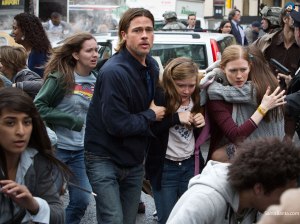
Fleeing the initial zombie outbreak in World War Z

Fleeing the initial zombie outbreak in World War Z

Adapting a book with World War Z‘s particular structure was always going to be tough, but it’s nevertheless surprising just how fast and loose the filmmakers have played with the source material, to the extent that virtually the only thing connecting the two is the title.

The novel’s only common thread is its narrator, so it makes sense the driving force for the movie is former UN investigator Gerry Lane (Brad Pitt), who’s portrayed as a loving father to two girls and husband to Karin (Mireille Enos), presumably to remind both us and him what he’s fighting to save when it all goes down.

Devastation-porn in World War Z

Devastation-porn in World War Z

And boy does it all go down right from the first few minutes when, sitting in heavy traffic in downtown Philadelphia, they are suddenly and violently attacked by a growing horde of rabid zombies. The family barely make it to the roof of an apartment complex, where they are extracted in the nick of time by helicopter (whose complement includes a blink and you’ll miss him Matthew Fox) to a US Navy vessel, where they discover the terrifying scale of the worldwide pandemic. Told that he and his family will be forcibly evacuated off the ship unless he co-operates, Gerry reluctantly agrees to join the needle in a haystack search for Patient Zero, starting at a US military base in South Korea. From there, Gerry travels to Jerusalem and (randomly) Cardiff in a race against time to find anything to give them an advantage against “Zeke”.

Karin (Mireille Enos) and husband Gerry (Brad Pitt) seek escape in World War Z

Karin (Mireille Enos) and husband Gerry (Brad Pitt) seek escape in World War Z

A general rule of previous zombie movies has been to suggest the disturbing degree of the outbreak through emergency radio broadcasts or fuzzy television pictures. Not so World War Z, which tries to live up to its hardcore title by wallowing in the devastation, be it the military bombing the hell out of a city or an anthill of zombies furiously piling on top of each other to traverse a massive wall the Israelis have constructed to supposedly keep the undead out. Before you have chance to catch your breath, though, Gerry’s off again on his whistle stop tour.

Going after "Zeke" in World War Z

Going after “Zeke” in World War Z

As the film progresses, however, the focus gradually narrows from CGI-heavy mass destruction and chaos to a relatively claustrophobic third act set within a laboratory, which was bolted on after the movie’s original ending was jettisoned by the studio and producer Pitt.

Gerry (Brad Pitt) and co in World War Z

Gerry (Brad Pitt) and co in World War Z

Although clearly financially motivated (a static indoor location is far cheaper than horrendously expensive reshoots on the scale of the rest of the film) and somewhat derivative of many a great horror movie that’s come before, director Marc Forster makes the best of what he’s given and does a solid enough job ratcheting up the tension, although this is dampened by one unintentionally humorous zombie’s endless teeth-clicking.

While Brooks’ episodic narrative gave the reader a thorough sense of each individual and their story, World War Z’s script doesn’t have time for such distractions as character. Despite his commendable efforts to get the thing onto the big screen, Pitt feels like the wrong fit for Gerry. An actor with more range would have better suited the material and given the audience a greater sense of the personal impact this unimaginable horror must be having. And with the exception of Daniellla Kertesz’s Israeli soldier, no-one else is given the chance to make any impact.

Probably the most memorable image of World War Z

Probably the most memorable image of World War Z

Watching World War Z, I couldn’t help having the feeling that it would have worked better as a cable TV mini-series. The famous Battle of Yonkers chapters aside, wherein US soldiers make an Alamo-style stand against tens of thousands of ghouls (which is missing from the film anyway), Brooks’ novel largely stayed away from massive spectacle, concentrating instead on ordinary men, women and children fighting for survival.

As fast-moving as the thousands of undead who swarm across the screen, World War Z aims to be the last word in zombie-geddon, but in sacrificing character for spectacle it ends up lacking the bite of the genre’s true classics.

Review – Behind The Candelabra

It’s an unfortunate twist of fate that a film featuring an outrageously flamboyant central figure who was one of the world’s biggest stars ended up being relegated to the small screen in the United States.

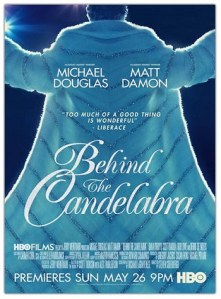
Behind The Candelabra may be a relatively low key film for Soderbergh to bow out on, but it is consumate filmmaking nonetheless and fully advocates Liberace's motto that "too much of a good thing is wonderful".

Behind The Candelabra may be a relatively low key film for Soderbergh to bow out on, but it is consumate filmmaking nonetheless and fully advocates Liberace’s motto that “too much of a good thing is wonderful”.

Despite starring Michael Douglas and Matt Damon and featuring Steven Soderbergh behind he camera for what is supposedly his final film, the Hollywood studio system shamed itself by refusing to back Behind The Candelabra for being ‘too gay’.

In the end, it took HBO to fund the picture and remind those who had forgotten that we’re living in the 21st century. This meant the movie only saw the light of day in America via the cable TV giant, a bittersweet irony considering it played in competition at this year’s Cannes Film Festival and made it into cinemas outside of the States.

'Mr Showmanship' Liberace (Michael Douglas) in action in Behind the Candelabra

‘Mr Showmanship’ Liberace (Michael Douglas) in action in Behind the Candelabra

Best known for overtly masculine roles in the likes of Basic Instinct, Wall Street and Fatal Attraction, Douglas plays seriously against type as Walter ‘Lee’ Liberace, the world-famous pianist extraordinaire who became the highest-paid entertainer on the planet and the epitome of Las Vegas excess.

Behind The Candelabra chronicles the last 10 years of Liberace’s life, focussing in particular on the covert affair he had with the much younger Scott Thorson (Damon), on whose eponymous memoir the film is based. An animal trainer for movies, Scott is introduced to Liberace through Bob Black (Scott Bakula), a Hollywood producer who he meets in a gay bar. Scott is dazzled by Liberace’s piano skills, while Lee is instantly taken with the handsome younger man.

Liberace (Michael Douglas) tells Scott (Matt Damon) how he feels in Behind the Candelabra

Liberace (Michael Douglas) tells Scott (Matt Damon) how he feels in Behind the Candelabra

While’s Liberace’s carefully managed public persona portrays him as being straight, in real life he and Scott become lovers and behind the candelabra embark on a passionate relationship that takes a turn for the surreal before finally ending up in acrimony.

The slightly fuzzy lens reflects the affection Soderbergh clearly has with his subject matter. There are similarities to Paul Thomas Anderson’s Boogie Nights, both in the late 70s and early 80s setting and Damon’s beautifully observed portrayal of Thorson, whose journey from eager-to-please greenhorn to a hurt and embittered shadow of his former self calls to mind Mark Wahlberg’s Dirk Diggler.

Scott Thorson (Matt Damon) all dolled-up in Behind the Candelabra

Scott Thorson (Matt Damon) all dolled-up in Behind the Candelabra

When the story takes a painful turn, Soderbergh is careful not to trade in black and whites and place the blame on any one person’s doorstep. Liberace and Scott are essentially two sides of the same coin, both lonely and desperate to be loved. In Scott’s case this stems from his time as a foster child, in Lee’s it’s from his mother Frances (played by Debbie Reynolds), whom he feels stiffled by. In a telling scene, Frances wins the jackpot on a slot machine she’s playing in Lee’s home, but no money comes out. Lee offers her whatever money he can find, but she refuses and demands a cheque instead.

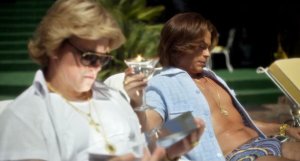
Being two such lonely souls looking for companionship, it’s of little surprise their relationship is so intense, although things start to get very odd when Lee brings in plastic surgeon Dr Jack Startz (Rob Lowe) to perform some off-kilter work on Scott.

Scott (Matt Damon) and half-baked plastic surgeon Dr Jack Startz (Rob Lowe) in Behind the Candelabra

Scott (Matt Damon) and half-baked plastic surgeon Dr Jack Startz (Rob Lowe) in Behind the Candelabra

Watching Behind The Candelabra, it’s remarkable to think no-one publicly questioned Liberace’s sexuality when he minced about on stage in all manner of camp and ostentatious costumes because it naturally formed part of his self-styled ‘Mr Showmanship’ image. Even Scott looks taken aback when, after watching Liberace on stage for the first time and suggesting to Bob “it’s funny the crowd would like something this gay”, Bob tells him: “They have no idea he’s gay.”

A scene that's probably 'too gay' for the studios in Behind the Candelabra

A scene that’s probably ‘too gay’ for the studios in Behind the Candelabra

Although ironically one of Soderbergh’s least flashy films considerig the subject matter, he still includes a number of clever touches, not least of which when a surly Scott is eating a meal while Lee is flirting with a group of younger men which subtly parallels a scene earlier in the film when Lee’s piano protegé Billy (Cheyenne Jackson) is sat in the same seat dourly eating food while Lee is first chatting to Scott. It’s a nicely observed moment of how disposable things are in Liberace’s world.

While Damon is superb, Douglas is just as good, showing a pain behind the eyes and the showman’s smile that looks decades old. He tells Scott he wants to be his “father, brother, lover and best friend”, but doesn’t know how to be any of them. Lowe, meanwhile, is hilarious as the half-baked nip/tuck doc who’s hardly the greatest advert for plastic surgery.

Behind The Candelabra may be a relatively low key film for Soderbergh to bow out on, but it is consumate filmmaking nonetheless and fully advocates Liberace’s motto that “too much of a good thing is wonderful”.

Review – Man Of Steel

The superhero’s superhero is back, but not as we’ve seen him before, in Zack Snyder’s earnest origin story that strives to put the king-daddy of comic books back on his throne.

There's enough in Man Of Steel to promise much for future adventures, but let's hope there's more fun next time around

There’s enough in Man Of Steel to promise much for future adventures, but let’s hope there’s more fun next time around

While his ability to leap tall buildings in a single bound and run faster than a speeding locomotive naturally lend themselves to incredible set pieces, Superman as a character has always been tricky to build a movie around. His intrinsic capacity for good is far less dramatic than the dark, brooding of Batman, for instance, or the cocksure machismo of Iron Man.

Jor-El (Russell Crowe) prepares to sending his son away from a dying Krypton in Man Of Steel

Jor-El (Russell Crowe) prepares to send his son away from a dying Krypton in Man Of Steel

Uninspiring action sequences, a lacklustre plot and an over-extended running time sank Supes’ last cinematic outing, 2006’s Superman Returns, so the challenge was on to rediscover the magic of 1978’s Superman and make him relevant to a modern day audience.

The news that Man Of Steel would be ‘A Zack Snyder Film’ was hardly a great start. Since his highly watchable 2004 remake of Dawn Of The Dead, the quality of Snyder’s output has diminished further with each new release, to the extent that his most recent film, 2011’s Sucker Punch was virtually unwatchable.

Clark Kent flashbacks to his childhood in Man of Steel's best moments

Clark Kent flashbacks to his childhood in Man of Steel’s best moments

Although the presence of Batman alumnus Christopher Nolan and David S Goyer as, respectively, producer and screenwriter can be felt, there’s no mistaking this is a Snyder movie, which means stylised violence delivered at an ear-bleeding volume.

Taking the character back to his roots, Man Of Steel begins at the moment of his birth on a dying Krypton. His father Jor-El (Russell Crowe) and mother Lara (Ayelet Zurer) manage to launch the spacecraft carrying Kal-El before maniacal rebel General Zod (Michael Shannan) is able to get his hands on the child. Crash-landing on Earth, he’s raised by honest-to-goodness farmers Jonathan and Martha Kent (Kevin Costner and Diane Lane), who name him Clark. When Clark starts to develop super-human powers, his alien lineage is revealed to him by his father, who warns of the need to keep his abilities a secret for fear that a confused, frightened society would reject him. However, when Zod and his followers arrive years later demanding that Earth surrender Kal-El or suffer the consequences, Clark must finally embrace his Kryptonian ancestry and become the superman he was destined to be.

Jonathan Kent (Kevin Costner) consoles a confused Clark in Man Of Steel

Jonathan Kent (Kevin Costner) consoles a confused Clark in Man Of Steel

While the dark and serious approach taken by Nolan for his Dark Knight trilogy works for a superhero who lives in the shadows, the similar direction Man Of Steel takes doesn’t make much sense. Tossing words around like “edgy” and “realistic” is all well and good, but when you’re dealing with god-like alien beings beating the hell out of each other and laying waste to half of Metropolis (and killing thousands of faceless people in the process, although this doesn’t seem important) on a scale not seen since the The Matrix Revolutions, “realistic” is stretching it somewhat.

Taken on their own merits, the childhood flashbacks Clark has during his Christ-like wandering phase in the film’s first act are the film’s finest moments. Handsomely filmed, these scenes are richly evocative and beautifully played by Costner and Lane. Indeed, the brief, wordless moment when a young Clark plays with the family dog and wears a makeshift red cape is Man Of Steel‘s high watermark.

Intrepid Daily Planet reporter Lois Lane (Amy Adams) in Man Of Steel

Intrepid Daily Planet reporter Lois Lane (Amy Adams) in Man Of Steel

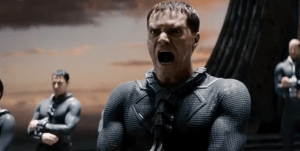
A typically restrained Michael Shannan as General Zod in Man Of Steel

A typically restrained Michael Shannon as General Zod in Man Of Steel

However, they look like they belong in another film when Snyder switches into default mode and lets the CGI do the talking. While there was a palpable sense of jeopardy for Iron Man and co during Avengers Assembled‘s extended final battle in New York, here the only thing you feel is a sore backside.

In his big break, Henry Cavill does everything that’s asked of him, from brooding lonerism to conflicted turmoil and finally self-assurance that falls on the right side of smug. He’s no Christopher Reeve, but then who is? Anyone aware of Shannon’s turns in the likes of Take Shelter and HBO’s Boardwalk Empire may wonder like me how much CGI was actually required to show Zod’s heat vision, so intense are Shannon’s eyes anyway. It’s hardly a stretch, but it’s fun nonetheless to watch him deliver Zod’s semi-regular meltdowns.

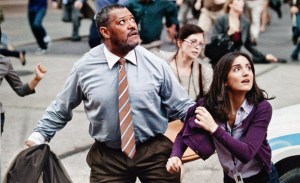
Daily Planet editor Perry White (Laurence Fishburne) and his staff take shelter in Man Of Steel

Daily Planet editor Perry White (Laurence Fishburne) and his staff take shelter in Man Of Steel

Although she starts out well as feisty reporter Lois Lane, Amy Adams struggles with a script that runs out of things for her to do. Laurence Fishburne, meanwhile, dons his Morpheus hat for a spot of sermonising as Daily Planet editor Perry White and Crowe at least gets to run around more than Marlon Brando.

Superman (Henry Cavill) at one with the suit in Man of Steel

Superman (Henry Cavill) at one with the suit in Man of Steel

Hans Zimmer’s score may indulge the Christ motif a little strongly at times (there’s only so many angels you need to hear), but is otherwise stirring and haunting in all the right places and doesn’t make you pine for Jerry Goldsmith’s iconic composition.

Snyder drops in a few nice touches to prepare the ground for the inevitable sequel (a Lexcorp lorry is overturned during the Superman vs Zod melee, suggesting Mr Luthor is being primed) and one can only hope it makes room for a bit more fun next time around.

It’s ironic that a film featuring a character gradually finding himself should lose its way as it goes on. There’s enough here to promise much for future adventures, but this man of steel still has a long way to fly if he hopes to reclaim his crown.