Review – Only God Forgives

Rarely has a film divided critical opinion in recent years as much as Nicolas Winding Refn’s ultra-violent, religiously symbolic and uncompromising journey into hell.
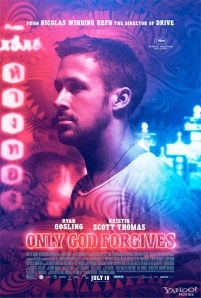
A bleak nightmare, Nicolas Winding Refn's Only God Forgives doesn't so much enter the void as dives headlong into it

A bleak nightmare, Nicolas Winding Refn’s Only God Forgives doesn’t so much enter the void as dive headlong into it

Following the surprising success of Refn’s man-with-no-name neo-noir Drive, he’s reteamed with star Ryan Gosling, relocated to Thailand and revved up the experimentalism in Only God Forgives.

Although Refn has connected his latest to Drive,  alluding to the fact they both exist in a heightened reality, it actually bears a closer kinship to his lesser-seen 2009 work Valhalla Rising. With its brutal acts of violence, minimalist style, and preponderance for mood over dialogue, the two films share a lot in common.
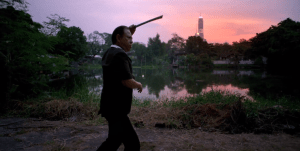
The ghost-like Angel of Vengeance Chang (Vithaya Pansringarm) in Only God Forgives

The ghost-like Angel of Vengeance Chang (Vithaya Pansringarm) in Only God Forgives

Critics rounded on the film at its Cannes premiere earlier this year, possibly out of confusion that Refn and Gosling hadn’t given them Drive 2,  but those who balk at the director’s use of violence and stripped-back approach (most notably his fascination with silence) forget these are the qualities that he’s built his career on. His Pusher trilogy, Bronson and Valhalla Rising are all stylistic works punctuated by moments of shocking ferocity.

Julian (Gosling) is an expat living in Bangkok whose boxing club is a front for an industrial-scale drug operation. When his brother murders a prostitute and is himself killed out of vengeance, the monosyllabic Julian must not only contend with his domineering and contemptuous mother Crystal (Kristin Scott Thomas), but also samurai sword-wielding cop Chang (Vithaya Pansringarm).

Julian (Ryan Gosling) on hisslow descent in Only God Forgives

Julian (Ryan Gosling) on his slow descent in Only God Forgives

If Drive was a pared-down story of heroism akin to a dream, Only God Forgives is its mirror image, a bleak nightmare whose self-loathing lead character is waiting to embrace his own damnation with open arms.

Crystal (Kristin Scott Thomas), a modern-day Lady Macbeth in Only God Forgives

Crystal (Kristin Scott Thomas), a modern-day Lady Macbeth in Only God Forgives

Indeed, arms feature regularly in the film, be they stretched out with hands open to represent helplessness and a plea for forgiveness, or with clenched fists to show rage and repression. Refn also attaches an Old Testament religious symbolism to these shots wherein Julian is welcoming punishment for his past misdeeds.

This theological inflection is as present as the hellish crimson lighting Refn drenches over many of the scenes. Corridors are given an extra menace, while the empty nightclub in which Julian meets Chang is a barely concealed metaphor for hell’s anteroom.

Crystal (Kristin Scott Thomas) gets gangster Bryon (Byron Gibson) on side in Only God Forgives

Crystal (Kristin Scott Thomas) gets gangster Bryon (Byron Gibson) on side in Only God Forgives

As well as being a cop, Chang exudes a supernatural force. Somehow able to produce his samurai sword as if it’s attached to his spine, Chang is referred to as the Angel of Vengeance. During filming, Refn apparently whispered into Pansringarm’s ear that “you’re God”. If he is God, he’s more of the Old Testament kind, the sort who has the power of forgiveness but doesn’t intend on showing any.

Mai (Rhatha Phongam) and Julian (Ryan Gosling) in Only God Forgives

Mai (Rhatha Phongam) and Julian (Ryan Gosling) in Only God Forgives

Thomas is deliciously repellant as Crystal, a modern day Lady Macbeth consumed by a thirst for revenge at the death of her son and a weirdly incestuous love/hate relationship with Julian. When Julian points out that his brother raped and killed a 16-year-old girl, she replies: “I’m sure he had his reasons.”

Pansringarm is eerily non-expressive as the ghost-like Chang, who seems conjured up from Julian’s tortured subconscious. With only 17 lines of dialogue in the while film, Gosling delivers a tightly coiled performance that deviates between submissive catatonia to moments of explosive rage. He has some of the most expressive eyes in modern cinema which can emote pained puppy dog one second and barely restrained psychosis the next.

Accompanied by Cliff Martinez’s typically excellent score (one that weaves in Eastern influences without ever coming across as rote or lazy), Only God Forgives doesn’t so much enter the void as dive headlong into it.

Review – Spring Breakers

The enfant terrible of American arthouse cinema is at it again in this shamelessly controversial witches’ brew of sexploitative teen drama, dreamscape and MTV’s Cribs.

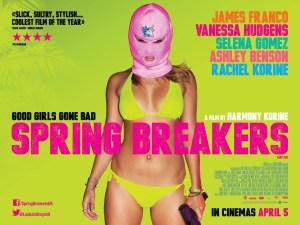
A weird, hallucinatory trip down the trashy corridors of its director's headspace, Spring Breakers is a one-of-a-kind and for that alone it deserves to be seen

A weird, hallucinatory trip down the trashy corridors of its director’s headspace, Spring Breakers is a one-of-a-kind and for that alone it deserves to be seen

Since making his name as the writer of Larry Clark’s headline-grabbing Kids back in 1995, Harmony Korine’s directorial career has crashed, banged and walloped through one two-fingered salute after another, most recently in 2009’s self-explanatory Trash Humpers.

Whilst unmistakably a Korine film, Spring Breakers is his most mainstream and accessible work to date and the first movie of his career to turn a profit.

Candy (Vanessa Hudgens), Brittany (Ashley Benson), Cotty (Rachel Korine) and Faith (Selena Gomez) let their hair down in Spring Breakers

Candy (Vanessa Hudgens), Brittany (Ashley Benson), Cotty (Rachel Korine) and Faith (Selena Gomez) let their hair down in Spring Breakers

Obsessed with ditching college for an epic spring break blowout – but short of cash to do so – Candy (Vanessa Hudgens), Brittany (Ashley Benson) and Cotty (Rachel Korine, wife of Harmony) put on pink balaclavas (bringing to mind the Putin-bashing Russian punk rock band Pussy Riot) and rob a fast food restaurant.

The trio, joined by the God-fearing Faith (Selena Gomez), head down to Florida for drink, drugs and wild beach parties and fall in with the charismatic Alien (James Franco), a self-proclaimed “hustler … a gangster with a heart of gold” who’s engaged in a turf war with Big Arch (rapper Gucci Mane). The craziness become too much for Faith, but for the others this is the chance to enjoy “spring break forever”.

"Spring break foreverrrr" - Alien (James Franco) in Spring Breakers

“Spring break foreverrrr” – Alien (James Franco) in Spring Breakers

Spring Breakers shares a similar sensibility to Sofia Coppola’s The Bling Ring in its unvarnished portrayal of a group of young American teenagers consumed by self-entitlement and dazzled by all things materialistic. Candy and co see it as their right to go on spring break and feel no guilt at robbing the store, indeed they “pretend it’s a video game”.

There’s a certain gratuitousness to Korine’s camerawork, exacerbated by the fact the girls are dressed in flourescent bikinis throughout, but he also often uses harsh lighting to both desexualise them and highlight the ugliness of their characters. The film is shot through with blue and red filters (at one point a friend of Faith’s suggests Candy, Brittany and Cotty have “got demon blood in them” before we see them bathed in red, hellish light), while UV lighting is also used to add an otherworldly nature to the film.

Brittany (Ashley Benson) pretends it's just a video game in Spring Breakers

Brittany (Ashley Benson) pretends it’s just a video game in Spring Breakers

Korine also uses repetition of dialogue to lend Spring Breakers a hallucinatory quality, while the increasingly fantastical narrative supports this notion.

While Candy, Brittany and Cotty are happy living in their own little fantasy worlds, their minds are blown when their encounter Alien, a gold-toothed drug dealer and self-styled personification of the American Dream who at one point tells the girls: “Everyone’s always tellin’ me you gotta change. I’m about stacking change. I’m about making money.”

Candy (Vanessa Hudgens), Brittany (Ashley Benson), Cotty (Rachel Korine) and Faith (Selena Gomez) in trouble in Spring Breakers

Candy (Vanessa Hudgens), Brittany (Ashley Benson), Cotty (Rachel Korine) and Faith (Selena Gomez) in trouble in Spring Breakers

Alien is consumerism personified – his flashy car has hub caps with dollar signs on them, while his mantra “look at my shit!” is repeated ad infinitum while proudly pointing out all the stuff he owns. He also shows off his guns and love of Scarface (“I got Scarface on re-peat; I got it on constantly!”) as if he’s trying to convince not just the girls of his gangster credentials but himself too.

James Franco plays larger-than-life gangsta Alien in Spring Breakers

James Franco plays larger-than-life gangsta Alien in Spring Breakers

Franco brings just the right balance of humour, pathos, arrogance and fear to the larger-than-life Alien and he’s without doubt Spring Breakers‘ star turn. Hudgens and  Benson are also impressive as the vacuous college girls blinded by self-delusional platitudes about the spiritual benefits their violent crime spree is providing.

There are moments when the film really hits the mark, not least of which in the oddly sweet (and tongue-in-cheek) moment when Korine intercuts a heartfelt Alien playing Britney Spears’ Everytime on his piano to the balaclava-clad girls with footage of them breaking peoples’ faces and robbing them of their stuff. The scene plays as a clever mirror image to a scene earlier in the film when the girls happily sing Spears’ Baby One More Time.

A weird, hallucinatory trip down the trashy corridors of its director’s headspace, Spring Breakers is a one-of-a-kind and for that alone it deserves to be seen.

Review – The World’s End

The Cornetto trilogy comes to a minty conclusion in this typically homage-heavy sci-fi comedy about bars, buddies, brawls and beer – lots of beer.

“Where Wright, Pegg and Frost go together from here who knows, but as the Cornetto trilogy’s final flavour The World’s End is sweet indeed”

Edgar Wright, Simon Pegg and Nick Frost followed-up their cult TV series Spaced with the 2004 rom-zom-com Shaun Of The Dead, a slice of genius that embraced George A Romero’s Dead films while at the same time doing something truly original with the formula.

They teamed up again three years later for the even more successful Hot Fuzz, an action comedy that winked in the direction of cop buddy movies like Lethal Weapon and Bad Boys, but was still very much its own quirky beast.

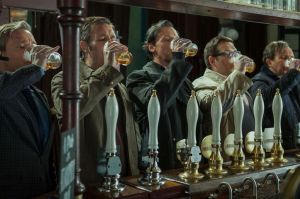
Oliver (Martin Freeman), Steve (Paddy Considine), Gary (Simon Pegg), Andrew (Nick Frost) and Pete (Eddie Marsan) prepare to get annhiliated in The World's End

Oliver (Martin Freeman), Steve (Paddy Considine), Gary (Simon Pegg), Andrew (Nick Frost) and Pete (Eddie Marsan) prepare to get annihilated in The World’s End

As the years have ticked by, Wright, Frost and Pegg especially have eclipsed their humble TV beginnings to become Hollywood figures, but that hasn’t stopped them from getting the band back together one more time for this long-awaited final chapter in the Cornetto trilogy (so named for the appearance of the famous ice cream brand in each film).

The film starts with a lengthy exposition-heavy voiceover from Pegg’s Gary King, the rebellious cool kid who led his four mates Andrew, Steve, Oliver and Pete on an epic post-school quest to traverse the ‘Golden Mile’, a perilous pub crawl encompassing 12 pubs in their hometown of Newton Haven. Despite a brave attempt, the gang failed to make it to The World’s End, the Golden Mile’s final watering hole.

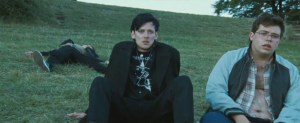
A young Gary (Thomas Law) and Andy (Zachary Bailess) consider what's to come of their lives in The World's End

A young Gary (Thomas Law) and Andy (Zachary Bailess) consider what’s to come of their lives in The World’s End

Now approaching 40, Gary tracks down his estranged buddies and convinces a reluctant Andrew (Frost), Steve (Paddy Considine), Oliver (Martin Freeman) and Pete (Eddie Marsan) to finally conquer the Golden Mile. An uncomfortable start to the crawl, made more awkward by the arrival of Oliver’s sister Sam (Rosamund Pike), suddenly takes a loony turn for the dangerously extraterrestrial.

Gary (Simon Pegg) unveils the map of 'the golden mile' showing all 12 watering holes in The World's End

Gary (Simon Pegg) unveils the map of the ‘Golden Mile’ showing all 12 watering holes, culminating at The World’s End

It would have been so easy for co-writer/director Wright, Pegg (also a co-writer) and Frost to have reheated the magic that made Shaun… and Hot Fuzz so adored, but to their credit they instead go off in another direction entirely, while still delivering the sort of joke rate that most ‘comedies’ don’t get anywhere near.

Gary is a pathetic character, an adult straightjacketed by stubborn arrested development who’s never been able to get past 1990. Still wearing the same goth clothing and still driving the same clapped out car he had as a teenager, Gary’s obnoxious, hard edges are softened out by Pegg’s sympathetic portrayal.

Gary (Simon Pegg), Oliver (Martin Freeman) and Steve (Paddy Considine) realise something is rotten in Newton Haven in The World's End

Gary (Simon Pegg), Oliver (Martin Freeman) and Steve (Paddy Considine) realise something is rotten in Newton Haven in The World’s End

The top-notch cast work splendidly off each other, each bringing their own unresolved baggage to what gradually turns into a painful, but necessary reunion for them all. Normally cast as resentful and/or angry, Marsan lets his hair down in a role that actually allows him to have a giggle, while Frost shows that when he’s given the right material (usually co-written by Pegg and Wright) he’s an actor with range.

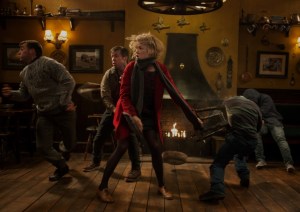
Sam (Rosamund Pike) kicks butt in The World's End

Sam (Rosamund Pike) kicks butt in The World’s End

The film cleverly manages to have it both ways; in the one hand it drums home the message that there’s little point dwelling on the past, while at the same time wallowing in the nostalgia of its early 90s soundtrack, in particular Primal Scream’s seminal track Loaded.

Wright has cited the legendary sci-fi writer John Wyndham as a big influence and there are definite nods to his paranoid tome The Midwich Cuckoos (turned into the classic movie Village Of The Damned), while other 1950s sci-fi classics Invasion Of The Body Snatchers and The Thing From Another World are also interwoven into the film’s DNA.

Despite being very amusing, The World’s End isn’t as instantly likeable as either Shaun… or Hot Fuzz. Maybe it was the special effects getting in the way, or the increasingly bonkers plot, but something felt missing. That being said, the first two chapters in the trilogy improved with age, so there’s no reason to think The World’s End won’t become a richer experience on repeated viewings.

Where Wright, Pegg and Frost go together from here who knows, but as the Cornetto trilogy’s final flavour The World’s End is sweet indeed.

Review – Pacific Rim

Michael Bay’s never-ending Transformers franchise may have given giant robots a bad name, but Guillermo del Toro’s epic monsters vs aliens mash-up delivers robo-spectacle on an eye-popping scale.

Leave your cynicism at the door and Guillermo del Toro's Pacific Rim will reward you two hours of monster mayhem that'll overload your senses

Leave your cynicism at the door and let Guillermo del Toro’s Pacific Rim reward you with two hours of monster mayhem that’ll pulverise your senses

Best known until now for modern Spanish-language horror-fantasy classics Pan’s Labyrinth and The Devil’s Backbone, as well as his two Hellboy films, del Toro has taken a (literal) giant step up with Pacific Rim.

Now that's a footprint, in Pacific Rim

Now that’s a footprint, in Pacific Rim

Pacific Rim has a long tradition of giant monster films in its wake and owes a tremendous debt to both legendary creature effects wizard Ray Harryhausen and iconic Japanese film director Ishirō Honda, whose 1954 classic Godzilla was the most influential monster movie since King Kong (1933).

Godzilla launched the Kaiju (“giant monster”) genre, which exploded in popularity in its native Japan and led to a slew of creature features, each more bonkers than the last. Rather a point of reference than a direct homage, Pacific Rim‘s giant bad guys are referred to as Kaiju, invading aliens from an underwater portal between dimensions that have only one thing on their mind – to take over the planet.

Brothers Yancy (Diego Klattenhoff) and Raleigh Becket (Charlie Hunnam) pilot their Jaeger in Pacific Rim

Brothers Yancy (Diego Klattenhoff) and Raleigh Becket (Charlie Hunnam) pilot their Jaeger in Pacific Rim

Faced with annihilation, mankind works together to build a series of 25 storey-high fighting machines called Jaegers (“hunters”), whose human pilots must share a mind link called The Drift in order to become one with the giant mechas.

A Kaiju goes to work on Sydney, in Pacific Rim

A Kaiju goes to work on Sydney, in Pacific Rim

Del Toro and Travis Beacham’s script ain’t much interested in the human characters; their back stories are perfunctory, or in some cases non-existent, and they trade-off with each other using the sort of dialogue that’s only ever found in special effects-laden summer blockbusters.

The cast is also predominately made up of familiar TV faces (mostly British), including Charlie Hunnam (Sons Of Anarchy) as Raleigh Becket, a gifted Jaeger pilot who’s lost his way since a tragic stand-off against a Kaiju (think Tom Cruise from Top Gun); Idris Elba (The Wire, Luthor) as tough, but fair Jaeger force commander Stacker Pentecost (who gets to utter the class line: “Today, we are cancelling the apocalypse!”); and Robert Kazinsky, who until now is best known for appearing in British soap EastEnders and here plays arrogant Australian Jaeger pilot Chuck Hansen.

Wannabe Jaeger pilot Mako Mori (Rinko Kikuchi) in Pacific Rim

Wannabe Jaeger pilot Mako Mori (Rinko Kikuchi) in Pacific Rim

In a film with delusions of grandeur, the paper-thin characterisation (with the exception of Rinko Kikuchi’s wannabe Jaeger pilot Mako Mori) and stilted dialogue would be too much of an issue, but what saves Pacific Rim is its self-awareness. Lest we forget, this is a film about enormous man-made robots laying into massive alien lizards; characterisation and dialogue doesn’t really matter when you’ve got that sort of spectacle on screen. The squabbling interplay between the chalk and cheese scientists Dr Newton Geiszler (Charlie Day) and Dr Hermann Gottlieb (Burn Gorman) is so heightened as to be cartoonish, but that’s exactly what del Toro is going for.

The Jaeger's go to war in Pacific Rim

The Jaegers go to war in Pacific Rim

That’s not to say the film is completely devoid of any depth (pun intended). While the creature Godzilla represented the unforeseen consequences of the Atomic Age, the Kaiju in Pacific Rim have only made it to our planet due to the effects of global warming on our oceans.

"Today, we are cancelling the apocalypse!" - tough, but fair Jaeger force commander Stacker Pentecost (Idris Elba) in Pacific Rim

“Today, we are cancelling the apocalypse!” – tough, but fair Jaeger force commander Stacker Pentecost (Idris Elba) in Pacific Rim

The special effects themselves are nothing less than jaw-dropping. When the Kaiju first attack in the lengthy, exposition-heavy pre-title sequence it’s a moment that will have you sat bolt upright in your seat. Bringing to mind Cloverfield (rather than 1998’s forgettable Hollywood remake of Godzilla), there’s nothing quite like watching a giant lizard tearing into a bridge.

The fact that it’s robots vs lizards certainly helps when it comes to working out who’s hitting whom. While Bay isn’t interested in whether you can follow which Decepticon is hitting which Autobot, del Toro keeps the action well-defined and, most importantly, epic in scale. The big problem with another of this summer’s tent pole movies, Man Of Steel, came in its final act where loud noises and mass destruction did not equal nose-bleeding entertainment; here the noise is deafening and the destruction is ultra-massive, but the difference comes in the fact you actually care about what’s happening and, in my case anyway, love every moment.

Leave your cynicism at the door and let Pacific Rim reward you with two hours of monster mayhem that’ll pulverise your senses.

In Retrospect – The Player (1992)

Robert Altman may have playfully described his ‘Hollywood on Hollywood’ black comedy as “a very mild satire”, but he was fooling no-one.

One of Robert Altman's very best, The Player could arguably be the ultimate example of Hollywood eating itself

One of Robert Altman’s very best, The Player could arguably be the ultimate example of Hollywood eating itself

One of the most cynical, caustic and clever dissections of a creatively bankrupt studio system that has only become worse in the 21 years since its release, Altman’s The Player is one of the late director’s most celebrated works and, ironically, brought him back in from the cold after a decade spent making no budget chamber pieces.

Actors are a contrary lot. Happy to take the cheque and star in the sort of drivel the director mercilessly satirises, dozens of actors (whose star wattage could power a small town) lined-up to take walk-on parts mostly as themselves in order to take a gleeful swipe at the piñata that is Tinseltown’s lumbering studio system.

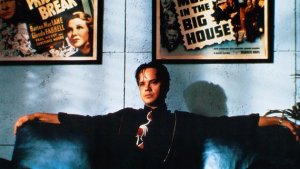
The sleek, shark-like studio executive Griffin Mill (Tim Robbins) in The Player

The sleek, shark-like studio executive Griffin Mill (Tim Robbins) in The Player

Based on Michael Tolkin’s book, Altman’s anti-hero is sleek, shark-like studio executive Griffin Mill (Tim Robbins), who’s scared he could be axed in favour of the younger, up-and-coming story executive Larry Levy (Peter Gallagher). Mill’s life is thrown into further disarray when he continues to receive increasingly threatening postcards from a writer he can’t remember whose pitch he ignored.

Everything in The Player is artifice from the very first shot of someone asking for “quiet on set” and a clapperboard shutting. A person’s word counts for nothing, false sincerity and hypocrisy is in plentiful supply and artistic backbone turns to spinelessness when money and power enter the equation. At one point, Mill bumps into Burt Reynolds, who’s all smiles until Mill walks away, at which point he calls him an “asshole”.

Studio exec Griffin Mill (Tim Robbins) sets his sights on artist June Gudmundsdottir (Greta Scacchi) in The Player

Studio exec Griffin Mill (Tim Robbins) sets his sights on artist June Gudmundsdottir (Greta Scacchi) in The Player

This most tellingly plays out in the second half of the film when pretentious English writer Tom Oakley (Richard E Grant) and producer Andy Civella (Dean Stockwell) pitch the death row thriller Habeas Corpus to Mill at a restaurant. Oakley vociferously insists it mustn’t lose its downbeat conclusion (“no Hollywood endings”) and feature no stars. Inevitably, as the studio’s claws get into the project Habeas Corpus turns into a very different movie, to the extent that has Bruce Willis and Julia Roberts as its leads and includes a tacked-on happy ‘Hollywood ending’, both of which Oakley seems happy about now it’s been made (in an example of life imitating art, one of the stars of Habeas Corpus is Susan Sarandon, who three years later teamed up with her long-time partner Robbins to make Dead Man Walking, a death row thriller).

Griffin Mill (Tim Robbins) receives yet another death-threatening postcard from a mystery writer in The Player

Griffin Mill (Tim Robbins) receives yet another death-threatening postcard from a mystery writer in The Player

Oakley isn’t the only writer who fails to come out of The Player smelling of roses. One pitches The Graduate: Part 2 (I’m personally amazed that one hasn’t been made) in which all the original characters incredulously still live together “in a big, old spooky house”. Another pitches “Out Of Africa meets Pretty Woman“, while a further writer’s idea for a hard-hitting politically radical film with a supernatural edge (“Ghost meets The Manchurian Candidate“) is reduced to a bland paint-by-numbers thriller after only 30 seconds in Mill’s hands.

One thing that strikes you about watching the film is just how disinterested Mill and his cronies are in watching movies (something you suspect is true for a lot of today’s execs). At an informal lunch, Mill asks those around him: “Can we talk about something other than Hollywood for a change?” The silence that follows speaks volumes.

At one point Mill gives a speech at a gala dinner in which he bangs on about the importance of finding the next John Huston or Orson Welles and the fact that “movies are art”. He unsurprisingly contradicts himself later in the film when he lists the key ingredients that make a successful Hollywood film, the most important one being “happy endings”.

Griffin Mill (Tim Robbins) says hi to the agent and Burt Reynolds, just one of dozens of cameos in The Player

Griffin Mill (Tim Robbins) says hi to the agent and Burt Reynolds, just one of dozens of cameos in The Player

The only time we see Mill actually watch a film is when he thinks he’s tracked down the mystery writer sending him death threats to an old movie theatre showing Vittorio De Seca’s 1948 neo-realist classic Bicycle Thieves and even then it’s only for the last five minutes. Perhaps underlining how there are no original ideas left in Tinseltown, Altman constantly makes references to Hollywood’s golden age, whether it be the posters of old classics in the studio’s offices or the threatening postcards featuring Humphrey Bogart and James Dean.

The late Robert Altman, director of The Player

The late Robert Altman, director of The Player

Head of studio security Walter Stuckel (Fred Ward) complains that all films today are “cut, cut, cut” and refers to the six-and-a-half-minute opening shot of Touch Of Evil. It’s a clever, self-referential nod to the audience as he opens the film with a celebrated tracking shot lasting almost eight minutes. It’s bravura filmmaking and shows off Altman’s unique and complex Peeping Tom style of filming certain moments using a long lens that often incorporate overlapping conversations and multiple set-ups.

The film has a wicked sense of humour (in a cute piece of marketing, a poster for it includes the quote “the best movie ever made!” … attributed to Griffin Mill) that veers from pitch black satire to farce. Altman was always a pranksterish filmmaker and this knowing humour runs through the core of The Player.

Alas, The Player feels all-too-pertinent to a modern-day big studio system scrambling about in the dark for the next big thing. One of Altman’s very best, this could arguably be the ultimate example of Hollywood eating itself.