Review – The Wolf Of Wall Street

The ugly reality of what constitutes the modern day American Dream is writ large over Martin Scorsese’s outrageous and intelligent trawl through the moral sewer of a world fuelled by power, prostitutes and pesos.

Far from slowing down in his autumn years, Scorsese's The Wolf Of Wall Street finds the director back at his very best.

Far from slowing down in his autumn years, Scorsese’s The Wolf Of Wall Street finds the director back at his very best.

The Wolf Of Wall Street begins with an advert for Jordan Belfort’s (Leonardo DiCaprio) church of capitalism, Stratton Oakmont, espousing the firm’s “stability” and “integrity”, before cutting to its “trained professionals” betting huge sums of money on a dwarf throwing contest.

It’s none-too-subtle – like much of the film – but this observation of the unbridled hypocrisy and moral vacuum at the black heart of Belfort and his army of disciples runs through the core of Scorsese’s exhilarating and exhausting 22nd feature.

Jordan (Leonardo DiCaprio) gets taken under the wing of sulphurous boss Mark Hanna (Matthew McConaughey) in The Wolf Of Wall Street

Jordan (Leonardo DiCaprio) gets taken under the wing of sulphurous boss Mark Hanna (Matthew McConaughey) in The Wolf Of Wall Street

Scorsese revisits the dwarf tossing scene later in the film when Belfort, his best friend and Vice President Donnie Azoff (Jonah Hill), and a couple of other senior traders discuss how best to exploit the dwarf and agree not to “consider him a human”. It’s a cleverly symbolic moment – we are the ‘little people’ being taken advantage of by these monsters for financial gain and their own amusement.

These guys know they’re crooks but are having too much fun in their grotesque bubble to care. When a potential client remarks over the phone that Belfort seems like “a pretty sincere guy”, his team collapse into howls of laughter; while Belfort literally and figuratively ‘closes the deal’ by simulating having sex as he makes the sale.

Naomi (Margot Robbie), Jordan's trophy wife in The Wolf Of Wall Street

Naomi (Margot Robbie), Jordan’s trophy wife in The Wolf Of Wall Street

Told through Belfort’s unreliable eyes, we follow him from his wet-behind-the-ears early days through to his rebirth following the Wall Street crash of 1987 to become a wildly successful stockbroker making money hand over fist by selling worthless stocks to unwitting schumcks who have bought into the get rich quick mantra peddled to them by the ‘free’ market.

Belfort’s success leads to the creation of Stratton Oakmont, a boiler room where illegal activity and corruption go hand in hand with opprobrious excess and decadence on a scale that would make Caligula blush.

The best of times... stockbroker-turned-rock star Jordan Belfort (Leonardo DiCaprio) in The Wolf Of Wall Street

The best of times… stockbroker-turned-rock star Jordan Belfort (Leonardo DiCaprio) in The Wolf Of Wall Street

It’s easy to get blindsided by the film’s numerous scenes of drug taking, orgiastic partying and general debauchery, but those who claim the director gives Belfort a pass are completely missing the point of The Wolf Of Wall Street. It is politicians, the legal system and society in general who let – and continue to let – snake oil salesmen like Belfort off the hook by allowing ourselves to be seduced by empty promises of riches beyond the dreams of avarice.

A key scene takes place towards the start of the film involving Matthew McConaughey’s obscenely immoral broker Mark Hanna taking a young Belfort out to lunch to explain to him – and us  – that the name of the game is to “move the money from your client’s pocket into your pocket” and to “keep the clients on the ferris wheel and keep the park open 24/7/365”.
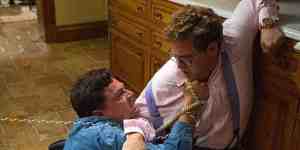
The worst of times... the wheels start coming off for Jordan Belfort (Leonardo DiCaprio) and partner-in-crime Donnie Azoff (Jonah Hill) in The Wolf Of Wall Street

The worst of times… the wheels start coming off for Jordan Belfort (Leonardo DiCaprio) and partner-in-crime Donnie Azoff (Jonah Hill) in The Wolf Of Wall Street

As appalling as Hanna’s pep talk is, we laugh in spite of ourselves, thanks in no small part to McConaughey’s inspired cameo. A similar reaction is had throughout what is at times a laugh-out-loud comedy. Belfort lives and breathes the words Hanna has taught him, which makes for numerous scenes of ridiculous comedy, most notably when he’s almost paralysed by an particularly strong batch of Quaaludes.

Based on Belfort’s book of the same name, the film follows in the ‘visual novel’ footsteps of Scorsese’s Goodfellas and Casino by relying heavily on narration to tell the tale. Just as Ray Liotta’s delivery sucked us in to a tale of New York gangsters, so too does DiCaprio, who builds an irresistible rapport with the audience through a mix of buddy-buddy repartee and matter-of-fact exposition.

FBI Agent Patrick Denham (Kyle Chandler) investigates Jordan Belfort (Leonardo DiCaprio) in The Wolf Of Wall Street

FBI Agent Patrick Denham (Kyle Chandler) investigates Jordan Belfort (Leonardo DiCaprio) in The Wolf Of Wall Street

It’s an electric performance from DiCaprio, arguably the highlight of his career and certainly his best under Scorsese’s mentorship. The over-the-top banter with his besotted staff and explosive physicality may be what grabs the headlines, but his more nuanced work, particularly opposite trophy wife Naomi (Margot Robbie) and FBI agent Patrick Denham (Kyle Chandler) are what sets the performance apart. DiCaprio is lent excellent support from all quarters, especially Robbie and a never-better Hill.

As you’d expect from a Scorsese picture, the needle-drop soundtrack is a music lover’s delight (although Rolling Stones’ Gimme Shelter is notable by its absence), while Terrence Winter’s volcanic script justifies the film’s three-hour running time.

Far from slowing down in his autumn years, Scorsese’s The Wolf Of Wall Street finds the director back at his very best.

Review – Lone Survivor

If it’s good old-fashioned jingoism you’re after then you’ve come to the right place with Peter Berg’s dramatisation of a US Navy SEAL mission gone bad.

In case you were wondering who the Lone Survivor is...

In case you were wondering who the Lone Survivor is…

In case you were wondering who the lone survivor in question is, the film is based on hospital corpsman Marcus Luttrell’s book of the same name. So there you go.

Although the ultimate fate of the four members of SEAL Team 10 tasked with carrying out reconnaissance and surveillance on  bloodthirsty Taliban leader Ahmad Shah in Afghanistan’s Hindu Kush region in 2005 is given away by the title (for those who missed or can’t remember the original story, anyway), it doesn’t stop Berg’s film from largely being an intense, if overly patriotic, experience.

Things go pear-shaped for Navy SEALs Marcus Luttrell (Mark Wahlberg) and Danny Dietz (Emile Hirsch) in Lone Survivor

Things go pear-shaped for Navy SEALs Marcus Luttrell (Mark Wahlberg) and Danny Dietz (Emile Hirsch) in Lone Survivor

Once the promising director of Friday Night Lights (2004), Berg subsequently turned his talents to blockbuster fare, to the extent that his previous film, 2012’s Battleship, was so dumb it would have made Michael Bay proud. Lone Survivor may contain plenty of action, but it’s of a far more visceral and harrowing nature than what we saw in his last movie.

The film follows the squad – Luttrell (Mark Wahlberg), communications specialist Danny Dietz (Emile Hirsch), sonar technician Matthew Axelson (Ben Foster) and team leader Lieutenant Michael Murphy (Taylor Kitsch) – as they’re dropped into the Hindu Kush and go about tracking down Shah, who’s seen at the start of the film ordering the beheading of an Afghan villager for allegedly helping the Americans, just to stress how evil he is.

The scale of the problem presents itself in Lone Survivor

The scale of the problem presents itself in Lone Survivor

Things soon take a turn for the unfortunate when they run into a group of goat herders, and truly go up the swanny when they’re ambushed by a small army led by Shah. A mission of stealth and surveillance turns into one of survival (well, for one of them anyway) as they’re forced to take increasingly desperate and dangerous risks to escape.

The film opens with an extended montage of real life Navy SEAL recruits being put through their paces. As well as making abundantly clear just how darned tough these guys are, Berg also uses the footage to emphasise the band of brothers mentality forged among those who are willing to put themselves through such hell. The point is pushed home further courtesy of post-rockers Explosions In The Sky’s stirring soundtrack. Brotherhood is a familiar theme in most war movies, but is particularly accentuated here.

Navy SEAL Matthew Axelson (Ben Foster) fights for his life in Lone Survivor

Navy SEAL Matthew Axelson (Ben Foster) fights for his life in Lone Survivor

Before Operation Red Wings gets under way (the targets are all named after brands of beer in true US military fashion), Berg works to develop an affininty between the squad and audience. It’s easy to buy Wahlberg and Kitsch as military types because of their previous action man turns, but it takes longer to accept Foster and Hirsch in the roles as it’s such a switch from what they’re best known for. That being said, the group make a convincing enough squad who find themselves in the wrong place at the wrong time.

It takes a good long while before the crap splats the fan, but when it does the film doesn’t let up and Berg reconstructs the prolonged gunfight between the SEALs and Shah’s men with gusto through an effective use of sweaty close-ups, first person perspective, fantastic sound design and convincing acting. It’s chaotic stuff, just as you’d imagine it would have been in real life.

Taliban in their sights in Lone Survivor

Taliban in their sights in Lone Survivor

What lets the film down, however, is Berg’s insistence on wrapping the men in the Stars and Stripes and painting them as all-American heroes (even going so far as to feature Peter Gabriel’s rendition of David Bowie’s Heroes over stills and footage of those who died in the operation at the end of the film). One soldier’s fate appears to borrow the famous Christ image of Willem Dafoe in Platoon and the use of slow motion in the more emotive scenes borders on crass.

It’s both extremely heavy-handed and unnecessary and takes you out of what could and should have been an absorbing and gut-wrenching story of brotherhood, sacrifice and humanity in the face of grave danger.

Review – Inside Llewyn Davis

The landscape of American film has changed considerably in the 30 years since Joel and Ethan Coen announced themselves with their blackly comic neo-noir debut Blood Simple.

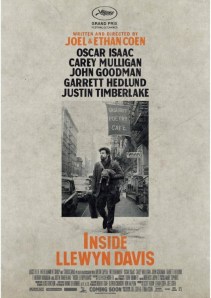
It may be as difficult to pin down as its leading character, but Inside Llewyn Davis is achingly beautiful and melacholic and another masterpiece from the Coens

It may be as difficult to pin down as its leading character, but Inside Llewyn Davis is achingly beautiful and melancholic and another masterpiece from the Coens

Once dismissively bracketed as ‘arthouse’, the Coens are among a handful of gifted filmmakers to have transformed the cinematic panorama without compromising their unique sensibility; to the extent their bleakly violent 2007 masterpiece No Country For Old Men won Best Film and Best Director Oscars and made a ton of money at the box office to boot.

With this, their 16th film, the Coens almost out-Coen themselves with a Russian doll of a movie that’s as enigmatic as it is engrossing.

Llewyn (Oscar Isaac) takes to the stage in Inside Llewyn Davis

Llewyn (Oscar Isaac) takes to the stage in Inside Llewyn Davis

The roster of seemingly cursed characters with a leaning towards self-destruction is a growing one in the Coens’ filmography and Llewyn Davis’ tractionless folk musician is right up there with Barton Fink, The Man Who Wasn’t There‘s Ed Crane Larry Gopnik from A Serious Man.

Llewyn (Oscar Isaac) is, like the songs he plays, “never new and never gets old” and spends his days drifting around New York’s early-60s Greenwich Village playing the odd gig and relying on the generosity of friends for a place to lay his head. You get the sense things have been this way since his former musical partner Mike committed suicide a few years earlier, while his only solo album, Inside Llewyn Davis, has fallen through the critical and commercial cracks.

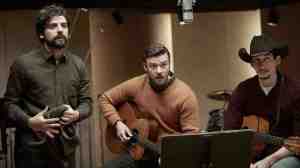
Please Mr Kennedy! Llewyn (Oscar Isaac) performs session guitar for friend Jim (Justin Timberlake) and Al Cody (Adam Driver) in Inside Llewyn Davis

Please Mr Kennedy! Llewyn (Oscar Isaac) performs session guitar for friend Jim (Justin Timberlake) and Al Cody (Adam Driver) in Inside Llewyn Davis

His inertia has left him bitter, despite (or because of) it being almost entirely his own fault. Llewyn simply can’t fathom how or why the folk-by-numbers tunes of the innocuous Troy Nelson (Stark Sands) “connect with people” and can’t hide his derision when playing session guitar on the inane folk-pop pap Please Mr Kennedy (the film’s standout hilarious scene) written by his friend Jim (Justin Timberlake). Meanwhile, Jim and Llewyn’s ex-flame, the perennially angry Jean (Carey Mulligan), are also starting to make waves on the folk scene as a duet – another sign that he’s being left behind.

Opportunities present themselves, but Llewyn has a compulsion to snatch defeat from the jaws of something more prosperous. An audition for respected Chicago producer Bud Grossman (F. Murray Abraham) comes to naught when, instead of playing something catchy, Llewyn instead chooses the sombre ballad The Death Of Queen Jane. Grossman’s pithy summation “I don’t see a lot of money here” firstly reminds us why it’s called the music business, and secondly underscores the fact Llewyn’s always going to be a square box trying to fit in a round hole.

The angry Jean (Carey Mulligan) in Inside Llewyn Davis

The angry Jean (Carey Mulligan) in Inside Llewyn Davis

The Coens’ very best films open themselves up to multiple interpretations and Inside Llewyn Davis is no different. For me, the oppressive sense of death hangs over the film like a shroud, to the extent that it could be argued the world we see Llewyn wandering around is some kind of purgatory.

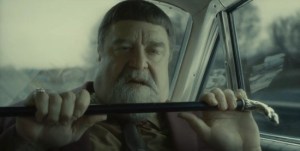
Bruno Delbonnel’s chilly cinematography lends the film a ghostly pallor, while the eerie road trip Llewyn takes with beat poet Johnny Five (Garrett Hedlund) and obnoxious Dr John-alike jazz muso Roland Turner (the one and only John Goodman) from New York to Chicago is like something out of a supernatural nightmare, with ominous-sounding vehicles screeching past their car.

Llewyn (Oscar Isaac) and the cat he can't seem to shake off in Inside Llewyn Davis

Llewyn (Oscar Isaac) and the cat he can’t seem to shake off in Inside Llewyn Davis

Furthermore, the cat(s) that Llewyn cannot seem to escape from have long been regarded as a symbol of death, while the fact one of the cats is called Ulysses could be a reference to Tennyson’s celebrated poem of the same name (rather than James Joyce’s novel) about a man with the spectre of death hanging over him.

The songs Llewyn performs are also soaked in morbidity, from The Death Of Queen Jane, to Hang Me Oh Hang Me (“wouldn’t mind the hangin… but the layin in the grave so long”), while the film’s elliptical structure could be seen as purgatorial. Mind you, it just as easily be about a poor schmuck living day-to-day and who gets saddled with a cat. That’s the Coens for you.

The Dr John-alike obnoxious jazz muso Roland Turner (John Goodman) in Inside Llewyn Davis

The Dr John-alike obnoxious jazz muso Roland Turner (John Goodman) in Inside Llewyn Davis

Isaac gives a superlative performance as the downtrodden Llewyn, a curious figure who’s his own worst enemy but somehow illicits our sympathy. There’s something both maddening and admirable about his bloody-mindedness.

The Coens have been accused in the past of being unsympathetic towards their characters and it’s a charge that’s been levelled at Llewyn Davis. This is to miss the point, however. Llewyn is flawed, of that there is no doubt, but Isaac injects the character with real pathos.

It may be as difficult to pin down as its leading character, but Inside Llewyn Davis is achingly beautiful and melancholic and another masterpiece from the Coens.

Review – All Is Lost

More than anything, dialogue played a crucial role in transforming J.C. Chandor’s financial crisis drama Margin Call into a gripping and intelligent debut feature.

All Is Lost is cinema in its purest form, a visual poem of hope, despair, strength and weakness that will wash over you like a warm tide

All Is Lost is cinema in its purest form, a visual poem of hope, despair, strength and weakness that will wash over you like a warm tide

Conversely, in Chandor’s compelling and very moving follow-up, All Is Lost, it’s actions rather than words that drive the narrative forwards and give the film its raw, physical power.

What links both films are the sky-high stakes – livelihoods are on the line in Margin Call, while a man’s life hangs precariously in the balance in All Is Lost. Robert Redford plays the unnamed near-ancient mariner whose solo sailing journey turns into a desperate fight for survival when a stray shipping container rips a hole in the side of his boat.

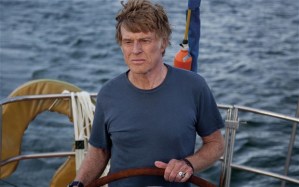
The calm before the storm in All Is Lost

The calm before the storm in All Is Lost

A brutal storm turns a bad situation into something far worse and, still 1,700 miles from land and without any working means of communication, Redford’s mariner (described as “Our Man” in the closing credits) must rely on his resourcefulness and dwindling resolve if he has any hope of survival.

Redford’s casting is a masterstroke on Chandor’s part. An icon of cinema for five decades, Redford was the anti-establishment pin-up respected by the establishment, who has often been at his best playing mysterious loners.

The full scale of the problems for Robert Redford's unnamed protagonist emerge in All Is Lost

The full scale of the problems for Robert Redford’s unnamed protagonist emerge in All Is Lost

Far from resting on his laurels, All Is Lost is arguably the 77-year-old’s most daring and challenging role to date. Few actors are as intriguing to watch as Redford and, with little or no dialogue to get in the way, it frees him up to act with his gut.

It’s a brave and entirely naturalistic performance and takes the actor to places we’ve never seen him go before. Picture Redford and the Sundance Kid or Jay Gatsby will likely spring to mind – a fresh-faced icon of cinema. But here, that familiar shock of blonde hair is greying at the sides, while the physical disintegration he goes through over the course of the film is alarming. The film may take place over the course of eight days, but Redford appears to age several decades.

The storm hits hard in All Is Lost

The storm hits hard in All Is Lost

Although few words are spoken, sound plays an integral role in the film. We know the groaning, snapping sound that starts the movie spells big trouble for Our Man, while the terrible cacophony of the storm feels like a punishment for unexplained past deeds. Likewise, Alex Ebert’s elemental score drifts in and out of the film and never once tries to get in the way of the drama.

Things go from bad to worse for our nameless sailor in All Is Lost

Things go from bad to worse for our nameless sailor in All Is Lost

The title of the film derives from Redford’s opening voiceover (which accounts for almost all of the dialogue), wherein he seeks forgiveness from an unnamed person, presumably his wife and/or family (a wedding ring is pretty much the only back story we get for his character), before concluding that “all is lost”.

As to whether all is indeed lost come the ambiguous ending and the cut to white is clearly open to interpretation, but it’s worth playing over in your mind what Our Man has been forced to endure throughout his ordeal before making a final judgement.

All Is Lost is cinema in its purest form, a visual poem of hope, despair, strength and weakness that will wash over you like a warm tide.

Review – Frozen

Winter may be coming, but the Mouse House is on fire in this enchanting reworking of Hans Christian Anderson’s timeless fairy tale The Snow Queen.

Far from leaving me cold, Frozen once again proved that when Disney gets it right, no-one else comes close

Far from leaving me cold, Frozen once again proved that when Disney gets it right, no-one else comes close

Disney’s affiliation with Anderson’s work is a long one; from its Silly Symphony short of The Ugly Duckling in the 1930s through to its hugely successful version of The Little Mermaid in 1989, which spawned a renaissance in animated features by the studio.

Although not a straight adaptation, Frozen fulfills the dream long-held by Uncle Walt to bring The Snow Queen to the big screen and does so in a way that would have made Disney extremely proud.

The sumptuous visuals in Frozen

The sumptuous visuals in Frozen

A chunk of the credit for the Mouse House’s creative and critical upturn should go to Pixar head honcho John Lasseter,  who was appointed Disney’s Chief Creative Officer back in 2006 and since then has overseen a fresh resurgence in the studio’s output.

It’s also notable that of Disney’s last four animated movies, three have featured strong female leads, with Frozen‘s Anna (voiced by Kristen Bell) and sister Elsa (Idina Menzel) among the most tenacious yet.

Snow Queen Elsa (Idina Menzel) in Frozen

Snow Queen Elsa (Idina Menzel) in Frozen

Elsa has the ability to create ice and snow and locks herself away to maintain her secret, even from Anna. When her powers are unintentionally revealed Elsa, in the process of escaping, unwittingly unleashes an eternal winter on the kingdom. Anna goes after her sister to save the kingdom from her icy spell and on her quest is joined by mountain man Kristoff (Jonathan Groff), his faithful reindeer Sven and a funny little snowman called Olaf (Josh Gad).

The dashing Prince Hans (Santino Fontana) sweeps Anna (Kristen Bell) off her feet in Frozen

The dashing Prince Hans (Santino Fontana) sweeps Anna (Kristen Bell) off her feet in Frozen

This wouldn’t be a Disney film without the musical numbers and Frozen upholds this fine tradition right from the off with the catchy men-at-work Frozen Heart that brings to mind Snow White And The Seven DwarfsHeigh-Ho.

The plaintive Do You Want To Build A Snowman? does what Disney does best – a heartfelt tune matched by swirling visuals that progresses the story and sticks in the mind, while a group of diminutive trolls are oddly reminiscent of the Fraggles (remember Fraggle Rock? No? Just me then) when they sing Fixer Upper.

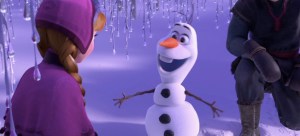
Olaf (Josh Gad) just wants a hug in Frozen

Olaf (Josh Gad) just wants a hug in Frozen

The relationship between Anna and Elsa is both simple and complex; they clearly love each other deeply, but time and Anna’s secret has driven a wedge between them, as evidenced by their awkward exchanges during Anna’s coronation as Queen. Disney has been guilty many times of drowning its films in saccharine sweetness, but it’s also the studio that respected its young audience enough to make them deal with death in Bambi and The Lion King.

Heroic mountain man Kristoff (Jonathan Groff) aboard his trusty reindeer Sven in Frozen

Heroic mountain man Kristoff (Jonathan Groff) aboard his trusty reindeer Sven in Frozen

It pretty much goes without saying that the animation is stunning, but it’s always worth drinking it in regardless, especially the rendering of ice and snow which is simply beautiful. Likewise, the film rattles along at such a pace that you forgive its rather lacklustre plot.

Strong female characters aside, Frozen‘s most memorable character is the loveable Olaf, a figment of Anna’s childhood imagination brought magically and amusingly to life by Elsa’s magic. A lover of “warm hugs”, Olaf is well written and acts just as you’d imagine an imaginary friend brought to life would. Gad’s lively performance elevates Olaf into the premier division of Disney sidekicks next to Pinocchio‘s Jiminy Cricket, the Genie from Aladdin and The Jungle Book‘s Baloo.

Far from leaving me cold, Frozen once again proved that when Disney gets it right, no-one else comes close.