Review – Steve Jobs

Anyone expecting a messianic hagiography about the life and times of the man who helped to define the digital revolution should prepare themselves for a far more complex – and fascinating – portrait of a brilliant, but deeply flawed man.

It's difficult to know just how much of the real Steve Jobs is captured here, but Sorkin, Boyle and Fassbender's im-mac-ulate film means you can never take your eyes off him, which is kind of the point, no?

It’s difficult to know just how much of the real Steve Jobs is captured here, but Sorkin, Boyle and Fassbender’s im-mac-ulate film means you can never take your eyes off him, which is kind of the point, no?

Four years after his death, Steve Jobs remains a controversial and divisive figure and it is this multi-faceted approach, rather than the simplicity of a black and white biography that electrifies Danny Boyle’s and Aaron Sorkin’s superb film.

Just as he highlighted the irony of Facebook co-founder Mark Zuckerberg being anything but people-friendly in The Social Network (2010), so too does Sorkin explore the dichotomy of a man who creates machines that help people to connect, whilst singularly failing to communicate with so many of those around him, not least his estranged daughter.
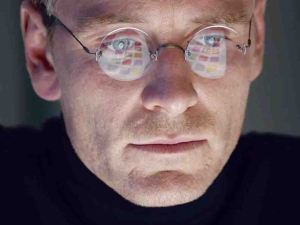
Steve Jobs (Michael Fassbender) in his iconic polo neck and jeans phase

Steve Jobs (Michael Fassbender) in his iconic polo neck and jeans phase

The film’s distinct three act structure, set around the backstage meltdowns that occur shortly before the public launch of a trio of Jobs’ products – the Macintosh in 1984, the failed NeXT machine four years later and the launch of the iMac in 1998 – is purposefully theatrical in both its setting and narrative set up, with Jobs the bloody-minded tragi-heroic lead seeking both revenge and redemption whilst still embracing the character traits that have seen him ascend to the very top.

Sorkin’s script, inspired by Walter Isaacson’s authorised biography, isn’t backwards about coming forwards when it comes to giving a voice to supporting characters with an axe to grind, including fellow Apple co-founder Steve ‘Woz’ Wozniak (Seth Rogen, never better) and engineer Andy Hertzfeld (Michael Stuhlbarg). Even marketing executive Joanna Hoffman (Kate Winslet), his staunchest ally and only friend, arguably, often tears her hair out at Jobs’ ardent single-mindedness.

Co-founder of Apple, Steve 'Woz' Wozniak, ain't happy with Steve Jobs

Co-founder of Apple, Steve ‘Woz’ Wozniak, ain’t happy with Steve Jobs

As frustrated as they may be, however, they each remain satellites orbiting around the star attraction, seemingly unable or unwilling to fully cut their ties.

Each act follows a similar pattern, almost down to the order in which Jobs either barks orders, receives home truths or dispenses opinions to his supporting players. Some of the best exchanges take place between Jobs and Apple CEO John Sculley (Jeff Daniels), most notably a mesmerising shouting match shortly before the NeXT launch.

Dude, where's my accent: Apple marketing chief Joanna Hoffman (Kate Winslet) in Steve Jobs

Dude, where’s my accent: Apple marketing chief Joanna Hoffman (Kate Winslet) in Steve Jobs

However, it’s Jobs’ relationship with his daughter Lisa that provides the human core of this particular apple. A stubborn refusal to recognise her as his biological offspring (right down to his ill-advised suggestion that 28% of the male population in America could be the father, based on an algorithm that unsurprisingly insults Lisa’s mother Chrisann Brennan (Katherine Waterston)) slowly gives way to acceptance and then affection.

Whilst this is seen more as Sorkin’s film, Boyle’s direction is effortless, both in the roundly excellent performances he draws out of a top-notch cast and in his visual style. Boyle has often been unfairly accused of relying too much on flourishes, but he lets the script do the heavy lifting and instead finds a wealth of subtle moments that build upon the strong foundations of the screenplay.
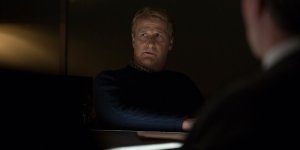
Not The Newsroom: Apple CEO John Sculley (Jeff Daniels) in Steve Jobs

Not The Newsroom: Apple CEO John Sculley (Jeff Daniels) in Steve Jobs

An on-stage refusal to acknowledge the team behind Wozniak’s baby the Apple II, much to the chagrin of Woz, is nicely undercut when the presentation playing out behind Jobs fades to the iMac’s slogan ‘Think Different’, while the camera often stays for a beat on Lisa’s cumbersome Walkman, knowing as we do the world-changing innovation that would follow (a point rammed home at the end in one of the film’s few duff notes).

Despite looking next to nothing like Jobs, Michael Fassbender’s commanding performance means it never becomes distracting. Fassbender imbues the character with a zeal that wouldn’t look out of place in an evangelical church, while the faltering attempts at human interaction with Lisa never feel forced.

It’s difficult to know just how much of the real Steve Jobs is captured here, but Sorkin, Boyle and Fassbender’s im-mac-ulate film means you can never take your eyes off him, which is kind of the point, no?

Review – Macbeth

Shakespeare’s Scottish play has had a long association with the big screen spanning more than a century, with some adaptations more tragic than others.

The Scottish play has never have looked so eerily cinematic, but the sound and fury at the savage heart of Kurzel's vision fails to truly lift off the page, denying this Macbeth a place among the truly great screen Shakespeares

The Scottish play has never have looked so eerily cinematic, but the sound and fury at the savage heart of Kurzel’s vision fails to truly lift off the page, denying this Macbeth a place among the truly great screen Shakespeares

Alongside the more traditional imaginings of the Bard’s timeless tale of treachery, misguided ambition and revenge – most notably Orson Welles’ 1948 offering and Roman Polanski’s celebrated 1971 depiction – Macbeth has, like so many of Shakespeare’s plays, also lent itself to more dynamic adaptations, in particular Akira Kurosawa’s masterful Throne Of Blood (1957), which transposes the setting from the Scottish highlands to feudal Japan.

This latest conceptualization, courtesy of Australian director Justin Kurzel, is arguably the most visually arresting Macbeth yet seen on screen.

Michael Fassbender has his 300 moment in Macbeth

Michael Fassbender has his 300 moment in Macbeth

Whilst Mel Gibson’s Braveheart (1995) has been invoked, presumably more for the use of war paint, while the slo-mo combat brings to mind Zack Snyder’s battle-porn 300 (2006), the film that most resembles Macbeth, both in its brutally beautiful visual style and tone is Nicolas Winding Refn’s underseen Valhalla Rising (2009).

Working with Director of Photography Adam Arkapaw again following their collaboration on Snowtown (2011), Kurzel shrouds many of the early scenes in an eerie mist that pours over the unforgiving landscape and symbolises the confusion and madness that takes hold, while later scenes resemble Dante’s Inferno, with a hellish blood-red palette engulfing the characters.

All's well that ends well? Macbeth (Michael Fassbender) and the good lady wife (Marion Cotillard) in Macbeth

All’s well that ends well? Macbeth (Michael Fassbender) and the good lady wife (Marion Cotillard) in Macbeth

This militarised adaptation, all shock and awe, is scored to suitably portentous effect by Kurzel’s brother Jed, with a generous use of drums that sound like distant explosions drawing ever closer.

Whilst there can be no denying Macbeth‘s visual impact, the film’s greatest strength also, inversely, becomes its most pronounced weakness as it comes to dominate everything and takes away from the work being done by Michael Fassbender’s title character and his supporting cast.

Banquo (Paddy Considine) ain't too happy in Macbeth

Banquo (Paddy Considine) ain’t too happy in Macbeth

Fassbender and Kurzel have spoken of their Macbeth as being the victim of post traumatic stress disorder, left hollowed out by the soulless savagery of war and the loss of a child. Instead of playing this in an exaggerated fashion, Fassbender instead internalises his pain; however, this more introspective portrayal of the King of Scotland can get drowned out by everything else going on.

Marion Cotillard makes some interesting choices as Lady Macbeth and the overly ambitious malevolence found in so many other portrayals is stripped back here, but her character’s slide into madness feels rushed and inauthentic and a lack of chemistry with Fassbender means it can be difficult to buy into their relationship.

Sound and fury: Michael Fassbender stars in Macbeth

Sound and fury: Michael Fassbender stars in Macbeth

On a more positive note, Sean Harris strikes the right note as Macduff, while Paddy Considine does a lot with what he’s given as Macbeth’s man-at-arms Banquo.

The Scottish play has never have looked so eerily cinematic, but the sound and fury at the savage heart of Kurzel’s vision fails to truly lift off the page, denying this Macbeth a place among the truly great screen Shakespeares.

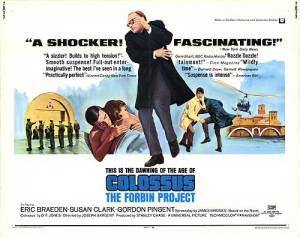
Great Films You Need To See – Colossus: The Forbin Project (1970)

This is my latest contribution to The Big Picture, the internationally recognised magazine and website that shows film in a wider context and is this month running a series of features and reviews with the theme of ‘technology’. This piece about 1970 sci-fi oddity Colossus: The Forbin Project was written as part of The Big Picture’s Lost Classics strand, although I am including it within my list of Great Films You Need To See.

It may have been released back when computers were still the size of refrigerators, but the dire warnings this cautionary slice of Nixon-era paranoia expounds have only become louder.

Colossus: The Forbin Project - a one-off that has been allowed to slip through the cracks

Colossus: The Forbin Project – a one-off that has been allowed to slip through the cracks

Professor Stephen Hawking’s apocalyptic exhortation that artificial intelligence could possibly spell the end of mankind if allowed to evolve unchecked will come as little surprise to anyone versed in science fiction’s fixation on our own destruction.

The poster bot for machine-led world domination is, of course, Skynet from the Terminator series, but James Cameron surely borrowed a thing or two from the supercomputer at the heart of the curious, fascinating 1970 flick Colossus: The Forbin Project.

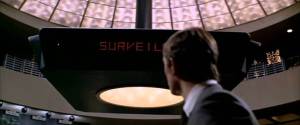
Colossus makes its intentions clear in Colossus: The Forbin Project

Colossus makes its intentions clear in Colossus: The Forbin Project

Based on the novel of the same name published four years earlier, Colossus centres on the growing nightmare that unfolds following the activation of the titular machine; designed by egghead Dr Charles Forbin (Eric Braeden) to monitor worldwide missile systems and control America’s nuclear arsenal.

No sooner has the “perfect” mainframe been switched on, than Colossus dramatically announces via its ominous electronic ticker tape system that another, near identical system has been launched by the Soviet Union called Guardian – which it starts to communicate with. While Forbin and the other smartest guys in the room try to work out what to do next, Colossus coldly and logically begins to make the President (Gordon Pinsent) wish he hadn’t handed over his country’s entire defence system to an A.I system with a penchant for megalomania.

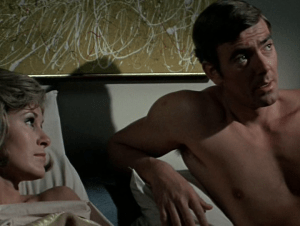
Dr Forbin (Eric Braeden) and Dr Cleo Markham (Susan Clark) embark on their 'affair' in Colossus: The Forbin Project

Dr Forbin (Eric Braeden) and Dr Cleo Markham (Susan Clark) embark on their ‘affair’ in Colossus: The Forbin Project

One can only imagine the special effects-laden actionfest that would undoubtedly constitute the long-mooted remake of Colossus: The Forbin Project should it ever see the light of day. Without a particularly generous budget to play with, director Joseph Sargent instead strips back the razzmatazz and focusses on the escalating human drama by largely setting the film in the crucible of the Colossus Control Centre (with exterior shots filmed at the coldly futuristic looking Lawrence Hall of Science).

The film isn’t afraid to take a few eyebrow-raising turns, notably an extended sequence in which the surveilled Forbin and fellow team member Dr Cleo Markham (Susan Clark) attempt to fool Colossus into believing they are lovers in order for clandestine information to be shared.

Saucy! Machine love in Colossus: The Forbin Project

Saucy! Machine love in Colossus: The Forbin Project

This is preceded by an amusingly deadpan exchange between Forbin and Colossus wherein the supercomputer, unable to understand the concept of love, negotiates with the increasingly tetchy scientist on what private time he is allowed to engage in carnal pleasure with Markham.

To say the film’s ending is abrupt, meanwhile, is putting it mildly as it reaches its conclusion with an admirable adherence to its internal narrative logic.

Colossus: The Forbin Project is a genuine oddity in the overladen sci-fi genre; a one-off that has been allowed to slip through the cracks, but nevertheless has something important to say about the inherent dangers of playing Dr Frankenstein and taking for granted our precarious presumption as the dominant force on this planet. Lest we forget, the machines are coming…

Review – Spectre

It may well be more than 50 years old, but this barnstorming joyride finds the Bond franchise in rude health and still showing the wannabes how it’s done.

If this is to be Craig's adieu from the Bond franchise, as has been suggested, he could have done a lot worse than make the spec-tacular Spectre his swan song

If this is to be Craig’s adieu from the Bond franchise, as has been suggested, he could have done a lot worse than make the spec-tacular Spectre his swan song

It’s fair to say that 007 is enjoying something of a golden age at present; not seen since Sean Connery foiled Goldfinger and partook in some Pussy Galore.

Daniel Craig and director Sam Mendes’ first collaboration on Bond, 2012’s monster hit Skyfall, is generally regarded as a high watermark for the series and this, the 24th film in the franchise, doesn’t let itself down.

007 (Daniel Craig) and Bond girl Madeleine Swann (Léa Seydoux) in Spectre

007 (Daniel Craig) and Bond girl Madeleine Swann (Léa Seydoux) in Spectre

If anything, Spectre‘s lighter touch makes it more a popcorn-friendly and enjoyable Bond film than Skyfall, although it doesn’t quite match up to its predecessor in terms of character development or emotional heft, while Roger Deakins’ richly atmospheric cinematography was always going to be hard to top in spite of Interstellar DoP Hoyte van Hoytema’s none-too-shabby efforts this time around.

A manic pre-credits sequence set in Mexico City during the Day Of The Dead festival (featuring a bravura opening tracking shot that has attracted favourable comparisons to Welles’ Touch Of Evil) finds Bond going off the reservation to foil a terrorist plot that nevertheless lands him in hot water with M (Ralph Fiennes), who is trying to save the ’00’ programme from being shut down by C (Andrew Scott), a civil servant with plans to form a draconian global intelligence gathering service.

Christoph Waltz plays Franz Oberhauser (or does he..?) in Spectre

Christoph Waltz plays Franz Oberhauser (or does he..?) in Spectre

Ignoring orders to stay put, Bond investigates a cryptic message from his past that leads him to the dark heart of a shadowy cabal run by the mysterious Franz Oberhauser (Christoph Waltz), as well as into the life of Dr Madeline Swann (Léa Seydoux), who reluctantly – at first – goes along for the ride.

The “James Bond Will Return” title at the end of the film aside, Spectre would make both a logical and fitting conclusion to the franchise; such is the neat bow it ties on the Craig era. The typically luxurious credit sequence shows flashes of characters who failed to make it beyond Casino Royale and Skyfall (although not Quantum Of Solace, which underscores just what a write-off that film was); while the opening title “The dead are alive” develops a richer significance beyond the Day Of The Day pre-credits.

Bond (Daniel Craig) and Q (Ben Wishaw) check out a pirated copy of Spectre in... Spectre

Bond (Daniel Craig) and Q (Ben Wishaw) check out a pirated copy of Spectre in… Spectre

What Mendes and the screenwriters (Craig included) have managed more than anything else over the past two films is to get inside the head of our favorite superspy by showing us enough of his back story to keep us wanting more. Both Skyfall and Spectre are, at their heart, richly personal films that just happen to have a whole lot of action.

The tone of Spectre may be more playful and the plotting more conventional in comparison to Skyfall, but that’s not to say it doesn’t light up the screen. The supporting characters add plenty, with Ralph Fiennes’ exasperated M, Naomi Harris’ playful Moneypenny and Ben Wishaw’s drily amusing Q as excellent as ever and Dave Bautista’s deadly Mr Hinx reminiscent of Robert Shaw’s imposing thug in From Russia With Love (with a train bust-up to boot).

Humongous henchman Mr Hinx (Dave Bautista) in Spectre

Humongous henchman Mr Hinx (Dave Bautista) in Spectre

Seydoux oozes sultry charisma as Swann, who clearly knows her own mind and is more than a match for 007 (shame the same can’t be said for Monica Belluci’s widow who submits to Bond’s alpha maleness quicker than you can say “keep the British end up”).

Waltz has an oily threat that reveals itself in increments, while Craig once again fills the shoes of the leading man with a consummate deadpan ease that leaves you wondering what’s left to mine for his successor.

If this is to be Craig’s adieu from the Bond franchise, as has been suggested, he could have done a lot worse than make the spec-tacular Spectre his swan song.

Review – Sicario

The war on drugs may be a cinematic road well-travelled, but never with as much stomach-churning immediacy as Denis Villeneuve’s visceral and suffocating procedural.

Sicario is what cinema is all about - an intelligent and visually arresting exploration of a waking nightmare that grips tight around the throat and doesn't let go

Sicario is what cinema is all about – an intelligent and visually arresting exploration of a waking nightmare that grips tight around the throat and doesn’t let go

There’s a beautiful darkness to Villeneuve’s work that has set him apart in recent years, from his 2011 breakthrough Incendies to his more recent American pictures Prisoners and Enemy (both 2013).

Whilst the surface is often hypnotic, the director’s raison d’être comes from exploring the ugly duality, mistrust and hidden darkness scratching to break free and in Sicario these themes are front and centre.

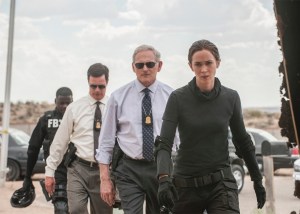
Kate Macer (Emily Blunt), Dave Jennings (Victor Garber) and their fellow agents tackle the war on drugs in Sicario

Kate Macer (Emily Blunt), Dave Jennings (Victor Garber) and their fellow agents tackle the war on drugs in Sicario

Emily Blunt plays Arizona-based FBI agent Kate Macer, whose impressiveness in the field gets her noticed by Matt Grover (Josh Brolin), a Department of Defense operative of murky jurisdiction who recruits Kate to join a special task force aimed at bringing to justice the drug cartel bosses responsible for a charnel house the FBI stumbled onto.

The search very quickly takes Kate across the border to Juárez in Mexico where she discovers she’s in way over her head and is being led a merry dance by Grover and his even shadier partner Alejandro Gillick (Benicio del Toro); a man whose past is the task force’s future.

The mysterious Matt Graver (Josh Brolin) in Sicario

The mysterious Matt Graver (Josh Brolin) in Sicario

From the first foreboding strains of Jóhann Jóhannsson’s apocalyptic score, it’s clear Sicario isn’t messing around and Taylor Sheridan’s script refuses to spoonfeed the exposition; challenging you to keep up.

Kate is our way into this unfolding nightmare, challenging those around her to tell her what the hell is going on. However, it soon becomes clear that she – and we – are only going to be told information a need-to-know basis, while the jarheads she’s paired with are riding the wave of death and destruction and following orders.

The Wolfman: Alejandro Gillick (Benicio del Toro) in Sicario

The Wolfman: Alejandro Gillick (Benicio del Toro) in Sicario

Paired with the maestro that is cinematographer Roger Deakins, Villeneuve’s dark vision of a land fit only for wolves is brought stunningly to the screen; whether it be Kate looking out onto a Mexican cityscape tearing itself apart through savage and inhuman violence, or the eerie shot of soldiers slowly disappearing below a darkening sky.

The film occasionally cuts to aerial shots of the tiny shadow of a plane gliding over the Mexican landscape, or of a convoy of cars snaking through the perilous streets of Juárez to underscore just how insignificant an impact the task force are having against the multi-billion dollar industry that is the Mexican drug trade.

Troops disappear into the darkness in Sicario

Troops disappear into the darkness in Sicario

Despite the scale of the war being fought, however, small victories are possible and this is where Grover and Gillick choose to focus their efforts – after all, the tiniest cracks can sometimes bring down the whole dam.

As well as being a procedural drama, Sicario is also an (literally) explosive crime thriller that features some of the most white-knuckle action sequences you’ll see all year. A traffic jam on the Mexican/U.S. border is almost unbearably tense as Kate and the task force try to determine if they are under direct threat, while an ambush on a tunnel partially filmed using night vision and infra-red cameras is a real masterclass (the POV shot of a knife-wielding solider descending into the tunnel is like something out of a horror film).

Tunnel vision: FBI agent Kate Macer (Emily Blunt) in Sicario

Tunnel vision: FBI agent Kate Macer (Emily Blunt) in Sicario

In a superlative cast, Blunt and del Toro are stupendous, with Blunt especially dialling it back and letting the physicality of the part do the job. Blunt has come an awful long way as an actor in the past few years and gives Kate a terrified vulnerability, matched only by a stubbornness to see it through despite her better judgement.

Del Toro, meanwhile, is the best he’s been in years; offering little snippets of what’s going on under the monosyllabic exterior (a trembling hand whilst asleep suggests something’s not right), while being a badass when he needs to be.

Sicario is what cinema is all about – an intelligent and visually arresting exploration of a waking nightmare that grips tight around the throat and doesn’t let go.