Review – The Place Beyond The Pines

The gospel according to Philip Larkin espouses that, whether they mean to or not, your parents will always f**k you up and “add some extra, just for you”.

The Place Beyond The Pines marks Derek Cianfrance out as one of the most exciting and accomplished young directors out there

The Place Beyond The Pines marks Derek Cianfrance out as one of the most exciting and accomplished young directors out there

Larkin’s most famous and acerbic poem, This Be The Verse, could well have been the operating manual for director Derek Cianfrance’s absorbing and operatic second feature, The Place Beyond The Pines.

The sins of the father weigh heavily on the young sons of lawless, directionless Luke (Ryan Gosling) and rookie cop Avery (Bradley Cooper), whose lives intersect in harrowing fashion and send out shock waves that reverberate years later.

Intense motorcycle stuntman Luke Glanton (Ryan Gosling) in The Place Beyond The Pines

Intense motorcycle stuntman Luke Glanton (Ryan Gosling) in The Place Beyond The Pines

Cianfrance chronicled a relationship’s happy beginnings and painful collapse in his previous feature, the acclaimed Blue Valentine, and that film’s exploration of how bad choices made with ‘good’ intentions can come back to haunt you finds a parallel in this more ambitious and superior follow-up.

The Place Beyond The Pines also sees a reunion between Cianfrance and Gosling, whose star wattage has brightened significantly since Blue Valentine, most notably as a result of 2011’s fantastic Drive. In that film Gosling played an intense stunt performer moonlighting as a getaway driver; here he plays an intense motorcycle stuntman who discovers he has a son with ex-lover Romina (Eva Mendes).

Rookie cop Avery Cross (Bradley Cooper) must learn to live with a split-second decision in The Place Beyond The Pines

Rookie cop Avery Cross (Bradley Cooper) must learn to live with a split-second decision in The Place Beyond The Pines

Determined not to follow his father’s example Luke vows to provide for young Jason and does so by robbing a bank, but as he gets carried away he’s warned by his friend Robin (Ben Mendelsohn): “If you’re going to ride like lightning, you’re going to crash like thunder.”

Avery, meanwhile, struggles to come to terms with the aftermath of a split-second decision made in the line of duty that gradually eats away at him. Wracked with guilt, he becomes distant from his infant son AJ and wife Jennifer (Rose Byrne) and starts listening to his district attorney father, who believes Avery should utilise the hero status he gained after that fateful decision by turning his back on the police force and entering politics.

AJ (Emory Cohen) and Jason (Dane DeHaan) in The Place Beyond The Pines

AJ (Emory Cohen) and Jason (Dane DeHaan) in The Place Beyond The Pines

The film’s title derives from the loose English translation of the Mohawk word Schenectady, a city in upstate New York where the picture events are set. The city itself plays as big a part as its characters, who are all anchored to their surroundings and the pits they have dug for themselves.

Gosling is electrifying as the charismatic, but foolish Luke, equal parts Marlon Brando and Paul Newman. His method has been criticised in the past for being overly showy and inauthentic, but many of his critics were won over by his magnetic performance in Drive and here proves it wasn’t a one-off. Gosling does much of his acting with his piercing blue eyes, which can convey shame, self-hatred and sociopathy in the space of a single blink.

Romina (Eva Mendes) and Luke (Ryan Gosling) in a rare happy moment in The Place Beyond The Pines

Romina (Eva Mendes) and Luke (Ryan Gosling) in a rare happy moment in The Place Beyond The Pines

Cooper gives a career-best turn as the conflicted and guilt-ridden Avery. It’s good to see Cooper stretching himself well beyond the smug and arrogant efforts he put into The Hangover franchise and The A-Team. He proved he had chops in Silver Linings Playbook, but here gives a more rounded and reined in performance.

The superb supporting cast include Mendes, who is beautifully naturalistic as the stability-seeking Romina, the terrific Mendelsohn as deadbeat Robin and a snake-like Ray Liotta doing what he does best as corrupt cop Deluca.

A moment nicely echoed later in The Place Beyond The Pines

A moment nicely echoed later in The Place Beyond The Pines

Much of the criticism of The Place Beyond The Pines has centred on Cianfrance’s decision to include what amounts to an extended coda set 15 years after the film’s earlier events in which the now teenage sons of Luke and Avery cross paths to devastating effect. Some have found fault with the neat way in which Cianfrance ties a bow on what until then had been a freeform narrative, while others have questioned why it’s there in the first place.

I for one feel the film is enriched by the scenes involving AJ (Emory Cohen) and Jason (Dane DeHaan) as they provide a deeper context and nicely echo moments that have gone before. When Jason rides his bike down a country road, for instance, it brings to mind the momentary freedom Luke feels on his motorcycle. We don’t need to know what happened in those intervening 15 years, Cianfrance gives us enough to work it out for ourselves.

If Blue Valentine was an impressive calling card, The Place Beyond the Pines marks Cianfrance out as one of the most exciting and accomplished young directors out there.

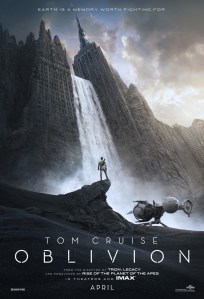
Review – Oblivion

The argument that original ideas in Hollywood are a rare beast is pretty difficult to refute if Tom Cruise’s slick, but highly derivative new slice of dystopian sci-fi is anything to go by.

However visually dazzling and ambitious Joseph Kosinski's Oblivion is, it ultimately gets lost in a void of its own making

However visually dazzling and ambitious Joseph Kosinski’s Oblivion is, it ultimately gets lost in a void of its own making

Director Joseph Kosinski has followed up the visually resplendent Tron: Legacy with another sumptuous spectacle that uses smoke and mirrors to deft effect to disguise its shortcomings.

Kosinski has openly admitted the stream of serious, pre-Star Wars sci-fi films made in the first half of the 1970s – in particular Silent Running, The Omega Man and Soylent Green – were a major influence on the look and feel he wanted for Oblivion.

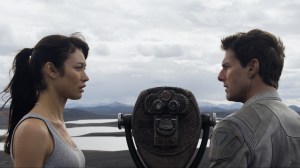
"I know you don't I?" Julia (Olga Kurylenko) is questioned by Jack (Tom Cruise) in Oblivion

“I know you don’t I?” Julia (Olga Kurylenko) is questioned by Jack (Tom Cruise) in Oblivion

However, there are also glaring nods to Planet Of The Apes, 2001: A Space Odyssey, Total Recall and, more recently Duncan Jones’ excellent Moon and the Pixar classic Wall-E.

Set in 2077, Cruise plays Jack Harper, who we learn in a long opening voiceover is part of “the mop-up crew” alongside partner/lover Victoria (Andrea Riseborough) for an Earth half-destroyed by an invading alien force 60 years previously. The war against the aliens, we are told, was won, but the planet was ravaged beyond saving and Jack and Victoria are preparing to rejoin what remains of humanity on Saturn’s largest moon Titan.

Their only contact with home is through a glitchy feed to Mission Control (Melissa Leo), who seeks regular assurances they remain “an effective team”. Jack is tasked with maintaining gun-wielding drones (a cross between Robocop‘s ED-209 and the robots from the classic Commodore 64 computer game Paradroid) which hunt down alien “scavengers”, but is haunted by a nagging memory that threatens to undermine everything he believes.

One of the many stunning shots in Joseph Kosinski's Oblivion

One of the many stunning shots in Joseph Kosinski’s Oblivion

There’s no doubt Kosinski (previously attached to a remake of another 1970s sci-fi classic Logan’s Run) has an eye for a memorable shot. Indeed, there are times when what you’re looking at takes your breath away, most indelibly when Jack is sat atop a mountain looking out onto a beautifully ravaged landscape (in reality Iceland). His ambitions have been given life thanks to the remarkable work of cinematographer Claudio Miranda, who won an Oscar for Life of Pi, and Darren Gilford’s incredible production design.

Victoria (Andrea Risedborough), one half of an effective team in Oblivion

Victoria (Andrea Risedborough), one half of an effective team in Oblivion

Kosinski also has a cool ear, having secured French dance pioneers Daft Punk to score Tron: Legacy and fellow electro-inclined Frenchies M83 to provide a Vangelis/Hans Zimmer-esque epic sci-fi soundtrack here.

A charge levelled at science fiction of this ilk is that it can come across as cold and aloof to the viewer and, unfortunately, Oblivion fails to avoid that trap. Stunning visuals do not a great film make and somewhere along the line an engaging and logical narrative got lost amid the search for the next jaw-dropping shot.

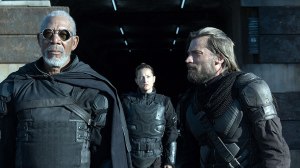
Malcolm Beech (Morgan Freeman), Kara (Zoë Bell) and Sykes (Nikolaj Coster-Waldau) in Oblivion

Malcolm Beech (Morgan Freeman), Kara (Zoë Bell) and Sykes (Nikolaj Coster-Waldau) in Oblivion

No stranger to dystopian sci-fi following Steven Spielberg’s Minority Report and criminally underrated War of the Worlds, Cruise does his best to find a fully rounded human being in Jack Harper but is let down by a disappointing script co-written by Kosinski.

Olga Kurylenko is given little to do as the enigmatic Julia, while Morgan Freeman and Game of Thrones‘ Nikolaj Coster-Waldau are entirely wasted as leading figures in the film’s dubious and confused second half. The real standout is Riseborough, who injects empathy and humanity into what could easily have been a cardboard cut-out role in lesser hands.

Serious, cerebral moviemaking on a sizeable budget is something of a rarity these days, but however visually dazzling and ambitious Oblivion is, it ultimately gets lost in a void of its own making.

Review – Iron Man 3

The law of diminishing returns has long been an affliction of the modern movie franchise, wherein bigger is believed to be better and the script often resembles a paint-by-numbers exercise in calculated cynicism.

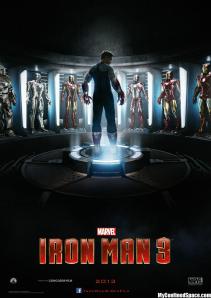
Iron Man 3 - "Black has forged a Marvel-ous summer blockbuster that’s as cool, collected and cocksure as its hero"

Iron Man 3 – “Black has forged a Marvel-ous summer blockbuster that’s as cool, collected and cocksure as its hero”

The rust appeared to have set in for Ol’ Shellhead with the turgid Iron Man 2, a vacant mess as bloated as its director John Favreau that undid all of the good work of the entertaining first instalment.

However, the mojo is back thanks to another bold decision by the powers that be at Marvel (following the call to appoint Kenneth Branagh to direct Thor) to take a punt on meta-man Shane Black to co-write and helm the studio’s first salvo since Joss Whedon’s Avengers Assemble struck box office platinum.

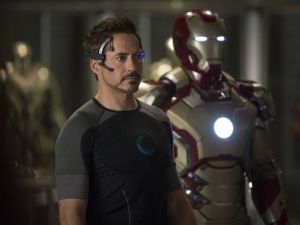
Tony Stark (Robert Downey Jr) with his latest toy in Iron Man 3

Tony Stark (Robert Downey Jr) with his latest toy in Iron Man 3

Anyone familiar with Black’s only previous stint in the director’s chair, 2005’s Kiss Kiss Bang Bang will know getting him on board for Iron Man 3 makes total sense. For one thing, Kiss Kiss Bang Bang starred Robert Downey Jr (in something of a career comeback performance), whose rapid-fire delivery fitted Black’s snappy, wise-cracking dialogue to perfection.

It therefore shouldn’t come as a major surprise to learn that Black has a blast with Tony Stark (Downey Jr), the ingenious, fast-talking billionaire egotist and self-appointed superhero who must go back-to-basics and overcome his post-Avengers Assembled panic attacks when his cosy world is turned upside down at the hands of the Mandarin (Ben Kingsley), a megalomaniacal terrorist seemingly hell-bent on bringing America to its knees.

Although there are obligatory boxes that need ticking when dealing with a franchise picture, there are more than enough Blackisms peppered throughout the film’s 130-minute running time. While Whedon got away with one truly inspired moment in Avengers Assembled when a crew member on S.H.I.E.L.D’s flying aircraft carrier is caught playing classic video game Galaga, Iron Man 3 is all Black.

The mysterious Mandarin (Ben Kingsley) in Iron Man 3

The mysterious Mandarin (Ben Kingsley) in Iron Man 3

He has a field day pulling the rug from under the viewer by undermining familiar screenwriting tropes, such as in the amusing relationship between Stark and troubled kid Harley (Ty Simpkins), who helps him get to the bottom of the Mandarin’s dastardly plan. Black knows we’re expecting a father/son bond to form, but buries the notion in a blizzard of cute one-liners.

Likewise, he saves some of the best lines for the smart-suited henchmen, who in any other blockbuster outside of an Austin Powers flick would be nothing more than target practice for our hero.

Pepper Potts (Gwyneth Paltrow) picks up the pieces in Iron Man 3

Pepper Potts (Gwyneth Paltrow) picks up the pieces in Iron Man 3

To Black’s credit, he and co-screenwriter Drew Pearce keep Tony out of the heavy metal suit for long periods (even during the inevitable robots-hitting-each-other final reel), no doubt understanding the franchise’s greatest strength isn’t the wham-bam special effects (although there’s still plenty of them), but rather Downey Jr’s scenery-chewing performance.

That being said, Downey Jr’s turn is so big many of the supporting cast barely have a chance to make an impact, especially Gwyneth Paltrow as Tony’s soul mate Pepper Potts, who looks confused or shocked most of the time, and Rebecca Hall as Stark’s former conquest Dr Maya Hansen, who has so little to do it’s almost tragic.

War Machine, make that Iron Patriot, in Iron Man 3

War Machine, make that Iron Patriot, in Iron Man 3

Don Cheadle gets a lot more to do this time around as Rhodes, whose Iron Man suit has been sprayed red, white and blue and renamed Iron Patriot (as opposed to its previous moniker, the more honest War Machine) and who gets to enjoy some Lethal Weapon-style buddy action with Tony, which is only appropriate bearing in mind Black wrote that 80s blockbuster.

The only one who truly stands out alongside Downey Jr, however, is Kingsley, who steals every scene he’s in as the mysterious Mandarin. It’s a superb, multi-layered performance that’s as out-there as it is memorable.

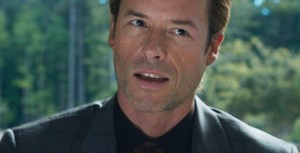
Tony Stark's former number one fan Aldrich Killian (Guy Pearce) in Iron Man 3

Tony Stark’s former number one fan Aldrich Killian (Guy Pearce) in Iron Man 3

One of the problems with creating a post-Avengers universe containing a big green guy and a hammer-wielding god is that they’re notable by their absence in Marvel’s stand-alone movies. The film tries to get around this big, gaping logic hole when Stark explains: “This isn’t superhero business. It’s American business.” But if that’s the case, then where’s Captain America?

As with Kiss Kiss Bang Bang and Black’s numerous other scripts (in particular The Last Boy Scout), Iron Man 3 gets a little too-cute for its own good, to the extent whereby some scenes get so caught up in the next one-liner the narrative grinds to a halt.

That being said, the direction Black and Pearce take the main character is a real winner. This Tony Stark must swallow his pride, understand the consequences of his actions and rely on the skills that created Iron Man in the first place if he is going to prevail.

Whether this is Downey Jr’s final solo stint as Ol’ Shellhead remains to be seen; either way Black has forged a Marvel-ous summer blockbuster that’s as cool, collected and cocksure as its hero.

In Retrospect – The Manchurian Candidate (1962)

This review forms part of the IMDB Top 250 Films project on the fantastic Head in a Vice‘s fantastic site. Try to make a beeline to his informative, entertaining site.

For a film so of its time, it’s remarkable how relevant John Frankenheimer’s 1962 Cold War classic The Manchurian Candidate has remained.

The Manchurian Candidate

John Frankenheimer’s The Manchurian Candidate – “one of the most chilling, paranoiac, satirical and downright surreal polemics against the politics of fear ever made”

Ostensibly a white knuckle thriller about a decorated soldier being brainwashed by a cabal of Communist conspirators into becoming an unwitting assassin, this adaptation of Richard Condon’s novel remains one of the most chilling, paranoiac, satirical and downright surreal polemics against the politics of fear ever made.

One of the first films to explore the notion of using mind control to create so-called sleeper agents, its continued resonance is such that ‘Manchurian Candidate’ is a term still used by panic-peddlers to describe public figures who they claim are the mouthpiece of evildoers.

The unfortunate platoon, unwitting pawns in a much larger game, in The Manchurian Candidate

The unfortunate platoon, unwitting pawns in a much larger game, in The Manchurian Candidate

Condon’s book, published in 1959 had, like Arthur Miller’s 1952 play The Crucible been a thinly veiled attack on Senator Joseph McCarthy’s poisonous, demagogic anti-Communist witch hunts.

The book’s central premise of a fantastical Communist plot to overthrow America from the inside is mere window dressing for Condon’s real target, made manifest in the character of John Iselin (played in the film by James Gregory), an ignorant, but dangerous buffoon controlled by his domineering, ideologically driven wife (Angela Lansbury).

The Communist plot takes shape when a platoon of US soldiers serving in the Korean War is captured and brainwashed. The platoon returns to America, where cold, unloveable Staff Sergeant Raymond Shaw (Laurence Harvey) is credited with saving the lives of his men and recommended for the Medal of Honour by Captain Marco (Frank Sinatra). Marco suffers a recurring nightmare in which Shaw brutally kills two of his own men and becomes convinced they were conditioned and that Shaw is being primed for something terrible. Little does Marco realise, however, who Shaw’s American operator is and quite how ambitious the plot is.

A meeting of the Ladies Garden Club concerning 'Fun with Hydrangeas' - or maybe not - The Manchurian Candidate

A meeting of the Ladies Garden Club concerning ‘Fun with Hydrangeas’ – or maybe not – The Manchurian Candidate

America was still in the icy grip of the Cold War when Frankenheimer’s film was released. Indeed, it landed in cinemas slap bang in the middle of the Cuban Missile Crisis when the Soviet Union and United States appeared destined for nuclear conflict and initially suffered at the box office as a result.

It’s appropriate for a film about a massive multi-national cabal to be the subject of its own conspiracy theories. Sinatra purchased the rights following the assassination in 1963 of President Kennedy (who was a fan of the book) and kept it from circulation until 1988, supposedly out of a sense of remorse for the loss of his friend. However, according to Frankenheimer the film’s withdrawal was actually the result of a fall-out over money between Sinatra and distributors United Artists.

Captain Bennett Marco (Frank Sinatra) has a strange exchange with Rosie (Janet Leigh) in The Manchurian Candidate

Captain Bennett Marco (Frank Sinatra) has a strange exchange with Rosie (Janet Leigh) in The Manchurian Candidate

The film’s quasi-documentary style lends the film an urgency and its recognition that television could be used to shape opinion and spread disinformation was well ahead of its time. The scene when Iselin gatecrashes a press conference waving a list of “card-carrying Communists” working within the government is expertly staged by Frankenheimer, who shows Iselin tub-thumping on TV screens in the foreground and an uproarious media behind.

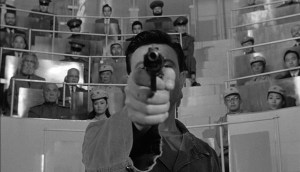
The Manchurian Candidate‘s most powerful moments bookend the film. The celebrated brainwashing sequence near the start is a bizarre, deeply unsettling tour-de-force by Frankenheimer and still shocks. The virtuoso 360° tracking shot starts with the soldiers sat laconically on stage at a talk given to the Ladies Garden Club concerning ‘Fun with Hydrangeas’. As the camera gradually comes full circle the terrifying reality dawns on the viewer – we’ve actually been witnessing events through the platoon’s delusional perspective; the person giving the talk is smug Communist doctor Yen Lo (Khigh Dhiegh), the ‘ladies’ are a coalition of Soviet, Chinese and Korean officials and rather than being a quaint affair this is a deadly demonstration of mind control.

Likewise, the political convention climax in Madison Square Garden is nail-biting stuff, shamelessly lifted from Hitchcock’s The Man Who Knew Too Much.

Eleanor Iselin (Angela Lansbury) and Raymond Shaw (Laurence Harvey) - one of the most uncomfortable mother/son relationships in history -  in The Manchurian Candidate

Eleanor Iselin (Angela Lansbury) and Raymond Shaw (Laurence Harvey) – one of the most uncomfortable mother/son relationships in history – in The Manchurian Candidate

One of the odder aspects of the film is George Alexrod’s script, dense and verbose at times (especially during the brainwashing sequence) and just plain surreal at others, most notably when a shaky Marco meets Rosie (Janet Leigh) on the train. After Marco corrects her on which state they’re in she replies: “I know. I was one of the original Chinese workmen who laid the track on this stretch.”

It’s a nonsensical exchange that some believe is code by Rosie to control Marco. Things get stranger still when, at their next encounter she announces she’s suddenly broken off her engagement with her fiancé and wants to get together with Marco.

Raymond Shaw (Laurence Harvey) - "the kindest, bravest, warmest, most wonderful human being I've ever known in my life" - in The Manchurian Candidate

Raymond Shaw (Laurence Harvey) – “the kindest, bravest, warmest, most wonderful human being I’ve ever known in my life” – in The Manchurian Candidate

Sinatra could pull it out of the bag when he needed and he’s never been better as the edgy soldier frustrated he can’t do more to help his sergeant. Harvey is perfectly cast as the doomed, tragic Shaw, a puppet on a string helplessly controlled by both his conditioning and his despicable mother, played by Lansbury.

One of the great movie villains, Lansbury (who was only three years older than Harvey) plays Mrs Iselin as the ultimate spin doctor, an ultra-domineering sociopath who serves an ideology but isn’t afraid to stamp on her comrades when things get personal.

Frankenheimer litters the film with numerous other subtle moments (Iselin’s reflection in a portrait of Abraham Lincoln to symbolise just how low politics has sunk) and his use of deep focus lends the film a clammy claustrophobia.

That the film is more relevant today than its unsatisfactory 2004 remake speaks volumes about its importance not only as a work of cinema but also as a beacon of vigilance against fear being used as the weapon of choice by our public servants.

In Retrospect – Life Of Brian (1979)

This review forms part of the IMDB Top 250 Films project on the excellent Head in a Vice site. If you haven’t already, make sure to check out the site, it really is very good.

Every once in a while a film comes along that generates a more fervent reaction among those who haven’t seen it compared to those who have.

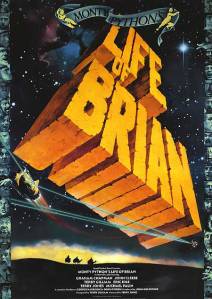
Life of Brian

Life of Brian

David Cronenberg’s Crash was hugely controversial on its 1996 release, leading to some councils banning it from being shown, while the furore dredged up by the slew of so-called ‘video nasties’ led to stricter censorship laws being adopted in the UK.

A similar outcry greeted the release of Monty Python’s Life of Brian in 1979. Branded ‘satanic’ and ‘blasphemous’ in the United States, almost exclusively by those who had only heard what the film was about through Chinese whispers, the film generated an equally vitriolic reaction in the British media, among certain religious groups and rent-a-quote social campaigners such as Mary Whitehouse.

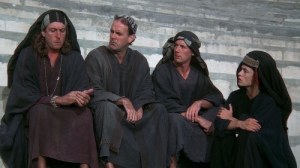
"Squatters!" Members of the People's Front of Judea put the world to rights in Life of Brian

“Squatters!” Members of the People’s Front of Judea put the world to rights in Life of Brian

Most (in)famously, Python’s own John Cleese and Michael Palin staunchly defended the film on the BBC against the juvenile and contrary jibes peddled by Christian broadcaster Malcolm Muggeridge and the flamboyant Bishop of Southwark, Mervyn Stockwood.

The simple fact is that, almost 35 years on from its original release, Life of Brian remains the most insightful and satirical film ever made about religious dogma, as well as one of the funniest movies in cinema history.

As the title suggests, the film follows the life of Brian Cohen, a simple Jewish man who happens to be born in the stable next to Jesus Christ. Brian falls in love, joins the People’s Front of Judea, is temporarily picked up by an alien spaceship and is mistaken for the messiah on his way to a very musical end.

Brian at the 'men' only stoning in Life of Brian

Brian at the ‘men’ only stoning in Life of Brian

Upon the release of the comedy troupe’s previous feature Monty Python and the Holy Grail in 1975, a journalist reportedly asked Eric Idle what their next film would be, to which Idle replied “Jesus Christ – Lust For Glory”. The Pythons ultimately decided not to cheapen the image of God’s only child (Hollywood epics had been doing that for decades); instead they took the far cleverer approach of using their singularly left field style to subvert many of the clichés we have of that time and point the finger at those who practice religious intolerance.

Right from the off it is made patently clear this is not a film about Christ. The first scene sees the Three Wise Men enter the manger where Brian has just been born, believing him to be the messiah, only to realise a few moments later they’ve gone to the wrong stable. The next scene picks up in AD33 with Jesus giving the Sermon on the Mount, only to pan to the back of the crowd where someone shouts “speak up!”, while a group behind bicker among themselves over what they think they’re hearing (“I think he said blessed are the cheese makers”) and call each other names.

Brian's unwanted followers try to find meaning in the smallest things in Life of Brian

Brian’s unwanted followers try to find meaning in the smallest things in Life of Brian

This misinterpretation of religion – and the dangers that can ensue – is central to Life of Brian, none more so than in the hilarious scene when Brian unwittingly creates a movement and attracts a legion of followers who attach their own nonsensical symbolism to everything he does or says. A lost sandal is interpreted as a sign that all must cast off their shoes, while a blind man declares he has been given back his sight … shortly before plunging head first into a hole.

Indeed, when an exasperated Brian shouts “I’m not the messiah!”, one follower replies in all seriousness: “I say you are Lord, and I should know I’ve followed a few.”

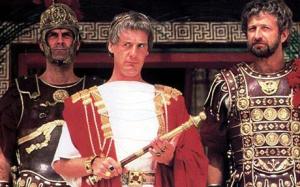
Pontius Pilate (Michael Palin) and right-hand-man Biggus Dickus (Graham Chapman) in Life of Brian

Pontius Pilate (Michael Palin) and right-hand-man Biggus Dickus (Graham Chapman) in Life of Brian

This inspired deconstruction of the delusionary influence of religious dogma is soon followed by an equally brilliant scene when Brian opens his window to be met by hundreds of his ‘followers’:

Brian: “You don’t need to follow me. You don’t need to follow anybody. You’ve got to think for yourselves. You’re all individuals.”
Crowd: “Yes! We’re all individuals.”
Brian: “You’re all different.”
Crowd (except one): “Yes! We are all different.”
One crowd member: “I’m not.”

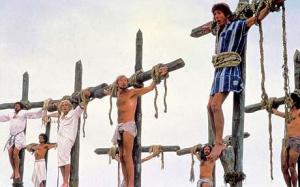
Brain and chums try to look on the bright side of life in Life of Brian

Brain and chums try to look on the bright side of life in Life of Brian

The Pythons also take aim at the talking shop politics of old-school socialists/communists/trade unionists who like the sound of their own voice too much to do anything constructive, encapsulated in the People’s Front of Judea, who brand fellow Roman-haters the Judean People’s Front and the Judean Popular People’s Front “splitters” and call for a meeting instead of action following Brian’s arrest.

The swipes don’t stop there. Public schools and the British gentrified classes both get sent-up, while the appearance of the alien spacecraft could be seen as the only direct example of religion-bating. As their TV show so often proved, the Pythons aren’t below the odd spot of low-brow humour either, be it Pontius Pilates’s ridiculously over-the-top lisp (“I shall welease Woger!”) or the character of Biggus Dickus.

In the end, Brian is encapsulated by his wildly overbearing mother as “not the messiah. He’s a very naughty boy!”. It’s a very silly line from an equally silly film that somehow manages to walk the tight rope between respect and out-and-out satire, and in doing so cements its position as one of the very greatest screen comedies.