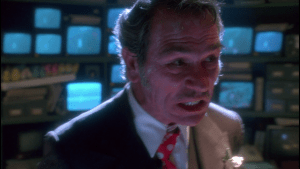
In Retrospect – The Player (1992)

Robert Altman may have playfully described his ‘Hollywood on Hollywood’ black comedy as “a very mild satire”, but he was fooling no-one.

One of Robert Altman's very best, The Player could arguably be the ultimate example of Hollywood eating itself

One of Robert Altman’s very best, The Player could arguably be the ultimate example of Hollywood eating itself

One of the most cynical, caustic and clever dissections of a creatively bankrupt studio system that has only become worse in the 21 years since its release, Altman’s The Player is one of the late director’s most celebrated works and, ironically, brought him back in from the cold after a decade spent making no budget chamber pieces.

Actors are a contrary lot. Happy to take the cheque and star in the sort of drivel the director mercilessly satirises, dozens of actors (whose star wattage could power a small town) lined-up to take walk-on parts mostly as themselves in order to take a gleeful swipe at the piñata that is Tinseltown’s lumbering studio system.
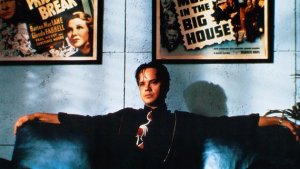
The sleek, shark-like studio executive Griffin Mill (Tim Robbins) in The Player

The sleek, shark-like studio executive Griffin Mill (Tim Robbins) in The Player

Based on Michael Tolkin’s book, Altman’s anti-hero is sleek, shark-like studio executive Griffin Mill (Tim Robbins), who’s scared he could be axed in favour of the younger, up-and-coming story executive Larry Levy (Peter Gallagher). Mill’s life is thrown into further disarray when he continues to receive increasingly threatening postcards from a writer he can’t remember whose pitch he ignored.

Everything in The Player is artifice from the very first shot of someone asking for “quiet on set” and a clapperboard shutting. A person’s word counts for nothing, false sincerity and hypocrisy is in plentiful supply and artistic backbone turns to spinelessness when money and power enter the equation. At one point, Mill bumps into Burt Reynolds, who’s all smiles until Mill walks away, at which point he calls him an “asshole”.

Studio exec Griffin Mill (Tim Robbins) sets his sights on artist June Gudmundsdottir (Greta Scacchi) in The Player

Studio exec Griffin Mill (Tim Robbins) sets his sights on artist June Gudmundsdottir (Greta Scacchi) in The Player

This most tellingly plays out in the second half of the film when pretentious English writer Tom Oakley (Richard E Grant) and producer Andy Civella (Dean Stockwell) pitch the death row thriller Habeas Corpus to Mill at a restaurant. Oakley vociferously insists it mustn’t lose its downbeat conclusion (“no Hollywood endings”) and feature no stars. Inevitably, as the studio’s claws get into the project Habeas Corpus turns into a very different movie, to the extent that has Bruce Willis and Julia Roberts as its leads and includes a tacked-on happy ‘Hollywood ending’, both of which Oakley seems happy about now it’s been made (in an example of life imitating art, one of the stars of Habeas Corpus is Susan Sarandon, who three years later teamed up with her long-time partner Robbins to make Dead Man Walking, a death row thriller).

Griffin Mill (Tim Robbins) receives yet another death-threatening postcard from a mystery writer in The Player

Griffin Mill (Tim Robbins) receives yet another death-threatening postcard from a mystery writer in The Player

Oakley isn’t the only writer who fails to come out of The Player smelling of roses. One pitches The Graduate: Part 2 (I’m personally amazed that one hasn’t been made) in which all the original characters incredulously still live together “in a big, old spooky house”. Another pitches “Out Of Africa meets Pretty Woman“, while a further writer’s idea for a hard-hitting politically radical film with a supernatural edge (“Ghost meets The Manchurian Candidate“) is reduced to a bland paint-by-numbers thriller after only 30 seconds in Mill’s hands.

One thing that strikes you about watching the film is just how disinterested Mill and his cronies are in watching movies (something you suspect is true for a lot of today’s execs). At an informal lunch, Mill asks those around him: “Can we talk about something other than Hollywood for a change?” The silence that follows speaks volumes.

At one point Mill gives a speech at a gala dinner in which he bangs on about the importance of finding the next John Huston or Orson Welles and the fact that “movies are art”. He unsurprisingly contradicts himself later in the film when he lists the key ingredients that make a successful Hollywood film, the most important one being “happy endings”.

Griffin Mill (Tim Robbins) says hi to the agent and Burt Reynolds, just one of dozens of cameos in The Player

Griffin Mill (Tim Robbins) says hi to the agent and Burt Reynolds, just one of dozens of cameos in The Player

The only time we see Mill actually watch a film is when he thinks he’s tracked down the mystery writer sending him death threats to an old movie theatre showing Vittorio De Seca’s 1948 neo-realist classic Bicycle Thieves and even then it’s only for the last five minutes. Perhaps underlining how there are no original ideas left in Tinseltown, Altman constantly makes references to Hollywood’s golden age, whether it be the posters of old classics in the studio’s offices or the threatening postcards featuring Humphrey Bogart and James Dean.
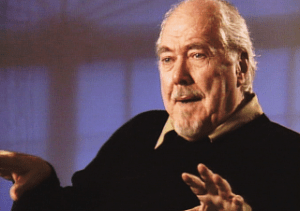
The late Robert Altman, director of The Player

The late Robert Altman, director of The Player

Head of studio security Walter Stuckel (Fred Ward) complains that all films today are “cut, cut, cut” and refers to the six-and-a-half-minute opening shot of Touch Of Evil. It’s a clever, self-referential nod to the audience as he opens the film with a celebrated tracking shot lasting almost eight minutes. It’s bravura filmmaking and shows off Altman’s unique and complex Peeping Tom style of filming certain moments using a long lens that often incorporate overlapping conversations and multiple set-ups.

The film has a wicked sense of humour (in a cute piece of marketing, a poster for it includes the quote “the best movie ever made!” … attributed to Griffin Mill) that veers from pitch black satire to farce. Altman was always a pranksterish filmmaker and this knowing humour runs through the core of The Player.

Alas, The Player feels all-too-pertinent to a modern-day big studio system scrambling about in the dark for the next big thing. One of Altman’s very best, this could arguably be the ultimate example of Hollywood eating itself.

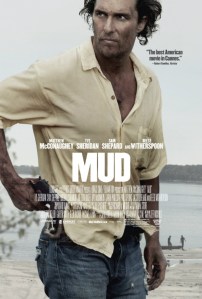
Review – Mud

A serious contender for this year’s Great American Film, Jeff Nicholls’ lyrical, poetic third feature evokes a timeless quality all-too-rare in today’s cinematic landscape.

A serious contender for this year's Great American Film, Jeff Nicholls' lyrical, poetic Mud evokes a timeless quality all-too-rare in today's cinematic landscape

A serious contender for this year’s Great American Film, Jeff Nicholls’ lyrical, poetic Mud evokes a timeless quality all-too-rare in today’s cinematic landscape

Nicholls has quietly positioned himself among the most visionary and essential directors at work today with his striking 2007 debut Shotgun Stories and his belated follow-up, the disturbing and astonishing Take Shelter (2011).

The incredible boat in a tree in Mud

The incredible boat in a tree in Mud

In both Shotgun Stories and Take Shelter, their leading characters (played each time by the mesmeric Michael Shannon) are driven by an almost insane conviction. That same dogmatic approach is adopted by Mud (Matthew McConaughey), the charismatic fugitive living out on a small island in the Mississippi River who befriends inquisitive teenagers Ellis (Tye Sheridan) and Neckbone (Jacob Lofland). Mud has risked his freedom by returning to the area in which he grew up to be reunited with his true love Juniper (Reese Witherspoon), but a group of killers arrive in town looking to avenge a past crime by Mud.

Nicholls has been quick to acknowledge the debt the film owes to Mark Twain’s Adventures of Huckleberry Finn in the overtly Finn/Tom Sawyer relationship between Ellis, who lives on a river boat with his squabbling parents (played by the excellent Ray McKinnon and Sarah Paulson) and Neckbone.

Ellis (Tye Sheridan) and Neckbone (Jacob Lofland) first meet Mud (Matthew McConaughey) in Mud

Ellis (Tye Sheridan) and Neckbone (Jacob Lofland) first meet Mud (Matthew McConaughey) in Mud

The 14-year-old Ellis is an idealist who’s obsessed with reuniting Mud and Juniper because he believes in the power of love. As young teenagers, the concept of true love can be all-encompassing and Ellis acts with such doggedness in order to counterbalance the failing relationship of his parents. Likewise, he gets a tough lesson in the ways of love courtesy of an older girl he falls for.

The love of Mud's life, Junniper (Reese Witherspoon) in Mud

The love of Mud’s life, Juniper (Reese Witherspoon) in Mud

Mud brings to mind Terence Malick in its penchant for the Magic Hour (and its fascination with nature) and Nicholls with long-time director of photography Adam Stone captures a string of breathtaking shots. The relationship with Malick doesn’t end there; Mud’s producer Sarah Green worked on The Tree of Life, while Sheridan was given his debut in that film.

Jeff Nicholls' long-time partner Michael Shannon plays Galen in Mud

Jeff Nicholls’ long-time partner Michael Shannon plays Galen in Mud

He only has a limited filmography, but Sheridan is already showing himself as a young actor with a lot of promise. It’s a demanding role and he brings a lot of maturity to it. All he wants is for people to be happy and for things to be in order, so you can feel his pain when he realises life is much harder to get a handle on.

Maintaining his remarkable career renaissance (aka, his McConaisance), McConaughey is a revelation in the title role. Once the butt of many a joke for his languid, cheque-grabbing performances in duds like Failure to Launch, McConaughey of late has returned to the high watermark he achieved in the likes of Dazed and Confused and Lone Star. Lovelorn, scared, but determined also, his Mud is not so very different from Ellis.

Mud (Matthew McConaughey) tries to save his skin in Mud

Mud (Matthew McConaughey) tries to save his skin in Mud

The excellent supporting cast includes Shannon as Neckbone’s placid Uncle Galen (as far removed from Take Shelter‘s Curtis LaForche as you can get) and the impeccable Sam Shepard as Tom, who may or may not be a former CIA agent living off the grid in the Mississippi swamps.

Just as Malick managed to capture the coming of age adventure of adolescence in The Tree of Life, so too does Nicholls here. When we see a boat stuck up a tree (Mud’s temporary home), we marvel instead of questioning the unlikelihood of what we’re watching; such is the power of Nicholls’ persuasive vision.

The slightly fumbled ending doesn’t detract from what is a work of true poetry from Nicholls. Much like last year’s Beasts of the Southern Wild, Mud is a real one-off that will stay with you for a long time after.

Review – Man Of Steel

The superhero’s superhero is back, but not as we’ve seen him before, in Zack Snyder’s earnest origin story that strives to put the king-daddy of comic books back on his throne.

There's enough in Man Of Steel to promise much for future adventures, but let's hope there's more fun next time around

There’s enough in Man Of Steel to promise much for future adventures, but let’s hope there’s more fun next time around

While his ability to leap tall buildings in a single bound and run faster than a speeding locomotive naturally lend themselves to incredible set pieces, Superman as a character has always been tricky to build a movie around. His intrinsic capacity for good is far less dramatic than the dark, brooding of Batman, for instance, or the cocksure machismo of Iron Man.

Jor-El (Russell Crowe) prepares to sending his son away from a dying Krypton in Man Of Steel

Jor-El (Russell Crowe) prepares to send his son away from a dying Krypton in Man Of Steel

Uninspiring action sequences, a lacklustre plot and an over-extended running time sank Supes’ last cinematic outing, 2006’s Superman Returns, so the challenge was on to rediscover the magic of 1978’s Superman and make him relevant to a modern day audience.

The news that Man Of Steel would be ‘A Zack Snyder Film’ was hardly a great start. Since his highly watchable 2004 remake of Dawn Of The Dead, the quality of Snyder’s output has diminished further with each new release, to the extent that his most recent film, 2011’s Sucker Punch was virtually unwatchable.

Clark Kent flashbacks to his childhood in Man of Steel's best moments

Clark Kent flashbacks to his childhood in Man of Steel’s best moments

Although the presence of Batman alumnus Christopher Nolan and David S Goyer as, respectively, producer and screenwriter can be felt, there’s no mistaking this is a Snyder movie, which means stylised violence delivered at an ear-bleeding volume.

Taking the character back to his roots, Man Of Steel begins at the moment of his birth on a dying Krypton. His father Jor-El (Russell Crowe) and mother Lara (Ayelet Zurer) manage to launch the spacecraft carrying Kal-El before maniacal rebel General Zod (Michael Shannan) is able to get his hands on the child. Crash-landing on Earth, he’s raised by honest-to-goodness farmers Jonathan and Martha Kent (Kevin Costner and Diane Lane), who name him Clark. When Clark starts to develop super-human powers, his alien lineage is revealed to him by his father, who warns of the need to keep his abilities a secret for fear that a confused, frightened society would reject him. However, when Zod and his followers arrive years later demanding that Earth surrender Kal-El or suffer the consequences, Clark must finally embrace his Kryptonian ancestry and become the superman he was destined to be.

Jonathan Kent (Kevin Costner) consoles a confused Clark in Man Of Steel

Jonathan Kent (Kevin Costner) consoles a confused Clark in Man Of Steel

While the dark and serious approach taken by Nolan for his Dark Knight trilogy works for a superhero who lives in the shadows, the similar direction Man Of Steel takes doesn’t make much sense. Tossing words around like “edgy” and “realistic” is all well and good, but when you’re dealing with god-like alien beings beating the hell out of each other and laying waste to half of Metropolis (and killing thousands of faceless people in the process, although this doesn’t seem important) on a scale not seen since the The Matrix Revolutions, “realistic” is stretching it somewhat.

Taken on their own merits, the childhood flashbacks Clark has during his Christ-like wandering phase in the film’s first act are the film’s finest moments. Handsomely filmed, these scenes are richly evocative and beautifully played by Costner and Lane. Indeed, the brief, wordless moment when a young Clark plays with the family dog and wears a makeshift red cape is Man Of Steel‘s high watermark.

Intrepid Daily Planet reporter Lois Lane (Amy Adams) in Man Of Steel

Intrepid Daily Planet reporter Lois Lane (Amy Adams) in Man Of Steel

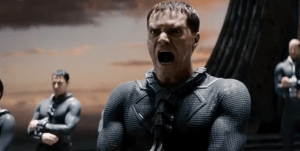
A typically restrained Michael Shannan as General Zod in Man Of Steel

A typically restrained Michael Shannon as General Zod in Man Of Steel

However, they look like they belong in another film when Snyder switches into default mode and lets the CGI do the talking. While there was a palpable sense of jeopardy for Iron Man and co during Avengers Assembled‘s extended final battle in New York, here the only thing you feel is a sore backside.

In his big break, Henry Cavill does everything that’s asked of him, from brooding lonerism to conflicted turmoil and finally self-assurance that falls on the right side of smug. He’s no Christopher Reeve, but then who is? Anyone aware of Shannon’s turns in the likes of Take Shelter and HBO’s Boardwalk Empire may wonder like me how much CGI was actually required to show Zod’s heat vision, so intense are Shannon’s eyes anyway. It’s hardly a stretch, but it’s fun nonetheless to watch him deliver Zod’s semi-regular meltdowns.

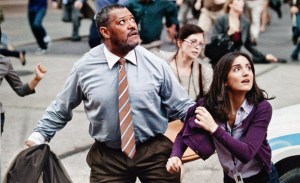
Daily Planet editor Perry White (Laurence Fishburne) and his staff take shelter in Man Of Steel

Daily Planet editor Perry White (Laurence Fishburne) and his staff take shelter in Man Of Steel

Although she starts out well as feisty reporter Lois Lane, Amy Adams struggles with a script that runs out of things for her to do. Laurence Fishburne, meanwhile, dons his Morpheus hat for a spot of sermonising as Daily Planet editor Perry White and Crowe at least gets to run around more than Marlon Brando.

Superman (Henry Cavill) at one with the suit in Man of Steel

Superman (Henry Cavill) at one with the suit in Man of Steel

Hans Zimmer’s score may indulge the Christ motif a little strongly at times (there’s only so many angels you need to hear), but is otherwise stirring and haunting in all the right places and doesn’t make you pine for Jerry Goldsmith’s iconic composition.

Snyder drops in a few nice touches to prepare the ground for the inevitable sequel (a Lexcorp lorry is overturned during the Superman vs Zod melee, suggesting Mr Luthor is being primed) and one can only hope it makes room for a bit more fun next time around.

It’s ironic that a film featuring a character gradually finding himself should lose its way as it goes on. There’s enough here to promise much for future adventures, but this man of steel still has a long way to fly if he hopes to reclaim his crown.

Review – The Last Exorcism Part II

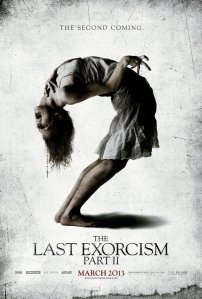
The word “last” clearly shouldn’t be taken literally in this lazy and derivative money-grabbing sequel that puts the ‘moron’ into oxymoron.

The word "last" clearly shouldn't be taken literally in this lazy and derivative money-grabbing sequel that puts the 'moron' into oxymoron in The Last Exorcism Part II

The word “last” clearly shouldn’t be taken literally in this lazy and derivative money-grabbing sequel that puts the ‘moron’ into oxymoron in The Last Exorcism Part II

Made for a pittance, 2010’s The Last Exorcism was something of a surprise hit with both horror-lovers and critics. Its plot was a clever twist on a tried and tested genre and at its core was a genuinely impressive performance by the relatively unknown Ashley Bell as troubled Nell Sweetzer.

Ashley Bell after reading the script for The Last Exorcism Part II

Ashley Bell after reading the script for The Last Exorcism Part II

The filmmakers (including producer Eli Roth) looked to have shaken off the tired and stale tropes of the found footage format for the first 70 unnerving and taut minutes, lost their bottle in the final reel and retreated to tried and tested genre staples, undermining everything the movie until that point had worked so hard to subvert.

The fact the film made a big profit was undoubtedly the driving force behind this ill-judged follow-up, whose title is as hilarious as it is non-sensical. Once again produced by Roth, directing duties have this time fallen to Canadian Ed Gass-Donnelly in what was presumably hoped to be a career breakthrough.

An unusual sleep pattern in The Last Exorcism Part II

An unusual sleep pattern in The Last Exorcism Part II

The opening credits are essentially a flashback to the events of the first movie, wherein a disillusioned preacher (played by Patrick Fabian) works with a documentary film crew to chronicle his final ‘exorcism’ and expose the whole practice as nothing more than religious hokum. The subject is Nell, whose father is convinced is possessed by the devil; but little do the preacher and film crew know that this particular case of satanic possession is all-too-real.

Picking up a short time afterwards, Part II‘s creepiest moments occur in the first few minutes when a demonic-looking Nell is discovered hiding in a couple’s kitchen. Alas, the promise of the opening scene dissolves quicker than you can say “Pazuzu”, and we’re very swiftly subjected to a game of spot the rip-off.

Poor old Nell Sweetzer (Ashley Bell) in The Last Exorcism Part II

Poor old Nell Sweetzer (Ashley Bell) in The Last Exorcism Part II

Nell is sent to a home for girls run by the kindly Frank (Muse Watson) and gradually comes out of her shell. She makes friends with several of the other girls, gets a job as a chambermaid and even develops a budding romance with bland hotel worker Chris (Spencer Treat Clark).

However, you know something bad’s going to happen when Frank reassures Nell by saying: “Whatever you’re running from won’t find you here.” And you definitely know it’s a case of famous last words when Nell happily declares: “There was a darkness, but now it’s gone … none of it was real.”

Gwen (Julia Garner) looking bland/evil in The Last Exorcism Part II

Gwen (Julia Garner) looking bland/evil in The Last Exorcism Part II

It almost goes without saying that Nell’s going to pay for wearing lipstick, being attracted to Chris and listening to rock ‘n’ roll (the devil’s music, lest we forget), but the film doesn’t even try to subvert what we know is coming from a mile off. What scares there are (next to none) are ruined by the lazy cliché of being accompanied by explosions of sound. A film’s always in trouble when is has to resort to that.

Bell gives a far better performance than the film deserves. Without her it would have been a total car wreck and it’s to her credit her turn brings to mind Sissy Spacek’s Carrie and Mia Farrow in Rosemary’s Baby. It’s a good job too, as the largely forgettable supporting cast only seem able to alternative between looking confused, evil or dumb.

To make matters worse, the door is left open for a sort of Omen III: The Final Conflict-style sequel which sounds about as much fun as being decapitated by a sheet of glass. Still, The Last Last Last Exorcism as it should be known could hardly be as demonic a waste of time as this.

In Retrospect – Natural Born Killers (1994)

It’s been almost 20 years since Oliver Stone’s outrageously provocative indictment of our obsession with media-fed celebrity and violence grabbed its own set of headlines, but if anything it’s become even more prescient.

As fearless as it is bombastic and problematic, it's unlikely we'll see the like of Oliver Stone's Natural Born Killers again

As fearless as it is bombastic and problematic, it’s unlikely we’ll see the like of Oliver Stone’s Natural Born Killers again

With each new school shooting, massacre and serial killer, America’s news networks have sunk to new depths and served up opinions and conjecture as ‘factual’ prime time entertainment to a public drawn to the grisly details like a moth to a flame.

Cinema has long-held a fascination with our darker side, from such classics as Badlands (1973), The Texas Chainsaw Massacre (1974) and Funny Games (1997) to schlock horror like the recent run of torture porn flicks.

Mickey and Mallory Knox (Woody Harrelson and Juliette Lewis) on their media-fuelled rampage in Natural Born Killers

Mickey and Mallory Knox (Woody Harrelson and Juliette Lewis) on their media-fuelled rampage in Natural Born Killers

Oliver Stone, one of America’s most polarising directors, has long explored humanity’s black heart and loss of innocence in the likes of Platoon, JFK and the under-appreciated Talk Radio, so it came as no surprise when it emerged he was making his most controversial film to date in Natural Born Killers.

Originally written by a pre-Reservoir Dogs Quentin Tarantino, Stone dramatically altered the tone of the script from popcorn action to a polemic attacking what he saw as the insidious and cynical devolution of the media from a fair and balanced news provider to a ratings-chasing entertainer that glorifies the violence it purports to condemn.

The shizer hits the fan fortabloid TV journalist Wayne Gale (Robert Downey Jr) in Natural Born Killers

The shizer hits the fan for tabloid TV journalist Wayne Gale (Robert Downey Jr) in Natural Born Killers

Drawn together by a common desire and abusive childhoods, lovers Mickey and Mallory Knox (Woody Harrelson and Juliette Lewis) hit the road and embark on a frenzied killing spree that captivates the sensation-hungry media machine, encapsulated by bloodthirsty tabloid journalist Wayne Gale (Robert Downey Jr) and his rabid TV show American Maniacs (which he describes as “junk food for the brain” for “those dim wits out there in zombieland”). Regarded as “the best thing to happen to mass murder since Manson” by his deluded fans, Mickey and Mallory’s notoriety only increases with each new massacre and explodes after they’re captured and locked up in prison, run by Warden Dwight McClusky (Tommy Lee Jones).

If you thought JFK was a cinematic smorgasbord, Stone and cinematographer Robert Richardson give us one of the most hyperactive and kaleidoscopic movie experiences ever committed to celluloid. Switching frenetically between colour, black and white, video, Super 8, CCTV, slow motion, projection, red lens, green lens and animation, it’s nothing if not eye-popping.

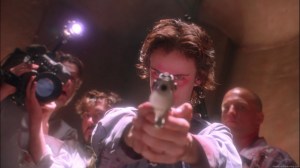
Not the thing you want to be staring at in Natural Born Killers

Not the thing you want to be staring at in Natural Born Killers

The late Roger Ebert said of the film: “Seeing this movie once is not enough. The first time is for the visceral experience, the second time is for the meaning.” Re-watching Natural Born Killers, I was able to get past the “visceral experience” and realised that Stone was trying to portray events through Mickey and Mallory’s crazy perspective. When we see the animated Mickey looking the cool hero, for instance, it’s how he sees himself.

Stone depicts his central pairing as an unstoppable force of nature relentlessly careering down “the road to hell”. When Mickey escapes prison for the first time, he jumps on a horse and symbolically rides towards a tornado. Likewise, they seem to float above those seeking to drag them down to the gutter, especially the parasitic Gale who sees Mickey and Mallory as his ticket to the big time. When Mickey poetically announces that “only love can kill the demon” during a live interview, Gale cheapens the moment by going to commercial, where an ad for Coke duly pops up.

Mickey and Mallory Knox (Woodly Harrelson and Juliette Lewis), “the best thing to happen to mass murder since Manson”, in Natural Born Killers

Mickey and Mallory Knox (Woody Harrelson and Juliette Lewis), “the best thing to happen to mass murder since Manson”, in Natural Born Killers

Images of sex and violence are projected in the background and dominate the airwaves, including footage of Scarface (an odd choice considering Stone wrote the screenplay). Also, Mickey and Mallory each have ying and yang tattoos to show their “extreme light and dark” sides, but they could just as easily represent the interdependence between their killing spree and the media’s insatiable blood lust.

However, for a film seeking to throw a cautionary spotlight on where we are and where we’re heading, Stone undermines his message in the way he depicts the moments of violence. Within the first five minutes, we’re shown a highly stylised scene of brutality visited upon the staff and customers of a diner, including an arresting tracking shot of a bullet fired from Mickey’s gun that dramatically stops in mid-flight before ending up in a cook’s head, and another tracking shot of a knife sent spinning slow motion through a window and into its victim. Crudely, Stone has the rednecks leer and grab at Mallory as she dances next to a jukebox, suggesting they’re asking for it.

Warden Swight McClusky (Tommy Lee Jones) loses it in Natural Born Killers

Warden Dwight McClusky (Tommy Lee Jones) loses it in Natural Born Killers

Stone would argue he’s seeking to project such violent scenes through the prism of satire, but when every cinematic trick in the book is adopted it’s difficult not to conclude he’s having his cake and eating it.

The excellent Harrelson and Lewis walk a fine line between being frightening, charming and sympathetic, while the manically over-the-top Jones and Downey Jr are deliciously sleazy and Arliss Howard’s angel of death on Mickey and Mallory’s shoulders is all the more unnerving for how underplayed it is.

As fearless as it is bombastic and problematic, it’s unlikely we’ll see the like of Natural Born Killers again, while for all his faults we need more directors like Oliver Stone to make us think, however unsubtle the message might be.