Review – Nebraska

The desperate search for fulfillment that so preoccupies the leading men of Alexander Payne’s films finds its zenith in this beautifully crafted elegy to small town America.
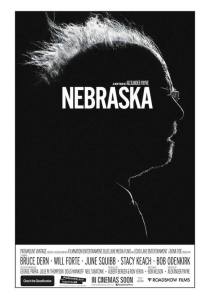
Tragic and melancholy; funny and touching, Nebraska is another triumph from one of cinema's most richly distinctive voices

Tragic and melancholy; funny and touching, Nebraska is another triumph from one of cinema’s most richly distinctive voices

A corrosive thread of sadness and frustration connects Matthew Broderick’s high school teacher in Election (1999), Jack Nicholson’s retired widower in About Schmidt (2002), Paul Giamatti’s wannabe novelist and wine obsessive in Sideways (2004) and George Clooney’s Hawaii-based attorney in The Descendants (2011).

Life has worn each of them down, but not as much as Woody Grant (Bruce Dern), the grizzled geriatric at the centre of Payne’s bittersweet and understated sixth feature Nebraska.

Father and son, Woody (Bruce Dern) and David (Will Forte) hit the road in Nebraska

Father and son, Woody (Bruce Dern) and David (Will Forte) hit the road in Nebraska

We’re first introduced to Woody as he’s shuffling along the highway – as lost and enigmatic a figure as Paris, Texas‘ Travis Henderson. The reason for his wanderings reveals itself when he explains to his son David (Will Forte) that he was on his way to Lincoln, Nebraska, to collect a $1m sweepstake prize he has supposedly won.

Against his better judgement, David agrees to drive his father to Lincoln despite knowing the letter he received is almost certainly a scam. Their trip takes them through Hawthorne, Woody’s dead-end home town, where they visit relatives and bump into his old business partner Ed (Stacey Keach), before being joined by Woody’s outspoken wife Kate (June Squibb) and David’s brother Ross (Bob Odenkirk).
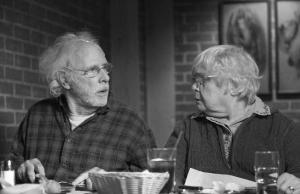
Woody (Bruce Dern) and Kate (June Squibb) squabble in Nebraska

Woody (Bruce Dern) and Kate (June Squibb) squabble in Nebraska

Following the fine tradition of the road movie, an emotional journey is taken alongside the physical one as the wall of ice that has built up around Woody and David begins to thaw and the son begins to understand and come to terms with the father.

The film may be gloriously shot by Payne’s longtime DP Phedon Papamichael in magnificent monochrome, but that’s the only thing black and white about Nebraska.

Family time for David (Will Forte) and brother Ross (Bill Odenkirk) in Nebraska

Family time for David (Will Forte) and brother Ross (Bill Odenkirk) in Nebraska

Payne’s blacky comic script doesn’t pull any punches and makes subtle observations about self-entitlement and the quiet desperation many of us feel for something to go our way.

Asked what he would do with the $1m, Woody shrugs his shoulders and can only think of buying a new truck and an air compressor. In spite of having a limited shopping list, what really motivates Woody is the thought of finally having something substantial that’s his and no-one else’s.

The quietly desperate Woody (Bruce Dern) in Nebraska

The quietly desperate Woody (Bruce Dern) in Nebraska

When Woody lets slip his impending payday while in Hawthorne, he becomes an overnight local celebrity; a development he appears both confused and quietly pleased about. While many are genuinely pleased for Woody, others, Ed in particular, try to pressure him into making good on old debts he’s supposedly accrued.

It’s a rich and nuanced performance from Dern, easily the best he has given for many, many years. Woody isn’t a terribly likeable character, but he’s all-too-human. We, along with David, discover what a flawed man he is through the many mistakes he’s made over the course of a long life; but equally we get a sense of the terrible childhood he must have endured and the scars left by war that carved him into the man he has become.

Like father, like son... David (Will Forte) in Nebraska

Like father, like son… David (Will Forte) in Nebraska

David sees the road trip as a chance to finally get to know his father. Certain home truths are tough to hear; most notably Woody’s matter-of-fact explanation that love “never came up” when it came to marriage to Kate and that they had kids because he “liked to screw”. David is also more alike to his father than he would care to admit; both are stubborn and lead unfulfilled lives.

A veteran of Saturday Night Live, Forte navigates the demands of a dramatic role with ease and plays wonderfully off Dern. The looks of mild confusion and annoyance he shoots at Woody are nicely counterbalanced later in the film by the pride and childlike love he displays.

Payne has a natural skill in handling actors and also helps to bring out great performances from Keach, Odenkirk and Squibb, who gets to let her hair down (and lift her skirt up, but we won’t go into that) with a wonderfully written role.

Tragic and melancholy; funny and touching, Nebraska is another triumph from one of cinema’s most richly distinctive voices.

Review – Killer Joe

Some directors mellow in their old age; not so William Friedkin, as his grisly and grimy take on Tracy Letts’ grand slice of southern gothic Guignol shows.

Killer Joe certainly isn't to everyone's tastes, but for those who enjoy their movies trashy it's finger lickin' good

Killer Joe certainly isn’t to everyone’s tastes, but for those who enjoy their movies trashy it’s finger lickin’ good

Friedkin’s controversy-baiting style has won him an army of devotees and led to a back catalogue that many filmmakers would sell their soul for. The French Connection (1971) and The Exorcist (1973) have rightly earned their place in cinema’s Valhalla, while pictures like Sorcerer (1977), Cruising (1980) and To Live And Die In LA (1985) may be lesser known, but are equally absorbing.

He made a welcome return to horror in his disturbing 2007 adaptation of Letts’ suffocating play Bug and collaborated again with the celebrated playwright four years later for what, according to the poster, is “a totally twisted deep fried Texas redneck trailer park murder story”.

Dumb Chris (Emile Hirsch) makes a play too far in Killer Joe

Dumb Chris (Emile Hirsch) makes a play too far in Killer Joe

The film centres around the Smith clan, a less-than-functional trailer trash brood who make the family from The Texas Chainsaw Massacre look sweet in comparison. Chris (Emile Hirsch) is a drug dealer who’s got himself into debt with the wrong people and, with the help of his simple-minded dad Ansel (Thomas Haden Church), makes a pact with the devil in the shape of Mephistophelean hitman-cop Joe Cooper (Matthew McConaughey) to murder his mother and collect on the life insurance.

Dottie (Juno Temple) takes her retribution in Killer Joe

Dottie (Juno Temple) takes her retribution in Killer Joe

Chris is unable to provide a down-payment to the dark and mysterious Joe, who decides instead to take a retainer in the form of Chris’ childlike sister Dottie (Juno Temple) until the cash is forthcoming.

Friedkin has never been one to shy away from down and dirty filmmaking and is at his most gleefully scuzzy here in what’s effectively a good old-fashioned exploitation B-movie. There’s something of the 1980s here, especially in the montage of close-ups as we’re introduced to Joe, who’s such a badass even the chained-up psycho dog sat outside the family trailer goes quiet when he strolls past.

'Angel of death' Joe Cooper (Matthew McConaughey) in Killer Joe

‘Angel of death’ Joe Cooper (Matthew McConaughey) in Killer Joe

Furthermore, a pretty good clue of what to expect comes early on when the first sign we get of Chris’ loathsome stepmother Sharla (Gina Gershon) is of her naked from the waist down. Subtle it ain’t.

The film’s blackly comic tone adds fuel to the argument that Friedkin is mocking the characters; the only one who seems remotely redeemable is Dottie, although you’re left with the sneaking suspicion she knows more than she’s letting on.

Redneck Ansel (Thomas Haden Church) and trailer trash wife Sharla (Gina Gershon) in Killer Joe

Redneck Ansel (Thomas Haden Church) and trailer trash wife Sharla (Gina Gershon) in Killer Joe

Killer Joe has been likened to a fairytale, with Dottie as the princess looking for her Prince Charming and Joe the wolf at the door, yet no-one emerges from this particular tale with a happy ending. The Smiths’ murderous greed and back-stabbing comes back to bite them hard as the evil they’ve invited into their home arrives for its pound of flesh in the film’s closing scenes, most notoriously involving a fried chicken drumstick.

The film is held together by McConaughey’s shark-eyed turn as Joe, who glides around like some Stetson-wearing angel of death and remains unnervingly calm until his thirst for violence takes over.

Killer Joe certainly isn’t to everyone’s tastes, but for those who enjoy their movies trashy it’s finger lickin’ good.

Review – Lone Survivor

If it’s good old-fashioned jingoism you’re after then you’ve come to the right place with Peter Berg’s dramatisation of a US Navy SEAL mission gone bad.

In case you were wondering who the Lone Survivor is...

In case you were wondering who the Lone Survivor is…

In case you were wondering who the lone survivor in question is, the film is based on hospital corpsman Marcus Luttrell’s book of the same name. So there you go.

Although the ultimate fate of the four members of SEAL Team 10 tasked with carrying out reconnaissance and surveillance on  bloodthirsty Taliban leader Ahmad Shah in Afghanistan’s Hindu Kush region in 2005 is given away by the title (for those who missed or can’t remember the original story, anyway), it doesn’t stop Berg’s film from largely being an intense, if overly patriotic, experience.

Things go pear-shaped for Navy SEALs Marcus Luttrell (Mark Wahlberg) and Danny Dietz (Emile Hirsch) in Lone Survivor

Things go pear-shaped for Navy SEALs Marcus Luttrell (Mark Wahlberg) and Danny Dietz (Emile Hirsch) in Lone Survivor

Once the promising director of Friday Night Lights (2004), Berg subsequently turned his talents to blockbuster fare, to the extent that his previous film, 2012’s Battleship, was so dumb it would have made Michael Bay proud. Lone Survivor may contain plenty of action, but it’s of a far more visceral and harrowing nature than what we saw in his last movie.

The film follows the squad – Luttrell (Mark Wahlberg), communications specialist Danny Dietz (Emile Hirsch), sonar technician Matthew Axelson (Ben Foster) and team leader Lieutenant Michael Murphy (Taylor Kitsch) – as they’re dropped into the Hindu Kush and go about tracking down Shah, who’s seen at the start of the film ordering the beheading of an Afghan villager for allegedly helping the Americans, just to stress how evil he is.

The scale of the problem presents itself in Lone Survivor

The scale of the problem presents itself in Lone Survivor

Things soon take a turn for the unfortunate when they run into a group of goat herders, and truly go up the swanny when they’re ambushed by a small army led by Shah. A mission of stealth and surveillance turns into one of survival (well, for one of them anyway) as they’re forced to take increasingly desperate and dangerous risks to escape.

The film opens with an extended montage of real life Navy SEAL recruits being put through their paces. As well as making abundantly clear just how darned tough these guys are, Berg also uses the footage to emphasise the band of brothers mentality forged among those who are willing to put themselves through such hell. The point is pushed home further courtesy of post-rockers Explosions In The Sky’s stirring soundtrack. Brotherhood is a familiar theme in most war movies, but is particularly accentuated here.

Navy SEAL Matthew Axelson (Ben Foster) fights for his life in Lone Survivor

Navy SEAL Matthew Axelson (Ben Foster) fights for his life in Lone Survivor

Before Operation Red Wings gets under way (the targets are all named after brands of beer in true US military fashion), Berg works to develop an affininty between the squad and audience. It’s easy to buy Wahlberg and Kitsch as military types because of their previous action man turns, but it takes longer to accept Foster and Hirsch in the roles as it’s such a switch from what they’re best known for. That being said, the group make a convincing enough squad who find themselves in the wrong place at the wrong time.

It takes a good long while before the crap splats the fan, but when it does the film doesn’t let up and Berg reconstructs the prolonged gunfight between the SEALs and Shah’s men with gusto through an effective use of sweaty close-ups, first person perspective, fantastic sound design and convincing acting. It’s chaotic stuff, just as you’d imagine it would have been in real life.

Taliban in their sights in Lone Survivor

Taliban in their sights in Lone Survivor

What lets the film down, however, is Berg’s insistence on wrapping the men in the Stars and Stripes and painting them as all-American heroes (even going so far as to feature Peter Gabriel’s rendition of David Bowie’s Heroes over stills and footage of those who died in the operation at the end of the film). One soldier’s fate appears to borrow the famous Christ image of Willem Dafoe in Platoon and the use of slow motion in the more emotive scenes borders on crass.

It’s both extremely heavy-handed and unnecessary and takes you out of what could and should have been an absorbing and gut-wrenching story of brotherhood, sacrifice and humanity in the face of grave danger.

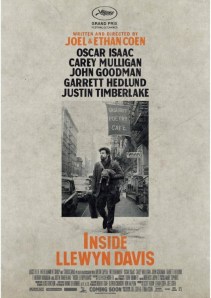
Review – Inside Llewyn Davis

The landscape of American film has changed considerably in the 30 years since Joel and Ethan Coen announced themselves with their blackly comic neo-noir debut Blood Simple.

It may be as difficult to pin down as its leading character, but Inside Llewyn Davis is achingly beautiful and melacholic and another masterpiece from the Coens

It may be as difficult to pin down as its leading character, but Inside Llewyn Davis is achingly beautiful and melancholic and another masterpiece from the Coens

Once dismissively bracketed as ‘arthouse’, the Coens are among a handful of gifted filmmakers to have transformed the cinematic panorama without compromising their unique sensibility; to the extent their bleakly violent 2007 masterpiece No Country For Old Men won Best Film and Best Director Oscars and made a ton of money at the box office to boot.

With this, their 16th film, the Coens almost out-Coen themselves with a Russian doll of a movie that’s as enigmatic as it is engrossing.

Llewyn (Oscar Isaac) takes to the stage in Inside Llewyn Davis

Llewyn (Oscar Isaac) takes to the stage in Inside Llewyn Davis

The roster of seemingly cursed characters with a leaning towards self-destruction is a growing one in the Coens’ filmography and Llewyn Davis’ tractionless folk musician is right up there with Barton Fink, The Man Who Wasn’t There‘s Ed Crane Larry Gopnik from A Serious Man.

Llewyn (Oscar Isaac) is, like the songs he plays, “never new and never gets old” and spends his days drifting around New York’s early-60s Greenwich Village playing the odd gig and relying on the generosity of friends for a place to lay his head. You get the sense things have been this way since his former musical partner Mike committed suicide a few years earlier, while his only solo album, Inside Llewyn Davis, has fallen through the critical and commercial cracks.

Please Mr Kennedy! Llewyn (Oscar Isaac) performs session guitar for friend Jim (Justin Timberlake) and Al Cody (Adam Driver) in Inside Llewyn Davis

Please Mr Kennedy! Llewyn (Oscar Isaac) performs session guitar for friend Jim (Justin Timberlake) and Al Cody (Adam Driver) in Inside Llewyn Davis

His inertia has left him bitter, despite (or because of) it being almost entirely his own fault. Llewyn simply can’t fathom how or why the folk-by-numbers tunes of the innocuous Troy Nelson (Stark Sands) “connect with people” and can’t hide his derision when playing session guitar on the inane folk-pop pap Please Mr Kennedy (the film’s standout hilarious scene) written by his friend Jim (Justin Timberlake). Meanwhile, Jim and Llewyn’s ex-flame, the perennially angry Jean (Carey Mulligan), are also starting to make waves on the folk scene as a duet – another sign that he’s being left behind.

Opportunities present themselves, but Llewyn has a compulsion to snatch defeat from the jaws of something more prosperous. An audition for respected Chicago producer Bud Grossman (F. Murray Abraham) comes to naught when, instead of playing something catchy, Llewyn instead chooses the sombre ballad The Death Of Queen Jane. Grossman’s pithy summation “I don’t see a lot of money here” firstly reminds us why it’s called the music business, and secondly underscores the fact Llewyn’s always going to be a square box trying to fit in a round hole.

The angry Jean (Carey Mulligan) in Inside Llewyn Davis

The angry Jean (Carey Mulligan) in Inside Llewyn Davis

The Coens’ very best films open themselves up to multiple interpretations and Inside Llewyn Davis is no different. For me, the oppressive sense of death hangs over the film like a shroud, to the extent that it could be argued the world we see Llewyn wandering around is some kind of purgatory.

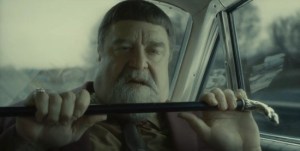
Bruno Delbonnel’s chilly cinematography lends the film a ghostly pallor, while the eerie road trip Llewyn takes with beat poet Johnny Five (Garrett Hedlund) and obnoxious Dr John-alike jazz muso Roland Turner (the one and only John Goodman) from New York to Chicago is like something out of a supernatural nightmare, with ominous-sounding vehicles screeching past their car.

Llewyn (Oscar Isaac) and the cat he can't seem to shake off in Inside Llewyn Davis

Llewyn (Oscar Isaac) and the cat he can’t seem to shake off in Inside Llewyn Davis

Furthermore, the cat(s) that Llewyn cannot seem to escape from have long been regarded as a symbol of death, while the fact one of the cats is called Ulysses could be a reference to Tennyson’s celebrated poem of the same name (rather than James Joyce’s novel) about a man with the spectre of death hanging over him.

The songs Llewyn performs are also soaked in morbidity, from The Death Of Queen Jane, to Hang Me Oh Hang Me (“wouldn’t mind the hangin… but the layin in the grave so long”), while the film’s elliptical structure could be seen as purgatorial. Mind you, it just as easily be about a poor schmuck living day-to-day and who gets saddled with a cat. That’s the Coens for you.

The Dr John-alike obnoxious jazz muso Roland Turner (John Goodman) in Inside Llewyn Davis

The Dr John-alike obnoxious jazz muso Roland Turner (John Goodman) in Inside Llewyn Davis

Isaac gives a superlative performance as the downtrodden Llewyn, a curious figure who’s his own worst enemy but somehow illicits our sympathy. There’s something both maddening and admirable about his bloody-mindedness.

The Coens have been accused in the past of being unsympathetic towards their characters and it’s a charge that’s been levelled at Llewyn Davis. This is to miss the point, however. Llewyn is flawed, of that there is no doubt, but Isaac injects the character with real pathos.

It may be as difficult to pin down as its leading character, but Inside Llewyn Davis is achingly beautiful and melancholic and another masterpiece from the Coens.

In Retrospect – New York, New York (1977)

Analyzing De Niro

I’m delighted to have contributed this review to You Talkin’ To Me‘s excellent Analyzing De Niro Blogathon, run by Mark at Marked Movies and Tyson at Head In A Vice. As the title suggests, the Blogathon focusses entirely on the movies of Mr Robert De Niro and this post covers Bobby’s third collaboration with Martin Scorsese, 1977’s New York, New York.

The long and fruitful partnership between Robert De Niro and Martin Scorsese has spawned a multitude of enduring classics forever etched in our collective cinematic consciousness.

A misfire, but a fascinating one nonetheless, New York, New York is the oft neglected offspring of the formidable Scorsese/De Niro partnership

A misfire, but a fascinating one nonetheless, New York, New York is the oft neglected offspring of the formidable Scorsese/De Niro partnership

In the four years between the release of Taxi Driver and Raging Bull, De Niro and Scorsese collaborated on New York, New York, the oft neglected offspring of their remarkable relationship.

After the critical and surprising commercial success of the apocalyptically dark Taxi Driver, an emboldened Scorsese used the bigger budget he was able to command to break away from down and dirty depictions of the Big Apple to instead direct what amounted to a love letter, both to the city of his birth and to the old Hollywood musicals he grew up watching.

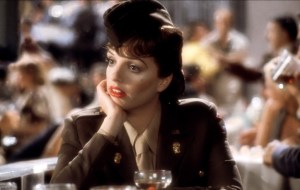
Start spreading the news, it's Francine Evans (Liza Minnelli) and Jimmy Doyle (Robert De Niro) in New York, New York

Start spreading the news, it’s Francine Evans (Liza Minnelli) and Jimmy Doyle (Robert De Niro) in New York, New York

Scorsese cast De Niro in the lead role of Jimmy Doyle, a smooth talking egotist with a zany streak and a gift for the saxophone. Audiences at the time were used to seeing Bobby play wiseguys and sociopaths, so to watch him clowning around on screen must have been a novelty.

The film opens in New York on V-J Day in 1945 and spends the first 20 minutes inside a nightclub in full swing, with Jimmy, sporting a Hawaiian shirt and a shiny pair of spats he won in a bet, trying to work his magic on Liza Minnelli’s demobbed singer Francine. Through sheer force of will it seems, Jimmy eventually manages to woo Francine and the pair discover that her voice and his sax are made for each other.

Robert De Niro learned how to play the sax to play Jimmy Doyle in New York, New York

Robert De Niro learned how to play the sax to play Jimmy Doyle in New York, New York

A marriage and a child follow but, as Francine becomes more successful in her own right, Jimmy’s inherent insecurities, bullying nature and jealousy threaten to tear both their personal and professional ties apart.

De Niro could do no wrong at the time and prepared for the role in typically methodical fashion by learning to play the sax (although the arrangements were actually dubbed in post-production by the esteemed Georgie Auld). As such, he looks at home on stage leading his band and handles the sax with aplomb instead of looking like he picked it up five minutes before the cameras rolled.

New York, New YorkWe now know that De Niro can ‘do’ comedy almost as well as he does drama, but at the time it was uncertain if the actor, renowned for his on-screen intensity, would be able to sell funny. Minnelli’s reaction to some of De Niro’s goofing is priceless, while the scene with Jimmy feigning a war wound to get out of paying a hotel bill is pure slapstick.

The comedy gradually wears off as the picture becomes more of a relationship drama and it’s here Bobby spreads his wings. De Niro is a master of the long silent stare (the one where you’re unsure whether he’s going to explode with violent rage or not) and employs it to disquieting effect here on more than one occasion. Minnelli’s genuine unease in these moments is palpable.

Jimmy Doyle (Robert De Niro) gets into a spot of trouble in New York, New York

Jimmy Doyle (Robert De Niro) gets into a spot of trouble in New York, New York

As Cabaret had shown back in 1972, there was still an audience for musicals. However, unlike the Hollywood greats it was hoping to emulate, New York, New York suffers from confused plotting and a flabby narrative (the film is almost three hours long). Apparently, the actors ad-libbed much of the movie and it shows; scenes are allowed to play out for far too long and things aren’t helped by the tepid on-screen chemistry between De Niro and Minnelli.

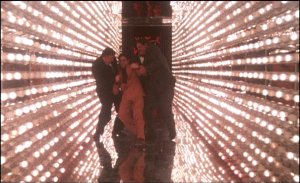
A typically memorable Martin Scorsese shot in New York, New York

A typically memorable Martin Scorsese shot in New York, New York

Sandwiched between Travis Bickle and Jake Lamotta, De Niro’s Jimmy Doyle ain’t all that, but when considered as part of his overall career it’s a notable chapter for opening up audiences’ eyes to a part of his repertoire that he’s since gone on to enjoy considerable success with.

If for nothing else, the film gave Frank Sinatra one of his most iconic hits and provided nightclubbers with an end-of-evening drunken anthem.

Scorsese’s description of New York, New York as a ‘film noir musical’ is apt one –  both Old Hollywood (the lovely moment Jimmy watches a sailor dancing with his girl under the subway tracks is an affectionate wink to On The Town) and New Hollywood are fused into what might end up being a misfire, but a fascinating one nonetheless.