Review – Blue Ruin

If revenge is a dish best served cold, then it’s never tasted so deliciously chilly than this stripped-back modern classic.
Concluding his Kickstarter pitch, Jeremy Saulnier stakes his career on the promise that he'll make good on those willing to put their faith in his film. After watching Blue Ruin, it's safe to say that faith has been hugely rewarded

Saulnier staked his career on the promise that he’d do good by those willing to put their faith in his film. After watching Blue Ruin, it’s safe to say that faith has been hugely rewarded

Looking for funding to help complete his sophomore feature through Kickstarter, writer-director Jeremy Saulnier pitched Blue Ruin as “not your standard revenge film. It does not glorify violence; it does not justify violence. It does the opposite”.

Thank goodness the public stepped in to hand over their hard-earned cash to help Saulnier deliver on that promise and turn in a truly subversive take on the traditional revenge picture.

Dwight (Macon Blair) prepares for a grisly deed in Blue Ruin

Dwight (Macon Blair) prepares for a grisly deed in Blue Ruin

Beach bum Dwight’s (Macon Blair) sheltered and reclusive life takes a hellish turn when he receives sickening news from an unlikely source. The revelation sets Dwight on a self-destructive path of revenge that leads to a bloody and unremitting aftermath he is ill-prepared for.

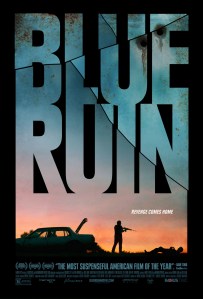
Blue Ruin has invited comparisons to the Coens, specifically their noirish debut Blood Simple, although the sombre and haunted No Country For Old Men feels like a more suitable reference point, right down to the similarity of the two films’ posters.
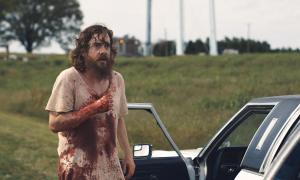
Dwight's (Macon Blair) descent begins in Blue Ruin

Dwight’s (Macon Blair) descent begins in Blue Ruin

The comparison to Joel and Ethan’s work is understandable, but somewhat depressing as it underlines just how rare films of this ilk are in American cinema.

Revenge movies invariably fall into the tried and tested constraints described by Saulnier in his Kickstarter pitch and adopt an ends-justify-the-means approach. Those films tend to conclude with the ‘happy ending’ of the revenge having been successfully realised, but Blue Ruin takes the entirely darker approach of showing what happens next.

Sam (Amy Hargreaves) takes her brother Dwight (Macon Blair) to task in Blue Ruin

Sam (Amy Hargreaves) takes her brother Dwight (Macon Blair) to task in Blue Ruin

If history has taught us anything, it’s that violence begets violence and Saulnier’s picture isn’t afraid to have Dwight traverse an increasingly bleak and bloody road to hell.

The violence, when it does come, is startling and visceral. There are no winks at the audience or satisfied one-liners; merely chaos, confusion and terror.

Ben (Devin Ratray) shows Dwight (Macon Blair) the ropes of how to use a gun in Blue Ruin

Ben (Devin Ratray) shows Dwight (Macon Blair) the ropes of how to use a gun in Blue Ruin

Clocking in at exactly 90 minutes, the film doesn’t waste a single shot. Dwight is shown in the near-wordless opening reel as a pretty methodical guy, all be it someone living out of a rusted old car. Upon receiving his news, he quickly turns his attention to the mission at hand, but it’s when the act of revenge is complete that Dwight discovers any semblance of control he had no longer exists and all bets are off.

Dwight (Macon Blair) puts those gun skills to test in Blue Ruin

Dwight (Macon Blair) puts those gun skills to test in Blue Ruin

As much as this is Saulnier’s film, so too is it Blair’s. It’s a refreshing performance, one that has a through-line of everyman authenticity to it. Dwight’s no macho action hero; he’s a broken shell with nothing to live for except to save his sister Sam (Amy Hargreaves) and her kids from harm. Blair’s saucer-like eyes are deeply expressive and sell the fear and bewilderment his character endures throughout.

Concluding his Kickstarter pitch, Saulnier staked his career on the promise that he’d do good by those willing to put their faith in his film. After watching Blue Ruin, it’s safe to say that faith has been hugely rewarded.

Review – The Amazing Spider-Man 2

Amazing by name, but not unfortunately by nature, this bloated second installment in the hastily rebooted Spidey franchise fails to trap you in its web.

A trio of great performances can't save what is, at best, a very average movie and another underwhelming entry in a franchise that's so far failing to live up to its title

A trio of great performances can’t save what is, at best, a very average movie and another underwhelming entry in a franchise that’s so far failing to live up to its title

When Sam Raimi brought Spider-Man to the big screen in 2002, it landed at a time when the new era of comic book movies that had begun with X-Men two years earlier was still in its infancy.

Fast forward to 2012 and Marc Webb’s The Amazing Spider-Man arrived in a far more crowded market place, dominated by the double whammy of Christopher Nolan’s The Dark Knight Rises and Marvel’s The Avengers.

Peter Parker (Andrew Garfield) investigates the death of his parents in The Amazing Spider-Man 2

Peter Parker (Andrew Garfield) investigates the death of his parents in The Amazing Spider-Man 2

While it did good business, when compared to these two box office behemoths, The Amazing Spider-Man felt like a lesser film. Lest we forget, it had only been five years since Raimi’s forgettable Spider-Man 3 and Webb’s reboot felt like what it was – a money-grabbing exercise by Sony Pictures to muscle in on the comic book movie boom.

The strongest aspects of that film remain the highlights of this follow-up – namely the performances of Andrew Garfield as awkward teenager Peter Parker turned superhero Spider-Man and Emma Stone as his smart and spiky love interest Gwen Stacy; and the winning chemistry both actors have together.

Nerdy Oscorp employee Max Dillon (Jamie Foxx) shortly before becoming Electro in The Amazing Spider-Man 2

Nerdy Oscorp employee Max Dillon (Jamie Foxx) shortly before becoming Electro in The Amazing Spider-Man 2

The Amazing Spider-Man 2 finds Peter struggling to maintain the promise he made to Gwen’s father to stay away from his daughter in order to keep her safe, while also settling into his role as Spidey. With great power comes great responsibility and Peter’s responsibility to the people of New York is severely tested by the arrival of powerful supervillain Electro (Jamie Foxx), formerly sad and lonely Oscorp engineer Max Dillon.

Meanwhile, Peter’s long-absent childhood pal Harry Osborn (Dane DeHaan) returns home in time to take over the reins of Oscorp from his dying father (Chris Cooper) and it’s not long before Spider-Man gets in the way of their friendship.

Peter Parker's love interest Gwen Stacy (Emma Stone) in The Amazing Spider-Man 2

Peter Parker’s love interest Gwen Stacy (Emma Stone) in The Amazing Spider-Man 2

The film inevitably draws comparisons to 2004’s Spider-Man 2, easily the best in Raimi’s Spidey trilogy, but falls short. The narrative is pretty similar – a brilliant Oscorp employee accidentally mutates into a supervillain and, with the help of a vengeful Harry Osborn, faces off against Spider-Man. However, while that film featured a properly three-dimensional villain and a storyline that zipped along, Electro’s arc feels underdeveloped, the action set pieces fail to properly engage and the pace often flags (at 142 minutes, it’s at least half-an-hour too long).

It also falls into the same trap as too many other comic book movies (Spider-Man 3 in particular) of believing that bigger is always better. Paul Giamatti’s Russian nutjob Aleksei Sytsevich is as superfluous as he is ridiculous and has presumably been injected into the film as a platform between this film and the next chapter in the franchise, while the curious shifts in tone between comic book goofiness and brooding seriousness suggest a movie that’s trying to be all things to all people, but ends up coming off as directionless.

Peter Parker (Andrew Garfield) catches up with old buddy Harry Osborn (Dane DeHaan) in The Amazing Spider-Man 2

Peter Parker (Andrew Garfield) catches up with old buddy Harry Osborn (Dane DeHaan) in The Amazing Spider-Man 2

The Amazing Spider-Man 2‘s saving grace are the trio of Garfield, Stone and DeHaan. The strained relationship between Peter and Gwen is effectively brought to life by both actors and Stone in particular radiates in a role that commands strength, purpose and fortitude. DeHaan, meanwhile, is great as the increasingly desperate Harry and employs a smile that turns more crooked as the film wears on.

Special mention should go to the soundtrack, crafted by Hans Zimmer in collaboration with Pharrell Williams and several others. The music that introduces the newly created Electro is particularly effective as it both drives the action and provides a schizophrenic audio accompaniment to the confusion and anger coursing through the character’s mind.

However, a trio of great performances can’t save what is, at best, a very average movie and another underwhelming entry in a franchise that’s so far failing to live up to its title.

Review – Captain America: The Winter Soldier

After seriously dropping the hammer with the disappointing Thor: The Dark World, Marvel has got its mojo back with this superheroic espionage thriller that packs a real biff, pow and bang.

Although on paper a two-dimensional relic of 1940s flag-waving propaganda comics, Captain America's onscreen adventures are fast becoming the Marvel movies to look out for

Although on paper a two-dimensional relic of 1940s flag-waving propaganda comics, Captain America’s onscreen adventures are fast becoming the Marvel movies to look out for

On its 2011 release, Captain America: The First Avenger was an unexpected pleasure, skillfully mixing pulpy action and period nostalgia with a World War Two setting that perfectly suited the old school heroics of Captain Steve Rogers (Chris Evans, a great fit for the role).

His appearance alongside Iron Man, Thor et al in Avengers Assemble (as it was called over here) was largely about him trying to come to terms with the modern world and it’s an issue that inevitably permeates through The Winter Soldier.

Steve 'Cap' Rogers (Chris Evans) forms a valuable friendship with fellow veteran Sam Wilson (Anthony Mackie) in Captain America: The Winter Soldier

Steve ‘Cap’ Rogers (Chris Evans) forms a valuable friendship with fellow veteran Sam Wilson (Anthony Mackie) in Captain America: The Winter Soldier

However, screenwriters Christopher Markus and Stephen McFeeley (who also wrote the first movie) deserve a lot of credit for crafting a story that transcends fish-out-of-water narrative tropes and instead gives the character something he can really get his shield stuck into.

While the bad guys he’s fighting this time around aren’t as clear-cut as the uber-Nazis he was battling in The First Avenger, Cap’s inherent goodness and staunch belief in the enduring power of freedom are traits that prove just as necessary in The Winter Soldier.

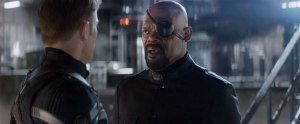
Cap (Chris Evans) expresses his concerns as to the direction S.H.I.E.L.D is taking to Nick Fury (Samuel L Jackson) in Captain America: The Winter Soldier

Cap (Chris Evans) expresses his concerns as to the direction S.H.I.E.L.D is taking to Nick Fury (Samuel L Jackson) in Captain America: The Winter Soldier

Since being thawed out from cryogenic stasis at the end of The First Avenger, Rogers has allied himself with S.H.I.E.L.D, the labyrinthine spy and law-enforcement network led by Nick Fury (Samuel L Jackson, given more to do this time) – but is growing ever-more sceptical about its true motives. Rogers is forced to go on the run from S.H.I.E.L.D after finding himself in the middle of a massive conspiracy and, with the help of deadly assassin Natalia Romanoff, aka Black Widow (Scarlett Johannson, also with more to do this time), and fellow war veteran Sam Wilson (Anthony Mackie, underused) sets about uncovering the truth.

While Thor’s second solo outing got lost in an Asgardian vortex of Dark Elves and cod-Lord Of The Rings nonsense, Cap’s big return has a far more engaging narrative.

Cap (Chris Evans) must work with deadly assassin Natasha Romanoff, aka Black Widow (Scarlett Johannson) in Captain America: The Winter Soldier

Cap (Chris Evans) must work with deadly assassin Natasha Romanoff, aka Black Widow (Scarlett Johannson) in Captain America: The Winter Soldier

The central plot makes no bones about its nods to 1970s conspiracy cinema classics like The Parallax View (1974) and Three Days Of The Condor (1975), right down to the casting of Condor‘s Robert Redford, who effortlessly raises the level of the film every time he’s on screen as senior S.H.I.E.L.D figure Alexander Pierce.

The juxtaposition of Cap’s clearly defined outlook of right and wrong with the murky, compromised ideology of S.H.I.E.L.D is a nice idea and a very contemporary concept, but the film doesn’t trust the audience to work it out for themselves. When he witnesses just how far S.H.I.E.L.D is willing to go to “neutralise threats”, a rattled Rogers tells Fury “This isn’t freedom, this is fear”; to which Fury replies the agency “takes the world as it is, not as we’d like it to be”. The point is made several more times in case we haven’t picked it up.

Nick Fury (Samuel L Jackson) with old buddy and fellow S.H.I.E.L.D colleague Alexander Pierce (Robert Redford) in Captain America: The Winter Soldier

Nick Fury (Samuel L Jackson) with old buddy and fellow S.H.I.E.L.D colleague Alexander Pierce (Robert Redford) in Captain America: The Winter Soldier

In spite of the lack of subtlety, it’s undoubtedly the most interesting element of both this and any other Marvel picture to date, and one you feel directors Anthony and Joe Russo would rather have concentrated on more. This being a superhero movie, however, it’s a prerequisite that things go boom sooner or later.

That being said, an early set piece involving an ambush on Fury’s S.H.I.E.L.D mobile is exhilarating stuff, while a fight involving Rogers and a dozen or so S.H.I.E.L.D goons in a lift gets the pulse racing. It’s when the scale of the action is amped up that the film – especially in the final act – loses its way and turns into just another Marvel movie involving a stack of CGI explosions in the sky.

The mysterious Winter Soldier in Captain America: The Winter Soldier

The mysterious Winter Soldier in Captain America: The Winter Soldier

In spite of being part of the title, we’re given only a brief taste of who and what the Winter Soldier is. It’s a plot thread you suspect had more meat on it during early drafts and is left dangling for Cap’s third solo movie. At 136 minutes, the film is too long anyway, so it’s not surprising this wasn’t developed more.

Although on paper a two-dimensional relic of 1940s flag-waving propaganda comics, Captain America’s onscreen adventures are fast becoming the Marvel movies to look out for.

Review – The Grand Budapest Hotel

The idiosyncratic Wes Anderson conjures up his latest magical microcosm in this sumptuously designed feast for the senses.

When Wes Anderson is good he's very, very good and with The Grand Budapest Hotel he's at the top of his game. It's is an absolute delight

When Wes Anderson is good he’s very, very good and with The Grand Budapest Hotel he’s at the top of his game. It’s an absolute delight

One could compare Anderson’s career to that of a sculptor meticulously chiseling away at a piece of rock and removing all of the rough edges until what’s left is a thing of beauty.

His 1996 debut Bottle Rocket was an uneven work with enough flashes of Anderson’s unique visual style to mark him out as one to watch. His following two films, the resplendent Rushmore (1998) and superior The Royal Tenenbaums (2001) marked the end of a highly impressive first phase.

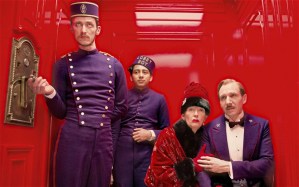
M. Gustave H. (Raplph Fiennes) comforts the elderly Madame D. (Tilda Swinton) in The Grand Budapest Hotel

M. Gustave H. (Ralph Fiennes) comforts the elderly Madame D. (Tilda Swinton) in The Grand Budapest Hotel

Phase two was more difficult, with The Life Aquatic With Steve Zissou (2004) and The Darjeeling Limited (2006) failing to strike the same chord. However, since 2009’s Fantastic Mr. Fox, the balance of whimsy, eccentricity and maturity he failed to achieve in his previous two films was finally stuck, with this third phase in Anderson’s oeuvre also producing the lovely Moonrise Kingdom (2012) and now this charming confection (actually his second ‘hotel’ picture following the 2007 short Hotel Chevalier).

The film begins with an unnamed author (Tom Wilkinson) recollecting the time he spent as a younger man (played by Jude Law) at the Grand Budapest Hotel, where he encountered its reclusive owner Zero Moustafa (F. Murray Abraham). Over dinner, Zero tells the extraordinary story of how, as a young man in the 1930s, he came to inherit one of Europe’s most lavish hotels from M. Gustave (Ralph Fiennes), who at the time was its suave and sophisticated concierge. They strike up a warm friendship after Gustave is framed for the murder of his octogenarian lover Madame D. (Tilda Swinton) and must prove not only his innocence but also uncover the real culprits.

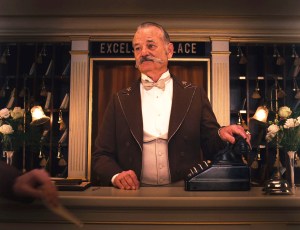
The one and only Bill Murray plays hotel concierge M. Ivan in The Grand Budapest Hotel

The one and only Bill Murray plays hotel concierge M. Ivan in The Grand Budapest Hotel

Anderson’s love of early cinema, present in Bottle Rocket with its nod to Edwin S Porter’s landmark 1903 picture The Great Train Robbery, can be found here in the wonderful old school effects shots that bring to mind pioneering genius Georges Méliès. Likewise, the film’s deadpan physical comedy inevitably brings to mind such early masters of the form as Chaplin and Keaton.

M. Gustave H. (Raplh Fiennes) confronts the dastardly Dmitri Desgoffe-und-Taxis (Adrieb Brody) and his henchman J.G. Jopling (Willem Dafoe) in The Grand Budapest Hotel

M. Gustave H. (Ralph Fiennes) confronts the dastardly Dmitri Desgoffe-und-Taxis (Adrien Brody) and his henchman J.G. Jopling (Willem Dafoe) in The Grand Budapest Hotel

His trademark mise en scène is also taken to the nth degree in The Grand Budapest Hotel, with its beautifully crafted and crisp tracking shots, zooms and back and forth camera shots so meticulously constructed as to make Stanley Kubrick proud.

In spite of being a marvel of precise technical mastery, the film is rich with memorable characters, each brought vividly to life by a splendid cast. Fiennes, in his first collaboration with Anderson, is a marvel and gives a beautifully measured turn that’s equal parts farcical, steely eyed and kind. He’s matched by Tony Revolori, whose portrayal of the loyal and determined young Zero sits perfectly next to his partner-in-crime Gustave.

Zero Moustafa (Tony Revolori) and his beau Agatha (Saoirse Ronan) in The Grand Budapest Hotel

Zero Moustafa (Tony Revolori) and his beau Agatha (Saoirse Ronan) in The Grand Budapest Hotel

The supporting cast, many giving extended cameos, all stand out due to the care and attention given to each of their characters. Willem Dafoe’s henchman J.G. Jopling looks like a cross between Nosferatu and Frankenstein’s monster, while Jeff Goldblum gives a typically terrific turn as the unfortunate Deputy Kovacs and Saoirse Ronan is sweet as Zero’s love interest Agatha. Let’s not forget Bill Murray, of course, who makes a quick impression as fellow hotel concierge M. Ivan.

These warm performances are matched by Anderson’s dialogue that, while maintaining the zippiness of his previous films, is also imbued with a generosity and affection that radiates when uttered by such a gifted cast.

When Wes Anderson is good he’s very, very good and with The Grand Budapest Hotel he’s at the top of his game. It’s an absolute delight.

Review – 300: Rise Of An Empire

Beware Greeks bearing swords, especially when they’re as testosterone-fuelled as the cast of this gleefully gory festival of brutal CGI-baked bloodletting.

300: Rise Of An Empire makes no apologies for itself and asks little of its audience other than to wallow in its tidal wave of blood and entrails. If you're after anything else you'd best look elsewhere

300: Rise Of An Empire makes no apologies for itself and asks little of its audience other than to wallow in its tidal wave of blood and entrails. If you’re after anything else you’d best look elsewhere

Comic books have provided a rich vein of material for filmmakers over the years, although the explosion of big budget movies involving Batman, Superman, Iron Man and Thor et al in recent times has reached near epidemic levels.

Alongside the big names of the Marvel and DC universes that have gone before the cameras are equally beloved titles, most notably from the pen and pencil of the revered Frank Miller. In 2005, a collection of Miller’s hugely acclaimed Sin City stories was directed by Robert Rodriguez and Miller himself (with a helping hand from Quentin Tarantino) and was noteworthy for being one of the first fully digital live action films.

The starting point - sort of - of 300: Rise Of An Empire

The starting point – sort of – of 300: Rise Of An Empire

It made the film look, for all intents and purposes, like a live action graphic novel and a similar visual approach was adopted by Zack Snyder for his 2006 adaptation of Miller’s 300, in which King Leonidas (Gerard Butler) leads his 300 Spartans into battle against the vastly superior forces of the invading Persian armies, led by the ‘God King’ Xerxes.

That film’s enormous success has inevitably led to 300: Rise Of An Empire that, while not directed by Snyder, might as well have been judging by its identical style. If anything, director Noam Murro has gone even further, throwing in curious tricks like the incessant and distracting floating dust that permeates nearly every frame.

War!! 'God-King' Xerxes (Rodrigo Santoro) rallies the Persians in 300: Rise Of An Empire

War!! ‘God-King’ Xerxes (Rodrigo Santoro) rallies the Persians in 300: Rise Of An Empire

This follow-up is a sequel of sorts, taking place before, during and after the fateful Battle of Thermopylae that was the centrepiece of 300. Sizeable chunks of the film are given over to exposition-heavy narration which establishes how the events of 300 came to pass. At the Battle of Marathon, Xerxes (Rodrigo Santoro) witnesses his father Darius’ death at the hands of Greek General Themistocles (Sullivan Stapleton) and is goaded into annihilating the Greeks by Darius’ bloodthirsty naval commander Artemisia (Eva Green).

Artemisia has her own reasons for wanting the Greeks to be wiped out and leads the entire Persian navy into war against the Greek fleet, led by Themistocles. Although vastly outnumbered the Greeks fight on, not only for their families, but also for their way of life.

Heroic Greek leader Themistocles (Sullivan Stapleton) in 300: Rise Of An Empire

Heroic Greek leader Themistocles (Sullivan Stapleton) in 300: Rise Of An Empire

By sticking so slavishly to 300‘s super-stylised visual palette, Rise Of An Empire loses a lot of its forebear’s impact, but that’s not to say the film doesn’t water the eyes with a series of shamelessly over-the-top battle scenes.

Set on  water for large chunks, the film does an effective job of showing large-scale naval warfare, while the swordplay is even more brutal than its predecessor, with limbs being lopped off and CGI blood spraying around so readily it beats you into submission.

The vengeful Artemesia (Eva Green) in 300: Rise Of An Empire

The vengeful Artemesia (Eva Green) in 300: Rise Of An Empire

Anyone looking for depth will find none here (Snyder co-wrote the script, which should tell you all you need to know), but then this is 300: Rise Of An Empire we’re talking about here and anyone who watched 300 will know what to expect.

The acting is of secondary importance; Stapleton is no Butler (not a phrase I thought I’d ever use), but Green deserves credit for giving a performance of such scenery chewing madness you’d be forgiven for thinking she’d been let out on day release. This isn’t a film that does anything by half and that also goes for the comically absurd sex scene involving Artemisia and Themistocles – illustrated by the glance exchanged by two guards stood outside.

300: Rise Of An Empire makes no apologies for itself and asks little of its audience other than to wallow in its tidal wave of blood and entrails. If you’re after anything else you’d best look elsewhere.